RMPD
The TIR carnet, how to get one and when it helps
A TIR carnet is a guarantee rather than a permit. Who admits a carrier, why there is an exam, how long a carnet lasts and what the TIR+ voucher adds.
Published · Author: Makaiev Kostiantyn Oleksandrovych, founder of Sigil RMPD
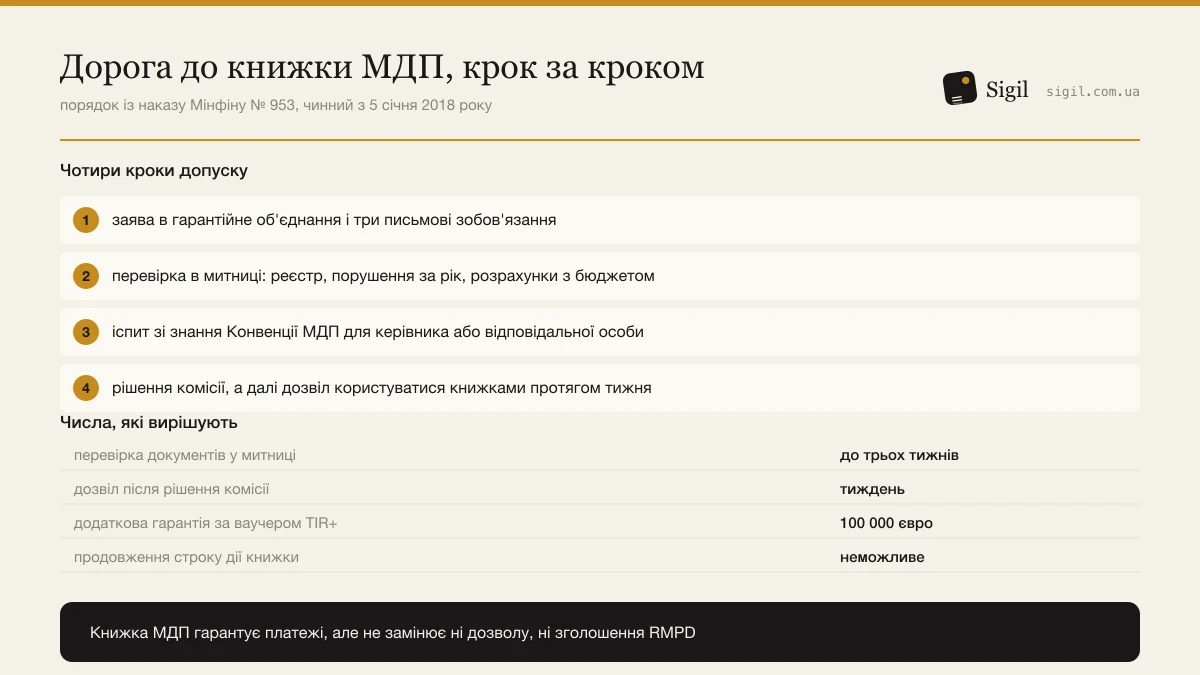
A haulier decides to run on TIR carnets because "it is faster at the border". The director calls the guaranteeing association and learns that first comes a commission, then a check by customs, and then an exam. The exam is taken by the head of the firm or the responsible officer, and without it no carnets are issued.
This article explains what a TIR carnet is, who admits a carrier to the procedure, how long it takes, and when the carnet genuinely helps rather than changing nothing.
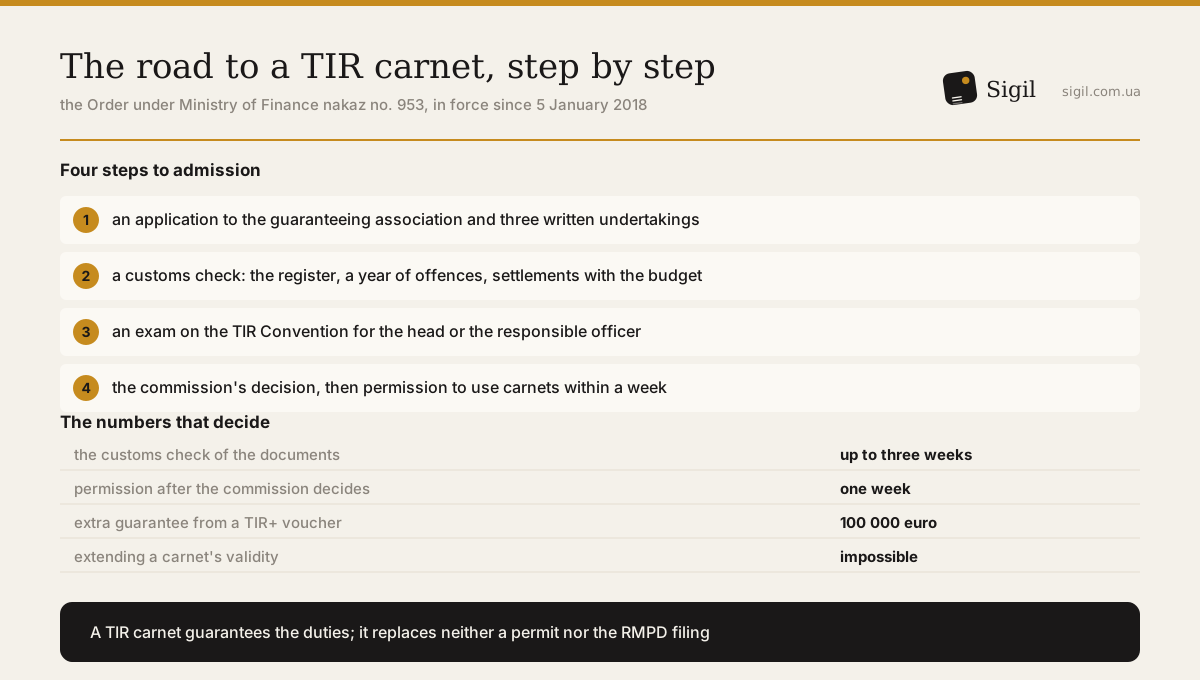
In brief: a TIR carnet is a financial guarantee for customs duties in transit, not a permit to carry · it is issued by a guaranteeing association, a role played in Ukraine by AsMAP, while admission to the procedure is granted by a commission of customs and the association · before admission the carrier gives three written undertakings, customs checks a year of customs offences and the state of settlements with the budget, and then comes an exam on the 1975 TIR Convention · the permission to use carnets is issued within a week of the commission's decision · the validity of a carnet is set by the association and cannot be extended, although carriage already begun runs to its end · a TIR+ voucher adds 100 000 euro of guarantee to one carnet and is registered at tirplus.net · in the border queue the carnet alone earns no priority · a carnet does not replace the RMPD filing.
What a TIR carnet is, and what it is not
A TIR carnet is the document of the TIR procedure under the 1975 Convention. Goods travel on it across several countries under customs supervision, while payment of any duties is guaranteed by a chain of national guaranteeing associations.
What it is not deserves saying separately. It is neither a permit to carry nor a substitute for a filing. A permit answers whether the carrier may run the job at all. A carnet answers a different question: who pays if the goods do not arrive where they should.
Carnets are issued by the guaranteeing association whose details appear on the cover. In Ukraine that role is played by AsMAP, recognised as guarantor in an arrangement with customs, and it is the association that sets the carnet's validity.
Who admits a carrier to the procedure
Admission is granted by a commission of customs officials and the guaranteeing association, appointed by a joint order.
The procedure runs like this. The association collects carriers' applications and writes to customs confirming two things: experience in international carriage or the ability to perform it regularly, and the sound financial standing of each applicant.
In the same letter the association confirms that the carrier has given three written undertakings.
- To observe the Convention's customs formalities at the offices of departure, destination and en route.
- To pay the sums under art. 8(1) and (2) of the TIR Convention where the competent authorities require it.
- To give the association information and access to the documentation proving compliance with the minimum conditions of Annex 9 Part II to the Convention.
What customs check, and why there is an exam
Customs check three things: that the carrier appears in the Ukrainian register of businesses, whether it has been held administratively liable for customs offences under articles 469, 470, 472, 474, 482-484 of the Customs Code within a year of the penalty, and the state of its settlements with the budget.
After the check the commission holds an exam on knowledge of the TIR Convention. The exam is taken by the head of the company or by an employed authorised person responsible for compliance with the Convention.
That is the real threshold, and no overview article mentions it. After a positive decision the permission to use TIR carnets is issued within a week, and the updated list of admitted carriers goes back to the association.
How long a carnet lasts
The validity is set by the guaranteeing association and cannot be extended. A carnet may be accepted by the first office of departure no later than the last day of its validity, and carriage already begun runs on it to the end.
The practical conclusion is short. A carnet with three days left will do for a start, but not for a trip that begins next week.
Customs refuse or withdraw a carnet in the following cases.
- Box 2 of the cover lacks the guaranteeing association's details.
- Box 3 lacks the holder's details.
- Box 4 lacks the stamp and signature of the association's officer.
- A SafeTIR message reports the carnet invalid.
- The validity expired before the carnet was presented at the office of departure.
- The holder has no Certificate of Approval of the vehicle for the carriage of goods under customs seals, or it has expired.
The last point is the most practical one for carriage. The certificate is issued for a particular vehicle, its number goes in box 9 of the cover, and without it no carnet will be processed. There is one exception: for heavy or bulky goods no customs seals are applied to the load compartment, and the certificate is not required. If at the time of carriage the vehicle no longer meets the requirements on which the certificate was issued, that too is a ground for refusal.
What a TIR+ voucher adds
The voucher is a computerised enhanced guarantee: 100 000 euro for each voucher used together with a carnet, on top of the carnet's own cover.
The sequence is in the carrier's hands. Before the carnet is presented at the office of departure, the voucher is registered at tirplus.net together with the valid carnet number, and the portal ties the voucher to that carnet in the IRU database. The voucher then goes to the office en route with the carnet, the officer checks the carnet status and the link, and applies a stamp.
The original voucher travels with the carnet to the office of destination and from there to the association. The office of departure may refuse a voucher where the duties exceed the guarantees of the voucher and the carnet taken together.
The simplifications that keep a truck away from the customs office
The Ukrainian Customs Code knows two transit simplifications tied specifically to TIR. Authorised consignor status under TIR allows goods to be placed under transit at the company's own premises in order to start a TIR operation. Authorised consignee status under TIR allows the operation to be ended at such premises (art. 91-1(1)).
The authorisation goes to a resident that declares regular TIR operations and meets three of the AEO criteria: compliance with customs and tax law, control of operations based on records, and practical standards of competence of the responsible officer (art. 91-1(3)).
Consignor status carries one further condition, without which the rest counts for nothing. The company must already hold an authorisation for seals of a special type (art. 13(1)(5)) or an equivalent simplification under the Convention on a common transit procedure (art. 91-1(4)).
For the driver it means loading or unloading happens at the company's premises, without a separate trip to the customs office.
Does a carnet earn priority in the queue
Not on its own. The first priority slot belongs to a vehicle carrying goods subject to first-priority control, moved by an AEO or travelling under a TIR carnet or common transit (p. 15 of the Rules). Without such goods the carnet earns no slot, unlike AEO status, which has one of its own.
How the whole algorithm is built is set out in the article on the queue for leaving Ukraine.
When a carnet is not needed at all
When the trip runs under common transit. For carriage between the countries of the Convention on a common transit procedure the T1 declaration in NCTS applies, and for a Ukrainian carrier that is today the ordinary road into Poland and further, while what a T1 declaration is is covered separately.
TIR remains where common transit does not reach, on routes through countries outside the Convention. The choice between T1 and TIR is therefore a question of the route rather than of habit.
Does a carnet replace the RMPD filing? No. These are different systems: TIR is a customs guarantee, RMPD a Polish carriage filing. A trip without the filing costs a 12 000 zł deposit, and the penalty calculator will work out your own figure.
What to do
- Let the route decide what you need: T1 for the EU as a rule, a TIR carnet for directions outside the common transit Convention.
- Start with the guaranteeing association, because admission runs through it rather than through customs directly.
- Prepare proof of experience and financial standing before filing the application.
- Appoint the responsible officer and prepare that person for the Convention exam.
- Check the carnet's validity and the entries in boxes 2, 3 and 4 before every trip.
- Register a TIR+ voucher at tirplus.net before presenting the carnet, where the duties are high.
- File the RMPD regardless of the carnet.
What not to do
- Treating a carnet as a permit. It guarantees duties; the right to carry comes from other documents.
- Planning a trip on a carnet whose validity ends before departure day. It cannot be extended.
- Erasing entries or correcting the forbidden boxes. A correction is made by crossing out and is certified by customs, but boxes 1-5 of the cover, box 4 of the detachable sheets and boxes 2, 3 and 5 of the protocol may not be corrected, and breaking that rule is a ground for refusal.
- Swapping the tractor unit in subcontracting without checking. The replacing vehicle must belong to a member of its own country's guaranteeing association.
- Registering the TIR+ voucher after the carnet has been presented. The rules require it beforehand.
- Counting on queue priority from the carnet alone. Without first-priority goods it earns no slot.
Sigil handles RMPD filings. TIR carnets are issued by the guaranteeing association, and Sigil takes no part in the admission procedure.
A demo or training for your team
30 minutes online. We show how Sigil™ files an RMPD from a CMR and answer questions about your runs.
Frequently asked questions
- How long does admission to the TIR procedure take?
- It depends on the commission, but the rules set deadlines. Customs check the documents within three weeks of the association's letter, the commission then holds the exam, and the permission to use carnets is issued within a week of the decision.
- Who sits the exam, the director or the driver?
- The head of the company or an employed authorised person. It is whoever is responsible for complying with the TIR Convention inside the firm. Drivers are not called to this exam.
- Can the validity of a carnet be extended?
- No. The validity is set by the guaranteeing association and cannot be extended. The first office of departure accepts a carnet no later than the last day of validity, and carriage already begun runs on it to the end.
- A TIR carnet or a T1 declaration for Poland?
- Inside the common transit Convention, usually T1. The carnet stays for routes beyond it. It is a question of the route, and the RMPD filing is required either way.
Sources
Normative acts, in force on the day of publication:
- The Order implementing the 1975 TIR Convention, approved by order no. 953 of the Ukrainian Ministry of Finance of 20 November 2017, registered on 12.12.2017, in force since 05.01.2018 without amendment: the definition of the TIR+ voucher, the validity of a carnet, the grounds for refusal and withdrawal, the chapter on issuing the voucher, and the chapter on admitting carriers to the TIR procedure.
- The Customs Code of Ukraine, zakon.rada.gov.ua, in the redaction of 17.09.2026: art. 91-1 (authorised consignor and consignee status under TIR and the conditions for granting it), art. 12(3) (the criteria art. 91-1 refers to).
- Customs Convention on the International Transport of Goods under Cover of TIR Carnets, 1975, zakon.rada.gov.ua: art. 8 (liability of the guaranteeing association), Annex 9 Part II (minimum conditions for admission).
- Order of the Ukrainian ministry of development of 20 June 2025 no. 1028, zakon.rada.gov.ua: p. 15 of the Rules, the place of the TIR carnet in the priority algorithm.
- Ustawa z dnia 6 września 2001 r. o transporcie drogowym, ISAP, consolidated text: art. 28b ust. 1, załącznik nr 3 lp. 3.2a (12 000 zł).
Exchange rate: National Bank of Ukraine, 11.5582 hryvnia to the zloty on 20 October 2026.
Sigil™ turns a CMR into an RMPD declaration and files it with PUESC, with every field checked against the original.
More about RMPD