RMPD
RMPD in Poland, what it is, who files and how
RMPD is the advance notice a non-EU carrier files before driving into Poland. Who files it, which forms apply, how long the number lasts and what errors cost.
Published · Updated · Author: Makaiev Kostiantyn Oleksandrovych, founder of Sigil RMPD
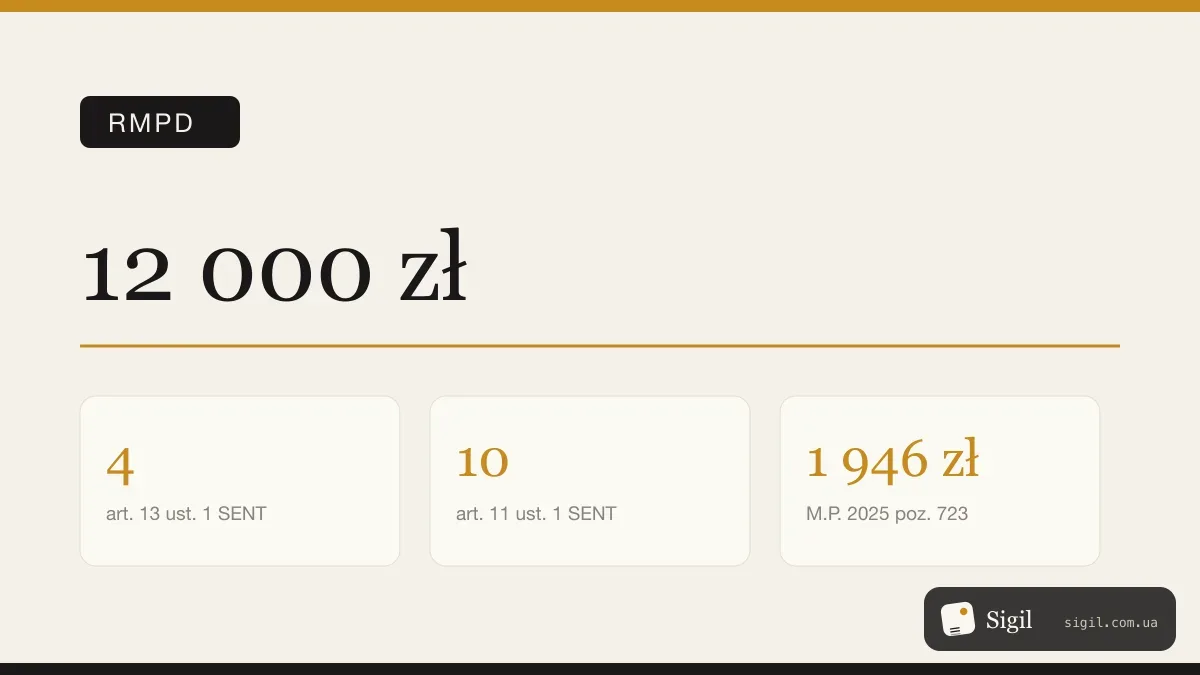
RMPD is the advance notification of an international haulage operation in a Polish register, filed on PUESC by a non-EU carrier before entering Poland, loaded or empty (Article 28b of the Road Transport Act). The duty has applied since 1 November 2024, the number is valid for 10 days, and a missing notification costs the carrier 12 000 zł.
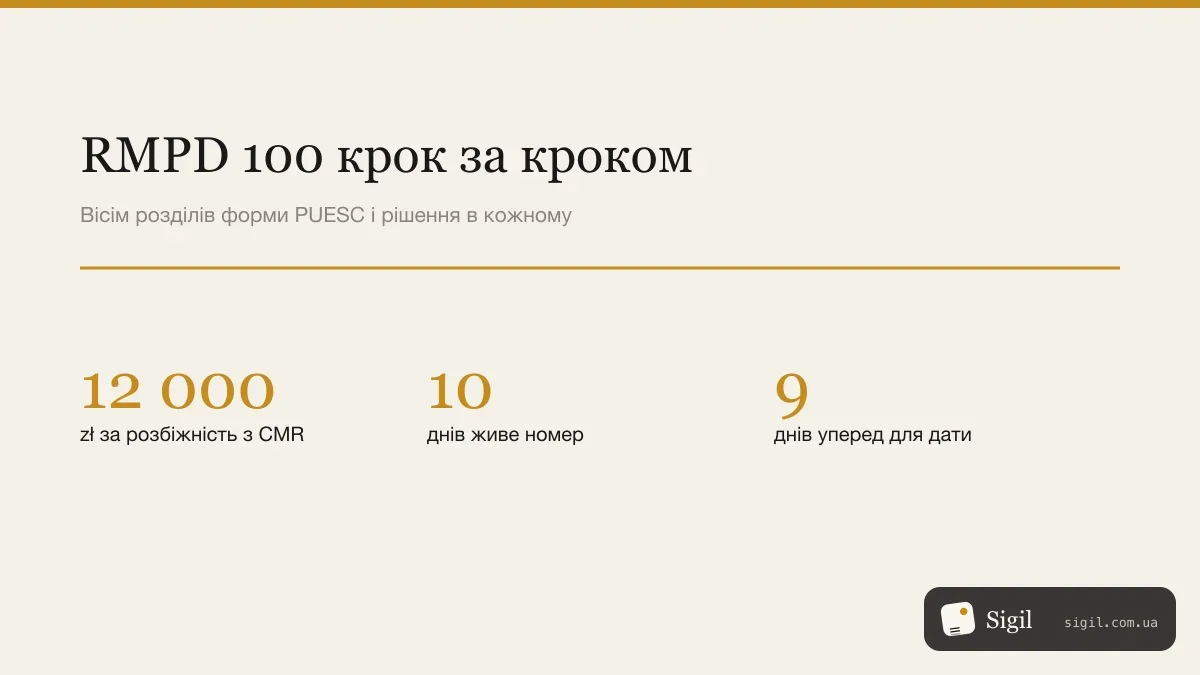
In brief: RMPD is the notification of a haulage operation in a Polish register, filed by a carrier from outside the EU before entering Poland, loaded or empty · the duty has applied since 1 November 2024 (Article 28b of the Road Transport Act) · the carrier files it, not the consignor or the consignee, from a basic PUESC account · there are five forms: RMPD100 registers, 101 amends, 103 closes, 104 cancels and 406 checks the number and GPS · the reference number is valid 10 days from issue, and the start date may be set at most 9 days ahead · a missing or incomplete notification costs the carrier 12 000 zł, a GPS gap another 10 000 zł · CMR data goes into the notification one to one, even when it contains a mistake.
The driver is queuing at Yahodyn, the load is agreed and the CMR is signed. The dispatcher remembers the RMPD when the truck is ten vehicles from the border. PUESC opens, the CMR data goes in at speed, and one digit of the trailer number comes out wrong.
RMPD stands for Rejestr Międzynarodowych Przewozów Drogowych, the Polish register of international road haulage, and "filing an RMPD" means registering a specific journey there before entry. The duty falls on carriers from outside the EU and does not depend on the cargo. Without a reference number the driver must refuse to set off (Article 28c(2)).
What RMPD is
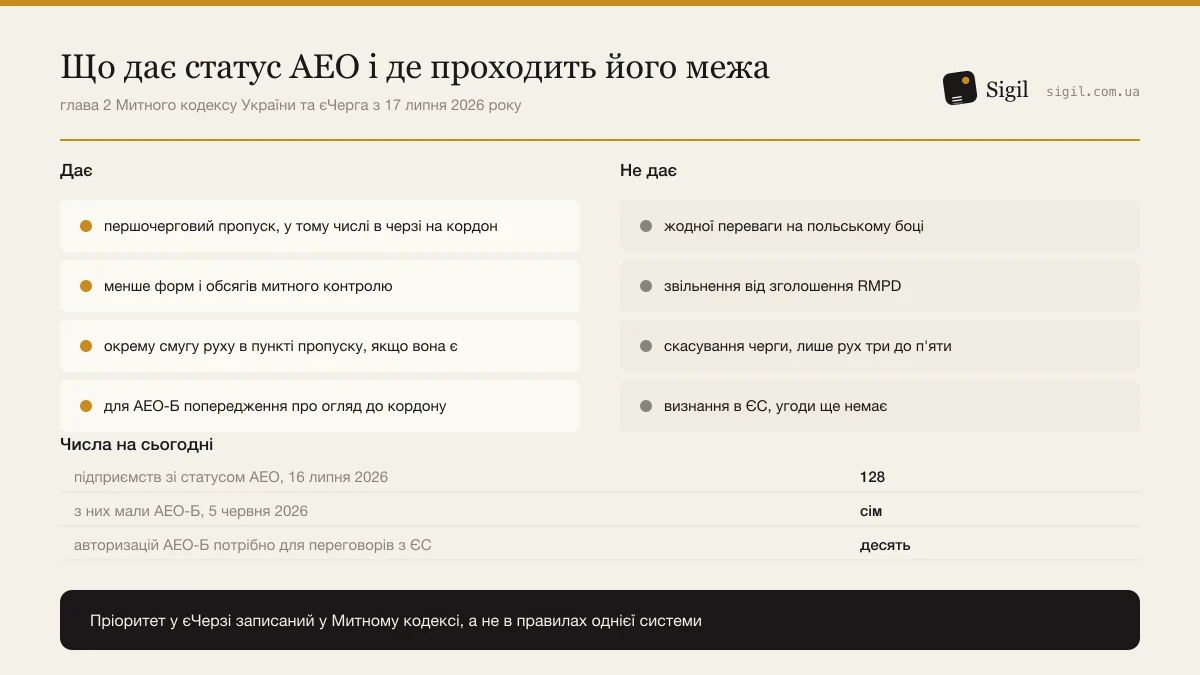
RMPD runs on the same PUESC portal as SENT and started on 1 November 2024 for carriers from Ukraine and other non-EU countries. Since 1 January 2025 it has also applied to carriers from the EU, Switzerland and EFTA performing carriage to or from a non-EU country under a permit from an international agreement (Article 28(1a)). Who exactly is covered, and when, is set out in who must file RMPD.
RMPD and SENT are confused all the time, although they are different registers under different laws. SENT concerns listed goods and is filed by the consignor or the consignee. RMPD concerns the haulage itself and is filed by the carrier, even for an empty run. The difference, and why the penalties differ, is explained in SENT and RMPD compared.
Who files RMPD and when
The carrier files before entering Polish territory. The law opens three doors to the duty: a transport permit, an ECMT licence or an exemption from permits under an international agreement (Article 28b(1)). A Ukrainian carrier usually comes through the third door, because the agreement between Ukraine and the EU exempts it from permits but not from notification.
Every international operation through Poland needs its own notification, whether loaded, empty, transit or bilateral. For cabotage a notification is filed for each operation (Article 28b(9)). Whether a trip counts as transit or as carriage to a third country, and why that decides the permit, is covered in transit or third-country carriage.
Does an empty truck crossing Poland need RMPD? Yes. The duty attaches to the haulage operation, not to the load, and an empty run is marked separately on the form.
How to file RMPD
A basic personal account on PUESC is enough, with no signature and no company registration. Opening that account and logging in are described on the PUESC page for carriers. The service is free.
There are five forms. RMPD100 registers an operation, RMPD101 amends one already registered, RMPD103 closes it after the trip, RMPD104 cancels it before the start and RMPD406 checks the validity of a number with the last GPS position. The register replies with RMPD110 carrying the reference number or RMPD500 with the reason for rejection. Which form applies when is explained in the article on RMPD100 and the other RMPD forms.
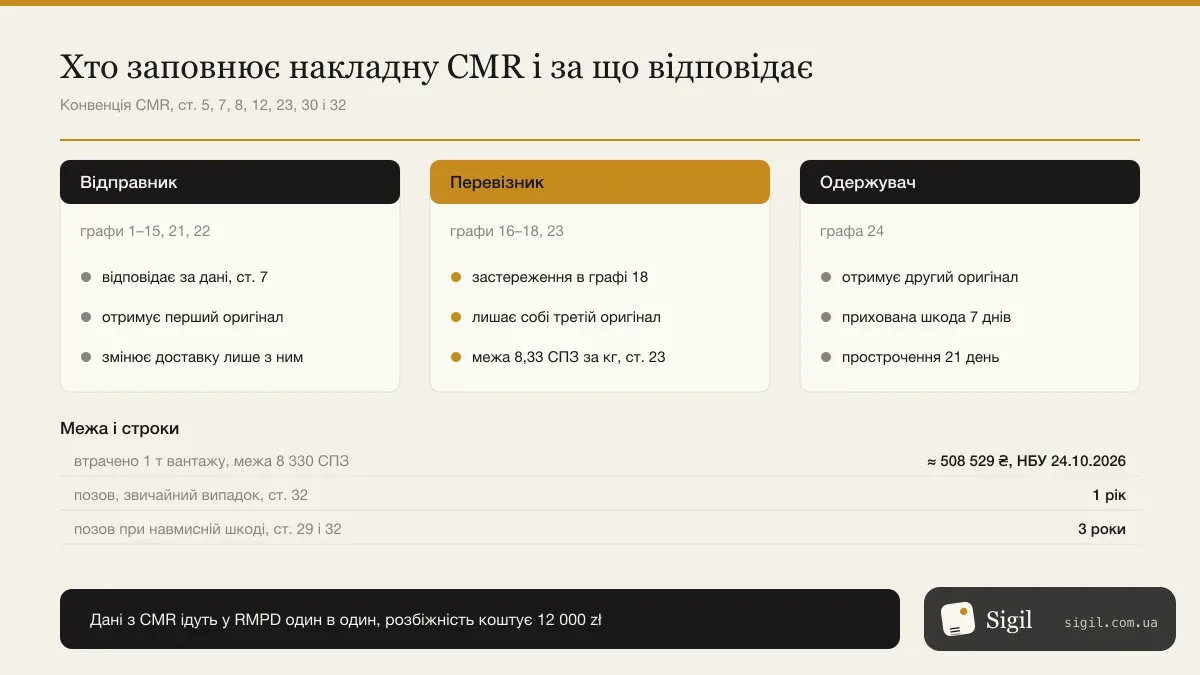
Most RMPD100 fields come from the CMR: consignor, consignee, places of loading and unloading, carrier, number and date of the consignment note, tractor and trailer registrations. The type of carriage, the legal basis of the permit exemption, border crossings and the locator number come from PUESC dictionaries and the carrier's own documents. The CMR to RMPD field map goes through them one by one.
How long the number lasts and how to change it
The reference number is valid for 10 days from the day it is issued, not from the start of the journey (Article 11(1) of the SENT Act via Article 28b(5)). A notification filed a week before departure leaves three days for the trip itself. A number cannot be extended by changing the date; a new notification referring to the previous number is needed.
A notification can be cancelled only before the journey starts. After that, only data changes through RMPD101 remain, for example when the trailer is swapped. The register does not currently process RMPD103 closures: of the 50 closures our platform sent between 2.07 and 4.08.2026, it accepted none. Status 5, a closure by the register itself, is rare in our data: 3 of 7,039 finished notifications in the production environment have it, and almost all the rest stay in status 2. These are one platform's data, not the market's. The traps of this stage are set out in closing and cancelling RMPD.
A notification can be checked with RMPD406 without logging in to PUESC, using the reference number, the registration plate and the locator number. The reply shows the last position the register received, and a reply without a position means nothing has arrived from the locator. Reading that reply is explained in the RMPD406 check.
What roadside checks look at and what errors cost
Checks are carried out by the Customs and Tax Service, the police, the Border Guard and ITD inspectors. They look at whether the notification covers this trip, whether the data is true, whether the driver has the number and whether geolocation is flowing. How such a check goes, and what the driver may do during it, is described in the RMPD roadside check.
A missing, incomplete or untrue notification costs the carrier 12 000 zł (Annex 3, item 3.2a), and a geolocation gap another 10 000 zł (item 3.2b), but the total from one roadside check cannot exceed 12 000 zł (Article 92a(3)). The driver separately pays 1 500 zł for failing to show the number and 2 000 zł for breaking the locator rules (Annex 1, items 2a and 2b).
One wrong digit costs as much as no notification at all, as explained in when one digit in RMPD costs 12 000 zł. A Ukrainian carrier pays the penalty at the roadside as a deposit, and without it the truck goes to a paid car park. The total for several breaches is worked out by the SENT and RMPD fines calculator.
Why the register rejects notifications
In our platform's data, of the 249 notifications sent to the PUESC production environment between 31.07 and 13.10.2026, the register rejected 10 over their data, roughly one in twenty-five. Most were about dates: an end of carriage later than the permitted limit (R06, 4 notifications) or a change to a date already past (R15, 3). The R16 rejection concerns not registration but an RMPD103 closure, and resending does not lift it. These are one platform's data, not the market's. The answers and codes are collected in RMPD, carriers' questions.
What a client or forwarder can check
The filing is made by the carrier, but anybody holding three numbers can check it. That is worth knowing from both sides.
A check needs the reference number, the tractor unit's registration number and the locator number. With those, the RMPD406 form on PUESC answers whether the filing is valid and where the register last saw the vehicle. No login is needed and there is no fee.
Two practical conclusions follow. First, the carrier does well to pass the reference number to the client right after filing, because otherwise the client has nothing to check with and reaches for the phone. Second, without the locator number a check shows no position, so that number belongs in the trip file rather than buried in the filing form.
What a client will not see matters too. There is no public list of other parties' filings in the register: without the three numbers nobody can check your carriage, and you cannot check anybody else's.
How long to keep the records
The register keeps an RMPD notification for only two years from the end of the year of filing, while a penalty can be imposed for five years. Between those dates your copy in the register is gone and a claim is still possible. What to keep yourself is set out in keeping RMPD and SENT records.
What to do
- File the RMPD before leaving for the border, not in the queue, and no more than a few days ahead of the trip.
- Copy CMR data word for word and check tractor and trailer numbers against the registration documents.
- Give the driver the reference number before departure and ask to see it on the phone.
- Check the notification with RMPD406 after entry to see whether the position is arriving.
- Keep notification confirmations for at least five years, because the register deletes them after two.
What not to do
- Do not file a week in advance. The number lives 10 days from issue and may not cover the trip.
- Do not "correct" CMR data. A mismatch between the notification and the consignment note costs 12 000 zł.
- Do not try to extend a number by changing the date. The register rejects the change, and a new notification is needed.
- Do not let a driver leave without the number. The driver must refuse to set off, and a truck without a notification goes to a car park at your cost.
Where technology fits in
Sigil prepares the RMPD from a photo of the CMR and files it through the official PUESC web service using the carrier's own credentials. The software reads the consignment note and proposes the fields, but the dispatcher checks each one against the original one to one and confirms, and nothing is sent without that. Across 126 notifications created from 31.07 to 19.09.2026, the median from CMR photo to PUESC number was 6.0 minutes. The price, the three filing steps and a comparison with filing by hand on PUESC are on the RMPD-100 online page.
Sigil handles RMPD documents: registration, amendment, closure, cancellation and the RMPD406 check. SENT is filed by the consignor or the consignee, and Sigil does not offer that function.
A demo or training for your team
30 minutes online. We show how Sigil™ files an RMPD from a CMR and answer questions about your runs.
Frequently asked questions
- Does an EU carrier file RMPD?
- Only in one case. Since 1 January 2025 a carrier from the EU, Switzerland or EFTA files RMPD when carrying goods to or from a non-EU country under a permit from an international agreement (Article 28(1a)). Within the EU it does not file RMPD.
- Can one RMPD cover several trips?
- No. Each international operation needs its own notification, and in cabotage each operation does (Article 28b(9)). The number is valid for 10 days and tied to the declared journey.
- What if the notification contains an error and the trip has started?
- Amend it with RMPD101. Cancellation is not possible after the start. Fix the error before any check, because untrue data carries the same penalty as no notification.
- Does RMPD include the weight and CN code of the goods?
- No. The form only asks whether the truck is loaded. Goods with their CN code are described in SENT when they are on the list.
- Is filing RMPD free?
- Yes, the PUESC service itself is free. Costs arise only for someone else's work or software when another party or a service files the notification.
Sources
Legislation, as in force on 19.10.2026:
- Ustawa z dnia 6 września 2001 r. o transporcie drogowym (Road Transport Act), ISAP, consolidated text Dz.U. 2025 poz. 1490: Articles 28(1a), 28b(1), (3), (5) and (9), 28c(2), 89a1(1a), 92a(3), Annex 1 items 2a and 2b, Annex 3 items 3.2a and 3.2b.
- Ustawa z dnia 9 marca 2017 r. o systemie monitorowania drogowego i kolejowego przewozu towarów oraz obrotu paliwami opałowymi (SENT Act), ISAP, consolidated text Dz.U. 2024 poz. 1218: Article 11(1).
Service descriptions and specifications:
- Zgłoszenie przewozu w przypadku międzynarodowego przewozu drogowego rzeczy, PUESC: forms, basic scope of permissions, free service.
- Usługi sieciowe, informacje i specyfikacje, PUESC: RMPD specification 1.0 of 20.11.2024, rules R15, R16 and R26.
Own data: Sigil's PUESC exchange log (10 data rejections out of 249 notifications in the production environment, 31.07 to 13.10.2026; 50 RMPD103 closures, 2.07 to 4.08.2026; statuses of 7,039 finished notifications in the production environment as of 25.10.2026) and the filing cycle measurement (126 notifications, 31.07 to 19.09.2026). These are figures from carriers working through Sigil, not market statistics.