RMPD
Truck border queues into Poland
Truck border queues into Poland run separately by mass, for empty vehicles and for goods of groups 1-24. Eight crossings, fifteen queues, how to read them.
Published · Author: Makaiev Kostiantyn Oleksandrovych, founder of Sigil RMPD
Two dispatchers sent trucks to Yahodyn on the same morning, one empty, one loaded with apples. The empty one crossed after seven days, the apples after nine, although on the map both stood at the same point. They stood in different queues, and neither dispatcher knew about the split when promising a date.
Border queues into Poland are not one line per crossing. The Ukrainian system keeps them apart by mass, by whether the vehicle carries goods, and by commodity group, so the choice of crossing weighs more than the hour of departure.
In brief: the Polish direction has eight crossings and fifteen queues, because the system splits them by mass, by loaded or empty, and by commodity group (p. 11 of the Rules under order no. 1028) · goods of UKTZED groups 1-24 keep their own queue and carry extra time for inspections (p. 13), so they wait longest · vehicles up to 7.5 tonnes have crossings of their own, where the wait runs in hours rather than days · priority cannot be bought, the system repeats a cycle of three priority vehicles to five ordinary ones (p. 15) · on 19 October 2026 the queues held 16 572 vehicles and the average time to entering a crossing was 88 hours 12 minutes · the Polish direction has two waiting zones, and for trucks entering one is not compulsory · the load is checked on the portal before every trip, because the figures change by the hour.
Why one crossing holds several queues
Because the rules say so. The system may split trucks into separate queues by these criteria: total mass up to or above 7500 kg, a vehicle carrying goods, where needed separately for particular UKTZED commodity groups, and a vehicle running empty (p. 11 of the Rules).
This is not administrative detail but the main reason two trucks from one firm get different dates on the same day. Each queue moves at its own pace, and the system calculates the estimate for each one separately, recalculating it from the actual speed at which that queue crosses (p. 10 of the Rules).
For goods of UKTZED groups 1-24, food and agricultural produce, the rules add one thing more. Their movement in the queue is recorded separately and allows extra time for the inspection operations such goods require (p. 13 of the Rules). Hence the longest waits sit precisely on the food queues.
Which carriage belongs in which queue at which crossing
Below is the structure from the portal as of 20 October 2026. The ministry can add or merge queues, so the portal is worth a look before a trip, but the split by mass and by load holds steady.
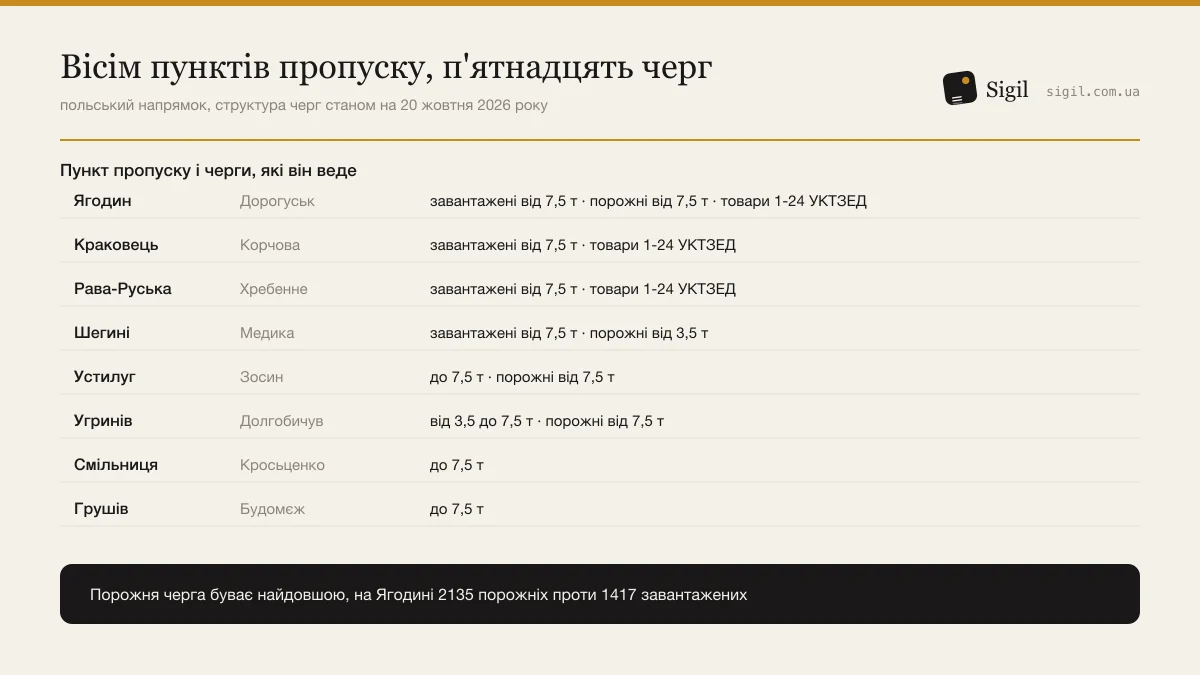
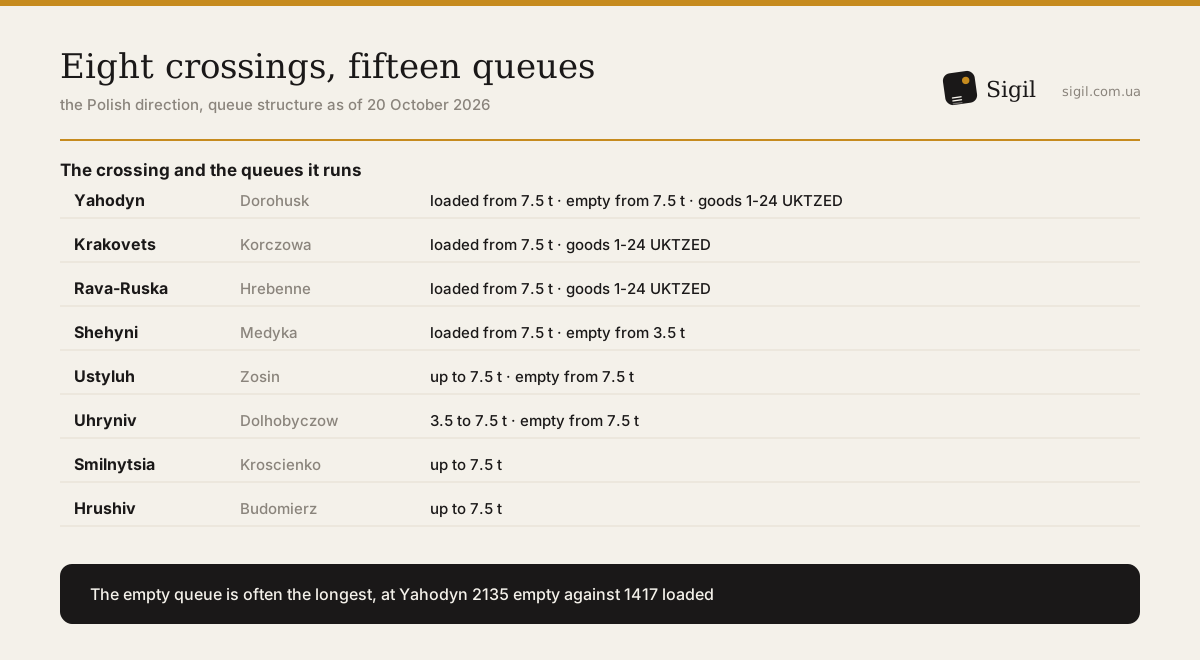
| Crossing, Ukrainian side | Polish side | Queues kept here |
|---|---|---|
| Yahodyn | Dorohusk | loaded from 7.5 t · empty from 7.5 t · UKTZED groups 1-24 |
| Krakovets | Korczowa | loaded from 7.5 t · UKTZED groups 1-24 |
| Rava-Ruska | Hrebenne | loaded from 7.5 t · UKTZED groups 1-24 |
| Shehyni | Medyka | loaded from 7.5 t · empty from 3.5 t |
| Ustyluh | Zosin | up to 7.5 t · empty from 7.5 t |
| Uhryniv | Dolhobyczow | 3.5 to 7.5 t · empty from 7.5 t |
| Smilnytsia | Kroscienko | up to 7.5 t |
| Hrushiv | Budomierz | up to 7.5 t |
The first thing this table shows: a heavy loaded vehicle has four crossings to choose from, and they are exactly the four with the longest queues. The second: a vehicle up to 7.5 tonnes has four other crossings and a different world. On that same 20 October, Hrushiv showed 11 hours 29 minutes and Yahodyn for heavy vehicles 6 days 18 hours.
Why an empty truck does not always come back faster
Because empty vehicles have their own queue, and it is often the longest at the crossing. On that same day Yahodyn held 2135 empty vehicles against 1417 loaded ones, and the empty ones waited longer.
The reason is plain. Empty vehicles return from Europe, there are many such runs, and the crossing has one capacity for all of them. Planning the return as "it will get there somehow" puts the vehicle in the longest queue of the crossing.
For an empty vehicle the rules add one more limit. Swapping the tractor unit in such a booking is forbidden and only the driver may change (p. 12 of the Rules). If the tractor breaks down, the booking has to be created again, and the waiting starts from zero with it.
Where to send food
Separate queues for UKTZED groups 1-24 are run by three crossings: Yahodyn, Krakovets and Rava-Ruska. Only there does this cargo have a line of its own, and only there is its separate time visible.
On 20 October those three queues read: Krakovets 6 days 18 hours, Yahodyn 8 days 20 hours, Rava-Ruska 8 days 23 hours. The gap between the best and the worst option exceeded two days that day, and it is chosen at the booking stage, not on the road.
How to read the load on the portal
The portal shows two numbers per queue: how many vehicles stand in it and the estimated wait. The second matters more, because the system calculates it automatically and recalculates it from the speed at which vehicles in that queue cross (p. 10 of the Rules).
So a long queue that moves beats a short one that stands. Compare the time rather than the vehicle count, and compare only within your own type, because a time from the light-vehicle queue says nothing about a heavy loaded one.
The figures live for hours. Any table in an article, ours included, is a snapshot of a day, while the current state always sits on the eCherha portal.
Why vehicles you cannot see stand ahead of you
Because the queue runs a priority, and the priority is not for sale. The system repeats a cycle in which three priority vehicles pass for every five ordinary ones (p. 15 of the Rules): one with first-priority goods carried by an AEO or under a TIR carnet or the common transit procedure, one with first-priority goods, and one AEO vehicle or one carrying goods under articles 250 and 360 of the Ukrainian customs code.
Hence a planning conclusion. For a carrier without AEO status and without TIR, the place in the queue shrinks more slowly than the arithmetic of "there are 500 of us and 200 pass a day" suggests. The portal's estimate already accounts for this; a calculation in your head does not. Whether the AEO status is worth pursuing for that priority depends on how many of your trips run through the large crossings.
How long the wait runs overall
The eCherha statistics panel, as of 19 October 2026 at 23:59, shows the picture across all directions together. Border crossings over the life of the project: 3 636 929. Vehicles in the queues at the end of the period: 16 572. Average time to entering a crossing: 88 hours 12 minutes; to crossing itself, 87 hours 51 minutes.
The same panel carries a number worth reading twice: 1 368 810 cancelled electronic queue places. Some of that is ordinary changes of plan, some is booking just in case, which makes the queue look longer than it is. Those bookings are exactly what the 14-day blocks target, described in the article on how eCherha works and when to file an RMPD.
Where the vehicle physically waits
The Polish direction has two waiting zones: Terminal M11 in the Shehyni community and the Trushevychi international service zone in the Sambir district. The portal shows the free places in each.
For trucks, entering a waiting zone is not a condition of using the system. The Order requires entry through a zone only for passenger cars (p. 22 of the Order). A truck driver may wait wherever it suits, as long as the crossing is reached on time.
What this means for planning
The crossing is chosen for the type of vehicle and cargo, not out of habit. A light vehicle to a small crossing, a heavy one to a large crossing, food to whichever food queue is shorter today.
The date given to a client comes from the portal on the booking day, not from memory of last month. And the RMPD filing is made once the real entry day is visible, because filing an RMPD takes minutes while the number lives ten days from issue.
An entry day pushed back by the queue can land on a Polish holiday or the evening before one, and a vehicle above 12 tonnes then stands still on the Polish side. Which days are banned and what may move anyway is covered in the article on the Poland truck driving ban.
The way back, from Poland to Ukraine, is estimated separately by the Polish services for every crossing, and our tool shows those hours as wait times to leave Poland from the official granica.gov.pl data.
What happens to the vehicle at the crossing itself, on the Polish side of the barrier, is shown by the border clearance status service. The queue and the clearance are two different things, each visible in its own system.
What to do
- Check the load on the relevant queue on the portal before naming a date.
- Compare waiting times rather than vehicle counts, and only within your own queue.
- Match the crossing to the mass of the vehicle, because up to 7.5 tonnes there are four crossings where the wait runs in hours.
- For food, compare the three food queues against each other; the gap can exceed two days.
- Plan the return as carefully as the outbound leg, because the empty queue is often the longest at the crossing.
- File the RMPD once the entry day is visible, so that its ten days do not run out while the truck is still queuing.
What not to do
- Comparing your queue with someone else's. The empty, loaded and food queues at one crossing carry different times, and the neighbour who crossed faster stood in another one.
- Assuming fewer vehicles means faster. The system derives the time from the actual crossing speed, so a longer queue is sometimes the quicker one.
- Sending a heavy vehicle to a small crossing. Smilnytsia and Hrushiv run queues only for vehicles up to 7.5 tonnes.
- Treating a table from any article as the current state. The figures change by the hour and the only live source is the portal itself.
- Booking places at several crossings to hedge. One vehicle holds one place, and two bookings without a single entry in 30 days earn a 14-day block.
- Crossing without an RMPD because the queue ate a week anyway. On the road that is a 12 000 zł deposit and the vehicle on a guarded car park, and the penalty calculator will work out your own figure.
Sigil handles RMPD filings. The queue for leaving Ukraine is booked by the carrier itself, in the eCherha system.
A demo or training for your team
30 minutes online. We show how Sigil™ files an RMPD from a CMR and answer questions about your runs.
Frequently asked questions
- Why did another truck from the same crossing get through faster?
- Because it stood in a different queue. One crossing runs up to three queues: loaded, empty and UKTZED groups 1-24. Each moves at its own pace, so two runs by the same carrier on the same day get different dates.
- Which crossing into Poland is the fastest?
- The one that matches the vehicle. For vehicles up to 7.5 tonnes these are Hrushiv, Smilnytsia, Ustyluh and Uhryniv, where on 20 October 2026 the wait ran from 11 hours to three days. Heavy loaded vehicles are left with Yahodyn, Krakovets, Rava-Ruska and Shehyni, where the wait is counted in days.
- Can a carrier book two crossings at once?
- No. One vehicle holds one place at a time. Two bookings without a single entry within 30 days earn that vehicle a 14-day block.
- Can food shipments be moved up the queue?
- Only by choosing the crossing. Three crossings run separate queues for UKTZED groups 1-24, and on 20 October the gap between them exceeded two days. Priority belongs to first-inspection goods, AEO consignments and TIR carnets, and it is not for sale.
Sources
Normative acts, in force on the day of publication:
- Order of the Ukrainian ministry of development of 20 June 2025 no. 1028, zakon.rada.gov.ua, registered with the Ministry of Justice on 24.07.2025 under no. 1116/44522, as amended by order no. 691 of 31.03.2026: the Rules, p. 10 (how the time is calculated), p. 11 (splitting into queues), p. 12 (swapping the tractor unit), p. 13 (UKTZED groups 1-24), p. 15 (the priority algorithm).
- Resolution of the Cabinet of Ministers of Ukraine of 5 December 2024 no. 1411, zakon.rada.gov.ua: the Order, p. 10 (no admission without a queue place), p. 22 (waiting zones for passenger cars).
- Ustawa z dnia 6 września 2001 r. o transporcie drogowym, ISAP, consolidated text: art. 28b (the RMPD filing duty), załącznik nr 3 lp. 3.2a (12 000 zł).
Authorities:
- Crossing point load, the eCherha portal, snapshot of 20 October 2026.
- Statistics, the eCherha portal, data as of 19 October 2026, 23:59.
- Waiting zones, the eCherha portal, as of 20 October 2026.
Exchange rate: National Bank of Ukraine, 11.5582 hryvnia to the zloty on 20 October 2026.
Read next
- How long an RMPD really takes, from CMR photo to numberRMPD filing time on our own data: median 6 minutes from CMR photo to PUESC number, one in ten over 14. Why the median, what it consists of, what drags on.
- What an RMPD is and who must file itRMPD from scratch: what the filing is, who must file it since 1 November 2024, when it is not needed, how it differs from SENT, what happens at entry without it
Sigil™ turns a CMR into an RMPD declaration and files it with PUESC, with every field checked against the original.
More about RMPD