RMPD
What an RMPD is and who must file it
RMPD from scratch: what the filing is, who must file it since 1 November 2024, when it is not needed, how it differs from SENT, what happens at entry without it
Published · Updated · Author: Makaiev Kostiantyn Oleksandrovych, founder of Sigil RMPD

A driver is stopped on a Polish road and the inspector asks for the "RMPD number". The driver hears the word for the first time. He calls the office; the dispatcher hears it for the first time too. An hour later the truck is on a guarded car park and the company is looking for 12,000 zł for a deposit. That is how many carriers from Ukraine found out in 2025 that RMPD exists.
This article explains, for a reader who meets the Polish system for the first time, what RMPD is, who must file it, since when, when it is not needed, and in what order a carrier bringing goods to Poland for the first time should act.
In short: RMPD is a filing about a carriage in a Polish register, made by a non-EU carrier before entering Poland · in force since 1 November 2024 for carriers from Ukraine and other non-EU countries, since 1 January 2025 also for EU carriers driving to non-EU countries on a permit · required for every international carriage of goods on Polish territory, loaded or empty · it is not SENT: SENT is about goods, RMPD about the carriage, and the fines come from different acts · without RMPD the carriage counts as one without a permit: 12,000 zł, a roadside deposit, the truck held until the filing is made · a basic PUESC account is enough to file.
What RMPD is
RMPD, Rejestr Międzynarodowych Przewozów Drogowych, is the Register of International Road Carriage. In it the Polish state sees every carriage of goods a foreign carrier performs on its territory: who carries, from where, to where, with what vehicle and under which permit.
Technically an RMPD is a filing in the same electronic register that Poland has used for eight years for its SENT goods-monitoring system, on the PUESC customs portal. The carrier sends the filing, the register returns a numer referencyjny (reference number). The driver must carry that number and present it to an inspector. The duty is in the Road Transport Act, ustawa o transporcie drogowym (art. 28b ust. 1).
What the filing contains is listed in the same act (art. 28b ust. 3): carrier, consignor and consignee details; place and date of the start and end of the carriage in Poland; country of loading and unloading; whether the truck is loaded; CMR number; permit or ECMT licence number; registration plate; locator number. Twelve groups of fields.
Who must file an RMPD
The carrier files the RMPD, not the consignor and not the driver.
Since 1 November 2024 the duty applies to carriers not established in the EU, Switzerland or EFTA. That is every Ukrainian, Moldovan, Kazakh or Turkish company carrying goods to Poland, from Poland or in transit through it.
Since 1 January 2025 the duty was extended to carriers from the EU, Switzerland and EFTA when they perform a carriage to or from a non-EU country under a permit issued under an international agreement. A Polish company carrying goods to Ukraine on a permit files an RMPD too.
The condition is the same for everyone: the carriage is performed under an international road haulage permit, under an ECMT licence, or an international agreement exempts it from a permit (art. 28b ust. 1). Ukrainian carriers are covered in full.
Why non-EU carriers, and why then. The duty was introduced by the act of 25 September 2024 amending the act on the posting of drivers in road transport and certain other acts. The Ministry of Infrastructure described the aim as protecting the Polish road haulage sector through more effective inspection of carriers and "skuteczniejsze monitorowanie i kontrolowanie podmiotów zagranicznych", more effective monitoring and control of foreign operators. In plain words: before the register, the state had no way to check whether every run of a foreign truck really had a permit. Now it has.
When RMPD is needed and when it is not
Needed:
- for every international carriage of goods on Polish territory: into Poland, out of Poland, in transit;
- for an empty run, if the carriage is subject to a permit: the permit regime applies to a journey without cargo as well (art. 28 ust. 3);
- for cabotage, that is a carriage between two points in Poland, with a separate filing (art. 28b ust. 2);
- for each operation separately, when one trip contains several carriages under different permits (art. 28b ust. 8).
Not needed:
- for carriage by vehicles with a permissible total mass of up to 2.5 tonnes: the Road Transport Act does not apply to them at all (art. 3 ust. 1 pkt 2a);
- for carriage that is not an international carriage of goods within the meaning of the act, for example the carriage of passengers.
Is an RMPD needed when the goods only transit Poland without unloading? Yes. The filing describes the carriage across the territory, not the place of unloading.
Is an RMPD needed when the truck runs empty? Yes, if the carriage is subject to a permit. An empty run to a loading place in Poland falls under the same regime as a loaded one.
How RMPD differs from SENT
Both filings live on the same portal, which is why they are constantly confused. The difference is simple.
SENT is about the goods. It is the monitoring system for listed goods: fuels, alcohol, dried tobacco and oils from the act itself (art. 3 ust. 2), plus goods from a Minister of Finance regulation, among them what typically travels from Ukraine: wheat, maize and rapeseed above 10 t, honey above 10 kg, eggs, poultry meat, frozen berries, and since 17 March 2026 clothing above 10 kg and footwear above 20 pairs. The SENT notification is filed by the consignor or consignee; the carrier only completes it with its own data. Furniture or spare parts are not covered; grain and second-hand clothing are.
RMPD is about the carriage. It is filed by a non-EU carrier for any cargo, sensitive or not. A Ukrainian truck with grain or clothing travels with two numbers: SENT from the consignor and RMPD from the carrier. A Ukrainian truck with furniture travels with RMPD only.
The fines differ too, because they are written in different acts. For RMPD, 12,000 zł under the Road Transport Act. For SENT, 20,000 zł for the carrier and 46 % of the goods' value for the consignor under the SENT Act. All amounts in one table: SENT and RMPD fines 2026.
What happens at entry without an RMPD
Where a permit or an ECMT carnet is required, a carriage without a filing is treated by the act as a carriage without a permit (art. 28b ust. 10). A valid permit or ECMT licence in the cab does not help if there is no reference number.
Then three things happen at once.
The carrier gets a 12,000 zł fine. A filing with incomplete or inaccurate data costs the same: one wrong date or country equals no filing (Annex 3, item 3.2a to the Road Transport Act). From a Ukrainian carrier this amount is collected on the roadside as a deposit, because Poland has no mutual enforcement agreement with Ukraine (art. 94 ust. 3). Without the deposit the truck goes to a guarded car park at the carrier's cost (art. 95).
The driver gets a 1,500 zł fine for not presenting the number (Annex 1, item 2a). The act says outright that a driver without a number must refuse to set off (art. 28c ust. 2).
The truck is not released until the filing is made. The SENT Act, which applies to RMPD as well, allows the vehicle to be returned only after the carrier has filed, obtained a number and presented a correctly completed permit (art. 18 ust. 2). So the filing has to be made anyway, only now on a car park, with a waiting driver and 12,000 zł less on the account.
To file an RMPD a carrier needs only a basic PUESC account, with no company registration or power of attorney: Which PUESC account a carrier needs. What to do with the filing after it is made, amend, close or cancel, is in the article RMPD100, 101, 103, 104 and which document to file when.
What to do when the PUESC register is down
The act has provided for this too. When the register is unavailable, the carrier sends the Chief Inspector of Road Transport a document replacing the filing, with the same data, and obtains confirmation of its receipt (art. 28b ust. 7). The form is on the GITD page gov.pl/web/gitd/sent; the completed PDF is sent to awaria.zezwolenia@gitd.gov.pl. The driver carries this document and the confirmation instead of a number. Whether the register is really down at this moment is shown on the PUESC status page, measured every five minutes, with step-by-step instructions for an outage.
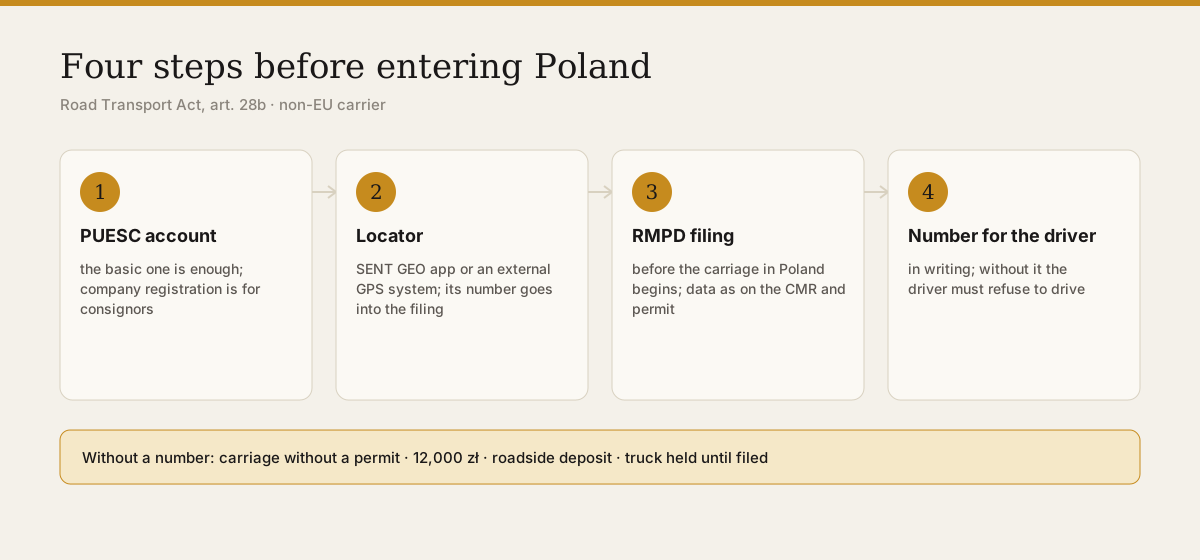
What to do if you carry goods to Poland for the first time
- Open an account on PUESC. A carrier needs only the basic account; company registration and powers of attorney are for consignors and consignees, not for you.
- Decide how you will transmit geolocation: the SENT GEO app on the driver's phone or an external GPS system connected to PUESC. The locator or device number is a field of the filing (art. 28b ust. 3 pkt 12).
- Prepare the documents before the run: CMR, permit or ECMT licence, the tractor's registration plate. Everything you enter in the RMPD will be checked by the inspector against these papers.
- File the RMPD before entering Poland and obtain the reference number. At the border it is too late: the duty applies before the carriage on Polish territory begins (art. 28b ust. 1).
- Hand the driver the number in writing. He must present it at a check, and without it he is obliged not to drive.
- Update the filing if the date or route changes. An old date after a change becomes inaccurate data, and that is the same 12,000 zł fine.
- Check whether the goods also fall under SENT: grain, honey, eggs, berries, and since March 2026 clothing and footwear are on the list too. If so, the SENT number comes from the consignor, and the driver carries both.
What not to do
- Do not leave the RMPD until the border. The filing must be made before the carriage in Poland begins, and the PUESC queue is longer in the afternoon.
- Do not reuse a number from a previous run. Every carriage is a new filing; an old number equals no filing.
- Do not retype data from memory. Country of loading, date, registration plate: the inspector checks against the CMR, not against what really happened.
- Do not confuse RMPD with SENT. If the consignor says "SENT is filed", that does not mean your RMPD is filed. They are two different filings.
- Do not let the driver go without the number in writing. His fine is 1,500 zł, but the car park and the deposit are yours.
Where Sigil fits in
Sigil turns a photo of the CMR into a ready RMPD filing: it reads the consignment note, carries the data over one to one, lets the dispatcher confirm it and submits it to PUESC under your own account. After registration it watches the SENT-GEO signal throughout the run. Thirty filings are credited on sign-up, no card needed. Sigil does not file the SENT notification about the goods; the consignor or the consignee does.
How long that really takes we measured: across 126 declarations from August and September 2026 the median from CMR photo to PUESC number is 6 minutes, of which PUESC accounts for 4 seconds. The spread and what drags on are in How long an RMPD really takes, from CMR photo to number.
Sigil handles RMPD declarations. The SENT notification for the goods is filed by the consignor or the consignee.
A demo or training for your team
30 minutes online. We show how Sigil™ files an RMPD from a CMR and answer questions about your runs.
Frequently asked questions
- Who files the RMPD: the carrier, the consignor or the driver?
- The carrier. The duty rests on the foreign operator performing the carriage (art. 28b ust. 1 of the Road Transport Act). The consignor files SENT if the goods are monitored. The driver only carries the number and must not drive without it (art. 28c ust. 2).
- Is an RMPD needed for a van up to 3.5 tonnes?
- It depends on the mass. The Road Transport Act does not apply to vehicles with a permissible total mass of up to 2.5 tonnes (art. 3 ust. 1 pkt 2a). For vehicles between 2.5 and 3.5 tonnes in international carriage the act applies, and the RMPD duty depends on whether a permit is required or an agreement exempts it. Check with PUESC or GITD before a van run; do not assume that under 3.5 t means no RMPD.
- Is a separate RMPD needed for every run?
- Yes. Every carriage is a new filing, and when one trip contains several operations under different permits, a separate one for each (art. 28b ust. 8). A number from a previous run equals no filing.
- What if PUESC is down before entry?
- Send a replacement document to GITD. The act provides for a document replacing the filing when the register is unavailable (art. 28b ust. 7); the form is on gov.pl/web/gitd/sent, the address is awaria.zezwolenia@gitd.gov.pl. The driver carries the document and the confirmation of receipt instead of a number.
Sources
Legislation, as in force on the date of publication:
- Ustawa z dnia 6 września 2001 r. o transporcie drogowym, ISAP, consolidated text: art. 3 ust. 1, art. 28 ust. 1, 1a and 3, art. 28b, art. 28c, art. 94 ust. 3, art. 95, załącznik nr 1 (lp. 2a), załącznik nr 3 (lp. 3.2a).
- Ustawa z dnia 9 marca 2017 r. o systemie monitorowania drogowego i kolejowego przewozu towarów oraz obrotu paliwami opałowymi, ISAP, consolidated text: art. 3 ust. 2, art. 4 ust. 1 pkt 1, art. 18 ust. 2.
- Ustawa z dnia 25 września 2024 r. o zmianie ustawy o delegowaniu kierowców w transporcie drogowym oraz niektórych innych ustaw, ISAP, Dz.U. 2024 poz. 1544: the act that introduced the RMPD duty.
- Rozporządzenie Ministra Finansów z dnia 25 kwietnia 2022 r. w sprawie towarów, których przewóz jest objęty systemem monitorowania, ISAP, t.j. Dz.U. 2024 poz. 1157, zm. Dz.U. 2025 poz. 1244 and Dz.U. 2025 poz. 1704: list of goods under SENT, including grain, honey, eggs, berries, clothing and footwear.
Authorities:
- Zmiany w systemie SENT od 1 listopada 2024 r., Ministerstwo Infrastruktury, gov.pl.
- Zmiany dotyczące zgłoszenia przewozu drogowego w SENT od 1 stycznia 2025 r., Ministerstwo Infrastruktury, gov.pl.
- Zgłoszenie przewozu w przypadku międzynarodowego przewozu drogowego rzeczy, PUESC, service description and legal basis of the duty.
- SENT – Rejestr Międzynarodowych Przewozów Drogowych, GITD, gov.pl, form of the document replacing the filing, address for outages.
- Nowe obowiązki zagranicznych przewoźników w rejestrze zgłoszeń SENT, WITD Radom, gov.pl.
Exchange rate: official hryvnia to złoty rate, National Bank of Ukraine, 11.94 ₴/zł on 14 September 2026.
Read next
- What gets fined when one digit in an RMPD costs 12,000 złA wrong digit or date in an RMPD costs 12,000 zł, the same as not filing. Provisions with article numbers, three 2025 roadside checks and what a carrier can do.
- SENT and RMPD fines 2026, amounts, who pays, how to appealEvery SENT and RMPD fine in one table: amount in złoty and hryvnia, who pays, article number with a link. Appeal deadlines and the difference between two acts.
- How long an RMPD really takes, from CMR photo to numberRMPD filing time on our own data: median 6 minutes from CMR photo to PUESC number, one in ten over 14. Why the median, what it consists of, what drags on.
- Which PUESC account a carrier needsBasic or extended PUESC account: what each allows, what it takes, how long. A carrier needs only basic for RMPD; company registration is for consignors only.
Sigil™ turns a CMR into an RMPD declaration and files it with PUESC — with every field checked against the original.
More on this topic: RMPD