RMPD
How long an RMPD really takes, from CMR photo to number
RMPD filing time on our own data: median 6 minutes from CMR photo to PUESC number, one in ten over 14. Why the median, what it consists of, what drags on.
Published · Author: Makaiev Kostiantyn Oleksandrovych, founder of Sigil RMPD
In brief: on our platform's data, 126 RMPD declarations with automatic submission, created between 31 July and 19 September 2026, take a median of 6.0 minutes from CMR photo to PUESC number · half of all declarations fall between 4.2 and 8.3 minutes, one in ten takes more than 14 · of that time PUESC answers in 4 seconds, the rest is the dispatcher's work: checking the recognised data against the original and adding what the CMR does not contain · we deliberately give no average, because one declaration left open for a day skews it for everyone · without the number the driver may not depart (art. 28c ust. 2), and carriage without a declaration costs 12,000 zł · what drags on is not the system but missing data: the CN code, the permit, the locator number.
Filing an RMPD takes six minutes. Not "two", as the adverts say, and not "half an hour", as drivers say at the truck stops, but exactly as long as a dispatcher needs to check the data from the CMR and add the fields the CMR does not carry. On our platform's data, across 126 declarations submitted automatically to PUESC and created between 31 July and 19 September 2026, the median from uploading the CMR photo to receiving the reference number is 6.0 minutes; PUESC accounts for 4 seconds of that.
What an RMPD is and why it has a clock on it
An RMPD is the declaration a carrier from outside the EU must file in Poland's PUESC system before every permit-based carriage to, from or through Poland. It has existed since 1 November 2024 and is built from the CMR consignment note plus a handful of fields the CMR does not have. Without the reference number the driver is legally obliged to refuse the carriage (art. 28c ust. 2 of the Road Transport Act), so the filing time is measured with a truck waiting somewhere. Who must file and when is covered in the article on who has to file an RMPD.
How long an RMPD takes on our data
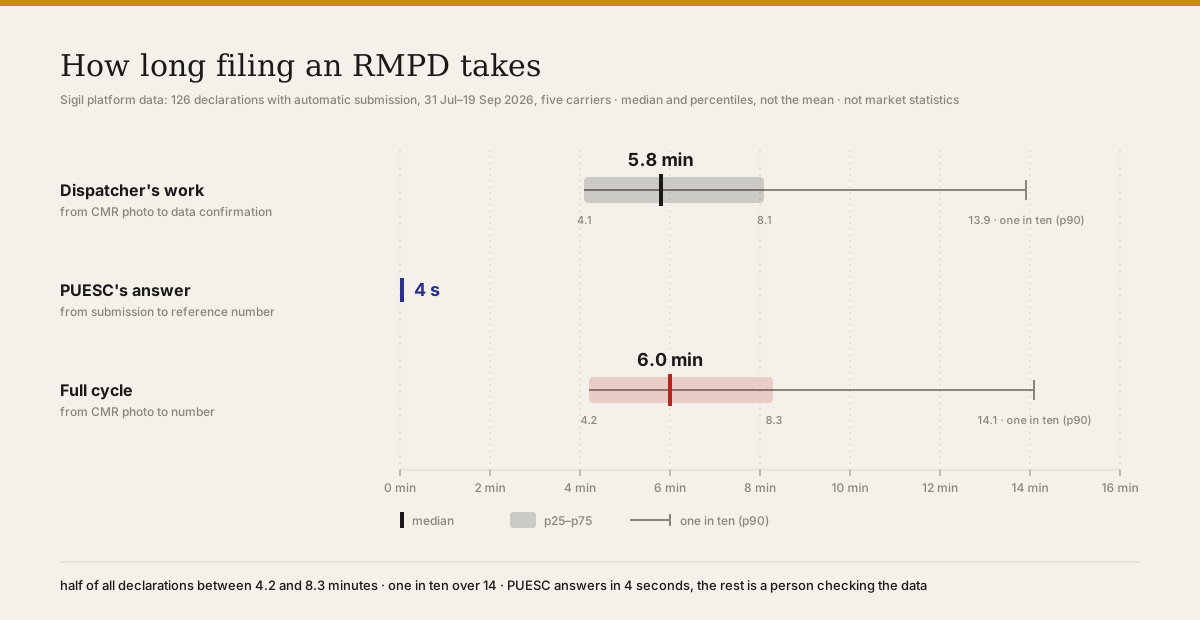
Median 6.0 minutes from CMR photo to PUESC number; half of all declarations between 4.2 and 8.3 minutes; one in ten over 14.1. This is a measurement on 126 declarations by five carriers, filed through automatic submission, in the PUESC production environment, between 31 July and 19 September 2026.
| Stage | Fastest quarter (p25) | Median | Slowest quarter (p75) | One in ten (p90) |
|---|---|---|---|---|
| Dispatcher's work, from CMR photo to data confirmation | 4.1 min | 5.8 min | 8.1 min | 13.9 min |
| PUESC's answer, from submission to number | 4 s | 4 s | 4 s | 5 s |
| Full cycle, from CMR photo to number | 4.2 min | 6.0 min | 8.3 min | 14.1 min |
What was left out and why. Three declarations in an error state, 21 that were created and never submitted, and one that the dispatcher confirmed more than a day after creating it. We did not count that last one as "a day of work", because it was a day of lying idle, not work; but it exists, and it has to be said. We also left out 5,444 declarations the carriers filed on the PUESC portal without us, which the platform later pulled in from the confirmations: they have no "CMR photo" moment, so there is nothing to measure.
August and September barely differ: median cycle 6.0 and 5.9 minutes. The tail differs: in August one declaration in ten took more than 19 minutes, in September more than 13. The tail shortens once the dispatcher knows which fields will have to be added.
Why the median and not the average
The median, because the average lies in both directions. One declaration left open for a day adds several minutes to everyone else's average and makes the cycle "slow". One confirmed in a minute, because all the data were already in the system from the previous trip, makes it "fast". Neither describes the trip you are filing now.
The median answers a simple question: how long a typical declaration takes. Half are faster, half slower. The percentiles answer a second, more useful one for planning: how long to allow to be safe. If one declaration in ten takes more than 14 minutes, a dispatcher filing with the driver on the phone at the border should allow a quarter of an hour, not six.
That is why this text contains no average and no "in two minutes". A number without N, period and spread is worth nothing, and in a subject where a mistake costs 12,000 zł we do not want to be taken at our word.
What the six minutes consist of
Almost entirely of a person's time, not a machine's. The cycle splits into three parts.
Recognition and checking, 5.8 minutes at the median. The dispatcher uploads the CMR photo, the system reads the document and fills in the declaration fields. Then the most important step, which cannot be skipped: the dispatcher compares every field with the original. Not because the recognition is poor, but because the fine is imposed for a discrepancy between the declaration and the CMR (Annex 3, item 3.2a of the Road Transport Act), and no system has the right to correct CMR data on the carrier's behalf. What to check and in what order is in the CMR to RMPD field map. The same stage includes adding what the CMR lacks: the type of carriage, the permit or ECMT carnet number, the locator number, the goods' CN code.
Submission and PUESC's answer, 4 seconds. The declaration goes to PUESC through its service interface, and the system returns an RMPD_110 confirmation with the reference number. Four seconds at the median, five in one case in ten. This is not a "review time": nobody at PUESC reads the declaration; rules check it and either accept it or reject it with a code. Why they reject and what to do then is in the article on RMPD500 rejection reasons.
What the measurement does not contain. The time the driver spends photographing the CMR and sending it to the dispatcher. The time spent establishing the CN code with the shipper. The time spent on a permit that is not in the cab. Those minutes happen before the first step and are invisible in our data. But they are exactly what turns six minutes into an hour, so they come next.
Automatic submission or XML download
Automatic submission returns the number in seconds; XML download adds a visit to the PUESC portal. On our platform's data, one declaration went through XML download in the same period, and one declaration is not a distribution, so we give no figures for that route. The difference is visible without figures: after downloading the XML the dispatcher has to log in to the PUESC portal, upload the file, sign it and wait for confirmation there. Each of those steps takes minutes, not seconds, and each is a place to pick the wrong file.
When XML download makes sense: when PUESC's service interface is temporarily not accepting declarations and the driver is already at the border. Then a prepared and checked file can be filed manually on the portal. Whether the interface is working right now is shown on the PUESC status page.
What really drags a filing out
Not buttons, but data that are not to hand. One declaration in ten takes more than 14 minutes, and those minutes almost always go on one of three things.
Can an RMPD be filed in six minutes when the goods' CN code is unknown? No. The CN code is mandatory in the declaration, the CMR does not carry it, and the dispatcher looks for it in the invoice or asks the shipper. Searching by phone during loading is the most common cause of the tail.
Second cause: the permit. The number of the international carriage permit or the ECMT carnet has to be entered, and if the dispatcher does not know which permit is in this tractor's cab, he calls the driver.
Third: the locator. The locator number must match the device in the truck; PUESC will accept somebody else's number, and position monitoring will then show silence. How many transports begin in silence for exactly this reason we counted in the article on GPS monitoring.
All three causes share one feature: they can be removed before the trip, not during it. A fleet register with locator numbers, permits tied to tractors, a goods dictionary with CN codes that have been carried before. Then the declaration is assembled from data that already exist, and the tail disappears.
Why the filing time matters
Because without the number the driver may not depart, and a truck at the border costs money by the hour. The act expressly obliges the driver to refuse the carriage if no reference number has been given (art. 28c ust. 2 of the Road Transport Act). Carriage without a declaration costs the carrier 12,000 zł (załącznik nr 3, lp. 3.2a), and where a permit was required the act treats the run as performed without one (art. 28b ust. 10): 12,000 zł, about 141,600 ₴ at the NBU rate of 11.80 on 22.09.2026, collected from a Ukrainian carrier on the spot as a deposit (art. 94 ust. 3). The truck is not released until the declaration is filed and the number shown (art. 18 ust. 2 of the SENT Act, which applies to RMPD too).
So the real price of the filing time lies not in the dispatcher's minutes but in where the truck is standing at that moment. Six minutes in the office the day before the trip cost nothing. Six minutes at a truck stop before the Dorohusk crossing with the driver on the line are nerves, and fourteen are a queue he lets pass.
Where Sigil fits
The six minutes above are a measurement on Sigil itself: the platform reads the CMR photo, fills in the declaration fields, shows them to the dispatcher for comparison with the original and, after confirmation, submits to PUESC under the carrier's own credentials, returning the reference number to the same record. The platform never alters CMR data on its own, the comparison step cannot be removed, and it is that step which takes most of the six minutes. Fleet, locators, permits and counterparties stay in Sigil and are filled into the next declarations, so the three causes of the tail above disappear after the first trip. Sigil does not handle SENT declarations.
What to do
- Set up the fleet before the first trip: tractors, trailers, locator numbers. That removes the call to the driver asking "which locator do you have".
- Tie permits and ECMT carnets to tractors instead of keeping them in the dispatcher's head.
- Collect the CN codes of the goods you carry once, together with the shipper, and keep them to hand.
- File the declaration before departure, not at the border. Six minutes in the office and six minutes at a truck stop are different six minutes.
- Compare every field with the original CMR even when the recognition is correct. The fine is for the discrepancy, not for carelessness.
- Allow a quarter of an hour, not six minutes, when filing for the first time or with a new shipper. That is what one declaration in ten looks like.
What not to do
- Do not believe "we file in two minutes" without an N and a period. A number without a spread is advertising, not measurement.
- Do not send the driver off with a promise that "the number will be there by the time you arrive". Without the number the driver must refuse to drive.
- Do not look for the CN code when the truck is already at the ramp. That is the most common reason six minutes become fifteen.
- Do not skip the comparison with the CMR to save a minute. That minute costs 12,000 zł when a field holds the wrong digit.
- Data collected before the trip and a comparison with the original during filing. Then six minutes really are six minutes.
A demo or training for your team
30 minutes online. We show how Sigil™ files an RMPD from a CMR and answer questions about your runs.
Frequently asked questions
- How long does filing an RMPD take?
- On our platform's data, 126 declarations with automatic submission created between 31 July and 19 September 2026, a median of 6.0 minutes from CMR photo to PUESC number. Half fall between 4.2 and 8.3 minutes, one in ten takes more than 14.
- How long does PUESC take to process an RMPD?
- Four seconds at the median, five in one case in ten, on the same 126 declarations. Rules check the declaration, not a person: it is either accepted with a reference number or rejected with an RMPD500 code.
- Why does the article give a median and not an average time?
- Because one declaration left open for a day, or one confirmed in a minute, skews the average. The median shows the typical case, and the percentiles say how much to allow to be safe: a quarter of an hour covers nine declarations in ten.
- What most often drags a filing out?
- Three things the CMR does not carry: the goods' CN code, the permit or ECMT carnet number and the locator number. All three can be collected before the trip; then the declaration is assembled from data that already exist.
- Can the driver depart before the number is issued?
- No. The driver must refuse the carriage if no reference number has been given (art. 28c ust. 2 of the Road Transport Act). Carriage without a declaration costs the carrier 12,000 zł, about 141,600 ₴ at the NBU rate of 11.80 on 22.09.2026.
Sources
Legislation, as in force on the day of publication:
- Act of 6 September 2001 on road transport, ISAP, consolidated text: art. 28b ust. 1 and 10, art. 28c ust. 2, art. 94 ust. 3, Annex 3 (item 3.2a).
- Act of 9 March 2017 on the system for monitoring the road and rail carriage of goods and trade in heating fuels (SENT Act), ISAP, consolidated text (Dz.U. 2024 poz. 1218): art. 18 ust. 2.
Own data: cycle-time measurement on the Sigil platform, PUESC production environment, 126 RMPD declarations with automatic submission created between 31 July and 19 September 2026, five carriers; computed on 21 September 2026, median and percentiles. Excluded and counted separately: 3 declarations in an error state, 21 never submitted, 1 confirmed after more than a day, 5,444 imported from PUESC. NBU rate 11.80 ₴ per złoty on 22 September 2026.
Read next
- How CMR data get into an RMPD, field by fieldWhich CMR box goes into which RMPD100 field, what the CMR lacks (type of carriage, permit, border), what the RMPD lacks (goods, CN). Three fields that diverge.
- Why PUESC rejects an RMPD and what to fix by RMPD500 codeRMPD500 rejection codes across 242 filings: R01 Cyrillic, R02 postal code, R06 dates, R30 locator not activated, crossing outside the dictionary. What to fix.
- How often SENT-GEO checks your truck's position in PolandGPS monitoring in SENT on our own data: 212 position checks per transport, where the signal really gets lost, how much silence is a problem, what to do.
Sigil™ turns a CMR into an RMPD declaration and files it with PUESC — with every field checked against the original.
More on this topic: RMPD