RMPD
Poland truck driving ban, holiday calendar
The Poland truck driving ban for vehicles over 12 t: holidays 8:00 to 22:00, the evening before, summer weekends, exemptions, fines and the 2027 dates.
Published · Author: Makaiev Kostiantyn Oleksandrovych, founder of Sigil RMPD
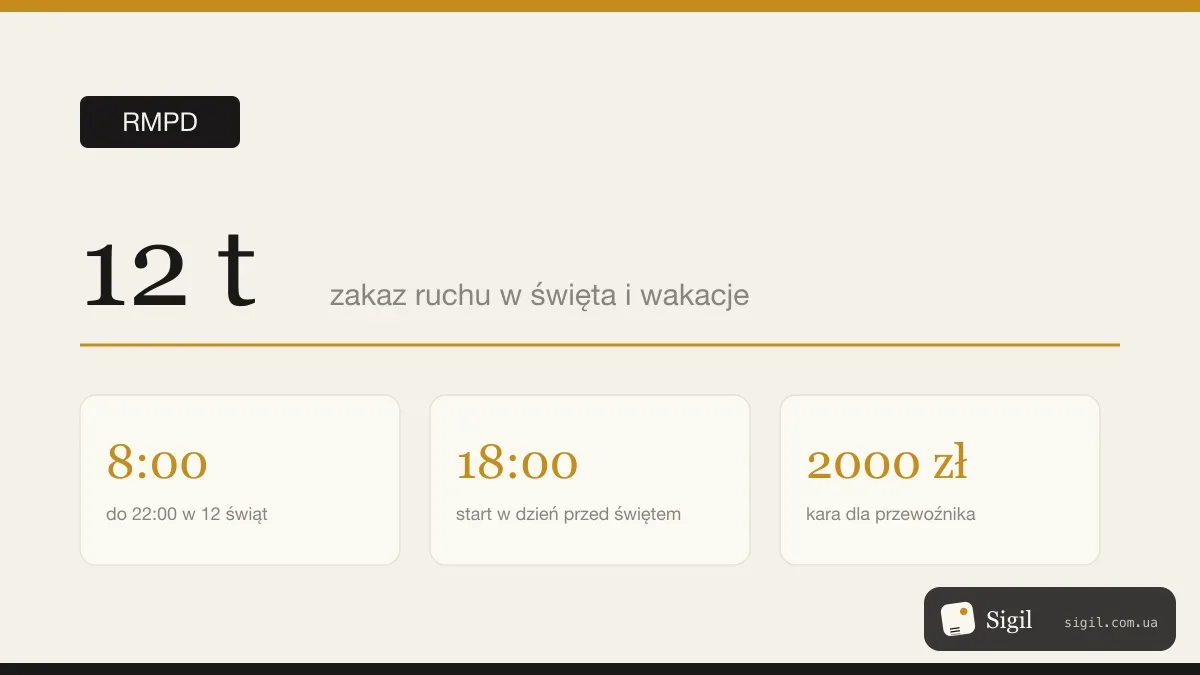
The Poland truck driving ban applies to vehicles above 12 tonnes permissible mass on every road. It has three regimes: holidays from 8:00 to 22:00, the evening before most of them from 18:00 to 22:00, and summer weekends from the end of the school year to its start. At night from 22:00 to 8:00 a truck drives freely.
In brief: the ban covers vehicles and vehicle combinations with a permissible maximum mass above 12 tonnes, buses excepted, on every road in Poland · on the 12 holidays listed in the regulation, traffic is banned from 8:00 to 22:00, and on the day before nine of them from 18:00 to 22:00 · 6 January and 24 December are public holidays in Poland, but the regulation does not list them, so there is no ban on those days · in summer 2027 the ban runs from Friday 25 June to Sunday 29 August, Fridays 18:00 to 22:00, Saturdays 8:00 to 14:00, Sundays 8:00 to 22:00 · exemptions cover perishable food, live animals, medicines, mail, dangerous goods under orange plates, coal and some twenty other cases, while an empty truck is exempt only on its way to or from such a load · the driver faces an on-the-spot fine of 200 to 500 zł, the carrier a penalty of 2 000 zł and the transport manager 1 000 zł · an RMPD reference number is valid for 10 days from issue, so a ban day pushes unloading back and the shifted date in the notification has to be corrected.
Monday, 10 November 2025. A Ukrainian truck loaded with furniture crossed the Dorohusk border post at 16:40, with unloading near Łódź booked for Tuesday at nine. The dispatcher knew that 11 November is a Polish holiday and counted on the truck arriving in the evening. At 18:00 the ban began, the driver parked near Lublin, and the furniture reached the customer on Wednesday.
When does the truck driving ban apply in Poland
The ban works in three regimes, and all three are set out in § 2 of the Minister of Transport regulation of 31 July 2007 on periodic restrictions and bans on certain vehicles (consolidated text, Dz.U. 2023 poz. 2423). Dz.U. is the Polish Journal of Laws, and the regulation is issued under art. 10 ust. 11 of the Road Traffic Act.
| Regime | When | Hours |
|---|---|---|
| Holiday | the 12 days listed in the regulation | 8:00 to 22:00 |
| Day before a holiday | before Easter Sunday, Easter Monday, 1 and 3 May, Whit Sunday, Corpus Christi, 15 August, 1 and 11 November | 18:00 to 22:00 |
| Summer, Friday | from the end of school lessons to the last Sunday before they resume | 18:00 to 22:00 |
| Summer, Saturday | the same period | 8:00 to 14:00 |
| Summer, Sunday | the same period | 8:00 to 22:00 |
An ordinary Sunday outside the summer carries no ban in Poland. The regulation knows no night bans either, so even on a holiday a truck can set off at 22:00 and drive until 8:00.
A holiday falling on a summer Saturday overrides the summer regime, because the regulation makes an exception for 15 August. That happened on 15 August 2026: a Saturday, yet the ban ran from 8:00 to 22:00 rather than to 14:00, as the Ministry of Infrastructure announced on 13 August 2026.
Which vehicles does the ban cover
The ban covers every vehicle and every vehicle combination with a permissible maximum mass (DMC in Polish) above 12 tonnes, buses excepted (§ 1 of the regulation). The country of registration makes no difference, so a Ukrainian truck is caught exactly like a Polish one. What counts is the permissible mass in the documents, not the actual weight that day, so an empty tractor and semi-trailer stops as well.
Does the ban cover a 7.5-tonne truck, even fully loaded? No. The threshold is measured by permissible maximum mass, and 7.5 tonnes is below 12. Such a vehicle drives on holidays and summer Sundays without restriction, unless a separate road sign says otherwise.
The list of holidays in the regulation is closed and does not follow the Polish public holidays act. The dates therefore come from the regulation, not from the calendar of days off.
Ban dates in 2026 and 2027
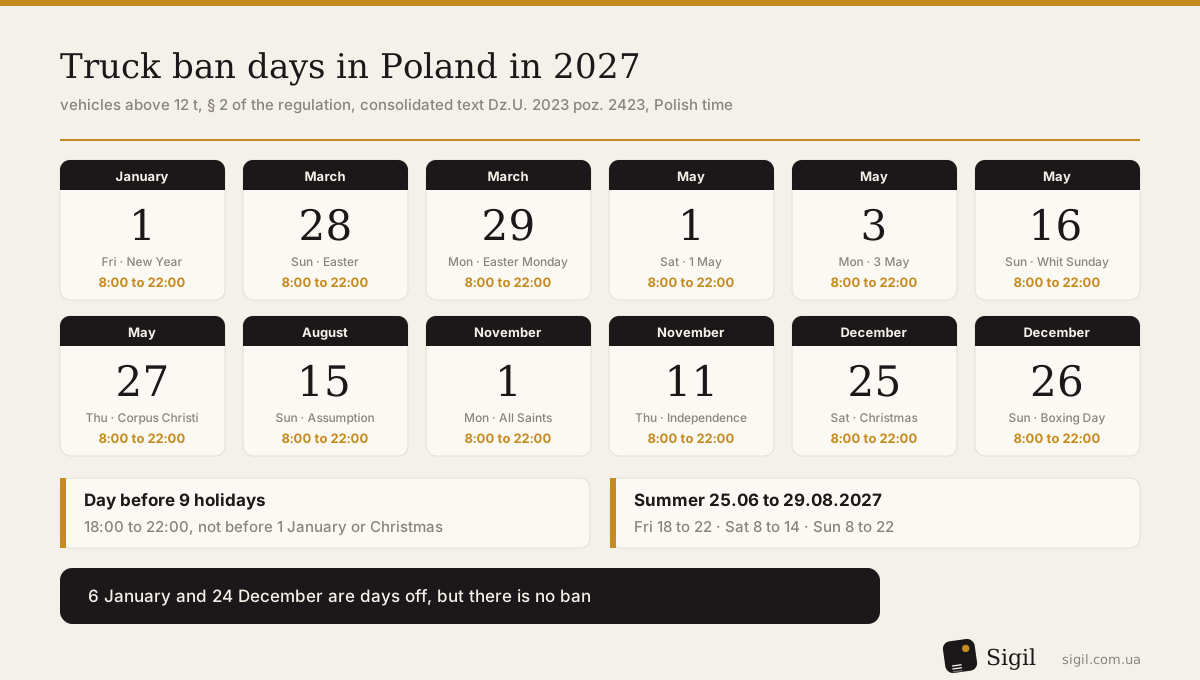
Fixed holidays fall on the same dates every year, while Easter, Whit Sunday and Corpus Christi move. Easter 2027 falls on 28 March. Whit Sunday is the seventh Sunday after it, 16 May, and Corpus Christi is the Thursday 60 days after Easter, 27 May.
| Date | Day | Reason | Hours |
|---|---|---|---|
| 10.11.2026 | Tuesday | day before 11 November | 18:00 to 22:00 |
| 11.11.2026 | Wednesday | Independence Day | 8:00 to 22:00 |
| 25.12.2026 | Friday | Christmas Day | 8:00 to 22:00 |
| 26.12.2026 | Saturday | second day of Christmas | 8:00 to 22:00 |
| 1.01.2027 | Friday | New Year's Day | 8:00 to 22:00 |
| 27.03.2027 | Saturday | day before Easter | 18:00 to 22:00 |
| 28.03.2027 | Sunday | Easter Sunday | 8:00 to 22:00 |
| 29.03.2027 | Monday | Easter Monday | 8:00 to 22:00 |
| 30.04.2027 | Friday | day before 1 May | 18:00 to 22:00 |
| 1.05.2027 | Saturday | State Holiday | 8:00 to 22:00 |
| 2.05.2027 | Sunday | day before 3 May | 18:00 to 22:00 |
| 3.05.2027 | Monday | Constitution Day | 8:00 to 22:00 |
| 15.05.2027 | Saturday | day before Whit Sunday | 18:00 to 22:00 |
| 16.05.2027 | Sunday | Whit Sunday | 8:00 to 22:00 |
| 26.05.2027 | Wednesday | day before Corpus Christi | 18:00 to 22:00 |
| 27.05.2027 | Thursday | Corpus Christi | 8:00 to 22:00 |
| 25.06 to 29.08.2027 | Fridays, Saturdays, Sundays | summer ban | Fri 18:00 to 22:00, Sat 8:00 to 14:00, Sun 8:00 to 22:00 |
| 14.08.2027 | Saturday | summer Saturday and day before 15 August | 8:00 to 14:00 and 18:00 to 22:00 |
| 15.08.2027 | Sunday | Assumption | 8:00 to 22:00 |
| 31.10.2027 | Sunday | day before 1 November | 18:00 to 22:00 |
| 1.11.2027 | Monday | All Saints' Day | 8:00 to 22:00 |
| 10.11.2027 | Wednesday | day before 11 November | 18:00 to 22:00 |
| 11.11.2027 | Thursday | Independence Day | 8:00 to 22:00 |
| 25.12.2027 | Saturday | Christmas Day | 8:00 to 22:00 |
| 26.12.2027 | Sunday | second day of Christmas | 8:00 to 22:00 |
Saturday 14 August 2027 carries two ban windows at once. The summer Saturday bans traffic from 8:00 to 14:00 and the evening before 15 August from 18:00 to 22:00, leaving only 14:00 to 18:00 for daytime driving.
Easter 2027 takes the most. From Saturday 27 March at 18:00 to Monday 29 March at 22:00, a truck can only move during two nights.
Why there is no ban on 6 January and 24 December
The Polish public holidays act lists 14 holidays, the truck ban regulation only 12. Epiphany on 6 January has been a day off since 2011, and Christmas Eve on 24 December since 1 February 2025 (amending act, Dz.U. 2024 poz. 1965). Neither day appears in § 2 pkt 1 of the regulation, so trucks drive on them without restriction.
There is no evening ban before New Year's Day or before Christmas either. The regulation attaches the day-before ban only to the holidays under letters b to j, from Easter to 11 November, so traffic after 18:00 on 31 December and 24 December is allowed.
A separate matter is that 24 December and 6 January are days off for employees. A warehouse may not accept goods then, but that is a question of the delivery slot, not of the traffic ban.
Poland's neighbours count these days differently. Czechia closes motorways on 24 December from 13:00 to 22:00, Austria stops on 6 January from 0:00 to 22:00, and Germany drives on 6 January. How the bans of the countries on the route fall across the holiday week is covered in the article on EU truck driving bans.
How the summer ban is counted
The summer ban starts on the first Friday after school lessons end, or on the Friday when they end, and lasts until the last Sunday before lessons resume. The school calendar regulation sets the end of lessons on the first Friday after 20 June and the start on the first working day of September (§ 2 ust. 1).
In 2026 that gave 26 June to 30 August, the dates the road transport inspectorate in Radom (WITD) announced on 24 June 2026. In 2027 the twentieth of June is a Sunday, so lessons end on Friday 25 June. The first of September 2027 is a Wednesday, so the last Sunday before school is 29 August.
The rule hides one trap. If the Thursday before that Friday is a public holiday, lessons end on the Wednesday, but the ban still starts on the following Friday. In 2027 Corpus Christi falls in May, so the case does not arise.
Which loads may move during the ban
The list of exemptions in § 3 of the regulation is closed: anything not on it does not move during the ban. For a Ukrainian carrier the ones that matter most are food, live animals, medicines, mail, dangerous goods and fuel, and all of them sit in point 3.
| Letter of § 3 ust. 1 pkt 3 | What is exempt |
|---|---|
| a | building and maintaining roads and bridges |
| b | carriage of live animals |
| c | collection of milk, grain or animals |
| d | supplying sea-going ships with fuel, oils, spare parts and drinking water |
| e | broadcasting equipment of radio and television stations |
| f | equipment for mass events |
| g | newspapers, if they form a significant part of the load or loading space |
| h | medicines and medical supplies |
| i | postal consignments, if they form a significant part of the load or space |
| j | keeping a continuous production cycle or a continuously operating service running |
| k | dangerous goods in quantities that require orange plates |
| l | perishable goods listed in the annex, if they form a significant part of the load or space |
| m | concrete and concrete pumps |
| n | municipal waste and liquid sewage |
| o | goods unloaded from rail wagons, within 50 km of the station |
| p | combined transport |
| r | free preventive medical screening |
| s | coal, coke and other solid fuels from coal, firewood, pellets and briquettes |
The annex to the regulation lists 19 groups of perishable goods. They include meat, fish, dairy, eggs, cut flowers and turf, fresh and frozen vegetables, mushrooms and fruit. Then come grain and raw materials for food, feed and vegetable fats, milling products, fats and oils, processed food, sugar and confectionery, soft drinks, prepared feed, sugar beet, potatoes and baker's yeast.
May grain from Ukraine move on a summer Sunday? Yes, if the grain forms a significant part of the load or loading space. The regulation gives no figure for that, so a few pallets of food between furniture do not earn the exemption.
Outside point 3, the ban spares the emergency services and rescue operations, farm machinery and, since 21 August 2026, carriage of military equipment and driving school vehicles (amendment Dz.U. 2026 poz. 1110).
Can an empty truck drive during the ban
An empty truck may drive during the ban only on its way to a point 3 load or on its way back after unloading one (§ 3 ust. 2). A reefer heading to collect apples, or a truck returning after carrying livestock, is exempt. An empty run after furniture or building materials is not.
A separate exemption for vehicles returning from abroad to complete a haul or reach the consignee covers only vehicles based in Poland (§ 3 ust. 1 pkt 5). A Ukrainian carrier cannot use it, even when heading home.
Can an empty Ukrainian truck drive from Poznań to the border on a summer Sunday? No, unless it has just carried a load from the exemption list. It has to wait for 22:00 or leave before 8:00.
What happens to a truck that entered Poland before the ban
A truck that crossed the border outside ban hours may move during the ban within 50 km of the crossing point (§ 3 ust. 1 pkt 6). That margin is meant for reaching a parking area, not the customer.
The same point exempts vehicles waiting at the border to leave Poland. Moving up an exit queue is not a breach, and the wait at each crossing is shown by our tool for wait times to leave Poland.
A truck that crossed the border when the ban had already started has no such exemption under the wording of the regulation. An entry pushed back by the queue on the Ukrainian side easily lands on the evening before a holiday, which is worth keeping in mind when reading about truck border queues into Poland.
What a breach costs and who pays
One breach of the ban can bring penalties for three different people, each amount with its own legal basis. Hryvnia figures use the National Bank of Ukraine rate of 11.5401 UAH per zloty on 25 October 2026.
| Who | Amount | Legal basis |
|---|---|---|
| Driver | on-the-spot fine of 200 to 500 zł (2 308 to 5 770 UAH) | fines tariff, table B item 248, art. 97 of the Petty Offences Code |
| Driver, if the case goes to court | fine up to 3 000 zł (34 620 UAH) | art. 97 of the Petty Offences Code |
| Carrier | administrative penalty of 2 000 zł (23 080 UAH) | Road Transport Act, annex 3 item 1.11 |
| Person managing transport in the firm | penalty of 1 000 zł (11 540 UAH) | Road Transport Act, annex 4 item 18 |
A driver without permanent residence in Poland pays the fine straight to the officer who imposed it, and only then does it become final (art. 98 § 2 of the Code of Petty Offence Procedure). The driver may refuse the fine, and the case then goes to court, where the ceiling is 3 000 zł.
From a carrier based in a state with no agreement on mutual recovery of claims, the inspector takes a deposit equal to the expected penalty on the spot, which here means 2 000 zł (art. 94 ust. 3 of the Road Transport Act). How the RMPD roadside inspection itself runs is described separately.
If the same inspection also finds no RMPD notification, a penalty of 12 000 zł comes on top of the 2 000 zł. The total of penalties on the carrier from one roadside inspection may not exceed 12 000 zł (art. 92a ust. 3 of the Road Transport Act), and the SENT and RMPD fines calculator works out the amount for a given case.
How the ban shifts RMPD dates
An RMPD reference number is valid for 10 days from the day it is issued (art. 11 ust. 1 of the SENT Act, applied to RMPD through art. 28b ust. 5 of the Road Transport Act). A single ban day rarely uses up that period, but it moves unloading. And the place and date where carriage in Poland ends are part of the notification itself (art. 28b ust. 3 pkt 5).
The register has limits of its own. In an edit, the start date cannot be set more than nine days after registration (rule R15). In R06 rejections the portal itself names the latest end date it will accept, and in our data that date is exactly nine days after the filing day, in five cases out of five.
The May holidays of 2027 show it best. A carrier obtains a number on Thursday 22 April for an entry on 29 April. The queue pushes entry to Friday 30 April, the ban before 1 May starts at 18:00, and further bans follow on 1 May, the evening of 2 May and 3 May. Unloading slides to Tuesday 4 May, by which time ten days from 22 April have passed.
What follows depends on validity. While the number is valid, the date is corrected by an edit, and what an RMPD update can change is covered separately. Once the number has expired, continuing the carriage takes a new notification quoting the previous number and the place where carriage resumes (art. 28b ust. 4).
It is simpler not to get there. An RMPD notification is best filed once the real entry day is visible with the ban days taken into account, because filing RMPD takes minutes, not days.
Where technology fits
Sigil prepares RMPD notifications from a photo of the CMR: the data is carried over one to one, and the dispatcher confirms it before sending. The system does not plan or track routes, ban hours or parking, which stays the dispatcher's job. When a holiday moves a date, Sigil can send an edit of the notification or a new one, and the register's reply lands in the declaration history.
What to do
- Check the trip dates against the table: holiday, the evening before, summer weekends.
- Plan the border crossing so the truck clears it before the ban starts and has parking within 50 km.
- Check whether the load is on the exemption list and makes up a significant part of the trailer.
- File RMPD once the real entry day is visible, with the ban days taken into account.
- Correct the end date in the notification as soon as a holiday moves unloading.
- File a new notification quoting the previous number if the shift runs past the 10 days of validity.
- Warn the driver that a foreign driver pays the fine on the spot.
What not to do
- Holding a truck on 24 December or 6 January because of the ban. There is no ban on those days, and the truck loses a day for nothing.
- Counting on the exemption for returns from abroad. It applies only to vehicles based in Poland, and a Ukrainian truck relying on it earns the carrier 2 000 zł and the driver a fine.
- Sending an empty truck out on a summer Sunday after an ordinary load. An empty run is exempt only on its way to or from a load on the exemption list.
- Relying on the food exemption when the food is a few pallets among other goods. The regulation requires a significant part of the load or loading space.
- Crossing the border after the ban has started in the hope of the 50 km margin. Under the wording of the regulation that exemption is for trucks that entered outside ban hours.
- Leaving the old end date in the notification after a shift. Notification data must match reality, and a mismatch costs 12 000 zł (annex 3 item 3.2a of the Road Transport Act).
Sigil handles RMPD notifications. Ban days and routes are planned by the dispatcher, and the system does not track them.
A demo or training for your team
30 minutes online. We show how Sigil™ files an RMPD from a CMR and answer questions about your runs.
Frequently asked questions
- Is there a truck ban in Poland on 24 December?
- No. Christmas Eve has been a public holiday in Poland since 2025, but the truck ban regulation does not list it. There is no evening ban before Christmas either, so on 24 December trucks drive freely, while on 25 and 26 December they stop from 8:00 to 22:00.
- Can a truck drive in Poland at night during a holiday?
- Yes. On a holiday the ban runs from 8:00 to 22:00, and on the day before from 18:00 to 22:00. Between 22:00 and 8:00 a vehicle above 12 tonnes may drive, which is a lawful way not to lose a whole day.
- Who pays for breaking the ban?
- The driver and the carrier separately. The driver faces an on-the-spot fine of 200 to 500 zł, which a foreign driver pays immediately. The carrier gets a penalty of 2 000 zł and the person managing transport in the firm 1 000 zł.
- Does a one-day shift caused by a holiday require a new RMPD notification?
- No, as long as the number is valid. The number lives for 10 days from issue, so the end date is corrected by editing the notification. A new notification quoting the previous number is needed only once the number has expired.
- Does the ban apply to an empty truck?
- Yes, with one exception. An empty vehicle above 12 tonnes stops just like a loaded one, unless it is on its way to or from a load on the exemption list, such as food or livestock. The exemption for returns from abroad covers only vehicles based in Poland.
Sources
Legislation, as in force on the day of publication:
- Regulation of the Minister of Transport of 31 July 2007 on periodic restrictions and bans on certain types of vehicles on roads, ISAP, consolidated text Dz.U. 2023 poz. 2423: § 1 (12 t threshold), § 2 pkt 1 letters a to l, pkt 2 and pkt 3 (days and hours), § 3 ust. 1 pkt 1 to 6 and ust. 2 (exemptions), annex (19 groups of perishable goods).
- Regulation of the Minister of Infrastructure of 17 August 2026, ISAP, Dz.U. 2026 poz. 1110, in force since 21.08.2026: § 3 ust. 1 pkt 7 to 9.
- Road Traffic Act of 20 June 1997, ISAP, consolidated text Dz.U. 2024 poz. 1251: art. 10 ust. 11 (basis of the regulation).
- Public Holidays Act of 18 January 1951, ISAP, consolidated text Dz.U. 2025 poz. 296: art. 1 pkt 1 (14 holidays, letters b and ka), amended by Dz.U. 2024 poz. 1965, in force since 01.02.2025.
- Regulation of the Minister of National Education of 11 August 2017 on the organisation of the school year, ISAP, consolidated text Dz.U. 2023 poz. 1211: § 2 ust. 1.
- Regulation of the Prime Minister of 30 December 2021, ISAP, Dz.U. 2021 poz. 2484, table B of the fines tariff: item 248 (200 to 500 zł).
- Petty Offences Code of 20 May 1971, ISAP, consolidated text Dz.U. 2026 poz. 1372: art. 97.
- Code of Petty Offence Procedure of 24 August 2001, ISAP, consolidated text Dz.U. 2026 poz. 1336: art. 96 § 1, art. 97 § 2, art. 98 § 1 pkt 1 and § 2, art. 99.
- Road Transport Act of 6 September 2001, ISAP, consolidated text Dz.U. 2025 poz. 1490: art. 28b ust. 3 pkt 5, ust. 4 and 5, art. 92a ust. 1 to 4, art. 94 ust. 3, annex 3 items 1.11 and 3.2a, annex 4 item 18.
- Act of 9 March 2017 on the system for monitoring road and rail carriage of goods (SENT Act), ISAP, consolidated text Dz.U. 2024 poz. 1218: art. 11 ust. 1 and 2.
Authorities:
- Summer driving bans for trucks, WITD Radom, gov.pl, 24.06.2026.
- Summer driving bans, WITD Poznań, gov.pl, 26.06.2026.
- Holiday restrictions on truck traffic, Ministry of Infrastructure, gov.pl, 13.08.2026.
Rate: National Bank of Ukraine, 11.5401 UAH per zloty on 25.10.2026.
Read next
- Truck border queues into PolandTruck border queues into Poland run separately by mass, for empty vehicles and for goods of groups 1-24. Eight crossings, fifteen queues, how to read them.
- How long an RMPD really takes, from CMR photo to numberRMPD filing time on our own data: median 6 minutes from CMR photo to PUESC number, one in ten over 14. Why the median, what it consists of, what drags on.
- An RMPD roadside check and what the inspector doesAn RMPD roadside check: what the inspector looks at in the filing, why last trip's number does not help, when the truck is impounded and the driver's rights.
- e-TOLL Poland for trucks from Ukrainee-TOLL in Poland for trucks from Ukraine: who pays, how to register in IKK, phone, OBU or ZSL, prepaid or security, and 1,500 zł fines after 21.09.2026.
Sigil™ turns a CMR into an RMPD declaration and files it with PUESC, with every field checked against the original.
More about RMPD