RMPD
An RMPD roadside check and what the inspector does
What an inspector checks in an RMPD filing, why a number from the previous run does not help, when the vehicle is impounded and what rights the driver has.
Published · Author: Makaiev Kostiantyn Oleksandrovych, founder of Sigil RMPD
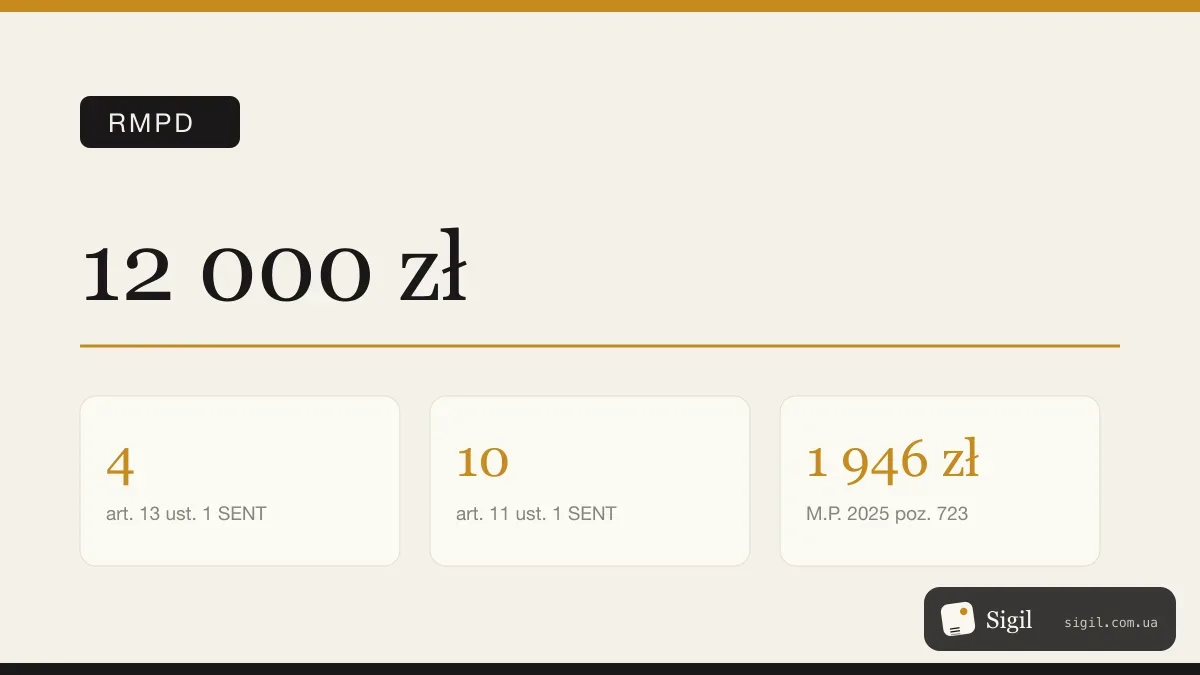
On 12 November 2024, on national road 50 in Mszczonów, inspectors stopped a tractor and semi-trailer belonging to a Moldovan carrier. The driver produced an RMPD filing and it was genuine. It covered a run to Włocławek that had closed the previous day at 6:42, while the load in the trailer had been picked up in Warsaw afterwards. The employer sent a second filing 30 minutes after the stop. A deposit of 12,000 zł was taken anyway.
Five months later, on 9 April 2025, on the S8 near Radzymin, the same thing happened to a carrier from Kazakhstan. The number came from an earlier empty run into Poland, not from the load heading back out.
In brief: checks are carried out by officers of the Customs and Fiscal Service, and alongside them by the Police, the Border Guard and road transport inspectors, each able to open the register on their own · four things are examined, and the first is not whether a number exists but whether the filing covers this carriage · a reference number is valid for 10 days from the day it is issued, which is why drivers show numbers from past runs · a missing filing means the vehicle is directed to the nearest guarded car park at the carrier's cost, not merely a penalty · filing after the stop lets the vehicle move on but does not remove the penalty · penalties from a single roadside check cannot exceed 12,000 zł · a protocol is not always drawn up, but it can be demanded.
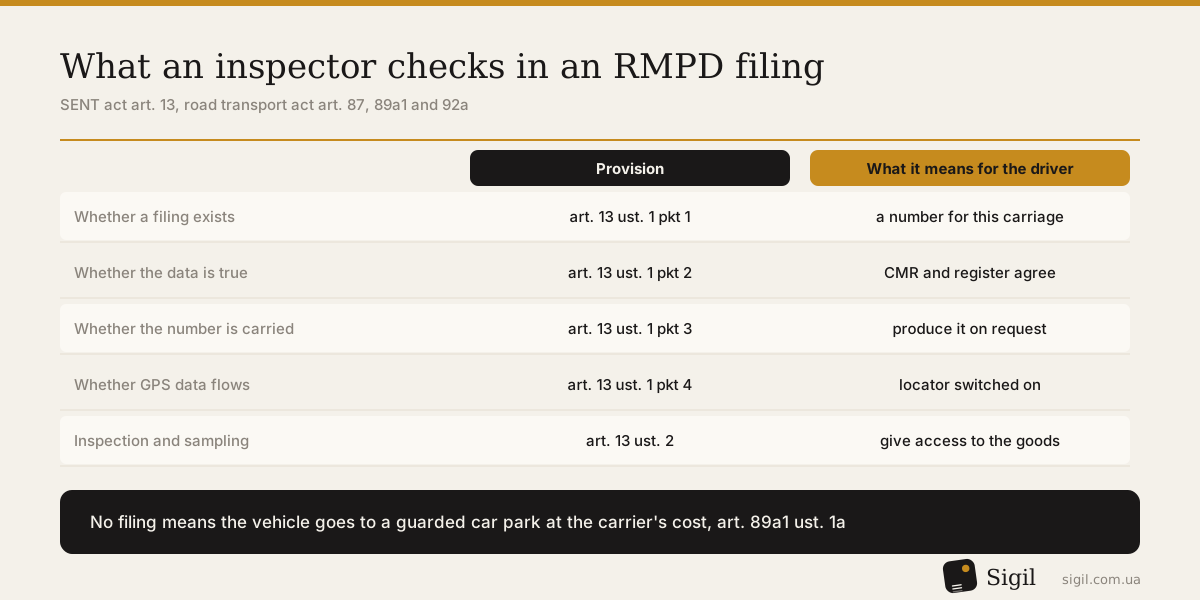
An RMPD roadside check is not a look at paperwork. It is a comparison of three sources: the number the driver shows, the entry in the register, and the transport documents and locator readings. What gets penalised is the gap between them.
Who may stop a vehicle and check the filing
Checks on the carriage of goods are carried out by officers of the Customs and Fiscal Service (SENT act, art. 13 ust. 3). In the course of their own statutory duties, Police officers, Border Guard officers and inspectors of the Road Transport Inspectorate may carry them out too (ust. 4). None of these services needs another one present to look a number up in the register.
The same set of services checks the documents required by the Road Transport Act, where the reference number sits on the mandatory list (art. 87 ust. 1 pkt 8, art. 89 ust. 1). So the line about this being a customs matter rather than an inspectorate matter does not hold in either direction.
What exactly is examined
The statute names four subjects of the check, and the order is not accidental (art. 13 ust. 1 of the SENT act). The first is the duty to file, supplement and update the filing. The second is the agreement of the filed data with the actual state of affairs. The third is possession of the reference number, or of a replacement document together with confirmation of its receipt. The fourth is the transmission of current geolocation data.
The check also covers three actions (ust. 2). Verification of the documents the driver produces, inspection of the goods including the taking of a sample, and verification of the readings of the locator or of the external locating system. That last point means the requirements placed on a locator are tested by looking into the system at the moment of the stop.
How a lawful check has to begin
A check begins once the service identity card has been shown and the authorisation to conduct it delivered, and only Police officers are exempt from the second part (art. 89b ust. 1 of the Road Transport Act). The statute then adds a duty few people know. The inspector must acquaint the inspected party with their rights and duties (ust. 2), and performs the actions in the presence of that party or of a person it authorises (ust. 3).
May a driver read the authorisation before handing over documents? Yes. It is the inspector's duty rather than a courtesy, and its wording shows how far the check reaches.
Why both cases had a number but no filing
A reference number is valid for 10 days, counted from the day it is issued rather than from the declared start of carriage (art. 11 ust. 1 of the SENT act). A number taken a week earlier is nearly used up by the day of the run, and the driver holds something formally alive that in fact belongs to a finished journey.
The second source of the same mistake weighs more. A separate filing is required where, within one carriage, more than one transport operation needs a permit, or where the legal ground for exemption differs (art. 28b ust. 8 of the Road Transport Act); for cabotage a separate filing is due for every operation with no further conditions (ust. 9). Driving in empty and driving out loaded are two operations.
Is one filing enough for a run into Poland and back? No. That is precisely what undid both carriers in the inspectorate's cases.
The driver's right that almost nobody knows
During a roadside check the driver may contact the carrier's office, its transport manager or another person in order to present, before the check ends, any evidence whose presence in the vehicle was not established (art. 87 ust. 6 of the Road Transport Act). This is a statutory rule, not something agreed with the inspector.
Its limit is just as clear. It does not remove the duty to carry documents, and it does not turn a phone call into a filing made before the carriage began. In the Mszczonów case the employer sent the filing 30 minutes after the stop, which allowed the vehicle to move on, yet the deposit was still taken.
What happens when there is no filing
Where a check reveals carriage without the required filing, the authority directs or removes the vehicle to the nearest guarded car park at the carrier's cost (art. 89a1 ust. 1a of the Road Transport Act). Carriage may continue once the foreign carrier has sent the filing and obtained a reference number for it. The SENT act allows the same (art. 14), while the goods or the means of transport may be detained where there is no filing or the driver does not produce the number (art. 16 ust. 1).
A deposit is taken from carriers established in states with no agreement on the mutual enforcement of penalties, which covers every Ukrainian carrier (art. 94 ust. 3). Without it the vehicle goes to the car park (art. 95 ust. 1 pkt 1), and the deposit and its refund follow their own deadlines. The 2026 ceilings for a vehicle over 16 tonnes are 1,946 zł for removal and 215 zł per day, rising to 2,367 zł and 312 zł for dangerous goods.
The protocol, and when to ask for one
The inspector draws up a protocol in four situations (art. 13 ust. 7 of the SENT act). On finding an irregularity, at the request of the inspected party, on taking a sample of the goods, and on applying official seals. The second case means a protocol can be had even when the check found nothing.
The reason is practical. The authority that imposes a penalty follows from the place of the check and from who conducted it (art. 93 ust. 1), and the address for appealing a penalty comes from the protocol rather than from a general rule.
How many penalties there actually are
Figures from the General Inspectorate of Road Transport for the first year of the obligation, as at 4 March 2025.
| Breach | Amount | Who pays | 2024 | 2025, to 4 March |
|---|---|---|---|---|
| Carriage without a reference number, annex 1 item 2a | 1,500 zł | driver | 44 | 33 |
| Breach of monitoring duties, annex 1 item 2b | 2,000 zł | driver | 45 | 25 |
| Carriage without a filing in the register, annex 3 item 3.2a | 12,000 zł | carrier | 64 | 8 |
| Breach of the monitoring duty, annex 3 item 3.2b | 10,000 zł | carrier | 52 | 2 |
For 2024 that is 89 driver fines and 116 administrative decisions against carriers.
The 12,000 zł ceiling and where it stops applying
Penalties imposed for breaches found during a single roadside check cannot exceed 12,000 zł (art. 92a ust. 3), and penalties on the driver cannot exceed 3,000 zł (ust. 4). Your own figure comes out of the SENT and RMPD penalty calculator.
The ceiling disappears when the check happens at the carrier's premises. There the sum depends on the arithmetic mean number of drivers over the 6 months before the check (ust. 5). It runs 15,000 zł up to 10 drivers, 20,000 zł above 10 to 50, 25,000 zł above 50 to 250, and 30,000 zł above 250.
Where technology belongs here
A roadside check does not measure how careful the dispatcher was. It measures whether the filing existed before the journey. So the only thing that genuinely helps is a short distance between the photograph of the CMR and the reference number. In our production measurement the median full cycle is 6.0 minutes and the registry answers in 4 seconds; how long filing takes was computed on 126 filings from 31 July to 19 September 2026.
What to do
- File separately for every transport operation, not once for a run into Poland and back.
- Check the date the number was issued, because the ten days run from it.
- Give the driver the number before carriage starts, since without it they must refuse to set off (art. 28c ust. 1 and 2).
- Ask for a protocol even when no irregularity was found.
- Call the office during the check if something is missing and supply it before the check ends.
What not to do
- Showing a number from the previous run. The register shows the inspector its date and its operation.
- Counting on a filing made after the stop to remove the penalty. It only lets the vehicle move.
- Keeping the number together with its issue date and the operation it belongs to.
- Refusing inspection of the goods or access to the locator. That is a separate breach.
- Sending a driver off without a number on a promise to send it later.
Sigil handles RMPD filings. A SENT filing is made by the consignor or the consignee, and our system does not do it.
A demo or training for your team
30 minutes online. We show how Sigil™ files an RMPD from a CMR and answer questions about your runs.
Frequently asked questions
- May a road transport inspector check RMPD, or is it only for customs officers?
- They may. Checks are carried out by the Customs and Fiscal Service as a baseline (art. 13 ust. 3 of the SENT act), while the Police, the Border Guard and road transport inspectors hold the same power within their own duties (ust. 4). The same services check the reference number as a mandatory transport document (art. 87 ust. 1 pkt 8 of the Road Transport Act).
- Can the filing be made after the vehicle has been stopped?
- Yes, and carriage continues, but the penalty stays. The statute expressly allows the journey to go on once the filing has been sent and a number obtained (art. 89a1 ust. 1a; art. 14 of the SENT act). In both inspectorate cases the employer filed on the spot and the 12,000 zł deposit was taken anyway.
- Is a protocol always drawn up after a check?
- No. A protocol is drawn up on finding an irregularity, on taking a sample, on applying official seals, and at the request of the inspected party (art. 13 ust. 7 of the SENT act). If you need one, you have to ask.
- What is the most that can be imposed for one roadside check?
- 12,000 zł on the carrier. That is the ceiling for all breaches found during a single roadside check (art. 92a ust. 3), with driver penalties running separately up to 3,000 zł (ust. 4). At the carrier's premises the ceiling depends on the number of drivers instead.
- Does it help that an employee rather than the owner failed to file?
- No. The carrier's liability under art. 92a ust. 1 is objective, and the courts do not treat an employee's mistake as a lack of influence over the breach. The only ground for waiving an RMPD penalty is art. 92c ust. 1 pkt 1, and it is narrow.
Sources
Legislation, as in force on the day of publication:
- Act of 6 September 2001 on road transport, ISAP, consolidated text Dz.U. 2025 poz. 1490: art. 28b ust. 8 and 9, art. 28c ust. 1 and 2, art. 87 ust. 1 pkt 8 and ust. 6, art. 89 ust. 1, art. 89a1 ust. 1a, art. 89b ust. 1, 2 and 3, art. 92a ust. 1, 3, 4 and 5, art. 92c ust. 1 pkt 1, art. 93 ust. 1, art. 94 ust. 3, art. 95 ust. 1 pkt 1, annex 1 items 2a and 2b, annex 3 items 3.2a and 3.2b.
- Act of 9 March 2017 on the road and rail carriage monitoring system, ISAP, consolidated text Dz.U. 2024 poz. 1218: art. 11 ust. 1, art. 13 ust. 1, 2, 3, 4, 5 and 7, art. 14, art. 15 ust. 4, art. 16 ust. 1.
- Announcement of the Minister of Finance on maximum charges for removing and storing a means of transport, M.P. 2025 poz. 723, rates for 2026.
Enforcement authorities:
- Carriage performed without a filing in the SENT and RMPD register, WITD Radom, gov.pl, 15 November 2024, the check in Mszczonów on 12 November 2024.
- Carriage stopped without a filing in the SENT and RMPD register, WITD Radom, gov.pl, 14 April 2025, the check on the S8 on 9 April 2025.
- The inspectorate reveals how many foreign carriers break the new SENT duties, trans.info, 4 March 2025, figures from the General Inspectorate of Road Transport for 2024 and 2025.
Platform data: median full cycle 6.0 minutes and a 4 second answer from the registry, N = 126 filings created between 31 July and 19 September 2026, automatic sending.
Rate: National Bank of Ukraine, 11.5297 ₴/zł on 15 October 2026.
Read next
- How to appeal a SENT or RMPD penalty step by stepTwo different procedures, two different appeals and one trap over enforcement. Deadlines, what the letter must contain, grounds, and what 2026 rulings show.
- RMPD and SENT deposits, how much and how to recoverWho holds an RMPD or SENT deposit, when it comes back and what to file to get it. Provisions, accounts, deadlines and court rulings from 2025 and 2026.
- SENT transit through Poland, the control summons and borderIn transit the carrier files SENT (SENT300). "Coordinates for the control" is an art. 12a summons: vehicle at customs on the exit day, call first, or 20,000 zł.
- What SENT-GEO demands of the carrier and the locatorWhat Poland's SENT-GEO demands of carrier and driver: a locator on the whole Polish leg, three ways to transmit (e-TOLL PL, OBU, ZSL), on and off times, fines.
- PUESC errors at login, signing and permissionsThree wrong passwords block access for 30 minutes, a signing problem is usually cured by changing browser, and a permissions error is not cured by resending.
Sigil™ turns a CMR into an RMPD declaration and files it with PUESC, with every field checked against the original.
More about RMPD