RMPD
RMPD and SENT deposits, how much and how to recover
Who holds an RMPD or SENT deposit, when it comes back and what to file to get it. Provisions, accounts, deadlines and court rulings from 2025 and 2026.
Published · Author: Makaiev Kostiantyn Oleksandrovych, founder of Sigil RMPD

On 21 January 2025 Polish customs officers stopped a Ukrainian truck leaving Poland with 16,272 kg of hatching eggs. The RMPD filing had been submitted the day before and the reference number was valid. In the trailer plate the dispatcher had swapped two digits. The officer assessed a 12,000 zł penalty under item 3.2a of annex 3 to the Road Transport Act and collected a deposit of the same amount on the spot. The carrier filed an explanation, asked for the case to be discontinued and for the money back. The Regional Administrative Court in Rzeszów dismissed the complaint on 4 August 2026, eighteen months after the roadside check.
This article explains who holds that money, on what deadline it comes back, and what has to be filed to get it.
In brief: a kaucja is security for a future penalty, not the penalty itself, and paying it is not an admission of the breach · Poland collects it on the spot only from carriers based in states with which it has no mutual debt recovery arrangement, which includes Ukraine · the deposit is 12,000 zł for RMPD and 20,000 zł for SENT, and it sits in a non interest bearing account · the RMPD deposit is held by the authority running the case, the SENT deposit by one single tax office for the whole country, Urząd Skarbowy w Nowym Targu · refunds are due within 7 days of service of a decision annulling the penalty, and the same deadline covers the difference when the penalty turns out lower than the deposit · refusing to pay sends the vehicle to a guarded car park at 1,946 zł for towing plus 215 zł per day for a unit above 16 tonnes · in three Ukrainian carrier cases the road from the check to a first instance judgment took between 12 and 19 months.
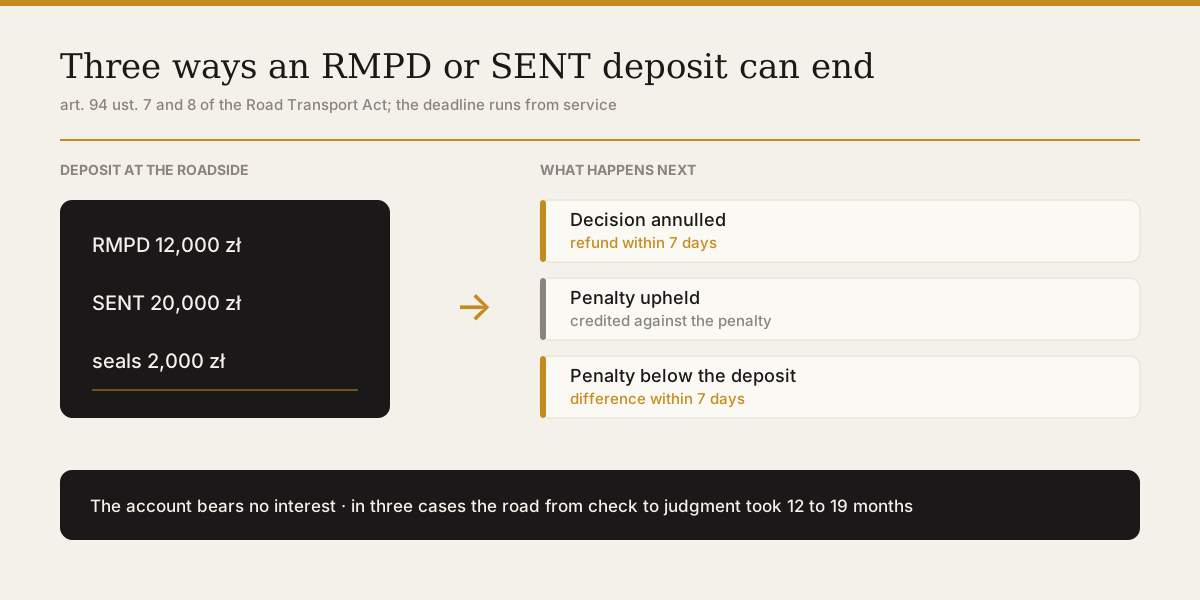
A deposit comes back in one situation only: when the penalty decision is annulled or declared void, and the authority then has 7 days from service of that ruling to transfer the money (art. 94 ust. 7 pkt 2 of the Road Transport Act). If the penalty stands, the deposit is credited against it and there is nothing left to refund. A third outcome exists: the penalty is lower than the deposit, and then the difference is returned on the same deadline and in the same way.
What a kaucja is and what it is not
A kaucja is advance security for a penalty that has not yet been imposed. The officer collects it at the roadside, in the amount of the expected fine, for one purpose only, which is to let the vehicle continue. The penalty itself arrives later, in a separate administrative decision, after proceedings in which the carrier can submit explanations.
Two practical consequences follow. Paying at the roadside is not an admission of fault and does not close the case. And as long as no decision exists, there is no legal basis for a refund either, because the deposit secures a penalty that has not been assessed yet.
Not every carrier pays. The statutory test is narrow. A deposit is collected where the carrier is based in a state with which Poland is not bound by an agreement on cooperation in mutual debt recovery. Enforcement must also fail to follow directly from international rules or from that state's own law (art. 94 ust. 3 of the Road Transport Act, art. 31 ust. 1 of the SENT Act). Ukraine falls inside that test and EU member states do not. A Lithuanian carrier receives the decision by post and pays once it becomes enforceable; a Ukrainian carrier pays at the roadside, before anyone has decided whether a breach occurred at all.
How much the deposit is
The deposit equals the expected penalty, so a table of deposits is a table of penalties. The amounts are fixed and the officer has no discretion to reduce them.
| For what | Deposit | Legal basis |
|---|---|---|
| No RMPD filing, or data incomplete or inconsistent with the facts | 12,000 zł (≈ 137,800 ₴) | annex 3, item 3.2a, Road Transport Act |
| Geolocation not transmitted during an RMPD carriage | 10,000 zł (≈ 114,800 ₴) | annex 3, item 3.2b |
| Carrier filed no SENT entry, goods do not match the filing, or the vehicle was not presented on request | 20,000 zł (≈ 229,600 ₴) | art. 22 ust. 1, SENT Act |
| Carrier did not add its own data to a SENT filing | 10,000 zł (≈ 114,800 ₴) | art. 22 ust. 2, SENT Act |
| Data in a SENT filing inconsistent with the facts | 10,000 zł (≈ 114,800 ₴) | art. 24 ust. 1 pkt 2, SENT Act |
| Official seals applied to the vehicle or the goods | 2,000 zł (≈ 23,000 ₴) | art. 15 ust. 4, SENT Act |
Converted at the National Bank of Ukraine rate of 11.4813 ₴/zł on 12 October 2026. Deposits add up when more than one unit is involved: in a check on the S17 road in May 2025 officers collected 24,000 zł from two trucks belonging to the same operator, based on materials of the Mazowiecki regional inspectorate. Individual combinations can be worked out in the SENT and RMPD penalty calculator, and the full list of amounts with the party who pays each one sits in the article on SENT and RMPD penalties.
Who holds the money
The money does not stay with the officer and does not enter the state budget straight away. An RMPD deposit sits in a separate, non interest bearing bank account of the authority conducting the penalty proceedings, or, where customs officers collected it, in a separate account of the head of a tax office designated in separate regulations (art. 94 ust. 4 pkt 2 and ust. 6 of the Road Transport Act).
For SENT deposits that tax office is named outright. A regulation of the Minister of Development and Finance dated 12 April 2017 designates a single office for the whole country: Urząd Skarbowy w Nowym Targu (§ 1). Money taken at the Dorohusk border crossing therefore waits in an account in Nowy Targ, at the opposite end of the country.
The phrase "non interest bearing" is not decoration. Over eighteen months of proceedings and litigation nobody pays the carrier a single złoty for the use of its working capital. A seal deposit collected in cash must reach the tax office account within 3 working days of collection (art. 15 ust. 8 of the SENT Act); for RMPD deposits the Act sets no such deadline at all.
How the deposit is paid at the roadside
The payment method decides how long the load stands still, so it is worth knowing the three options before a driver is ever stopped.
Cash. Always accepted, against a receipt issued on a strictly accounted form (art. 94 ust. 4 pkt 1 of the Road Transport Act, art. 15 ust. 5 of the SENT Act). That receipt is the only proof of payment the carrier will ever have, and without it no refund happens. The vehicle is released immediately.
Card. Available only where the deposit is collected by inspectors of the Road Transport Inspectorate, Inspekcja Transportu Drogowego, and only if they carry a terminal (art. 94 ust. 5). Authorisation and transfer costs are borne by the carrier irrecoverably, which means they are not returned even if the case is discontinued. For customs officers the Act provides no card option at all.
Bank transfer. The vehicle waits until the funds arrive, which takes between a few hours and a few days, and the transfer costs fall on the carrier as well (art. 94 ust. 4 pkt 2).
The receipt and the inspection report should be collected together. The report states how the breach was classified, and that classification determines the competent authority, the appeal deadline and the provisions to cite.
Which authority to write to
The competent authority follows from who carried out the check, not from the type of document involved. A penalty is imposed by the authority competent for the place of the check whose employees or officers established the breach (art. 93 ust. 1 of the Road Transport Act). On the road that is the regional road transport inspector, WITD, with appeals going to the Chief Inspector of Road Transport, GITD.
At border crossings and customs offices breaches are established by the Customs and Fiscal Service, so the decision is issued by the head of a customs and fiscal office, and the appeal is heard by the director of a tax administration chamber. In the three Ukrainian carrier cases that reached the courts in 2026 the decisions came from the heads of offices in Przemyśl and Biała Podlaska, with chamber directors in Rzeszów and Lublin as second instance. No WITD appeared in any of them, because the checks happened at the border.
The practical rule is simple. Copy the authority's name and the case reference out of the inspection report on the spot. A refund request sent to the wrong authority does not stop any deadline from running.
What to file so the money arrives
A refund does not happen by itself, because the authority does not know where to send the funds. Account details should be filed in writing, in the same letter that asks for the proceedings to be discontinued, without waiting for a decision.
- Give the full name and address of the bank, the account number in IBAN format and the SWIFT or BIC code. Any bank requires that minimum for a transfer outside Poland.
- Attach a copy of the deposit receipt and the reference of the inspection report.
- State that the account belongs to the entity that paid the deposit, because the Act returns the money to precisely that account (art. 94 ust. 7 pkt 2).
- Report a change of account if it changed after the deposit was paid. A transfer to a closed account bounces back to the authority and the cycle starts again.
For a seal deposit paid in cash the Act allows either the carrier's account or an account indicated by the driver (art. 15 ust. 9 pkt 1 of the SENT Act). For a deposit paid by card the money returns to the account tied to that card and there is no choice in the matter.
On what deadline the deposit returns
One deadline governs the refund and it is short: 7 days. The clock starts on service of the decision annulling or declaring void the penalty decision, or on service of an administrative court judgment doing the same (art. 94 ust. 7 pkt 2 of the Road Transport Act). The same deadline and the same mechanism apply to the difference where the penalty imposed turns out to be lower than the deposit collected (ust. 8).
When the case goes against the carrier, the same deposit moves the other way. A final decision becomes enforceable 30 days after service (art. 93 ust. 2), the penalty is payable within 14 days of the day the decision became enforceable (art. 94 ust. 2), and the deposit is transferred to the penalty account within 7 days of that same day (ust. 7 pkt 1).
One safeguard sits inside this machinery and is rarely written about. The authority that issued the final decision stays its enforcement of its own motion when the party lodges a complaint with an administrative court (art. 93 ust. 2). A complaint filed in time therefore keeps the deposit in the authority's account instead of letting it pass into the budget.
For a seal deposit the deadline is also 7 days, but it runs from the day the seals are removed (art. 15 ust. 9 of the SENT Act). Delay has a price here: if the carrier fails to present the vehicle for seal removal within 30 days of the date of the check, the deposit is not refundable at all and becomes state budget revenue (ust. 10).
How long this takes in practice
The statutory 7 days cover the last step, not the journey. Judgments show the real duration, and it is measured in months and years rather than days.
Rzeszów, 4 August 2026. Check on 21 January 2025, two digits swapped in a trailer plate. Proceedings opened on 17 June, first decision on 31 July, second instance on 26 September 2025, complaint dismissed on 4 August 2026. Eighteen months, with the deposit credited against the penalty.
Lublin, 12 February 2026. Check at Hrebenne on 15 February 2025, one wrong character in a semi trailer plate, deposit of 12,000 zł under art. 94 ust. 3. Decision on 17 July, second instance on 30 September 2025, judgment on 12 February 2026. Twelve months.
Lublin, 2 June 2026. Check at Dołhobyczów on 11 May 2025 at 06:55, with a different border crossing stated in the filing. The carrier updated the data at 07:23, twenty eight minutes later, but after the check had already begun. Penalty of 12,000 zł, complaint dismissed after thirteen months.
SENT cases run longer still. In a case about an incorrect gross weight for goods under CN 2710 the first decision was issued on 29 September 2020 and credited 20,000 zł from the deposit against the penalty. The Supreme Administrative Court dismissed the cassation complaint on 5 February 2026. Five years and four months. In another case the check took place on 24 January 2020 and on 11 December 2025 the Supreme Administrative Court set aside the first instance judgment and sent the case back. Almost six years after the check, and the case is still unresolved.
Whether a carrier can win and recover the deposit
Winning is possible, but the only real door is narrow. The Road Transport Act knows a single ground for discontinuing proceedings: the carrier had no influence over the breach, and the breach followed from events it could not have foreseen (art. 92c ust. 1 pkt 1). Courts read that provision literally.
An employee's mistake does not fit inside it. The court in Rzeszów said so directly: the employee acted within the organisation of the carrier's business, so the slip is not an external circumstance independent of the carrier. Absence of intent is not absence of influence, and liability under art. 92a ust. 1 is strict, requiring no proof of fault. Other events do fit: a lost connection, a registry outage, a locator broken by its operator, and each has to be proved with documents from third parties. What that proof looks like in court is shown by the case on a gap in the GPS signal, where the court quashed the decision precisely because the authority had not examined the cause of the gap.
The second door is closed for now, and that is the most important news in this article. Carriers routinely invoke art. 189f § 1 of the Code of Administrative Procedure, which allows an authority to refrain from imposing a penalty where the breach is of negligible gravity. Authorities and courts answer that chapter IVa of the Code does not apply, because art. 92c of the Road Transport Act is a separate provision within the meaning of art. 189a § 2 pkt 2 of the Code. On 14 July 2026, however, the Supreme Administrative Court referred exactly that question to a panel of seven judges (order II GSK 255/26). As of 12 October 2026 no resolution appears in the CBOSA database. The practical conclusion is to raise art. 189f in the appeal anyway, because without that argument on the file a favourable resolution cannot be used in the carrier's own case.
A third point is worth knowing: authorities do sometimes discontinue proceedings and return deposits. In the Lublin case the carrier pointed to another case before the same authority where, on identical facts, no penalty was imposed and the deposit was returned. The court disregarded the argument because the carrier never produced that decision. Anyone who hears of such a case should ask for its reference and a copy.
What refusing the deposit costs
Refusal does not cancel the penalty, it only adds costs. Without a deposit the vehicle is directed to the nearest guarded car park at the carrier's expense (art. 95 ust. 1 pkt 1 of the Road Transport Act), and in a SENT carriage to the nearest designated place together with the goods (art. 31 ust. 2 of the SENT Act).
| Vehicle above 16 tonnes | Maximum rate for 2026 |
|---|---|
| Towing to the car park | 1,946 zł (≈ 22,300 ₴) |
| Each day of storage | 215 zł (≈ 2,470 ₴) |
| Vehicle with dangerous goods, towing | 2,367 zł (≈ 27,200 ₴) |
| Vehicle with dangerous goods, per day | 312 zł (≈ 3,580 ₴) |
The Minister of Finance publishes these maximum rates every year in Monitor Polski; for 2026 in a notice dated 1 August 2025. A week on the car park for an ordinary unit costs 1,946 plus 1,505 zł, and the deposit still has to be paid afterwards, because a vehicle is released from the car park once the deposit has been transferred (art. 95 ust. 3 pkt 1). In a SENT carriage the storage charges are owed jointly and severally by the carrier and the party obliged to make the filing (art. 17 ust. 2 of the SENT Act), which in a carriage out of Poland is the consignor.
One further trap is known to very few. In international carriage of goods a vehicle cannot be released from the designated place before the carrier has made the filing and obtained a reference number, and has presented the required permit where one is required (art. 18 ust. 2 of the SENT Act, in force since 1 January 2025). Paying the deposit does not release the vehicle on its own if the filing is still missing.
How a SENT deposit differs from an RMPD deposit
Two statutes, two mechanisms, and confusing them is expensive.
| Point | RMPD, Road Transport Act | SENT Act |
|---|---|---|
| Provision on the deposit | art. 94 ust. 3 and 4 | art. 31 ust. 1, applying art. 15 ust. 5-11 |
| Where the money sits | separate non interest bearing account of the authority running the case | account of Urząd Skarbowy w Nowym Targu |
| Penalty lower than the deposit | difference refunded, expressly in the Act (ust. 8) | no such provision |
| No deposit paid | guarded car park (art. 95 ust. 1 pkt 1) | designated place together with the goods (art. 31 ust. 2) |
| Refraining from the penalty | only absence of influence (art. 92c ust. 1 pkt 1) | also important interest of the carrier or public interest (art. 22 ust. 3) |
| Procedural regime | Tax Ordinance excluded (art. 93 ust. 7) | Tax Ordinance applies |
| Appeal | 14 days to the higher authority (Code art. 129 § 2) | 14 days to the chamber director (Tax Ordinance art. 223 § 2 pkt 1) |
| Enforcement of a final decision | 30 days after service (art. 93 ust. 2) | 60 days before enforcement against the vehicle (art. 31 ust. 4) |
The row on refraining from the penalty hurts most. Under SENT an authority may refrain because of the important interest of the carrier; under RMPD no such possibility exists. An argument that the company is small and the amount unbearable therefore goes nowhere in an RMPD case, while in a SENT case it is at least examined on its merits.
What to do
- Collect the deposit receipt and a copy of the inspection report before moving on. Without the receipt there is no refund.
- Copy the authority's name, the case reference and the classification of the breach out of the report. All three decide where to write and by when.
- Pay in cash or by card where there is a choice. A transfer keeps the vehicle standing until the funds clear.
- Send the account details with IBAN and SWIFT immediately, together with the explanations, rather than after the decision.
- Keep to 14 days for the appeal. The deadline runs from service of the decision, not from the day somebody in accounts read it.
- Prove the absence of influence with third party documents where the case concerns connectivity or a locator. An explanation without evidence does not count.
- File the court complaint within 30 days. Filing stays enforcement, so the deposit stays in the authority's account.
What not to do
- Do not refuse the deposit as a matter of principle. The car park costs 1,946 zł plus 215 zł a day and the deposit still falls due.
- Do not wait for the decision before sending account details. Seven days run from service, not from the day an IBAN turns up.
- Do not expect interest. The account is non interest bearing by statute, and six years of waiting means six years without compensation.
- Do not rely on the breach being an obvious typing error. Authorities and courts answer that the statute does not grade the gravity of a discrepancy.
- Do not correct the data once a check has started. In the Lublin case a correction after twenty eight minutes did not help, because the check was already under way.
- Do not invoke somebody else's case without a copy of the decision. A court does not examine what was never produced.
Where technology belongs in this
A deposit has one feature that sets it apart from every other cost of a trip: it is collected for a discrepancy between the filing and the documents, not for poor work. Trailer plate, country of loading, border crossing, planned end date. Real cases from 2025 show deposits taken for exactly those fields, and all of them already exist in the CMR waybill.
Sigil therefore carries data from a photograph of the CMR into the filing one to one and never corrects it on its own, while the dispatcher confirms every field before sending. Human confirmation is not a missing piece of automation but the substance of the protection: the penalty is for a discrepancy with the CMR, so the data has to reach the registry in the form in which the waybill holds it. Production measurements put the median full cycle, from the CMR photograph to the reference number, at 6.0 minutes across 126 filings submitted between 31 July and 19 September 2026. Which CMR field lands in which form field is set out in the CMR to RMPD field map, and the price of a single wrong field is covered in the article on the penalty for one mistake.
Sigil handles RMPD declarations. A SENT filing is made by the consignor or the consignee of the goods, and Sigil does not pursue deposit refunds.
A demo or training for your team
30 minutes online. We show how Sigil™ files an RMPD from a CMR and answer questions about your runs.
Frequently asked questions
- Is a deposit returned when the proceedings are discontinued?
- Yes, but the Act sets no deadline for that case. The seven day rule in art. 94 ust. 7 pkt 2 of the Road Transport Act is written for a decision annulling or voiding the penalty, not for discontinuance. Once proceedings are discontinued there is no basis to hold the deposit, but the authority still needs the account details, so send them with the explanations rather than later.
- Can a carrier refuse to pay the deposit at the roadside?
- Yes, and the vehicle then goes to a guarded car park at the carrier's expense. The rule is art. 95 ust. 1 pkt 1 of the Road Transport Act. Maximum 2026 rates for a vehicle above 16 tonnes are 1,946 zł for towing and 215 zł per day. The vehicle is released once the deposit is transferred, so parking costs are added to the deposit, not substituted for it.
- Does a deposit earn interest while the case runs?
- No. The account holding it is non interest bearing by statute: art. 94 ust. 6 of the Road Transport Act and art. 15 ust. 7 of the SENT Act. Card authorisation and transfer costs are also borne by the carrier, and those are irrecoverable even if the case ends in the carrier's favour.
- Does paying the deposit admit the breach?
- No. A deposit secures a penalty that has not been imposed yet, so paying it neither admits the breach nor closes the case. Explanations, an appeal and a court complaint remain available exactly as they would without a deposit.
- Which authority decides an RMPD penalty at the border?
- The head of the customs and fiscal office, with the appeal going to the director of the tax administration chamber. The penalty is imposed by the authority whose officers established the breach at the place of the check (art. 93 ust. 1 of the Road Transport Act). Roadside checks by the Road Transport Inspectorate lead to WITD and GITD instead, so the correct address comes from the inspection report.
Sources
Legislation, in force on the date of publication:
- Road Transport Act of 6 September 2001, ISAP, consolidated text: art. 92a ust. 1, art. 92c ust. 1 pkt 1, art. 93 ust. 1, 2 and 7, art. 94 ust. 2-9, art. 95 ust. 1, 3 and 4, annex 3 (items 3.2a, 3.2b).
- Act of 9 March 2017 on the system for monitoring road and rail carriage of goods, ISAP, consolidated text Dz.U. 2024 poz. 1218: art. 15 ust. 4-11, art. 17 ust. 1 and 2, art. 18 ust. 2, art. 20 ust. 3 and 5, art. 22 ust. 1-3, art. 24 ust. 1 pkt 2, art. 31.
- Regulation of the Minister of Development and Finance of 12 April 2017 designating the tax office to whose bank account deposits are paid, ISAP, § 1: Urząd Skarbowy w Nowym Targu.
- Code of Administrative Procedure of 14 June 1960, ISAP: art. 129 § 2, art. 189a § 2 pkt 2, art. 189f § 1.
- Tax Ordinance of 29 August 1997, ISAP: art. 223 § 2 pkt 1.
- Law on Proceedings before Administrative Courts of 30 August 2002, ISAP: art. 53 § 1.
- Notice of the Minister of Finance and Economy of 1 August 2025 on maximum 2026 rates for towing a vehicle and guarded parking, M.P. 2025 poz. 723.
- Notice of the Minister of Finance and Economy of 5 October 2025 on maximum 2026 rates for removal, storage and guarding at a designated place, M.P. 2025 poz. 1114.
Control authorities:
- Kary pieniężne, Regional Road Transport Inspectorate in Bydgoszcz, gov.pl, page carries no update date, checked 12.10.2026.
Case law, Central Database of Administrative Court Rulings:
- Judgment of the Regional Administrative Court in Rzeszów of 4.08.2026, II SA/Rz 1580/25, an employee's error is not absence of influence, art. 189f of the Code does not apply; not final.
- Judgment of the Regional Administrative Court in Lublin of 12.02.2026, III SA/Lu 630/25, a 12,000 zł deposit for one character in a semi trailer plate.
- Judgment of the Regional Administrative Court in Lublin of 2.06.2026, III SA/Lu 226/26, an update made after the check began, and reliance on another case without a copy of the decision.
- Judgment of the Supreme Administrative Court of 5.02.2026, II GSK 1571/22, 20,000 zł credited from a deposit in a SENT case.
- Judgment of the Supreme Administrative Court of 11.12.2025, II GSK 1093/22, a 2,000 zł deposit for official seals and release of the vehicle with its cargo.
- Order of the Supreme Administrative Court of 14.07.2026, II GSK 255/26, the question on art. 92c of the Road Transport Act and art. 189f of the Code referred to a panel of seven judges.
Accounts of individual checks in the trade press:
- Ciężarówki ukraińskiego przedsiębiorcy zatrzymane w pobliżu Garwolina, egarwolin.pl, 19.05.2025, based on materials of Mazowiecki WITD.
Exchange rate: official hryvnia to złoty rate, National Bank of Ukraine, 11.4813 ₴/zł on 12.10.2026.
Read next
- SENT and RMPD fines 2026, amounts, who pays, how to appealEvery SENT and RMPD fine in one table: amount in złoty and hryvnia, who pays, article number with a link. Appeal deadlines and the difference between two acts.
- What gets fined when one digit in an RMPD costs 12,000 złA wrong digit or date in an RMPD costs 12,000 zł, the same as not filing. Provisions with article numbers, three 2025 roadside checks and what a carrier can do.
- How CMR data get into an RMPD, field by fieldWhich CMR box goes into which RMPD100 field, what the CMR lacks (type of carriage, permit, border), what the RMPD lacks (goods, CN). Three fields that diverge.
- Court quashed a 10,000 zł SENT GPS fine, how to appealThe driver's app showed green while SENT saw 4 hours of silence. The Kraków court quashed the 10,000 zł fine as automatic punishment. What to do about yours.
- SENT transit through Poland, the control summons and borderIn transit the carrier files SENT (SENT300). "Coordinates for the control" is an art. 12a summons: vehicle at customs on the exit day, call first, or 20,000 zł.
Sigil™ turns a CMR into an RMPD declaration and files it with PUESC, with every field checked against the original.
More about RMPD