GPS monitoring
Court quashed a 10,000 zł SENT GPS fine, how to appeal
The driver's app showed green while SENT saw 4 hours of silence. The Kraków court quashed the 10,000 zł fine as automatic punishment. What to do about yours.
Published · Updated · Author: Makaiev Kostiantyn Oleksandrovych, founder of Sigil RMPD

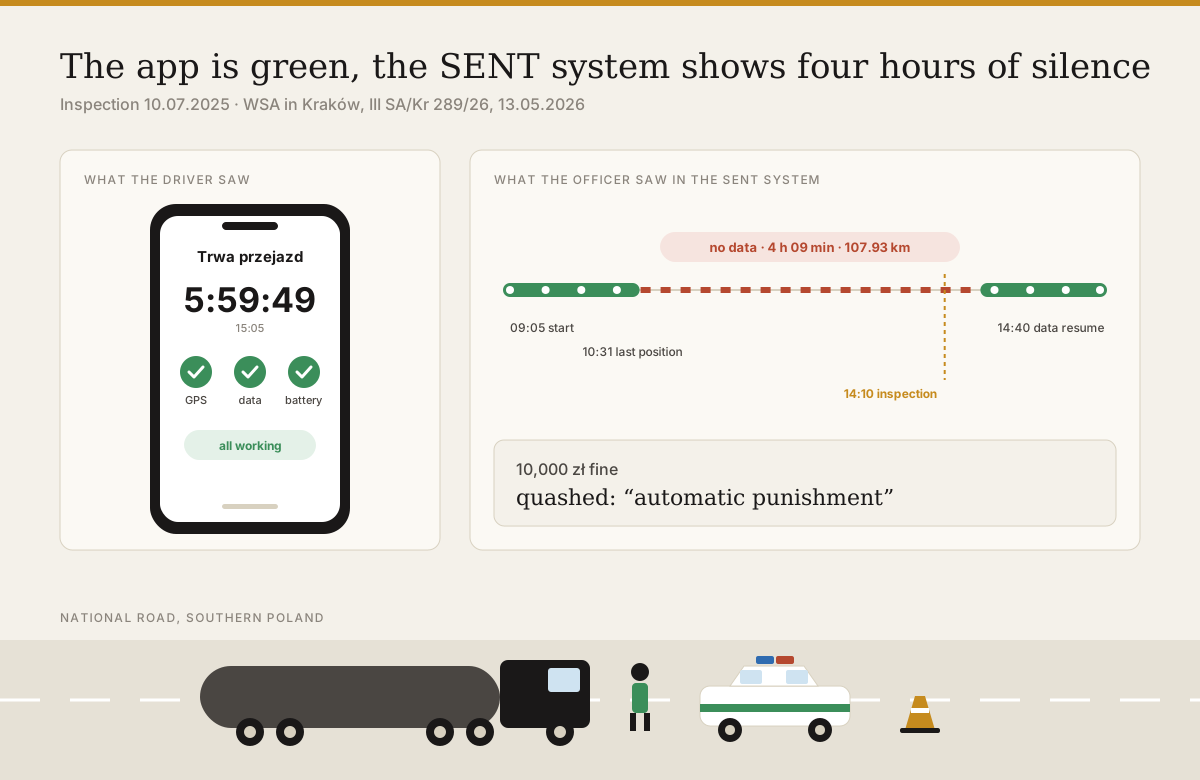
10 July 2025, southern Poland, a national road. A tanker carrying 9,427 litres of petroleum oils is on its way from the second loading site to the consignee. At 14:10 customs officers of the Urząd Celno-Skarbowy (Customs and Tax Office) pull it over. In the state monitoring system, SENT, the truck's position has been missing since 10:31: four hours and nine minutes of silence, 108 kilometres. The driver shows his phone: the words "Trwa przejazd" (journey in progress), a timer past the sixth hour, GPS and data icons green. The officer photographs the screen and says the route does not show on his side. Protocol, proceedings, a 10,000 zł fine, appeal dismissed. Only on 13 May 2026 does the Regional Administrative Court in Kraków quash both decisions (case III SA/Kr 289/26).
This article explains what exactly the court said, why it matters to a carrier from outside the EU, and what to do at the roadside so that ten months later there is something to take to court.
In brief: for a gap in GPS transmission the carrier pays 10,000 zł, about 118,000 ₴, and the law does not ask about fault · the Kraków court quashed such a fine because the authority refused to examine why the app's data never reached the system, although the app was on and green · the key evidence was screenshots of the driver's phone with the journey timer, taken during the inspection · Poland's Supreme Administrative Court (NSA) said the same in January 2024 in case II GSK 659/23: "automatic punishment" breaches proportionality · the authority must genuinely weigh waiving the fine under art. 22 ust. 3 of the SENT Act, not write that "there are no grounds to examine the causes" · but where the driver saw the locator was down and drove on for 5 and 9.5 hours, the NSA upheld the fine · a Ukrainian carrier in a SENT carriage has the same duty and pays a deposit at the roadside; under RMPD the same 10,000 zł applies, but the defence rests on a different provision.
The Kraków court quashed a 10,000 zł fine for a gap in geolocation because the authority punished automatically. The driver's app showed the journey running and data flowing; the authority replied that the causes were of no interest. The court called this "automatic punishment" and ordered the case reheard, this time examining the app's data and the truck's actual route.
What SENT is and why GPS matters
SENT is Poland's monitoring system for "sensitive" goods: fuel, alcohol, dried tobacco, and since 2022 a growing list of farm produce and, since March 2026, clothing and footwear. Every such carriage is declared in the PUESC portal, and the carrier must ensure that the vehicle's live position reaches the register throughout the route. The locator can be a telematics unit or a phone with the state app e-TOLL PL. A non-EU carrier meets the same GPS duty a second time through RMPD, the declaration every carrier from outside the EU files before entering Poland. The full list of monitored goods is in Goods under SENT monitoring.
What happened on the road and in the offices
The truck ran under two SENT declarations: two loading sites, one delivery site. The locator was the driver's phone with e-TOLL PL, the app the Ministry of Finance itself provides for sending geolocation to SENT.
| Moment | What was established |
|---|---|
| 09:05 | app starts transmitting, first loading site |
| 10:31 | last position in SENT, second loading site |
| 10:31 to 14:40 | no position in the system, 4 h 9 min, 107.93 km |
| 14:10 | roadside stop, driver shows the green app |
| 15:05 | screenshot: "Trwa przejazd", 5 h 59 min 49 s |
| 16:42 | second screenshot: 7 h 37 min 22 s |
| 04.09.2025 | Naczelnik Małopolskiego Urzędu Celno-Skarbowego opens proceedings |
| 03.11.2025 | decision: 10,000 zł |
| 27.01.2026 | Dyrektor Izby Administracji Skarbowej w Krakowie upholds the fine |
| 13.05.2026 | WSA w Krakowie quashes both decisions, judgment final |
In the inspection protocol the officers recorded the driver's statement that everything in the app worked correctly, and attached a printout of the screen. Neither authority disputed it. That proved decisive. The carrier answered the authority's summons within five days: screenshots, the app's journey log for 10 July, two years of tax returns, the revenue ledger, six decisions temporarily deregistering vehicles. Of nine truck sets, three were working.
What the fine is for and why the authority would not listen
The 10,000 zł fine falls on a carrier who did not ensure transmission of current geolocation data for the whole route. The duty is in art. 10a ust. 1 of the SENT Act, the amount in art. 22 ust. 2a of the same act (ustawa o systemie monitorowania drogowego i kolejowego przewozu towarów). There is one exception: if the register itself was down, no fine is imposed (art. 22 ust. 2b).
Liability is objective: the authority need not prove fault, the absence of data is enough. Both authorities added a key sentence: "brak jest podstaw do badania przyczyn, dla których przewoźnik nie zapewnił przekazywania aktualnych danych geolokalizacyjnych", there are no grounds to examine why the carrier failed to ensure transmission. They checked one thing: the Ministry's IT centre confirmed that on 9 and 10 July the central SENT GEO system had no outage. Hence the carrier was at fault. The second instance added a suspicion: 107 kilometres in 4 hours is "disproportionately long".
The act lets the authority waive the fine where an important interest of the carrier or the public interest justifies it (art. 22 ust. 3). The authority looked at the books: turnover 1.96 million zł in 2024, three properties, 11 employees, no tax arrears. Conclusion: 10,000 zł will not sink the firm, so no important interest. And the public interest demands a "tight" system; waiving the fine would privilege this carrier over others.
Does a green app and a driver who knew nothing excuse the fine? No. The breach exists because the data are missing from the system. The green screen works at the second stage: when the authority decides whether to waive the fine. That is the stage the Kraków authority skipped.
What the court said and why it matters
The court agreed with the authorities on one point: SENT must be tight, and a transmission gap is no minor formality. Then it took the decisions apart.
The app is part of the system, not the carrier's private business. The court opened the e-TOLL PL manual on the Ministry of Finance website: pressing "Rozpocznij przejazd" (start journey) starts the timer, and location data are collected and sent to SENT. Then it did the arithmetic. The 15:05 screenshot shows 5 h 59 min of journey; 15:05 minus 5:59 gives 9:05. That is the very minute the authority itself recorded as the start of transmission. The second screenshot, 16:42 with 7 h 37 min, gives the same result. So the app was active for the entire route, and by the manual that means data were being sent. Why the phone's data never reached the central system is unknown, and the authority "kwestii tej nawet nie próbował wyjaśnić", did not even try to find out.
Causes do matter, just at a different stage. For establishing the breach, fault is irrelevant. But when the authority decides whether to waive the fine under art. 22 ust. 3, fault and circumstances become the subject of examination. This is not the Kraków court's invention: the NSA ruled the same on 17 March 2026 in II GSK 2239/22. An authority that writes "no grounds to examine the causes" skips an entire stage the law requires of it.
The driver's trust in the app is a public-interest argument. The driver looks at the screen, everything is green. The state itself gave him the tool and itself wrote in the manual that green means correct operation. Punishing him because the screen lied undermines citizens' trust in public authorities, which is one component of the public interest. The court cites the NSA in II GSK 659/23: an active app could have misled the driver, and the authority must take that into account.
On 107 kilometres in four hours. The court dismissed the suspicion in one paragraph. The authority never established how long loading at the second site took or when the truck left it. Without that, computing an "average speed" is meaningless.
What the court did not give the carrier. On the "important interest of the carrier" the court sided with the authority: the carrier sent financial documents but showed no extraordinary circumstance under which 10,000 zł would threaten its liquidity. The win came on the public interest and on procedure: the authority failed to assess evidence it had on file, breaching art. 187 § 1 of the Tax Ordinance.
The court did not cancel the fine outright. It quashed the decisions and sent the case back with instructions on what to examine. The authority may impose 10,000 zł again, but now it must explain why the app's data never reached the system and weigh the driver's trust in the green screen.
Remember: establishing the breach does not depend on fault, waiving the fine does. An authority that writes "no grounds to examine the causes" skips a stage the law requires. That is exactly what gets decisions quashed.
Is this the first such case
No. It is the second known case with the same storyline, and the first reached the Supreme Administrative Court.
II GSK 659/23, NSA judgment of 16 January 2024. An inspection on 2 August 2019 in Silesia, 24,720 kg of rapeseed oil. Two transmission gaps longer than an hour, the first 1 h 18 min over 86 kilometres. The SENT-GEO app on the driver's phone showed "wszystkie ikony na zielono", all icons green, which the officers themselves recorded in the protocol. System logs contained a message about possible rejection of data between 8:00 and 9:00. The authority assumed the driver had not updated the app, but never checked. The NSA quashed the lower court's judgment and both decisions. Its words: the authorities "przyjęły automatyzm karania", adopted automatic punishment. And then a list of what an authority must weigh before refusing to waive a fine.
| What the authority must weigh per the NSA (II GSK 659/23) | How it looked in Kraków |
|---|---|
| Total absence of data or a gap in transmission | a gap: data until 10:31 and from 14:40 |
| One-off or recurring | one inspection, no prior fines on file |
| Whether the breach poses a real risk to the budget or looks like a scheme | a legitimate carrier with a forwarder's authorisation, no arrears |
| Ratio of the fine to the income from this carriage | firm's income for 2024 was 9,172 zł, fine 10,000 zł |
| The carrier's conduct during and after the inspection | driver showed the app at once, carrier replied within 5 days |
| Whether the app could have misled the driver | green icons, running timer, no notification |
Keep this list in front of you when drafting an appeal. It is the structure of argument the courts expect from the authority and from you.
And when the court does not help. II GSK 1324/22, NSA judgment of 5 February 2026. An inspection on 8 January 2020: two gaps, 5 hours and 9.5 hours. The driver continued despite a known locator failure and accepted a 5,000 zł on-the-spot fine. The regional court in Bydgoszcz had quashed the carrier's fine; the NSA reinstated it: the authority had weighed everything correctly, the gaps were long and repeated, the driver knew. The difference from Kraków is one word: knew. A green screen and a failure notice are two different cases with two different outcomes.
What this means for a carrier from outside the EU
A Ukrainian firm ends up in this situation by two routes, and the defence differs.
In a SENT carriage. If you carry goods under SENT monitoring, the duty in art. 10a ust. 1 falls on you exactly as on the Kraków carrier, and the fine is the same. One difference: from a carrier based in a country with which Poland has no agreement on mutual recovery of claims, the officer collects a deposit equal to the future fine on the spot, and without it the vehicle and cargo are directed to a designated depot (art. 31 ust. 1 and 2 of the SENT Act). The money leaves the firm on the day of the inspection and returns after a win, about a year later. The line of defence is the same: art. 22 ust. 3, the public interest, trust in the app, and the judgments II GSK 659/23 and III SA/Kr 289/26 as arguments.
In a carriage under RMPD. The geolocation duty applies here too: the Road Transport Act applies the same art. 10a of the SENT Act to RMPD (art. 28b ust. 5 of the Road Transport Act), and the amount is in Annex 3, item 3.2b: 10,000 zł. Can an RMPD case invoke the "public interest" as in Kraków? No. The Road Transport Act has no such clause. It has only art. 92c ust. 1 pkt 1: proceedings are discontinued if the carrier had no influence on the breach and it resulted from events it could not foresee. A green app that silently failed to deliver data is exactly such an event. That is our reading, though: there is no RMPD judgment on these facts yet, and lack of influence must be proven with documents, not by pointing to the Kraków case. How the two regimes differ is explained in The difference between SENT and RMPD nobody explains.
Common to both routes: evidence is gathered at the roadside, not two months later. The state's own e-TOLL PL instruction on PUESC says: "w trakcie przejazdu zwracaj uwagę na kolor ikon. Jeśli którakolwiek z nich pali się na inny niż zielony kolor, oznacza to, że wybrany moduł nie pracuje prawidłowo", watch the icon colours during the journey; any colour other than green means the module is not working properly.
Green is the official "all working" signal, in the state's own instruction. A screenshot of green icons with the timer, taken in front of the officer, is your main document.
What the road to court costs
A deposit or fine of 10,000 zł is about 118,000 ₴. In the Kraków case the firm's entire income for 2024 was 9,172 zł: the fine exceeded a year's income.
The road to judgment took ten months. The court fee for the complaint to the WSA was 400 zł, about 4,700 ₴, and the court ordered the authority to refund it. The appeal to the Dyrektor Izby Administracji Skarbowej is free. Deadlines are rigid: 14 days for the appeal from service of the decision (art. 223 § 2 pkt 1 of the Tax Ordinance, applied via art. 26 ust. 5 of the SENT Act) and 30 days for the court complaint (art. 53 § 1 p.p.s.a.). A missed deadline closes the case, and no green screenshot will help afterwards.
What exactly the act demands of the locator, which devices are allowed and when the driver must stop is collected in What SENT-GEO demands of the carrier and the locator.
What to do
- Stop the vehicle if any icon in the app is not green for longer than an hour. Art. 10c ust. 1 of the SENT Act requires it. A driver who saw red and drove on loses the case, as in II GSK 1324/22.
- Take screenshots in front of the officer if the icons are green: the screen with the journey timer, the phone clock in the same shot, the journey history in the app. Two shots some time apart, as in Kraków, let a court compute when the journey began.
- Ask for the protocol to record that the app was on and showed correct operation. In both winning cases the officers wrote it down, and the courts relied on that entry.
- Answer the authority's summons on time and with documents: the app's journey log for that day, tachograph data, the route from your own tracking system, loading time and departure from the depot. The Kraków court faulted the authority precisely for not comparing these with the gap.
- State it plainly in the appeal: I request waiver of the fine under art. 22 ust. 3 on public-interest grounds. List the points from the NSA list above. Cite II GSK 659/23 and III SA/Kr 289/26.
- Prove the carrier's important interest only with what can be shown: loan instalments, payroll, lease debt. General words about "hard times" the Kraków court rejected.
- File the complaint to the WSA within 30 days if the authority upheld the fine. The 400 zł fee comes back on a win.
What not to do
- Do not drive on when the app shows a failure. After an hour it is the driver's own breach, and the carrier loses its main argument: "the driver did not know".
- Do not build the defence on the budget having lost nothing. Both courts say plainly: absence of tax loss does not by itself excuse the fine.
- Do not send the authority financial documents alone. They prove an "important interest", which courts do not grant a stable firm. The public interest is proven by screenshots and the route.
- Do not stay silent on the summons because "liability is objective anyway". The authority must assess your evidence, and ignoring it is exactly why courts quash decisions.
- Do not replace the phone or wipe the app after an inspection. The court named the data inside the app as what the authority should have examined.
Where technology fits in
The 10 July gap lasted four hours and nobody in the firm knew. The driver watched a green screen, the dispatcher watched other runs. They learned from the officer. That is what a geolocation fine looks like: not a failure someone knew about, but silence nobody reported.
How typical such a gap is can be seen in our own data: across 571 transports in August and September 2026 only 7 % had a gap while moving, and only 14 had one longer than an hour. The signal is lost at the edges of the trip, before the start and after unloading; the figures are in How often SENT-GEO checks your truck's position in Poland.
For RMPD declarations, Sigil polls SENT-GEO for the truck's position after registration and notifies the dispatcher when positions stop arriving. The dispatcher learns of the silence before the inspector and can call the driver while the gap is still under an hour. The history of received positions stays with the declaration. That is exactly the route data the Kraków court held the authority obliged to examine, and which the file lacked. How it looks in the status view is described in the help article Checking RMPD statuses.
Sigil (RMPD): once a declaration is registered, the system polls SENT-GEO for the vehicle's position itself and notifies the dispatcher when positions stop arriving. The gap is visible inside the firm before the one hour of art. 10c runs out and before an inspector sees it. The position history stays with the declaration as evidence.
Sigil does not see SENT carriages and does not replace the locator in the cab. It adds a second pair of eyes on the screen a driver at the wheel cannot watch.
Sigil handles RMPD declarations. The SENT declaration is filed by the consignor or consignee.
A demo or training for your team
30 minutes online. We show how Sigil™ files an RMPD from a CMR and answer questions about your runs.
Frequently asked questions
- Did the court cancel the 10,000 zł fine for good?
- No. The Kraków court quashed the decisions of both instances and sent the case back to the authority. The authority must now establish why the app's data never reached the SENT system and weigh the public interest, including the driver's trust in the app. It may impose the fine again, but no longer automatically.
- Do green icons in the app excuse the fine?
- Not by themselves. The breach of art. 10a ust. 1 of the SENT Act exists once data are missing from the system, and fault is irrelevant. But a green app is an argument for waiving the fine under art. 22 ust. 3: the Kraków court and the NSA in II GSK 659/23 held that the authority must consider it rather than dismiss it with "no grounds to examine the causes".
- Does this ruling apply to a GPS fine in an RMPD carriage?
- Not directly, partly by analogy. The 10,000 zł geolocation fine under RMPD is imposed under the Road Transport Act (Annex 3, item 3.2b), which has no public-interest clause. The only ground for discontinuance is art. 92c ust. 1 pkt 1: the carrier had no influence on the breach. A green app that silently failed to deliver data fits that provision, but it must be proven with documents, and there is no RMPD judgment on such facts yet.
- How long do I have to appeal a SENT fine, and what does it cost?
- 14 days and 30 days. The appeal to the Dyrektor Izby Administracji Skarbowej is filed within 14 days of service of the decision (art. 223 § 2 pkt 1 of the Tax Ordinance) and is free. The complaint to the regional administrative court is filed within 30 days of the second-instance decision (art. 53 § 1 p.p.s.a.); the court fee for a 10,000 zł fine is 400 zł. In the Kraków case the court ordered the authority to refund those 400 zł.
- What should the driver do when an icon in the app is no longer green?
- Stop. If the locator failure lasts longer than an hour, the driver must stop without delay at the nearest car park or lay-by (art. 10c ust. 1 of the SENT Act). A driver who saw the failure and drove on loses the case: in II GSK 1324/22 the NSA upheld the carrier's fine precisely because the driver knew about the failure.
Sources
Legislation, as in force on the publication date:
- Act of 9 March 2017 on the system for monitoring the road and rail carriage of goods and trade in heating fuels (SENT Act), ISAP, consolidated text (Dz.U. 2024 poz. 1218): art. 10a ust. 1, art. 10c ust. 1, art. 22 ust. 2a, 2b and 3, art. 26 ust. 3, 4a and 5, art. 31 ust. 1 and 2.
- Act of 6 September 2001 on road transport, ISAP, consolidated text: art. 28b ust. 5, art. 92c ust. 1 pkt 1, Annex 3 (item 3.2b).
- Act of 29 August 1997, Tax Ordinance, ISAP: art. 187 § 1, art. 223 § 2 pkt 1.
- Act of 30 August 2002, Law on proceedings before administrative courts, ISAP: art. 53 § 1, art. 145 § 1 pkt 1, art. 200.
Authorities:
- Send vehicle geolocation data to the SENT register with the e-TOLL PL mobile app, PUESC, service description and the instruction on icon colours.
Case law, Central Database of Administrative Court Rulings:
- Judgment of the WSA in Kraków of 13.05.2026, III SA/Kr 289/26, final.
- Judgment of the NSA of 16.01.2024, II GSK 659/23, green app icons, "automatic punishment".
- Judgment of the NSA of 5.02.2026, II GSK 1324/22, driver knew of the failure, fine upheld.
- Judgment of the NSA of 17.03.2026, II GSK 2239/22, fault examined at the waiver stage.
- Judgment of the NSA of 25.04.2024, II GSK 2219/22, proportionality and the public interest.
Exchange rate: official hryvnia to zloty rate, National Bank of Ukraine, 11.75 ₴/zł on 18.09.2026.
Read next
- How often SENT-GEO checks your truck's position in PolandGPS monitoring in SENT on our own data: 212 position checks per transport, where the signal really gets lost, how much silence is a problem, what to do.
- What SENT-GEO demands of the carrier and the locatorWhat Poland's SENT-GEO demands of carrier and driver: a locator on the whole Polish leg, three ways to transmit (e-TOLL PL, OBU, ZSL), on and off times, fines.
- SENT and RMPD fines 2026, amounts, who pays, how to appealEvery SENT and RMPD fine in one table: amount in złoty and hryvnia, who pays, article number with a link. Appeal deadlines and the difference between two acts.
- What a driver should do when GPS loses signal in PolandThe SENT locator went silent on the road. What to check in the first ten minutes, when art. 10c says stop, what the dispatcher does, what to show an inspector.
Sigil™ turns a CMR into an RMPD declaration and files it with PUESC — with every field checked against the original.
More on this topic: GPS monitoring