GPS monitoring
What a driver should do when GPS loses signal in Poland
The SENT locator went silent on the road. What to check in the first ten minutes, when art. 10c says stop, what the dispatcher does, what to show an inspector.
Published · Author: Makaiev Kostiantyn Oleksandrovych, founder of Sigil RMPD

The Kraków ring road, 16:40, rain. The driver glances at the phone in its holder: the GPS icon in the e-TOLL PL app is orange, so is the internet one. Two tunnels, then half an hour in a jam, and he did not notice when the colour changed. Forty minutes to the unloading in Katowice. Drive on or pull over? Call the dispatcher or the device operator? And from which moment does that one hour everyone talks about actually count?
This article is for the driver and the dispatcher at the moment the locator is already silent. For a reader outside Poland: SENT is the Polish register that monitors carriage of listed goods and, since November 2024, every non-EU carrier's run under an RMPD notification. SENT-GEO is its GPS part, and e-TOLL PL is the free state app that sends the position. How to tell a real loss of signal from a delay. What to check in the cab in the first ten minutes. When the law orders a stop and after what you may drive on. What the dispatcher does while the truck stands. What to show an inspector and what to keep in case of a fine.
In brief: in the "Przejazd SENT" mode the e-TOLL PL app shows an orange GPS or internet icon at a delay over 10 minutes and a red one over 60; act on orange (PUESC service description of 23.04.2026) · a failure longer than an hour means an immediate stop at the nearest car park or lay-by (art. 10c ust. 1 of the SENT Act), and the hour counts from the last position in the register, not from the moment you noticed · the first ten minutes go on five checks: an active "Przejazd SENT" with the right notification number, location permission "always", mobile data in roaming, battery saver, charging · you may drive on after one of four: the locator works again, the goods are reloaded onto a truck with a working locator, the truck is fitted with one, customs seals the load or assigns an escort (art. 10c ust. 3) · a rest break is not a failure; the next transmission starts from the place of the stop (PUESC FAQ 04.27) · silence in the register costs the carrier 10,000 zł, about 117,000 ₴ at the NBU rate of 11.74 ₴/zł on 21.09.2026 (art. 22 ust. 2a), and the driver 5,000 to 7,500 zł (art. 32 ust. 1) · in our data from 571 runs between 1.08 and 21.09.2026 there were 14 gaps longer than an hour in the middle of a run and none longer than twelve hours.
When the locator loses signal on the road, the driver has one hour from the last position the register saw. In that hour he checks the app, the connection and the power, calls the dispatcher, and the dispatcher calls the device operator and adds a backup locator to the notification. If the position has not returned within the hour, the truck stops at the nearest car park and stays there until one of the four conditions in the act is met.
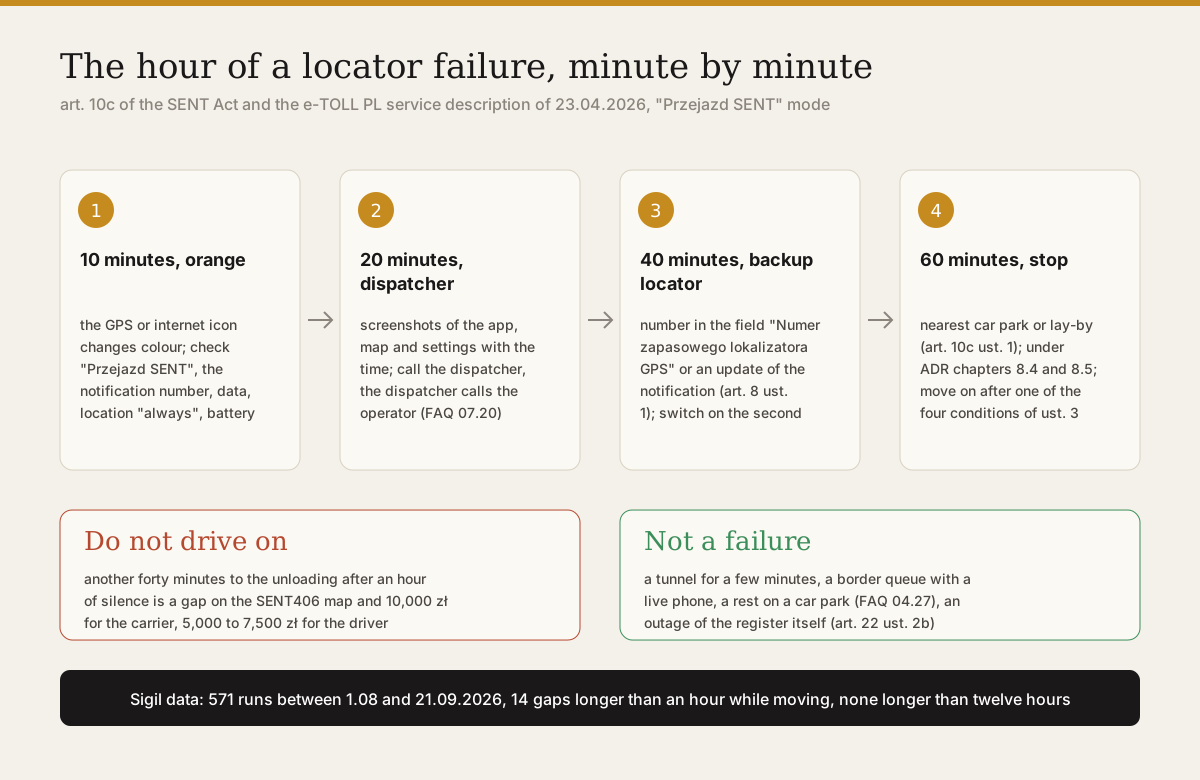
How to tell that the signal is really lost
The signal is lost when the register receives no position, not when the phone briefly loses the satellites. The e-TOLL PL app in the "Przejazd SENT" mode shows this with three icons: battery, GPS and internet. For GPS and internet, orange means a delay over 10 minutes and red a delay over 60 minutes (PUESC service description, updated 23.04.2026). A red icon is already the hour from art. 10c, so the moment to react is orange. The map is more precise than the icon: "Szczegóły przejazdu", then "Pokaż mapę", and if the last point on the map is not where you are standing, the data are not getting through.
Short gaps are normal, not a failure. The register asks for the truck's position a median of 120 times per run, and a tunnel or a valley without coverage produces one or two answers without a position, after which the data return. In our data from 571 runs under RMPD between 1.08 and 21.09.2026 there were 14 gaps longer than an hour while moving, 3 longer than three hours and none longer than twelve. Where the position really gets lost, at the start and the end of a run rather than on the road, is taken apart in How often the system asks for your position on the road.
Is a five-minute tunnel a failure? No. A delay of up to 10 minutes in the SENT mode does not even change the icon's colour. A failure begins where the position is missing for longer, and the statutory hour runs from the last transmitted position, not from the moment the driver looked at the phone.
What to check in the cab in the first ten minutes
The first ten minutes go on five checks, and the order matters, because the first two clear most cases. First: is the app in the "Przejazd SENT" mode at all, and is the right notification number selected. After an app update or a phone restart the run may not be started, and the trip counter stands at zero. Second: is there mobile data. Roaming on a Polish network, an exhausted data plan, background data switched off for this app. Third: the location permission must be "always", not "only while using", otherwise Android and iOS stop the transmission as soon as the screen goes dark.
Fourth: battery saver and app "optimisation". A phone saving power kills background transmission, and the app is silent even though it opens green. Fifth: power. An orange battery, 20 to 50 %, is by the PUESC description a recommendation to stop and plug in the charger; red below 20 % is an order to stop at once.
If the position has not returned after the five checks, the driver calls the dispatcher, not the operator. An OBU or ZSL operator learns about a failure only from the carrier (PUESC FAQ 07.20), and the person to call them is the one who holds the contract number and the device's business number, that is the dispatcher.
When you must stop and after what you may drive on
You must stop when the failure lasts longer than an hour. The act frames it as the driver's duty: if the locator or the external system is out of order for longer than an hour, stop at once at the nearest car park or lay-by (art. 10c ust. 1 of the SENT Act). With dangerous goods under ADR the stop must respect chapters 8.4 and 8.5 of the agreement on supervision of the vehicle (ust. 2). The duty applies equally to SENT and RMPD, because for a non-EU carrier the Road Transport Act refers to the same provisions (art. 28b ust. 5).
You may drive on after one of four (art. 10c ust. 3): the locator or the external system transmits again; the goods are reloaded onto a vehicle with a working locator; the vehicle is fitted with a working locator; customs applies seals or assigns an escort. In practice the fastest way is a second locator in the same cab: a spare OBU or the e-TOLL PL app on the driver's second phone. The backup locator's number can be entered in the notification in advance, in the field "Numer zapasowego lokalizatora GPS" (FAQ 07.14), and if it is not there, the dispatcher adds it by updating the notification, because carrier data may be updated (art. 8 ust. 1).
May you drive the forty minutes to the unloading if the hour has already passed? No. The act says "niezwłocznie", at once, and the distance to the unloading does not appear in it. Forty minutes of driving without a position after an hour of silence is exactly the stretch the inspector sees as a gap on the SENT406 map, and exactly what the 10,000 zł is written for.
Tunnel, border, rest and a dead phone
A tunnel or a valley without coverage: the position returns within minutes, the icon stays green or orange, nothing to do. A queue at the border: the app must be on from the start of the carriage on Polish territory, that is from the entry, and standing in a queue does not interrupt the positions as long as the phone is alive. A rest on a car park or an overnight stop: breaks required by driving-time rules do not breach the duty, with one caveat, that the next transmission starts from the place of the stop (PUESC FAQ 04.27, 04.36). Forgetting to switch off after unloading: no consequences (FAQ 04.28).
A failure is: a dead or switched-off phone, an app killed by the battery saver, and an OBU that has gone dark. In the first case a charger and pressing "Rozpocznij przejazd" again, if the run has stopped, is enough. In the second the restrictions on the app must be lifted and the run started again. In the third the driver can do nothing: the OBU/ZSL operator registers the device and sends the data, but the carrier answers to the register for the result (art. 10a). That is why the cab needs a second channel, and the cheapest one is the app on a phone.
Does silence count when PUESC itself is down? No. A gap in data caused by unavailability of the register is not fined (art. 22 ust. 2b), and PUESC asks you in that case to follow the notices on the portal (FAQ 04.35). You must, however, be able to tell a register outage from your own internet: how is described in What to do with RMPD and SENT when PUESC is down.
What to show an inspector and what to keep
The inspector sees the SENT406 form on PUESC with a map of positions, and a gap on it is a fact he does not debate. What is debated is the cause, and that is what you must be able to show. The main evidence in the case a court in Kraków decided for the carrier was the screenshots from the driver's phone taken during the check: app on, trip counter running, icons green. The court quashed a 10,000 zł fine for four hours of silence precisely because the authority refused to examine why the app's data had not reached the register (WSA w Krakowie, III SA/Kr 289/26). The case and the reply to a summons are taken apart in Court quashed a 10,000 zł SENT GPS fine, how to appeal.
So during a failure the driver does four things, all with the phone. A screenshot of the app screen with the icons and the counter, with the time visible. A screenshot of the "Pokaż mapę" map with the last point. A screenshot of the location and battery settings for this app. And a call to the dispatcher, whose time stays in the call log. If the truck has stopped, one more screenshot with the stop time and a photo of the car park. The dispatcher, in turn, keeps the time of the call to the operator, the ticket number and the moment the position returned.
Will "the phone went flat" help with the inspector? No. A flat phone is a locator failure for which the carrier is responsible, and the act gives it the same hour. What helps is different: proof that after the hour the truck stood, and proof that after the stop the driver did what ust. 3 requires.
What the dispatcher does while the truck stands
The dispatcher has three tools the driver does not: the register, the operator and the second locator. In the register the dispatcher checks that the notification really carries the business number of the device that is now silent, and whether it has a backup number. If it does, the driver switches on the backup device and transmission continues. If it does not, the dispatcher updates the notification and adds the backup locator's number, because carrier data, the locator number included, are updated without a new notification (art. 8 ust. 1).
The dispatcher calls the OBU or ZSL operator with the device's business number and the notification number. The operator does not see register errors and learns about a failure from the carrier (FAQ 07.20), but does see on their side whether the device connected at all and when it last did. The time of the call and the ticket number stay in the correspondence with the operator.
Third: the dispatcher does not close the declaration. A carriage with an active declaration and silence is a failure that can be explained; a carriage whose declaration was closed in the middle of Poland is a carriage without a notification. The dispatcher also watches the PUESC notices: if "Aktualności" lists an announced break or an outage, a screenshot of that notice is worth more than all the others.
What silence costs
Silence in the register costs the carrier 10,000 zł, about 117,000 ₴ at the NBU rate of 11.74 ₴/zł on 21.09.2026, and the act does not ask whether the carrier is at fault (art. 22 ust. 2a of the SENT Act). The authority may waive the fine only where an important interest of the carrier or the public interest requires it (art. 22 ust. 3), and replies to a summons are built on that provision. A gap caused by unavailability of the register is not fined (ust. 2b).
The driver pays separately. For a locator not switched on and for not stopping after an hour of failure the act provides 5,000 to 7,500 zł (art. 32 ust. 1 pkt 2 and 3). On a run under RMPD the driver is also liable under the annex to the Road Transport Act: 2,000 zł for carriage without a locator switched on (załącznik nr 1 lp. 2b). For a company with two trucks 10,000 zł is the profit of several runs, taken by one hour in which nobody looked at the icon.
What to do
- Look at the icons at every stop and every exit: an orange GPS or internet icon is a signal to act, not to wait for red.
- Check in the first ten minutes: "Przejazd SENT" with the right number, mobile data, location "always", battery saver, charging.
- Take screenshots of the app, the map and the settings with the time visible.
- Call the dispatcher; the dispatcher calls the operator and adds the backup locator to the notification.
- Switch on the backup locator as soon as its number is in the notification.
- Stop at the nearest car park if an hour has passed since the last position; under ADR with chapters 8.4 and 8.5 in mind.
- Move on only after one of the four conditions of art. 10c ust. 3, and keep the time the position returned.
What not to do
- Do not drive "another forty minutes to the unloading" after an hour of silence. That is the gap the inspector sees on the map, and 10,000 zł.
- Do not switch the phone off to "restart the app" while moving. Every minute without a position adds to the hour.
- Do not close the declaration in the middle of Poland so that "there is no silence". That is carriage without a notification, not a failure.
- Do not rely on one device. A second phone with e-TOLL PL in the cab costs less than one fine.
- Do not explain a failure in words. Screenshots with the time, the call log and the stop time speak for you.
Where technology fits in
Sigil asks SENT-GEO for the truck's position the whole time an RMPD declaration is active and shows the dispatcher the status "GPS problem" as soon as the register answers that there is no position. What each status means and what to do with it is in the help article RMPD statuses. The dispatcher sees the silence before the driver looks at the phone, and has the same hour to make the call. The history of checks stays in the declaration: when the position was there, when it disappeared, when it came back, and that is what goes into the reply to a summons. Who is responsible for the locator, where its number comes from and when to switch it on and off is covered in What SENT-GEO demands of the carrier and the locator.
The locator, the driver's app and the stop on the car park remain on the carrier's side: Sigil sees the silence but cannot break it.
Sigil handles RMPD declarations and watches the position in SENT-GEO. The SENT notification is filed by the consignor or consignee, and the locator on the road is switched on by the driver.
A demo or training for your team
30 minutes online. We show how Sigil™ files an RMPD from a CMR and answer questions about your runs.
Frequently asked questions
- From which moment does the hour of a locator failure count?
- From the last position the register received. Not from the moment the driver noticed the orange icon. In the "Przejazd SENT" mode orange appears at a delay over 10 minutes and red over 60, so a red icon means the hour has already passed.
- Do I have to stop if the signal disappeared in a tunnel?
- No. A delay of up to 10 minutes does not even change the icon's colour, and the position returns by itself after the tunnel. A stop is mandatory only for a failure longer than an hour (art. 10c ust. 1 of the SENT Act).
- May I drive on after the stop?
- Yes, after one of four conditions. The locator transmits again; the goods are reloaded onto a truck with a working locator; the truck is fitted with a working locator; customs applies seals or assigns an escort (art. 10c ust. 3). The fastest way is a backup locator entered in the notification.
- Is a rest break a failure?
- No. Breaks required by driving-time rules do not breach the duty. The next transmission must start from the place of the stop (PUESC FAQ 04.27, 04.36).
- What does an hour of silence cost?
- 10,000 zł for the carrier and 5,000 to 7,500 zł for the driver. That is about 117,000 ₴ and 59,000 to 88,000 ₴ at the NBU rate of 11.74 ₴/zł on 21.09.2026 (art. 22 ust. 2a, art. 32 ust. 1 of the SENT Act). A gap caused by unavailability of the register itself is not fined (art. 22 ust. 2b).
Sources
Legislation, as in force on the publication date:
- Act of 9 March 2017 on the system for monitoring the road and rail carriage of goods (SENT Act), ISAP, consolidated text Dz.U. 2024 poz. 1218: art. 8 ust. 1, art. 10a, art. 10b, art. 10c ust. 1, 2 and 3, art. 22 ust. 2a, 2b and 3, art. 32 ust. 1 pkt 2 and 3.
- Act of 6 September 2001 on road transport, ISAP, consolidated text Dz.U. 2024 poz. 1539 as amended by Dz.U. 2024 poz. 1544: art. 28b ust. 5, Annex 1 item 2b.
Authorities:
- Send the vehicle's geolocation data to the SENT register with the e-TOLL PL mobile app, PUESC, service description, updated 23.04.2026: the "Rozpocznij przejazd" and "Zakończ przejazd" buttons, "Szczegóły przejazdu" and "Pokaż mapę", thresholds of the battery, GPS and internet icons, separate for the SENT mode (10 and 60 minutes).
- SENT FAQ, PUESC: answers 04.27, 04.28, 04.35, 04.36, 07.14, 07.20.
- News, group Niedostępności, PUESC: notices about register breaks.
Case law:
- Judgment of the Regional Administrative Court in Kraków of 13.05.2026, ref. III SA/Kr 289/26, CBOSA: app screenshots as evidence, the authority's duty to examine the cause of the gap.
Own data: 571 runs under RMPD between 1.08 and 21.09.2026 in Sigil, SENT-GEO position queries; a median of 120 queries per run, 14 gaps longer than an hour while moving, none longer than twelve hours. Platform data, not market data.
Rate: official hryvnia to zloty rate, National Bank of Ukraine, 11.74 ₴/zł on 21.09.2026.
Read next
- What SENT-GEO demands of the carrier and the locatorWhat Poland's SENT-GEO demands of carrier and driver: a locator on the whole Polish leg, three ways to transmit (e-TOLL PL, OBU, ZSL), on and off times, fines.
- How often SENT-GEO checks your truck's position in PolandGPS monitoring in SENT on our own data: 212 position checks per transport, where the signal really gets lost, how much silence is a problem, what to do.
- Court quashed a 10,000 zł SENT GPS fine, how to appealThe driver's app showed green while SENT saw 4 hours of silence. The Kraków court quashed the 10,000 zł fine as automatic punishment. What to do about yours.
- What to do with RMPD and SENT when PUESC is downWhen Poland's PUESC portal is down, RMPD and SENT are filed with a replacement document by e-mail to GITD or KAS. Addresses, format, proof, can the driver go.
Sigil™ turns a CMR into an RMPD declaration and files it with PUESC — with every field checked against the original.
More on this topic: GPS monitoring