GPS monitoring
How often SENT-GEO checks your truck's position in Poland
GPS monitoring in SENT on our own data: 212 position checks per transport, where the signal really gets lost, how much silence is a problem, what to do.
Published · Author: Makaiev Kostiantyn Oleksandrovych, founder of Sigil RMPD

In brief: on our platform's data, 571 transports from 1 August to 21 September 2026, one transport's position is checked 212 times on average over 2.7 days of monitoring · one check in seven (13.7 %) comes back as "no stored location in the system" · the signal is lost not on the road but at the edges of the trip: 47 % of transports begin in silence, 40 % end in silence, only 7 % have a gap in the middle · monitoring starts the moment the declaration becomes active, not when the driver pulls out · a locator failure longer than an hour obliges the driver to stop (art. 10c ust. 1 of the SENT Act) · an inactive locator costs the carrier 10,000 zł and the driver 2,000 zł.
Poland's SENT system records the position of a monitored truck hundreds of times per trip. On our platform's data, across 571 transports from 1 August to 21 September 2026 the system made 121,122 position checks, 212 per transport on average, with monitoring lasting 2.7 days on average. One check in seven found no position at all, and almost always that happened at the start or the end of the transport, not somewhere on a Polish motorway.
When position monitoring starts and when it ends
Monitoring starts the moment the declaration in PUESC becomes active and lasts until it is closed. Not when the driver switches the locator on, and not when the truck moves. This is the main reason the driver and the system see two different trips.
SENT is Poland's system for monitoring the road carriage of sensitive goods: fuels, alcohol, tobacco, and since 2022 a growing list of foodstuffs. Every monitored transport must transmit its position throughout its time on Polish territory. For a carriage under SENT the duty sits in art. 10a ust. 1 of the SENT Act; for a non-EU carrier working under an RMPD declaration it sits in art. 28b ust. 5 of the Road Transport Act. The data source is the locator: the SENT GEO or e-TOLL PL app on the driver's phone, or an external GPS device whose number is written into the declaration. The data lands in the SENT-GEO subsystem, and that is where everyone who wants to know where the truck is goes to read it: the roadside inspector, the carrier, the platform that manages the declaration.
The driver switches the locator on before the carriage begins and off no earlier than at delivery or on leaving Poland (art. 10b of the SENT Act). Between those two moments every "no position" answer is recorded against the carrier, whether the truck is loading, queuing at the border or driving.
How many times a position is checked in one transport
On our platform's data, 212 checks per transport on average; half of all transports have up to 120 checks, one in ten more than 470. These figures describe monitoring from the carrier's side: how often Sigil asked SENT-GEO for the truck's position while the declaration was active. How often the inspection services look, the system does not disclose.
| Indicator | Value |
|---|---|
| Transports with position monitoring | 571 |
| Period | 1 August to 21 September 2026 |
| Position checks in total | 121,122 |
| Checks per transport, mean | 212 |
| Checks per transport, median | 120 |
| One transport in ten | more than 470 checks |
| Monitoring duration, mean | 2.7 days |
| Monitoring duration, median | 1.7 days |
| One transport in ten | more than 8 days under monitoring |
The gap between mean and median tells the story. A typical trip across Poland closes within one and a half to two days. But one in ten stays open for more than a week, and for that whole week the system expects a position. A declaration nobody closed after unloading is not "nothing happened"; it is seven days of "no location" answers.
What the system sees when the locator is silent
When the locator is not transmitting, SENT-GEO answers literally: "Nie można pobrać ostatniej zapisanej w GEO lokalizacji", "the last location stored in GEO cannot be retrieved". On our platform's data 13.7 % of checks ended this way, 16,579 out of 121,122. This is not a connection failure between us and PUESC; it is the system itself saying that at this moment it holds not a single point for this transport.
Does one such answer mean a fine? No. The fine is imposed for a transport during which data were not transmitted, not for a single check. But every such answer is recorded, and during an inspection these records are what builds the picture "the carrier failed to ensure transmission". The causes will have to be explained afterwards, in reply to the authority's summons, as in the case we analysed in the article on the Kraków court ruling on a GPS gap.
Where the signal is really lost
The signal is lost at the edges of the trip, not on the road. This is the most important finding in our data and it contradicts what carriers fear most.
| Where in the transport there is no position | Transports | Share of 571 |
|---|---|---|
| At the start: declaration already active, locator not yet transmitting | 269 | 47 % |
| At the end: locator already off, declaration not yet closed | 227 | 40 % |
| In the middle: a gap between two stretches with a position | 38 | 7 % |
| Mid-trip gap longer than one hour | 14 | 2.5 % |
| Mid-trip gap longer than three hours | 3 | 0.5 % |
| Mid-trip gap longer than twelve hours | 0 | 0 % |
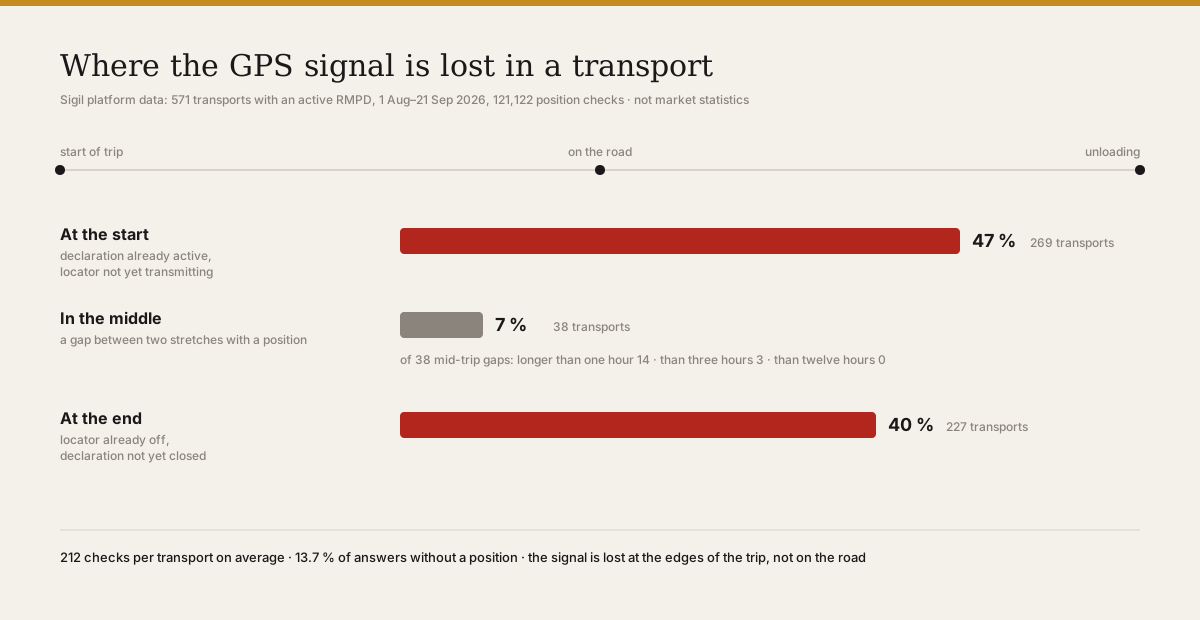
Almost half of all transports start in silence. The declaration is filed, the number issued, the truck is still loading or waiting at the border, the locator is off or the app has no permission to use location in the background. To the system it all looks the same: transport active, no position.
Forty per cent end in silence. The driver has unloaded and closed the app; the dispatcher has not closed the declaration. Every hour until closure adds answers without a position.
Only 7 % have a gap while moving. Of those, gaps longer than an hour, the ones that already trigger the duty to stop, number fourteen in 571 transports. Not one exceeded twelve hours. Tunnels, poor coverage near the border and a dead phone battery happen, but they are not the main threat. The main threat is a "start journey" button pressed too late and a declaration closed too late.
How much silence is already a problem
One hour. If the locator failure lasts longer than an hour, the driver must stop without delay at the nearest car park or lay-by (art. 10c ust. 1 of the SENT Act) and not move until transmission resumes or the authority decides otherwise. The rule applies to RMPD carriages too.
Is the hour a "safe zone" in which a gap does not count? No. The hour is the threshold after which the driver has to be stationary. The gap itself, even a ten-minute one, is recorded in the system. In case II GSK 659/23 Poland's Supreme Administrative Court looked at gaps longer than an hour and quashed the fine because the driver's app showed every icon green and the authority never examined the causes. In case II GSK 1324/22 the gaps lasted 5 and 9.5 hours, the driver knew the locator was down and drove on; the fine stood. The difference was not the length of the gap but whether the driver knew and what he did.
The practical conclusion for a dispatcher: the gap must be seen before the hour is up. The driver watches the road, not the icon. So somebody other than the driver has to be watching the position during the trip.
What an inactive locator costs
The carrier 10,000 zł, the driver 2,000 zł, and the two fines do not exclude each other.
| Breach | Amount | Who pays | Basis |
|---|---|---|---|
| Failure to ensure geolocation transmission, RMPD carriage | 10,000 zł (about 118,000 ₴ at the NBU rate of 11.80 on 22.09.2026) | carrier | Road Transport Act, Annex 3, item 3.2b |
| Failure to ensure geolocation transmission, SENT carriage | 10,000 zł (about 118,000 ₴) | carrier | SENT Act, art. 22 ust. 2a |
| Driver did not switch the locator on, or switched it off early, RMPD carriage | 2,000 zł (about 23,600 ₴) | driver | Road Transport Act, Annex 1, item 2b |
| Driver broke the locator rules, SENT carriage | 5,000 to 7,500 zł | driver | SENT Act, art. 32 ust. 1 |
The carrier's fine does not depend on fault: the authority needs only the absence of data. Fault and circumstances matter at the second stage, when the authority decides whether to waive the fine (art. 22 ust. 3 of the SENT Act for SENT; for RMPD only art. 92c ust. 1 pkt 1 of the Road Transport Act, meaning circumstances beyond the carrier's control). A carrier from a country without an enforcement agreement with Poland pays a deposit at the roadside (art. 31 of the SENT Act, art. 94 ust. 3 of the Road Transport Act). The full table of fines with commentary is in the article on SENT and RMPD fines in 2026.
Where Sigil fits
Sigil asks SENT-GEO for the truck's position for as long as the RMPD declaration is active, shows it on a map in the declaration's record and warns the dispatcher when the system answers that there is no position. The history of checks stays with the declaration, so when the authority calls there is something to show: when the position was there, when it vanished and when it came back. The locator, the driver's app and closing the declaration remain on the carrier's side; Sigil shows what the system sees and cannot transmit a position on behalf of a locator that is switched off. Sigil does not handle SENT declarations; this concerns RMPD carriages only. How to build a declaration so that the locator number in it is the right one is covered in the CMR to RMPD field map.
Where the locator number comes from, when to switch it on and off and what to do in a failure longer than an hour is taken apart in What SENT-GEO demands of the carrier and the locator.
What to do
- Switch the locator on before the declaration becomes active, not after leaving the depot. If the locator is an app, check that location permission is set to "always", not "while using".
- Check that the locator number in the declaration matches the device in the truck. A different number means the system is waiting for data from a device that is not on this trip.
- Watch the position in the system, not only in the driver's app. A green icon on the phone and an empty SENT-GEO answer happen at the same time; that was exactly the Kraków case.
- Stop when there has been no position for more than an hour, and note the time and place. It is the driver's duty under art. 10c ust. 1, and for the carrier it is proof that the driver acted correctly.
- Close the declaration immediately after unloading or leaving Poland. Every hour of an open declaration after the locator is off is an hour of "no position" answers.
- Keep the position history at least until the period in which the authority may impose a fine has run out. App screenshots, tachograph data and the route from the carrier's own tracking system decided case III SA/Kr 289/26.
What not to do
- Do not switch the locator on "once we're moving". The declaration is already active, and 47 % of transports in our data start with exactly this mistake.
- Do not close the app straight after unloading if the declaration is still open. Close first, switch off second.
- Do not treat the hour as a "permitted gap". The hour is the stopping threshold, not a zone in which the gap does not count.
- Do not rely on the driver noticing the failure. He is driving; the dispatcher is the one who should see the position in the system.
- One locator, one number in the declaration, switched on before the start and off after closure. That removes two of the three causes of silence.
A demo or training for your team
30 minutes online. We show how Sigil™ files an RMPD from a CMR and answer questions about your runs.
Frequently asked questions
- Is a gap shorter than an hour recorded?
- Yes. Every SENT-GEO answer without a position is stored in the system regardless of how long the gap lasts. The hour in art. 10c ust. 1 of the SENT Act is the threshold after which the driver must stop, not a period during which the gap "does not count".
- When does GPS monitoring start, at departure or at filing?
- The moment the declaration becomes active. The locator must transmit data throughout the transport on Polish territory (art. 10a ust. 1 of the SENT Act, art. 28b ust. 5 of the Road Transport Act). On our platform's data, 47 % of transports begin in silence precisely because the locator was switched on after the declaration was activated.
- What must the driver do when there is no position for more than an hour?
- Stop. At the nearest car park or lay-by, and not move until transmission resumes (art. 10c ust. 1 of the SENT Act). Note the time and place: a driver who saw the failure and drove on lost case II GSK 1324/22.
- Can the app be closed straight after unloading?
- Not until the declaration is closed. The locator is switched off no earlier than at delivery or on leaving Poland (art. 10b), and the system expects a position until the declaration is closed. On our platform's data, 40 % of transports end in silence because of the order "switched off first, closed second".
- How much does an inactive locator cost?
- The carrier 10,000 zł, about 118,000 ₴ at the NBU rate of 11.80 on 22.09.2026 (Annex 3, item 3.2b of the Road Transport Act for RMPD; art. 22 ust. 2a of the SENT Act for SENT). The driver additionally 2,000 zł in an RMPD carriage (Annex 1, item 2b) or 5,000 to 7,500 zł in a SENT carriage (art. 32 ust. 1).
Sources
Legislation, as in force on the day of publication:
- Act of 9 March 2017 on the system for monitoring the road and rail carriage of goods and trade in heating fuels (SENT Act), ISAP, consolidated text (Dz.U. 2024 poz. 1218): art. 10a ust. 1, art. 10b, art. 10c ust. 1, art. 22 ust. 2a and 3, art. 31, art. 32 ust. 1.
- Act of 6 September 2001 on road transport, ISAP, consolidated text: art. 28b ust. 5, art. 92c ust. 1 pkt 1, art. 94 ust. 3, Annex 1 (item 2b), Annex 3 (item 3.2b).
Case law: NSA II GSK 659/23 (16 January 2024), NSA II GSK 1324/22 (5 February 2026), WSA Kraków III SA/Kr 289/26 (13 May 2026), Central Database of Administrative Court Rulings.
Own data: Sigil's table of position checks, 571 transports with an active RMPD declaration, 1 August to 21 September 2026, 121,122 checks; computed on 21 September 2026. NBU rate 11.80 ₴ per złoty on 22 September 2026.
Read next
- Court quashed a 10,000 zł SENT GPS fine, how to appealThe driver's app showed green while SENT saw 4 hours of silence. The Kraków court quashed the 10,000 zł fine as automatic punishment. What to do about yours.
- SENT and RMPD fines 2026, amounts, who pays, how to appealEvery SENT and RMPD fine in one table: amount in złoty and hryvnia, who pays, article number with a link. Appeal deadlines and the difference between two acts.
- How CMR data get into an RMPD, field by fieldWhich CMR box goes into which RMPD100 field, what the CMR lacks (type of carriage, permit, border), what the RMPD lacks (goods, CN). Three fields that diverge.
- What SENT-GEO demands of the carrier and the locatorWhat Poland's SENT-GEO demands of carrier and driver: a locator on the whole Polish leg, three ways to transmit (e-TOLL PL, OBU, ZSL), on and off times, fines.
Sigil™ turns a CMR into an RMPD declaration and files it with PUESC — with every field checked against the original.
More on this topic: GPS monitoring