RMPD
Closing and cancelling an RMPD, deadlines and consequences
An RMPD can be cancelled only before the carriage starts. Closing is not serviced and the register closes the filing itself. What to do with an expired number.
Published · Author: Makaiev Kostiantyn Oleksandrovych, founder of Sigil RMPD
A dispatcher filed an RMPD on Tuesday for a Wednesday loading. The customer moved the loading to Friday, then cancelled the run, then gave another load to the same tractor unit. A filing with a number nobody closed is sitting in the register, and the dispatcher is looking for a "close" button on PUESC. There is none. The question of what to do with it comes back once a week in every company with more than three trucks.
This article explains how the life of an RMPD filing really ends: when cancelling is allowed, why closing does not work, what the register does on its own, and how to handle an expired number. For a reader outside Poland: RMPD is the notification a non-EU carrier files for every run across Poland, and PUESC is the portal that holds the register.
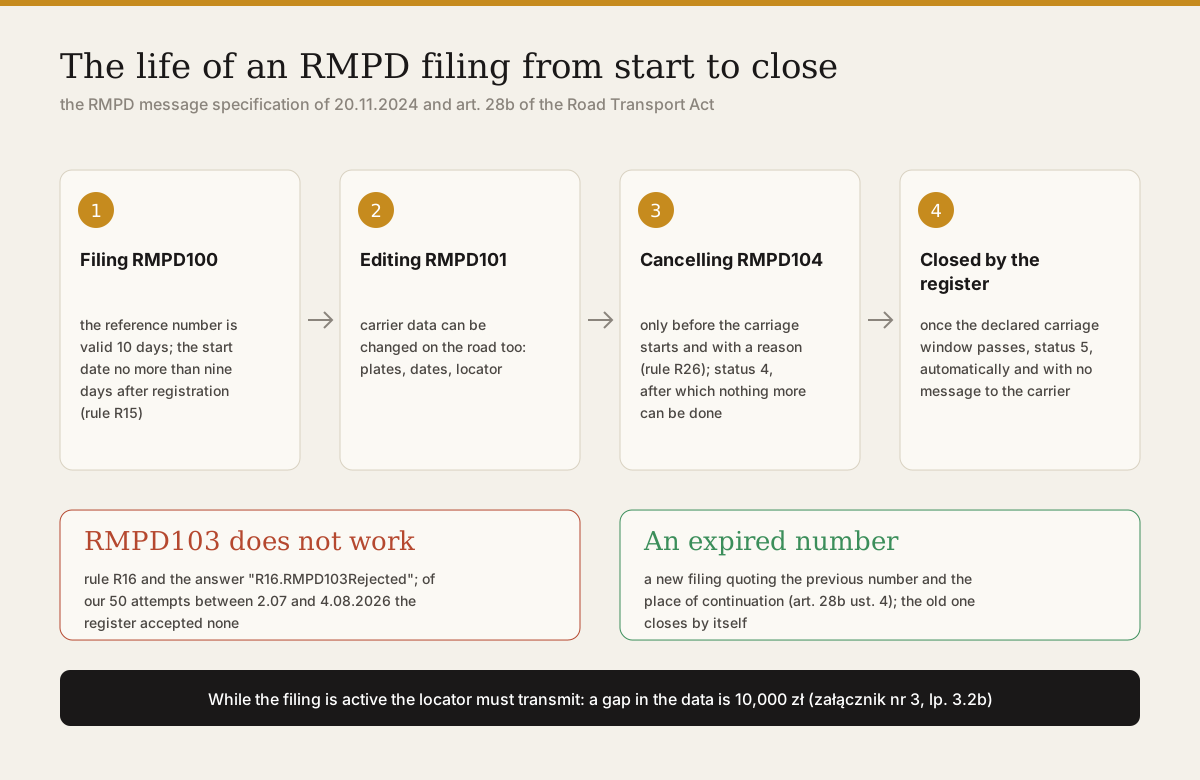
In brief: cancelling a filing (RMPD104) is possible only before the carriage starts, which is rule R26 of the RMPD message specification of 20.11.2024 · once the carriage has started, cancelling is closed and only editing the carrier data remains (RMPD101) · closing a filing (RMPD103) is not serviced by the register: rule R16 and the live answer "R16.RMPD103Rejected: Przesłany komunikat nie jest aktualnie obsługiwany" · the register closes the filing itself once the declared carriage window has passed, status 5 "closed automatically", and sends no message about it · the reference number is valid for 10 days (art. 11 ust. 1 of the SENT Act through art. 28b ust. 5 of the Road Transport Act) · if the number expires while the carriage continues, a new filing is made quoting the previous number and the place of continuation (art. 28b ust. 4) · the start date may not be more than nine days after the date of registration (rule R15), and in our data none of the 50 RMPD103 messages sent between 2.07 and 4.08.2026 was accepted, while all 19 RMPD104 cancellations between 1.07 and 25.09.2026 went through.
An RMPD can be cancelled only before the carriage has started. Closing exists as a separate operation in the specification but does not work: PUESC answers with a rejection and closes the filing itself once the declared window has passed. The practice is therefore simple: cancel before departure, leave it alone after departure, and replace an expired number with a new filing that quotes the previous one.
When a filing may be cancelled
Cancelling is possible only before the carriage starts. That is rule R26 of the Technical Specification of RMPD System Messages of 20 November 2024, and it has no exceptions: the register accepts an RMPD104 message only while the carriage has not begun. Cancelling asks for a reason, which goes into the register together with the number.
After cancelling, the filing takes status 4, "cancelled". Nothing more can be done with it: the specification states plainly that a document will not be processed when the filing has the cancelled status. Cancelling is a final act, not a way to fix data.
Can a filing be cancelled once the truck is already in Poland? No. Rule R26 closes that path the moment the carriage starts. If the data change on the road, they are edited with an RMPD101 message.
Why closing does not work
Closing a filing is a separate message, RMPD103, described in the specification but not serviced by the register. The rules table carries R16 with the text "Nie jest możliwe przesłanie komunikatu RMPD_103", and a live attempt comes back as "R16.RMPD103Rejected: Przesłany komunikat nie jest aktualnie obsługiwany".
This is not theory. Between 2 July and 4 August 2026 we sent 50 RMPD103 messages from production, received rejections under rule R16 and stopped sending them. These are our platform's data, not the market's. The practical conclusion for a dispatcher: the "close" button is missing from PUESC not because it was overlooked but because the operation does not work.
So what closes a filing? The register does it itself. Once the declared carriage window has passed, the filing moves to status 5, "closed automatically", and no message about it reaches the carrier. The statuses in the register are: 0 registered, 2 complete, 3 closed, 4 cancelled, 5 closed automatically.
How long the reference number lives
The reference number is valid for 10 days from filing. That is art. 11 ust. 1 of the SENT Act, applied to RMPD through the reference in art. 28b ust. 5 of the Road Transport Act. Ten days cover any run across Poland, border queue and weekend included.
The form has one more limit that is mentioned less often. The start date of the carriage may not be earlier than the date the filing was registered, nor more than nine days after it (rule R15 of the specification). Filing for a run two weeks ahead simply will not go through.
Can an RMPD be filed in advance for several runs at once? No. Every transport operation needs its own filing (art. 28b ust. 7), and the nine-day window leaves no room for a stockpile. When a run falls through, the filing is cancelled before departure.
What to do when the number expires on the road
If the number has expired while the carriage continues, a new filing is made for the continuation. The act requires it to quote the previous reference number and the place where the continuation begins under the new number (art. 28b ust. 4). The old filing is not cancelled: it lives out its window and closes automatically.
This is the only situation in which two numbers legitimately sit in the register for one physical carriage. The driver carries the new number and the old one stays in the history. How long filing really takes, and why a margin in days matters more than speed, is taken apart in How long filing an RMPD really takes.
What to do when plans change
Changing plans has three typical scenarios, and each calls for a different move. The loading moves to another day within the nine-day window: edit the filing with an RMPD101 message. The run is cancelled before departure: cancel the filing with RMPD104 and give a reason. The cargo or the route changes after departure: cancelling is no longer allowed, so you edit what may be edited, and when the transport operation itself changes, you file anew.
Swapping the tractor unit is a case of its own. Registration plates are carrier data and are updated by editing while the carriage has not started. After the carriage has started, swapping the unit means a new transport operation, and therefore a new filing. Which data go into the form and what may be changed at all is taken apart in What transfers from CMR to RMPD100 and what does not.
What an unclosed filing risks
An unclosed filing brings no fine of its own: since closing does not work, an inspector cannot demand what the register will not accept. The risk lies elsewhere. While the filing is active, the carrier owes the duty to transmit geolocation (art. 28b ust. 5 through art. 10a of the SENT Act), and a gap in the data costs 10,000 zł (załącznik nr 3, lp. 3.2b of the Road Transport Act).
Hence the practical rule: do not leave an active filing on a tractor unit that is already standing at the yard with the locator off. If the run was cancelled before departure, cancel the filing. If the carriage is over, wait for the automatic close on the declared date instead of switching the locator off earlier. What to do when the locator goes silent on the road is described in What a driver should do when GPS loses signal in Poland.
What mistakes around closing cost
Three amounts are worth keeping in mind. Carriage without a filing is 12,000 zł for the carrier (załącznik nr 3, lp. 3.2a), and a run on an expired number is treated exactly as that. A gap in geolocation on a run under RMPD is 10,000 zł (lp. 3.2b). A driver who fails to produce the number or the replacement document pays 1,500 zł (załącznik nr 1, lp. 2a).
In hryvnia that is roughly 140,000 ₴, 117,000 ₴ and 17,500 ₴ at the NBU rate of 11.67 ₴/zł on 25.09.2026. The full table with the legal bases is collected in SENT and RMPD fines 2026.
What to do
- Run cancelled before departure: cancel the filing with RMPD104 and give the reason.
- Loading moved within the nine days: edit the filing, do not cancel it.
- Carrier data changed on the road: edit, because cancelling after the start is no longer available.
- Number expired while the carriage continues: file anew, quoting the previous number and the place of continuation.
- Carriage finished: do nothing with the filing, the register closes it on the declared date.
- Keep the locator on while the filing is active, even when the truck is already unloaded.
- Before every new filing, check that the previous one on that tractor unit is no longer active.
What not to do
- Do not hunt for a "close" button on PUESC. The register does not service RMPD103, and that is not your mistake.
- Do not cancel a filing in order to fix data. A cancelled filing is final and nothing more can be done with it.
- Do not file two weeks ahead. The start date may not be more than nine days after registration.
- Do not drive on an expired number. That is carriage without a filing, which is 12,000 zł.
- Do not switch the locator off right after unloading while the filing is still active. A gap in the data is 10,000 zł.
Where technology fits in
Sigil carries a declaration to the end. It files, receives the number, edits and cancels it while that is allowed, and records the close locally on the declared date, because the register sends no message about closing automatically. The dispatcher sees in the list which declaration is still active on each tractor unit, so a new one does not go on top of an old one. When a number is running out, the system shows it before the driver finds out at the border.
Cancellations and edits go to PUESC in the same messages the specification describes, and every request with its answer stays in the declaration's history.
Sigil handles RMPD declarations. The SENT notification is filed by the consignor or the consignee, and in transit by the carrier itself on PUESC.
A demo or training for your team
30 minutes online. We show how Sigil™ files an RMPD from a CMR and answer questions about your runs.
Frequently asked questions
- Can an RMPD be cancelled after the carriage has started?
- No. Cancelling is possible only before the carriage starts, which is rule R26 of the RMPD specification of 20.11.2024. After the start only editing the carrier data with an RMPD101 message remains.
- Why is there no button to close a declaration on PUESC?
- Because the register does not service the RMPD103 message. Rule R16 of the specification and the live "R16.RMPD103Rejected" answer confirm it. The register closes the filing itself once the declared carriage window has passed, status 5.
- How long is an RMPD reference number valid?
- 10 days from filing (art. 11 ust. 1 of the SENT Act through art. 28b ust. 5 of the Road Transport Act). The start date of the carriage may not be more than nine days after the date of registration.
- What if the number expires while the truck is still in Poland?
- File anew for the continuation. The new filing quotes the previous reference number and the place where the continuation begins (art. 28b ust. 4). The old filing closes automatically.
- Is there a fine for an unclosed declaration?
- Not for the lack of closing itself. But while the declaration is active the duty to transmit geolocation applies, and a gap in the data is 10,000 zł (załącznik nr 3, lp. 3.2b of the Road Transport Act).
Sources
Legislation, as in force on the publication date:
- Act of 6 September 2001 on road transport, ISAP, as amended by Dz.U. 2024 poz. 1544 in force from 01.11.2024: art. 28b ust. 3, 4, 5, 7 and 10, annex 1 item 2a, annex 3 items 3.2a and 3.2b.
- Act of 9 March 2017 on the system for monitoring the road and rail carriage of goods (SENT Act), ISAP, consolidated text Dz.U. 2024 poz. 1218: art. 10a ust. 1, art. 11 ust. 1.
Specification:
- Technical Specification of RMPD System Messages, version 1.0, Tax Administration Chamber in Zielona Gora, 20.11.2024: messages RMPD_100, 101, 103 and 104, rules R15, R16 and R26, the dictionary of filing statuses (0, 2, 3, 4, 5).
Own data: 50 RMPD_103 messages sent from Sigil production between 2.07 and 4.08.2026, all rejected under rule R16; 19 RMPD_104 cancellations between 1.07 and 25.09.2026, all accepted. Platform data, not market data.
Rate: official hryvnia to zloty rate, National Bank of Ukraine, 11.67 ₴/zł on 25.09.2026.
Read next
- How long an RMPD really takes, from CMR photo to numberRMPD filing time on our own data: median 6 minutes from CMR photo to PUESC number, one in ten over 14. Why the median, what it consists of, what drags on.
- RMPD100, 101, 103, 104 and which document to file whenRMPD documents by code: 100 registration, 101 amendment, 103 closing, 104 cancellation, 406 GPS check. When to file each, the 9-day rule, what open filings do.
- How CMR data get into an RMPD, field by fieldWhich CMR box goes into which RMPD100 field, what the CMR lacks (type of carriage, permit, border), what the RMPD lacks (goods, CN). Three fields that diverge.
- What a driver should do when GPS loses signal in PolandThe SENT locator went silent on the road. What to check in the first ten minutes, when art. 10c says stop, what the dispatcher does, what to show an inspector.
Sigil™ turns a CMR into an RMPD declaration and files it with PUESC — with every field checked against the original.
More on this topic: RMPD