RMPD
RMPD100, 101, 103, 104 and which document to file when
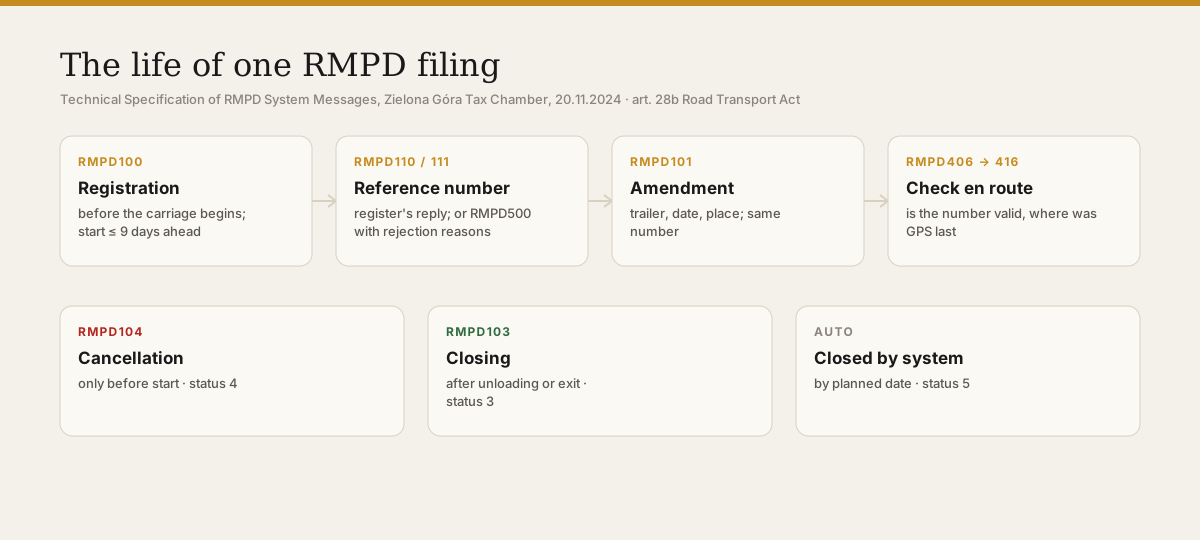
RMPD documents by code: 100 registration, 101 amendment, 103 closing, 104 cancellation, 406 GPS check. When to file each, the 9-day rule, what open filings do.
Published · Author: Makaiev Kostiantyn Oleksandrovych, founder of Sigil RMPD

A dispatcher filed an RMPD for a run to Poznań. In the morning, at loading, the trailer was swapped. The dispatcher could not find how to correct the trailer number, so he filed a new entry. The register now holds two open filings for one tractor: one with the old trailer, one with the new. The driver has two numbers and does not know which to show. The inspector sees both.
The RMPD register speaks in codes: 100, 101, 103, 104, 110, 406. Each code is a separate action at a specific moment of the run. This article explains what each one does, when to send it and what happens if you do not. Written for a reader who meets the Polish register for the first time.
In short: RMPD100 registers a carriage, RMPD101 amends a registered one, RMPD103 closes it after the run, RMPD104 cancels it before the start · the register replies with RMPD110 or 111 carrying the reference number, or RMPD500 with the reasons for rejection · RMPD406 and 416 are the request and reply about the number's validity and the last GPS position · the start date can be set at most 9 days ahead · cancellation is possible only before the carriage begins · closing is due after the run; the register will close it itself, but with a catch · a trailer swap is a 101, not a new 100.
What documents make up the RMPD family
All messages are described in the official technical specification of the RMPD system, issued by the Tax Administration Chamber in Zielona Góra on 20 November 2024. Each refers to art. 28b of the Road Transport Act. Codes with a zero in the middle are what the carrier sends; with a one, the register's replies; with a four, status queries.
| Code | What it does | Who sends it | When |
|---|---|---|---|
| RMPD100 | registers the carriage, i.e. makes the filing | carrier | before the carriage in Poland begins |
| RMPD101 | edits a registered filing | carrier | when data changed: trailer, date, place |
| RMPD103 | closes the filing | carrier | after unloading or leaving Poland |
| RMPD104 | cancels the filing | carrier | only before the carriage begins |
| RMPD110, 111 | confirm acceptance of the filing and assign the reference number | register | in reply to 100 and to later changes |
| RMPD500 | gives the reasons for rejection | register | when 100 or 101 failed validation |
| RMPD400 | verifies keys and returns the filing | carrier | to download one's own filing |
| RMPD406 | asks whether the number is valid and where the GPS was last seen | carrier or a system | during the run |
| RMPD416 | replies to 406: validity of the number and last position in SENT-GEO | register | in reply to 406 |
| RMPD420, 421 | history of the filing and the list of its versions | carrier | to check what changed and when |
On the PUESC portal these actions sit behind form buttons; the codes are visible in form names and confirmations. In systems working through the PUESC web service, the code is in the name of every message. Sigil handles 100, 101, 103, 104 and 406.
What statuses a filing can have
The register keeps five statuses, and the status decides which documents can still be sent: 0 registered, 2 complete, 3 closed, 4 cancelled, 5 closed automatically. A closed or cancelled filing is no longer processed: a 101 or 103 to it comes back rejected. The closing date is the date of the change to status 3, 4 or 5.
What RMPD100 does
RMPD100 is filed before the carriage on Polish territory begins, and it is for this filing that the register returns the reference number in RMPD110. Twelve groups of fields from art. 28b ust. 3: carrier, consignor, consignee, places and dates, countries, cargo, CMR number, permit, registration plate, locator.
A few rules from the specification that carriers trip over most often. The start date cannot be in the past and cannot be later than 9 days from the day of filing. Registration plates without spaces or special characters: AC4533HP, not AC 4533 HP. If an address has no street or house number, the field takes the value BRAK. The locator number is mandatory and checked with a checksum. If the country of loading is not Poland, an entry point must be given; if the country of unloading is not Poland, an exit point.
If something is wrong, RMPD500 with error codes comes instead of 110.
What RMPD101 does
RMPD101 amends an already registered filing; the number stays the same, and the register replies with a confirmation. That is what should have been done with the trailer in the first paragraph: not a new 100, but a 101 to the existing filing.
Updating a filing is a duty, not an option. The SENT Act requires data that changed to be updated (art. 8 ust. 1), and for RMPD that rule applies through art. 28b ust. 5 of the Road Transport Act. An old end date after a route change, or the old trailer after a swap, is "data inconsistent with the facts", for which the carrier pays 12,000 zł (Annex 3, item 3.2a). What inspectors have found in filings is in the article One digit in an RMPD costs 12,000 zł.
The limits are the same as at registration: the start date cannot move before the registration date, nor more than 9 days after it. A closed or cancelled filing cannot be amended.
Can a mistake in an RMPD be corrected after being stopped by an inspector? Technically yes, legally too late. The register will accept the 101, but the breach is already in the protocol and the correction does not undo it.
What RMPD104 does
RMPD104 cancels a filing that will not be used: the run is called off, the goods did not go, the filing was made by mistake. Cancellation is possible only before the carriage begins: the specification says outright that the start date cannot be earlier than the current one. After the start, only closing remains.
A cancelled filing moves to status 4 and is no longer processed. If the run does take place after all, a new RMPD100 is needed.
What RMPD103 does
RMPD103 closes the filing after the carriage in Poland has ended: the goods are unloaded or the truck has left the country. The filing moves to status 3.
Why it matters. As long as the filing is open, the register treats the carriage as ongoing, and the duty to transmit geolocation lasts for the entire route (art. 10a ust. 1 of the SENT Act). An open filing for a truck already parked in Lutsk is a filing whose locator is silent. Second: an inspector who stops the same truck on its next run will see two filings for one registration plate, and the driver will do the explaining. Third: on the way back, the previous filing's number has to be quoted in the new one (art. 28b ust. 4), and the register has to be in order.
The law provides no separate fine for an unclosed filing. The register closes it itself after the planned end date, giving status 5, "closed automatically". But automatic closing hangs on the date entered at registration: if the run overran, the register closes the filing on a truck still driving through Poland, and from then on it drives without a valid number. So the end date is updated with a 101, and the filing is closed with a 103 when the run has really ended.
Sigil closes the filing itself the day after the planned end date, and as soon as it sees the truck has left Poland, right after the exit. How this shows in statuses is in the help article Checking RMPD statuses; cancelling is in Cancelling an RMPD.
What RMPD406 and RMPD416 do
RMPD406 is a query: is the reference number valid, and where did the register last see the locator. RMPD416 is the reply with the last position recorded in SENT-GEO. The inspector on the road makes the same query. The carrier can make it too, and it is the only way to learn about a lost signal before the inspector does.
According to our platform's data, for 346 declarations under GPS monitoring in the period up to 7 September 2026 the system made on average 244 position queries per run. How often the register asks about your position, and what follows from it, will be a separate article.
What exactly sits in each RMPD100 field and where the data the CMR lacks come from is in the article How CMR data get into an RMPD, field by field. All these documents are filed from a basic PUESC account: Which PUESC account a carrier needs.
What to do
- File RMPD100 before entry and set the start date no more than 9 days ahead. The register does not accept filings "in reserve".
- On any change, send RMPD101 to the same filing. Trailer, date, place of unloading, driver.
- Do not file a new 100 while the old one is open for the same tractor. Two open filings are two numbers for one driver.
- Cancel a called-off run with a 104 before the start date. After the start date, cancellation is impossible.
- After unloading or exit, close with a 103 the same day. Do not wait for automatic closing.
- If the run overruns, first a 101 with a new end date, then a 103 when it has ended. Otherwise the register closes the filing on a truck still on the road.
- Before the border, make a 406 yourself or through a system that does it for you. The 416 reply shows whether the number is valid and whether the locator transmits.
What not to do
- Do not "correct" a filing with a new 100. That doubles the filings and confuses the driver and the inspector; a correction is a 101.
- Do not try to cancel after the start. The register refuses; after the start a filing can only be closed.
- Do not leave filings open "just in case". An open filing is an ongoing geolocation duty.
- Do not rely on automatic closing when the run overran. The register closes by the old date while the truck is still in Poland.
- Do not put spaces in registration plates or leave address fields empty. The specification requires
AC4533HPandBRAK; otherwise RMPD500 comes back.
Where Sigil fits in
Sigil sends RMPD100 from data read off the CMR, after the dispatcher's confirmation; changes go as RMPD101, cancellation as RMPD104, closing as RMPD103, and the truck's position is polled with RMPD406 throughout the run, with an alert when the signal disappears. Sigil translates RMPD500 error codes into the name of the field to fix. Sigil does not file the SENT notification about the goods.
Sigil handles RMPD declarations. The SENT notification for the goods is filed by the consignor or the consignee.
A demo or training for your team
30 minutes online. We show how Sigil™ files an RMPD from a CMR and answer questions about your runs.
Frequently asked questions
- How does RMPD101 differ from a new RMPD100?
- 101 amends the existing filing, 100 creates a new one. After a 101 the reference number stays the same and the driver changes nothing. A new 100 while the old one is open gives two filings for one tractor and two numbers for one driver.
- How many days ahead can an RMPD be filed?
- No more than 9 days. Under the specification's rules the start date of the carriage cannot be later than 9 days from the day of filing and cannot be in the past. The same applies to an amendment via RMPD101.
- Can an RMPD be cancelled after the carriage has started?
- No. RMPD104 is accepted only before the start date. After the start, a filing can only be closed with RMPD103 once the carriage in Poland has ended.
- What happens if an RMPD is not closed after the run?
- There is no separate fine, but there are risks. The register closes the filing itself after the planned end date (status 5). While it is open, the geolocation duty continues; on the next run an inspector will see two filings for one plate; and if the run overran, the register closes the filing on a truck still in Poland, which then drives without a valid number.
Sources
Legislation, as in force on the date of publication:
- Ustawa z dnia 6 września 2001 r. o transporcie drogowym, ISAP, consolidated text: art. 28b ust. 1, 3, 4 and 5, załącznik nr 3 (lp. 3.2a).
- Ustawa z dnia 9 marca 2017 r. o systemie monitorowania drogowego i kolejowego przewozu towarów oraz obrotu paliwami opałowymi, ISAP, consolidated text: art. 8 ust. 1, art. 10a ust. 1.
Technical documentation:
- Specyfikacja Techniczna Komunikatów Systemu RMPD, wersja 1.0, Izba Administracji Skarbowej w Zielonej Górze, 20.11.2024 (PUESC document for integrators, with XSD schemas): list of messages RMPD_100–RMPD_500, filing statuses, rules R05–R26 (9 days, cancellation before start, plate format).
- Zgłoszenie przewozu w przypadku międzynarodowego przewozu drogowego rzeczy, PUESC, service description and forms on the portal.
Platform's own data: 346 declarations under GPS monitoring, 84,345 GPS events, on average 244 position queries per run, as of 7 September 2026.
Read next
- What an RMPD is and who must file itRMPD from scratch: what the filing is, who must file it since 1 November 2024, when it is not needed, how it differs from SENT, what happens at entry without it
- What gets fined when one digit in an RMPD costs 12,000 złA wrong digit or date in an RMPD costs 12,000 zł, the same as not filing. Provisions with article numbers, three 2025 roadside checks and what a carrier can do.
- How CMR data get into an RMPD, field by fieldWhich CMR box goes into which RMPD100 field, what the CMR lacks (type of carriage, permit, border), what the RMPD lacks (goods, CN). Three fields that diverge.
Sigil™ turns a CMR into an RMPD declaration and files it with PUESC — with every field checked against the original.
More on this topic: RMPD