PUESC
Filling the RMPD replacement document field by field
The GITD form used when PUESC is down has 46 fields. Field by field: the 1A number, the Polish leg, Latin characters and what counts as proof.
Published · Updated · Author: Makaiev Kostiantyn Oleksandrovych, founder of Sigil RMPD

It is Friday and PUESC has not responded for forty minutes. The dispatcher finds the replacement document form on the GITD website, opens it and sees 46 fields labelled in Polish and English. The explanations on page four cover eight of them. The rest has to be guessed, while the truck stands loaded and the driver waits.
This article goes through the RMPD replacement document field by field. What goes in each one, where the data comes from, which fields stay empty, and the one place where the form misleads anyone filling it in for the first time.
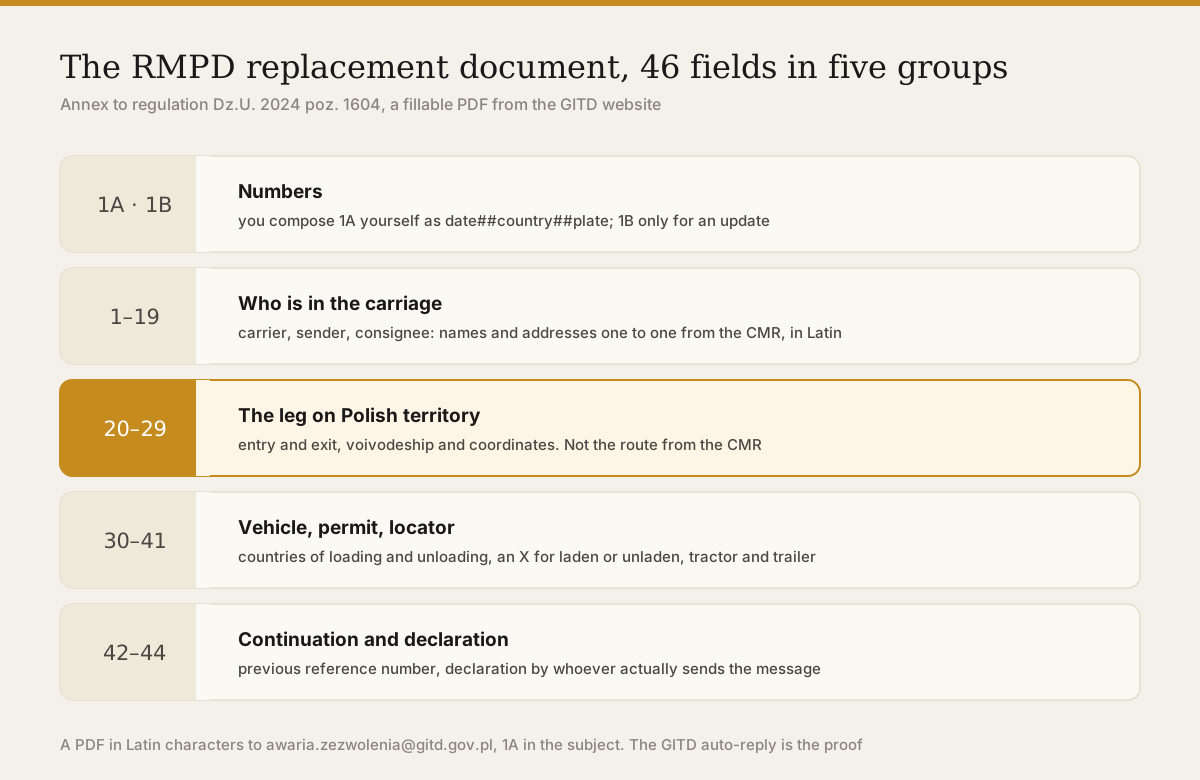
In brief: the form is the annex to the Minister of Infrastructure's regulation of 25 October 2024 (Dz.U. 2024 poz. 1604), a fillable PDF with 46 fields, published at gov.pl/web/gitd/sent in three language versions · you compose the number in field 1A yourself, as YYYY.MM.DD##country code of registration##tractor unit plate, and the date is the day the e-mail goes out, not the day of carriage (§ 2 ust. 1) · fields 20–29 describe the leg on Polish territory, not the route from the CMR (art. 28b ust. 3 pkt 4 and 5), and this is where most people get it wrong · field 1B stays empty for a new notification, as opposed to an update · only Latin characters are allowed (§ 2 ust. 5) · field 44 is signed by whoever actually sends the message (§ 2 ust. 6) · once PUESC is back the same notification is not filed again, because the replacement document already is the notification (§ 2 ust. 1).
The replacement document is completed on the official form from the annex to the regulation, on a computer, in Latin characters, and sent as a PDF to awaria.zezwolenia@gitd.gov.pl. The data is the same as in an ordinary RMPD notification, that is the catalogue in art. 28b ust. 3 and 4 of the Road Transport Act. The difficulty is not the amount of data but the fact that one group of fields means something other than its label suggests.
Where to get the replacement document form
The form is published on the GITD page gov.pl/web/gitd/sent in an editable version in Polish, English and Russian. It is the annex to the Minister of Infrastructure's regulation of 25 October 2024 (Dz.U. 2024 poz. 1604), and the file itself is a fillable PDF, so the fields are clickable and text is typed straight into them.
Can you send your own PDF with the same data instead of the GITD form? No. The regulation says the document is drawn up on the form whose template the annex sets out (§ 2 ust. 5 in connection with ust. 7). A Word table with the same rows is not that form.
The form runs to four pages. Pages one and four hold the explanations in three languages, the fields themselves sit on the two middle pages. There are 46 fields: two numbers at the top, 1A and 1B, and forty-four numbered from 1 to 44.
What goes in fields 1A and 1B
Field 1A, document number. Nobody issues it to you. You compose it yourself from three parts separated by "##": the date as YYYY.MM.DD, the country code of the vehicle's registration and the registration number of the motor vehicle. For a Ukrainian truck it looks like this: 2026.09.27##UA##AA1234BB. The same string goes in the subject line of the e-mail to GITD.
The date here is the day the notification is made, that is the day you send the e-mail (§ 2 ust. 1 pkt 1). Not the loading date, not the departure date and not the date of crossing the border. If the document was prepared in the evening and sent the next morning, the date has to be corrected both in the field and in the subject line.
Field 1B, reference number. In a new notification it stays empty, because there is no number yet: the register is down, which is exactly why you are filling in this form. Field 1B is used only when you update or supplement a notification that did receive a number while PUESC was still working. The subject line then carries both numbers, yours and the reference one, separated by "##" (§ 2 ust. 4).
What data goes in fields 1–19
The first nineteen fields are three blocks with the same structure: who you are, who the sender is, who the consignee is.
| Fields | Block | What to enter |
|---|---|---|
| 1–7 | the foreign entity, that is you | company name, tax identifier, street, building number, town, postcode, country |
| 8–13 | sender of the goods | name, street, number, town, postcode, country |
| 14–19 | consignee of the goods | the same |
Field 2 asks for the tax identification number of the party filing, and only where that party is obliged to hold one (art. 28b ust. 3 pkt 1 lit. c). A carrier from outside the EU enters its own national number here, not a Polish NIP, which it does not have. Our own data shows what PUESC accepts here. Across 278 declarations confirmed with a reference number between 25.06 and 25.09.2026, the carrier is identified by its own national number, an eight-digit ЄДРПОУ or a ten-digit РНОКПП, never by a Polish NIP.
Sender and consignee data come from the CMR and are transferred one to one. A divergence between the CMR and the notification is itself grounds for a penalty, so nothing here gets corrected at your own discretion. How these fields map into an ordinary RMPD is covered separately in How CMR data reaches the RMPD.
Why fields 20–29 are not the route from the CMR
Fields 20–29 describe the leg of the carriage on Polish territory, not the route from warehouse to warehouse. The label on the form is short, "Data rozpoczęcia przewozu", and that is what misleads. The meaning comes from the Act: art. 28b ust. 3 pkt 4 and 5 speak of the place and date of the beginning and the end of the carriage on the territory of the Republic of Poland.
The simplest proof sits in the form itself. Fields 23 and 27 ask for a województwo, a Polish voivodeship. There is no voivodeship in Lutsk and none in Berlin, only in Poland. If these fields described the whole route, both rows would make no sense.
| Field | What to enter |
|---|---|
| 20, 21 | date of entry and date of exit, format DD.MM.YYYY |
| 22, 26 | town, border crossing or road number where the carriage on Polish territory begins and where it ends |
| 23, 27 | the voivodeship for each of those two points |
| 24, 25, 28, 29 | the geographic coordinates of those points, longitude and latitude |
What goes in field 22 when the truck enters from Ukraine? The border crossing. Dorohusk or Korczowa, for instance. Carriage on Polish territory begins at the border, not at the sender's warehouse in Kovel. If instead this is cabotage and loading happens inside Poland, then field 22 carries that Polish town.
What goes in fields 30–41
| Fields | What to enter |
|---|---|
| 30, 31 | country of loading and country of unloading, real countries here, not Poland by default |
| 32, 33 | an "X" in one of the two: laden carriage or unladen carriage |
| 34, 35 | country of registration and registration number. For a vehicle combination the trailer or semi-trailer is entered as well |
| 36 | number of the permit under art. 28 ust. 1 or art. 29 ust. 1 of the Road Transport Act |
| 37 | legal basis for exemption from the permit, where no permit is required |
| 38, 39 | validity period of the ECMT permit and the carrier's state of establishment, for ECMT carriage only |
| 40 | number of the transport document, that is the CMR number |
| 41 | number of the locator or of the device transmitting geolocation data |
Fields 36 and 37 are mutually exclusive. A Ukrainian carrier normally fills in 37 rather than 36, because the exemption from the permit follows from the agreement between Ukraine and the EU, in force until 31 March 2027. Field 41 is mandatory exactly as in an ordinary notification, because an outage of the register does not lift the duty to transmit geolocation data.
When fields 42, 43 and 44 are used
Fields 42 and 43 cover one situation: the reference number of the previous notification has expired and the carriage continues. Field 42 then carries that previous number and field 43 the place where the continuation begins (art. 28b ust. 4). In the ordinary case both stay empty.
Field 44 is a declaration that the person filing the document is authorised to act on behalf of the carrier. It is filled in by whoever actually presses send. If the message goes from a dispatcher rather than the owner, field 44 carries the dispatcher's details. This is not a formality. The regulation expressly requires such a person, in performing that act, to declare that they act in the name and on behalf of the carrier (§ 2 ust. 6).
What to do about Cyrillic
The document is completed in Latin characters only (§ 2 ust. 5). This covers everything: company name, address, town, the name in field 44. GITD will not accept a form filled in Cyrillic, and you will find out when the auto-reply fails to arrive.
For a Ukrainian carrier that means transliterating names and addresses. Use the same Latin form the company already uses in ordinary RMPD notifications rather than inventing a new one: two different spellings of the same company easily turn into questions. Cyrillic in the data is, incidentally, one of the frequent reasons PUESC rejects a notification in normal operation too, code R01, examined in The most common reasons PUESC rejects a notification.
What a mistake in the replacement document costs
The replacement document is a full notification, so liability for it is the same as for a notification in the register.
| Breach | Amount | Who pays | Basis |
|---|---|---|---|
| No notification, or data incomplete or untrue | 12 000 zł | carrier | załącznik nr 3, lp. 3.2a |
| Geolocation data not transmitted | 10 000 zł | carrier | załącznik nr 3, lp. 3.2b |
| Driver failed to produce the notification number | 1 500 zł | driver | załącznik nr 1, lp. 2a |
For a firm running three trucks, 12 000 zł is roughly a month of drivers' wages, paid for one form that was never filled in.
Does the notification have to be filed in the register again once PUESC is back? No. The regulation states that the carrier makes the notification by sending the replacement document (§ 2 ust. 1). The replacement document is not a temporary stopgap but the notification itself, and no provision requires repeating it in the register. A new notification makes sense only if you want a reference number for the rest of the route.
What to do
- Confirm the register really is unavailable: the "Niedostępności" notices on PUESC and a retry after 10 minutes. The order of steps during an outage is set out in What to do with RMPD and SENT when PUESC is down.
- Download the form from gov.pl/web/gitd/sent and open it in a PDF reader that handles form fields.
- Compose the 1A number from today's date, the country code and the tractor unit's plate. Copy it into the subject line.
- Fill fields 1–19 from the CMR one to one, in Latin characters.
- Enter in fields 20–29 the entry into and exit from Poland, with the voivodeship and coordinates, not the sender's and consignee's warehouses.
- Check fields 32 and 33: the "X" stands in exactly one of them.
- Send the PDF to awaria.zezwolenia@gitd.gov.pl and wait for the auto-reply. Without it the notification is not filed.
- Hand the driver two files before departure: the PDF itself and the confirmation e-mail (art. 28c ust. 1).
What not to do
- Do not send your own form or a scan of one filled in by hand. The regulation requires the form from the annex, completed on a computer (§ 2 ust. 5), and the wrong form means no notification at all.
- Do not put the CMR's loading and unloading places in fields 22 and 26. These are fields about entering and leaving Poland, as the voivodeship in fields 23 and 27 confirms.
- Do not put the date of carriage in field 1A. It carries the date the message is sent, and if sending slips to the next day the date changes with it.
- Instead, keep the auto-reply and give the driver both files, because without the confirmation the driver must refuse to begin the carriage (art. 28c ust. 2).
Where technology fits in
Every piece of data the replacement document asks for is already in the notification: carrier, sender, consignee, entry into and exit from Poland with coordinates, CMR number, locator number. An outage of the register does not change the data, it changes only the channel by which the data reaches the state.
That fields 22–29 concern Poland specifically is visible from the technical side as well. Before every filing Sigil checks the latitude of the entry and exit points against the range 49.0000 to 54.8400, that is the bounds of Poland, and a notification carrying the coordinates of a warehouse in Kovel does not pass that check. The system transfers CMR data one to one, the dispatcher confirms every field, and nothing is corrected on their behalf. The state of the service before filing is shown on the PUESC status page, and who has to file an RMPD at all, and from what weight, is explained in What RMPD is and who must file it.
Sigil handles RMPD declarations. The replacement document goes to GITD from the carrier's own mailbox: the confirmation arrives at the sender's address, and that confirmation is the proof of filing.
A demo or training for your team
30 minutes online. We show how Sigil™ files an RMPD from a CMR and answer questions about your runs.
Frequently asked questions
- Can the replacement document be sent while PUESC is working, simply to save time?
- No. The procedure applies only where the register is unavailable, that is during a failure or technical break of PUESC itself (PUESC FAQ 01.06). A notification sent this way without an outage does not discharge the duty to file it in the register.
- Which date goes in field 1A if the carriage starts tomorrow?
- The date the e-mail is sent. § 2 ust. 1 pkt 1 refers to the date the notification is made, not the date of carriage. The date of the journey goes in field 20.
- What goes in field 22 when the truck is in transit and does not unload in Poland?
- The border crossing of entry. And in field 26 the border crossing of exit. Transit also has a leg on Polish territory, and that leg is what these fields describe.
- Does field 41 have to be filled in if the locator is already running?
- Yes. The locator or device number is a mandatory element of the notification data (art. 28b ust. 3 pkt 12), and an outage of the register does not remove it.
- Will GITD accept a form filled in by hand in block capitals?
- No. The regulation requires completion on a computer, in written form in electronic format, in Latin characters (§ 2 ust. 5).
Sources
Legal acts, as in force on the date of publication:
- Ustawa z dnia 6 września 2001 r. o transporcie drogowym, ISAP, consolidated text Dz.U. 2024 poz. 1539 as amended by Dz.U. 2024 poz. 1544: art. 28b ust. 3, 4, 7 and 11, art. 28c ust. 1 and 2, załącznik nr 1 (lp. 2a), załącznik nr 3 (lp. 3.2a, 3.2b).
- Rozporządzenie Ministra Infrastruktury z dnia 25 października 2024 r. w sprawie sposobu postępowania zagranicznego podmiotu w przypadku niedostępności rejestru zgłoszeń, ISAP, Dz.U. 2024 poz. 1604: § 2 ust. 1, 3, 4, 5, 6 and 7, annex (template of the replacement document, 46 fields).
Authorities:
- SENT, register of international road carriage, Chief Inspectorate of Road Transport, gov.pl: the replacement document form in PL/EN/RU, address awaria.zezwolenia@gitd.gov.pl.
- SENT FAQ, PUESC: answer 01.06 on what counts as unavailability of the register.
Read next
- What to do with RMPD and SENT when PUESC is downWhen Poland's PUESC portal is down, RMPD and SENT are filed with a replacement document by e-mail to GITD or KAS. Addresses, format, proof, can the driver go.
- How CMR data get into an RMPD, field by fieldWhich CMR box goes into which RMPD100 field, what the CMR lacks (type of carriage, permit, border), what the RMPD lacks (goods, CN). Three fields that diverge.
- Why PUESC rejects an RMPD and what to fix by RMPD500 codeRMPD500 rejection codes across 242 filings: R01 Cyrillic, R02 postal code, R06 dates, R30 locator not activated, crossing outside the dictionary. What to fix.
- What an RMPD is and who must file itRMPD from scratch: what the filing is, who must file it since 1 November 2024, when it is not needed, how it differs from SENT, what happens at entry without it
- Closing and cancelling an RMPD, deadlines and consequencesAn RMPD can be cancelled only before the carriage starts. Closing is not serviced and the register closes the filing itself. What to do with an expired number.
Sigil™ turns a CMR into an RMPD declaration and files it with PUESC — with every field checked against the original.
More about PUESC