PUESC
SENT and RMPD message codes and what each one means
SENT and RMPD message codes from the official PUESC specification: SENT100, SENT300, RMPD100, RMPD406 and the rest, who files each and what to do with it.
Published · Author: Makaiev Kostiantyn Oleksandrovych, founder of Sigil RMPD
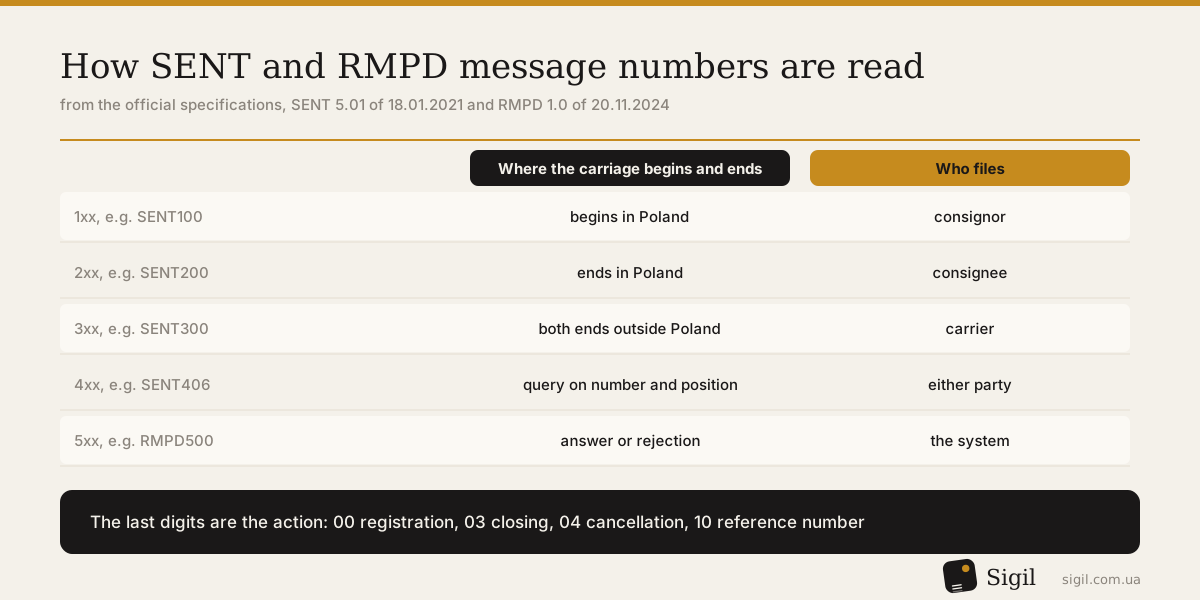
SENT and RMPD message codes are read digit by digit: the first gives the carriage situation, the last two the action. In SENT, 1xx belongs to the consignor, 2xx to the consignee and 3xx to the carrier in transit. In RMPD the carrier files RMPD100 and gets RMPD110 with a reference number, while RMPD406 checks status and GPS position.
In brief: a message number is an address rather than a label, and the hundreds digit says where the carriage begins and ends · 1xx the carriage begins in Poland and the consignor files · 2xx it ends in Poland and the consignee files · 3xx it begins and ends outside Poland and the carrier files · 4xx queries and answers, among them SENT406 and RMPD406 about the GPS position · 5xx the system's answer, either a confirmation or the reasons for rejection · the 3xx group has no closing message at all, because closing belongs to the consignee and transit has none.
A client writes "file a SENT300" and the dispatcher types those seven characters into a search box. They are not looking for a lecture on the system, only for an answer to whether this is their job at all. People type the codes themselves into search more often than the names of the services, and RMPD406 most often of all.
A message is an XML document that your system or the portal sends to the registry. The number states unambiguously who files, where the goods travel from and to, and what the document does.
How to read a number without the table
The first digit is the situation. One means carriage starting on Polish territory, filed by the consignor. Two means carriage ending in Poland, filed by the consignee. Three means carriage starting and ending outside Poland, which is transit, and the carrier files it.
The last two digits are the action, and they repeat in every group. Zero zero is registration, one an update by the filer, two an update by the carrier, three closing, four cancellation, five a complete filing including carrier data. Ten is the confirmation carrying the reference number, eleven a preview, twenty and thirty the collective filings for road and rail.
Do SENT102 and SENT202 mean the same thing? Almost. Both are an update by the carrier, the first in carriage starting in Poland and the second in carriage ending there.
The SENT messages a carrier meets
| Code | Name in the specification | Who files |
|---|---|---|
| SENT100 | registration of carriage starting in Poland | consignor |
| SENT102 | update of that filing | carrier |
| SENT103 | closing of the filing | consignee |
| SENT104 | cancellation of the filing | consignor |
| SENT105 | complete filing including carrier data | consignor |
| SENT120 | collective filing for road carriage | consignor |
| SENT200 | registration of carriage ending in Poland | consignee |
| SENT202 | update of that filing | carrier |
| SENT203 | closing of the filing | consignee |
| SENT300 | registration of carriage outside Poland at both ends | carrier |
| SENT301 | update of a transit filing | carrier |
| SENT304 | cancellation of a transit filing | carrier |
| SENT310 | confirmation of registration and the reference number | the system |
SENT300
Registration of a filing for carriage of goods beginning and ending outside Polish territory, by road or rail. It is the only SENT filing made by the carrier itself, and its basis is art. 7 ust. 1 of the SENT act. In plain terms it is transit through Poland, with no Polish consignor and no Polish consignee.
The 3xx group has no closing code, and that is not an omission. Closing is the duty of the receiving party (art. 5 ust. 5 of the SENT act), and in transit no such party exists in Poland. What follows from that in practice is covered in the article on transit and the summons to a check.
SENT500
Confirmation of an update, a cancellation or a closing of a carriage filing, or information about the reasons for rejecting it. One code serves both, so seeing SENT500 settles nothing by itself.
SENT406
A check on the validity of a carriage filing together with retrieval of the last position of the GPS device recorded in SENT-GEO. The answer comes back as SENT416. This is how a position is verified, and its mirror image RMPD406 has an article of its own.
SENT402
A check on the validity of a SENT number without the GPS position, answered by SENT412. When all you need is whether the number is alive, it is the cheaper query.
The RMPD messages, the full set
The RMPD specification of 20 November 2024 describes more documents than the portal shows.
| Code | What it does | Answer |
|---|---|---|
| RMPD100 | registration of a filing by the carrier | RMPD110 |
| RMPD101 | editing of a filing by the carrier | RMPD111 |
| RMPD103 | closing of a filing | RMPD111 |
| RMPD104 | cancellation of a filing | RMPD111 |
| RMPD110 | confirmation of registration with the reference number | none |
| RMPD111 | preview of the filing by the carrier | none |
| RMPD400 | key verification and retrieval of filing previews | RMPD111 |
| RMPD406 | query on status and SENT-GEO position | RMPD416 |
| RMPD420 | request for the history of a filing | RMPD421 |
| RMPD500 | the generic system answer, confirmation or rejection | none |
RMPD100
Registration of a filing by the carrier, the document everything starts with. The registry answers it with RMPD110 carrying the reference number. The three routes for sending it are set out in the article on ways to file RMPD.
RMPD406
A query on the status of a filing and on the last SENT-GEO position, answered by RMPD416. There is a practical limit here that we found on our own integration and that PUESC support confirmed on 11 August 2026. Only the portal serves this query; the web service rejects its schema outright.
RMPD460
No such code exists. It is searched for often, being an easy mistyping of 406 on a phone.
RMPD500
The generic answer of the RMPD system, carrying both confirmations of registration, change, cancellation and closing, and notices of rejection with a list of errors. The rule codes inside it, R01 to R30, are taken apart in the FAQ on RMPD and rejection codes using our own production data.
ID SISC
The unique number PUESC assigns to a person or a company at registration and that you then use in dealings with the fiscal authorities through the portal. Once registration is confirmed it appears under Mój pulpit | Moje dane, and the document titled "Informacja o rejestracji danych i nadaniu ID SISC" sits under Mój pulpit | Dokumenty.
How does ID SISC differ from EORI? In the reach of the system. EORI is a customs number shared across the European Union. ID SISC lives in the Polish fiscal and customs system, and it is given even to a person with no business activity, because it is assigned when the account is created. What registration itself looks like is shown in the step by step guide.
The reference number and the keys
The reference number is what the registry returns for an accepted filing, and it is what the driver produces on the road. It is valid for 10 days from the day it is issued (art. 11 ust. 1 of the SENT act), not from the declared start of carriage.
Keys are a separate thing often confused with the number. In SENT the carrier receives a key along with the number, and messages SENT400 and SENT401 serve to verify keys and to generate new ones. In RMPD the same role falls to RMPD400.
What actually concerns a carrier
On an ordinary run a non-EU carrier deals with four codes. It files RMPD100, receives RMPD110, reads RMPD500 when something went wrong, and uses RMPD406 when a position has to be shown. SENT300 joins them only when the carriage both begins and ends outside Poland.
What to do
- Read the first digit of the number to see straight away whose action it is.
- Check whether a code quoted in a client's email belongs to the carrier at all.
- Open the contents of SENT500 and RMPD500, since one code carries both outcomes.
- Ask for a position through RMPD406 on the portal, not through the web service.
- Keep the reference number together with the date it was issued.
What not to do
- Assuming SENT100 and RMPD100 are the same. The first is filed by the consignor, the second by the carrier.
- Searching the registry for RMPD460. It does not exist.
- Checking the specification, where message names are unambiguous.
- Waiting for a transit SENT filing to be closed. The 3xx group has no closing code.
Sigil handles the RMPD family of documents. We explain SENT messages as a phenomenon, but we do not file them for you.
A demo or training for your team
30 minutes online. We show how Sigil™ files an RMPD from a CMR and answer questions about your runs.
Frequently asked questions
- What is SENT300 and do I have to file it?
- It is the filing for carriage that begins and ends outside Poland, made by the carrier. The basis is art. 7 ust. 1 of the SENT act. If the goods are loaded or unloaded in Poland, SENT300 is not your document, because the consignor or the consignee files instead.
- How does SENT100 differ from RMPD100?
- In the system and in who files. SENT100 registers carriage beginning in Poland and is filed by the consignor. RMPD100 is the carrier's filing in the register of international carriage and is made by a non-EU carrier. Both live on PUESC, but they are separate duties.
- What should I do when RMPD500 arrives?
- Read what is inside, because the code carries both a confirmation and a rejection. The specification describes RMPD500 as the generic answer of the system to registration, change, cancellation and closing, together with a notice of rejection. Inside sits a rule code between R01 and R30, and that is what tells you what to fix.
- Does the code RMPD460 exist?
- No. There is no such message in the RMPD specification. Almost always the code meant is RMPD406, the query on the status of a filing and the last SENT-GEO position, which the system answers with RMPD416.
- Who closes a transit SENT300 filing?
- Nobody, and the group has no closing code. Closing is the duty of the receiving party (art. 5 ust. 5 of the SENT act), and transit through Poland has no such party. In the specification the 3xx group has registration, update and cancellation, but no closing.
Sources
Official specifications, read in the original:
- Technical specification of SENT system messages, version 5.01 of 18 January 2021, Fiscal Administration Chamber in Zielona Góra, 448 pages, sections 3.1 to 3.92.
- Technical specification of RMPD system messages, version 1.0 of 20 November 2024, same chamber, package RMPD_v20.11.2024 from the PUESC specifications page, section 2 and the rules table.
PUESC service pages:
- File, supplement or update a filing for carriage beginning and ending outside Poland, forms SENT300 and SENT330, the service is free.
- File, supplement, update or close a filing for carriage beginning in Poland, forms SENT100, SENT105, SENT120 and SENT_EDIT.
- Create an account or check your data, the assignment of ID SISC and where it is shown.
Legislation:
- Act of 9 March 2017 on the road and rail carriage monitoring system, ISAP, consolidated text Dz.U. 2024 poz. 1218: art. 5 ust. 1, 2 and 5, art. 7 ust. 1, art. 11 ust. 1.
Platform data: the RMPD406 limit over the web service, confirmed by PUESC support on 11 August 2026, and search statistics for the 28 days to 6 October 2026.
Read next
- RMPD100, 101, 103, 104, 406 and which document to file whenRMPD100 is the registration, 101 an amendment, 103 closing, 104 cancellation, 406 a GPS check. When to file each, the 9-day rule and what open filings do.
- Why PUESC rejects an RMPD and what to fix by RMPD500 codeRMPD500 rejection codes across 242 filings: R01 Cyrillic, R02 postal code, R06 dates, R30 locator not activated, crossing outside the dictionary. What to fix.
- RMPD406 form on PUESC, GPS check without loginDirect link to the RMPD406 form on PUESC, no login, no fee. Three numbers, filing status, last GPS position. Over an hour of silence costs PLN 10,000.
- RMPD questions, answers and PUESC rejection codesRMPD questions answered: the legal basis, the deadlines and the real PUESC rejection codes, ranked by frequency from our own data.
- The difference between SENT and RMPD nobody explainsSENT follows the goods, RMPD follows a non-EU carrier. Who files which, when both meet on one run, and what a missing one costs: 12,000 and 20,000 zł.
- An RMPD roadside check and what the inspector doesAn RMPD roadside check: what the inspector looks at in the filing, why last trip's number does not help, when the truck is impounded and the driver's rights.
Sigil™ turns a CMR into an RMPD declaration and files it with PUESC, with every field checked against the original.
More about PUESC