PUESC
PUESC numbers a carrier needs, ID SISC and EORI
A road carrier needs no EORI number, PUESC assigns the ID SISC itself, and a filing takes three identifier types. What to enter and where each one comes from.
Published · Author: Makaiev Kostiantyn Oleksandrovych, founder of Sigil RMPD
A dispatcher opened a new RMPD filing and reached the field labelled "Typ identyfikatora podmiotu", the entity identifier type. The drop-down offered eight abbreviations and the number the carrier had sent over matched none of them. One browser tab held an article about EORI, an e-mail asked about an ID SISC, and the lorry was due to leave within the hour. There are indeed several numbers in play, yet a filing needs exactly one of them.
In short: an RMPD filing needs nothing more than a personal PUESC account with the basic scope of rights, and the portal assigns the ID SISC itself during registration · the ID SISC is exactly 17 characters long, as the XSD schema defines it, and it is displayed under "Mój pulpit | Moje dane" · inside the filing itself the IdSisc element is optional · the identifier type comes from dictionary PDR1324, which holds eight codes and no EORI at all · only three of them are valid for a carrier in a SENT carriage, INNY, NIP and VAT UE, and a Ukrainian company uses INNY with its national register number · an EORI is required from a non-EU company before a customs declaration, or when it acts as a sea, inland waterway or air carrier, and road haulage is absent from that list · in our own data, across 489 filings sent between 24 June and 19 October 2026, the carrier identifier type was INNY in all 489.
Filing an RMPD takes one number, and nobody has to go looking for it. That number is the ID SISC, which the portal assigns when a person registers. A Polish NIP, an EORI number and a company registration on the portal are not needed for it.
Which number does an RMPD filing require
It requires a personal account with the basic scope of rights, and nothing beyond that. The PUESC service page says so plainly, and that is how it works in practice. The portal assigns the ID SISC in answer to the registration application, and the number belongs to the person, not to the company.
Registering a company, granting a power of attorney and obtaining an EORI form a separate path. That path matters to anyone filing on behalf of another company or handling customs business. Which scope of rights unlocks what is set out in the article on PUESC account types. A carrier filing its own declaration under its own login never walks that path.
What the ID SISC is and where to find it
The ID SISC is the number by which the Tax and Customs Information System recognises a person or a company. The XSD schema behind the RMPD messages describes it as "Numer identyfikacyjny podmiotu lub osoby w Systemie Informacyjnym Skarbowo-Celnym" and fixes its length at exactly 17 characters. It is not a number anyone invents, nor one that has to be requested in a separate letter.
The portal assigns it once the registration application has been examined. First comes the UPO, the official confirmation of receipt. Then a document named "Informacja o rejestracji danych i nadaniu ID SISC osobie fizycznej" appears under "Mój pulpit | Dokumenty". The number itself is visible under "Mój pulpit | Moje dane". The portal warns that verification may take a few days, and every screen of the process is shown in the guide to registering with PUESC step by step.
The Ministry of Finance instruction also describes how the number is built. For a holder of a Polish NIP it is the NIP followed by the last five digits of the REGON. For a holder of an EORI it is the EORI, and for a holder of a PESEL it is the PESEL. Shorter numbers are padded with zeros up to seventeen characters. None of this has to be worked out by hand, because the finished number sits on the account.
Which identifier type to choose in the filing
In a filing each party is described by three fields: the name, the identifier type and the number itself. The type comes from the official dictionary PDR1324, "Typ identyfikatora podmiotu SENT", version 2 of 21 October 2024. The dictionary holds eight codes, and three of them are valid for a carrier in a SENT carriage.
| Code | What it means | Valid for a carrier |
|---|---|---|
| INNY | another identifier, the place for a Ukrainian register number | yes |
| NIP | Polish tax identification number | yes |
| VAT UE | EU VAT number | yes |
| PESEL | Polish personal number | no |
| DO, KS, PJ, PS | identity card, residence card, driving licence, passport | no |
A Ukrainian company picks INNY and enters its national register number. Rule R29 of the RMPD specification demands that the value match the dictionary, and rule R03 checks the chosen type on its merits. For a NIP it computes the checksum and accepts digits only, with no hyphens or spaces, while VAT UE and PESEL are verified separately. A type picked at random ends in a rejection rather than a warning, and the other rules that throw a filing out are collected in the article on how PUESC refuses a filing.
The consignor and the consignee have one option a carrier does not. The schema allows the value BRAK for them, meaning there is no number, and in that case the number field must read BRAK as well. This is not sloppiness but what the statute demands. The identifier is required from the carrier itself (art. 28b ust. 3 pkt 1 lit. c of the Road Transport Act), while for the consignor and the consignee a name and an address suffice.
Why an EORI never appears in a filing
Because the dictionary does not contain it. PDR1324 holds eight codes and EORI is not among them, so the identifier type field will not take it, however firmly a company holds one. This is the most common source of wasted effort. Somebody reads that Poland requires an EORI, spends a week obtaining one, and then finds no field to put it in.
The IdSisc element in the message does not rescue the situation either. It is optional, declared in the schema with minOccurs zero, and it serves to recognise a party inside the system rather than to serve any customs purpose. In short, an EORI number appears nowhere in an RMPD filing.
When a non-EU company really does need an EORI
An EORI is a number for customs business, and what settles the question is not the cargo but what the company does at the customs frontier. Union law defines it as a number unique in the customs territory of the Union, assigned by a customs authority to register a person for customs purposes.
A company not established in the Union registers before lodging a customs declaration, an entry or exit summary declaration, or a temporary storage declaration. It also registers when it acts as a sea, inland waterway or air carrier, or as a carrier connected to the customs system that wishes to receive notifications about summary declarations. That is article 5 of Delegated Regulation (EU) 2015/2446. Road haulage is absent from the list, which is precisely why an ordinary road carrier needs no EORI for a journey.
Where one is genuinely needed, because the company lodges customs declarations itself, a Ukrainian company can obtain a Polish EORI. PUESC answers this directly. The number is issued in Poland to a domestic company or to a company from outside the European Union, while a company established inside the Union applies in its own country. Registration is carried out by the authority responsible for the place where the company first lodges a declaration or an application (art. 9(2) of the Union Customs Code). The number is invalidated at the registered person's request, or when the authority knows the activity has ceased.
How these numbers differ from one another
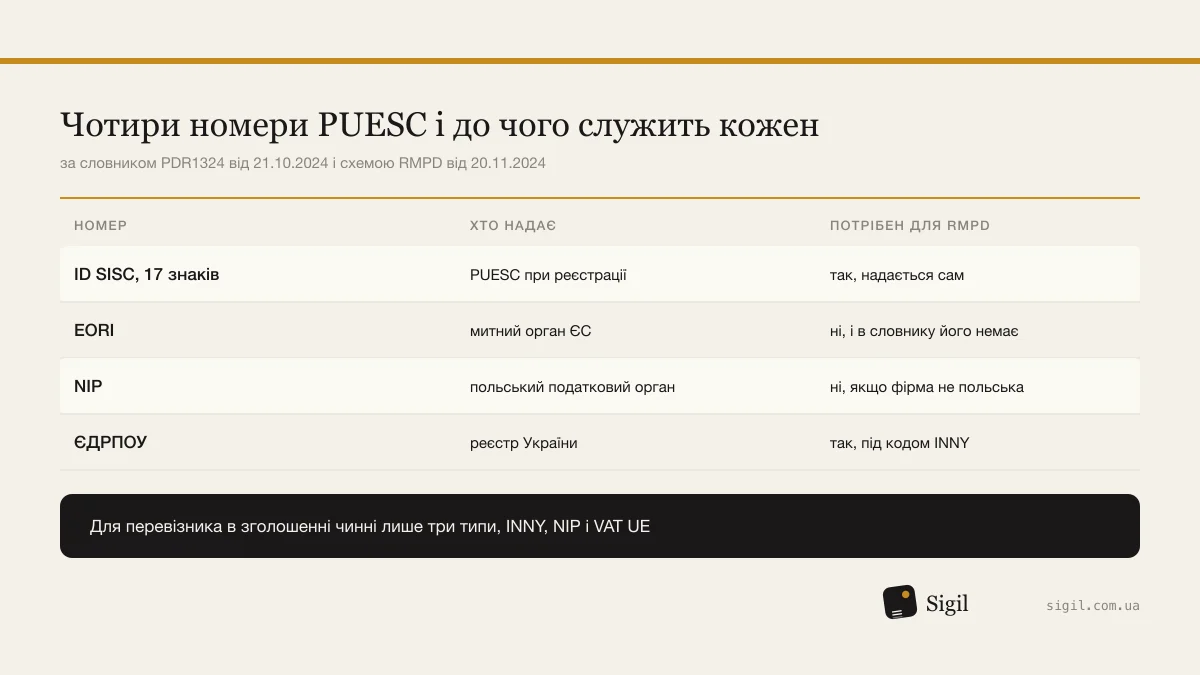
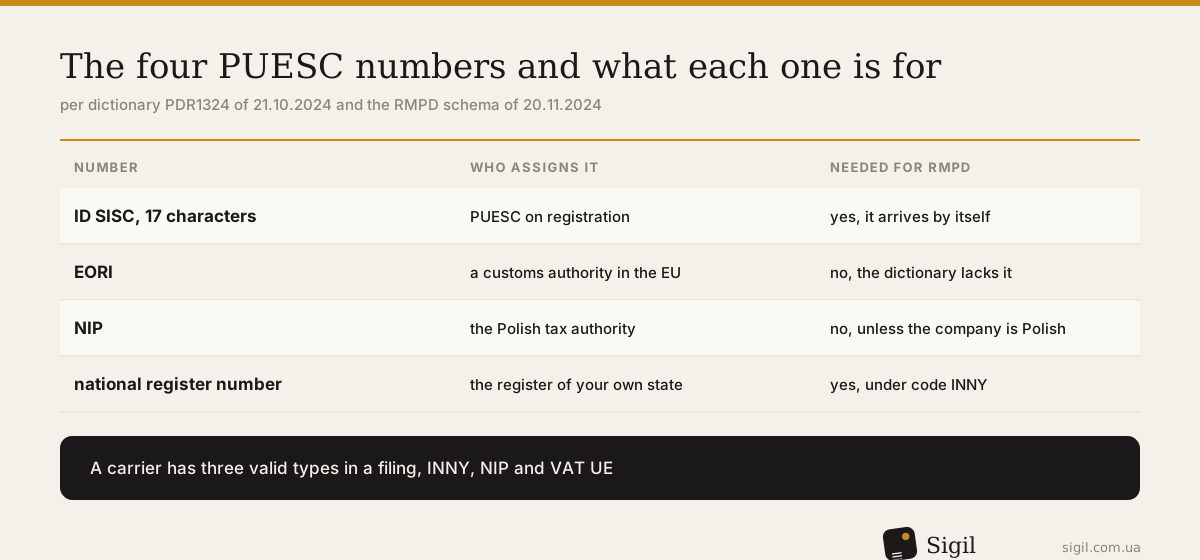
| Number | Who assigns it | What it is for | Needed for RMPD |
|---|---|---|---|
| ID SISC | PUESC on registration | recognising a person or company on the portal | yes, and it arrives by itself |
| EORI | a customs authority of an EU state | customs declarations and summary declarations | no |
| NIP | the Polish tax authority | Polish tax matters | no, unless the company is Polish |
| national register number | the register of the carrier's own state | identifying the company at home, entered under code INNY | yes, as the value of the field |
What a foreign national enters at registration
When an account is opened, the portal asks a person without Polish citizenship for the number assigned in the country of citizenship, the date of birth, and the type, number and series of an identity document. For a Ukrainian citizen that number is the RNOKPP. A PESEL is entered only by those who hold one, while an e-mail address is always mandatory, because the confirmation code is sent there.
One trap costs the whole registration. Entering Poland in the "Kraj obywatelstwa" field without holding Polish citizenship ends in a refusal and the deletion of the account. Everything then starts again, with a new code and a new wait.
What our own data shows
Across 489 filings sent through Sigil between 24 June and 19 October 2026, the carrier identifier type was INNY in all 489. It could hardly be otherwise, since that is the only code in the dictionary that describes a Ukrainian register number. An EORI number appeared in none of the nearly two hundred thousand exchange records with the portal from the same period, and could not have appeared, because the dictionary does not know it.
Counting every party together, the picture looks like this: BRAK in 601 cases, INNY in 549, NIP in 102, VAT UE in 13. BRAK leads because a consignor or a consignee does not need a number of their own in the filing. The figures come from several companies, and they describe our filings rather than the market. How each CMR box lands in the filing is shown by the field map from CMR to RMPD.
What to do
- Register as a natural person with the basic scope of rights and wait for the ID SISC.
- Check the number under "Mój pulpit | Moje dane" before promising a client a date.
- Choose the type INNY in the filing and enter the register number without spaces or hyphens.
- Leave BRAK for the consignor and the consignee when there truly is no number, and BRAK in the number field as well.
- Establish whether the company lodges customs declarations at all before starting on an EORI.
What not to do
- Obtaining an EORI "just in case" before the first journey. A week of work, and the filing has no field that would take it.
- Open the account and collect the ID SISC instead, because that is what the filing needs.
- Entering a Ukrainian register number under the type NIP because "it is a tax number too". Rule R03 computes the Polish NIP checksum and the filing falls over.
- Choose INNY instead, the code written for exactly this case.
- Putting a dash or the word "none" in the consignor's number field while the type reads BRAK. The portal expects the literal word BRAK.
- Declaring Polish citizenship while holding a Ukrainian passport. The account is deleted and the registration starts again.
A demo or training for your team
30 minutes online. We show how Sigil™ files an RMPD from a CMR and answer questions about your runs.
Frequently asked questions
- Does filing an RMPD require an EORI number?
- No. The identifier type dictionary PDR1324 contains no EORI code at all, so there is no way to enter one in a filing. Filing takes an account with the basic scope of rights and the ID SISC the portal assigns by itself.
- Where can I see my ID SISC?
- Under „Mój pulpit | Moje dane”. The document confirming the assignment sits under „Mój pulpit | Dokumenty”. The portal warns that examining the application may take a few days.
- Which identifier type does a Ukrainian carrier choose?
- INNY. It is the only code in the dictionary that describes a Ukrainian register number. NIP and VAT UE are valid for a carrier too, but they denote a Polish tax number and an EU VAT number, which a Ukrainian company usually does not hold.
- Can a non-EU company obtain a Polish EORI?
- Yes. PUESC states that the number is issued in Poland to a domestic company or to a company from outside the European Union. That matters when the company lodges customs declarations itself, not for an RMPD filing.
- Does the company have to be registered on the portal to file?
- No. An RMPD filing needs a personal account with the basic scope of rights. Registering the company and granting a power of attorney concern anyone filing on behalf of another company.
Sources
Official specifications, read in the original:
- Specyfikacja Techniczna Komunikatów Systemu RMPD, version 1.0 of 20.11.2024, package RMPD_v20.11.2024 from the PUESC specifications page: rules R03 and R29, schema PTypes.xsd (types IdSisc, TraderIdentityType, TraderIdentityTypeIDNull).
- Dictionary PDR1324 "Typ identyfikatora podmiotu SENT", version 2 of 21.10.2024, from the same package: eight codes and the carrier attribute.
PUESC service pages:
- Załóż konto lub sprawdź swoje dane, the data required from a person without Polish citizenship, the assignment of the ID SISC and where it is displayed.
- EORI, uzyskaj numer identyfikacyjny na potrzeby importu i eksportu towarów and the FAQ answer on who may obtain the number in Poland.
Legal acts:
- Ustawa z dnia 6 września 2001 r. o transporcie drogowym, ISAP: art. 28b ust. 3 pkt 1 lit. c.
- Regulation (EU) No 952/2013 laying down the Union Customs Code, EUR-Lex: article 9.
- Commission Delegated Regulation (EU) 2015/2446, EUR-Lex: article 1(18), articles 5, 6 and 7.
Platform data: 489 filings sent through Sigil between 24.06 and 19.10.2026, and close to two hundred thousand exchange records with the portal from the same period.
Read next
- Registering on PUESC as a non-EU carrier, step by stepRegistering on PUESC as a non-EU carrier, step by step. Which account to choose, what to prepare, every form screen, the e-mail code and three traps.
- Which PUESC account a carrier needsBasic or extended PUESC account: what each allows, what it takes, how long. A carrier needs only basic for RMPD; company registration is for consignors only.
- Why PUESC rejects an RMPD and what to fix by RMPD500 codeRMPD500 rejection codes across 242 filings: R01 Cyrillic, R02 postal code, R06 dates, R30 locator not activated, crossing outside the dictionary. What to fix.
- How CMR data get into an RMPD, field by fieldWhich CMR box goes into which RMPD100 field, what the CMR lacks (type of carriage, permit, border), what the RMPD lacks (goods, CN). Three fields that diverge.
Sigil™ turns a CMR into an RMPD declaration and files it with PUESC, with every field checked against the original.
More about PUESC