PUESC
Which PUESC account a carrier needs
Basic or extended PUESC account: what each allows, what it takes, how long. A carrier needs only basic for RMPD; company registration is for consignors only.
Published · Updated · Author: Makaiev Kostiantyn Oleksandrovych, founder of Sigil RMPD
A dispatcher in Rivne opens puesc.gov.pl to file his first RMPD. The registration screen offers two options: "podstawowy zakres uprawnień" (basic scope of rights) and "rozszerzony zakres uprawnień" (extended scope). He picks extended, because more must be safer. The portal then asks for a signature, then for company registration with documents and a translation, then for a power of attorney with stamp duty. Three weeks later the company is still not registered, and the trucks cross into Poland every day without an RMPD.
A carrier needs only a basic PUESC account to file RMPD. It is a personal account, created in one evening: a form, a code by e-mail, a login. Company registration, identity confirmation and a power of attorney are needed by consignors and consignees, who file SENT, not by a carrier, who files RMPD or completes a SENT.
In short: a PUESC account is opened by a natural person, the dispatcher or the owner, in their own name, not by the company · a basic account, with no signature and no identity check, allows filing RMPD and completing SENT as a carrier · an extended account needs a qualified electronic signature or a visit in person to a Polish customs office · company registration and linking a representative are needed only by those who file SENT as consignor or consignee · a power of attorney for a representative carries 17 zł of stamp duty per person · working through Sigil uses the same basic account: login and password.
What PUESC accounts exist
PUESC, Platforma Usług Elektronicznych Skarbowo-Celnych, is the portal of Poland's tax and customs administration. An account on it belongs to a person, not a company. One natural person may hold only one account, and the portal says so outright: "Konto zakłada osoba fizyczna na swoje dane" (an account is opened by a natural person in their own name). A company exists separately, as a registered entity to which people are later linked.
The portal offers two scopes of rights.
| Basic account (podstawowy zakres uprawnień) | Extended account (rozszerzony zakres uprawnień) | |
|---|---|---|
| What it allows | filing RMPD; completing and filing SENT as a carrier or driver; excise returns | everything in basic plus acting on behalf of a company: SENT as consignor or consignee, customs declarations, applications |
| What is required | first name, surname, citizenship, ID document number, e-mail, correspondence address | the same plus identity confirmation |
| Signature | not needed, button "Wyślij bez podpisu" (send unsigned) | qualified electronic signature or Polish trusted signature (profil zaufany); otherwise a visit in person to an urząd celno-skarbowy |
| How long | code by e-mail, login the same day | application review "kilka dni" (a few days) plus time for the signature or the visit |
| Company registration | not needed | needed to act on behalf of a company |
| Who needs it | carrier, driver | consignor, consignee, customs agent |
This table comes from the service descriptions on the portal itself. The page "Sposoby potwierdzania tożsamości osoby" lists what a basic account can do, and one of the items is "zgłosić przewozy w SENT jako przewoźnik lub kierowca" (report carriage in SENT as a carrier or driver). The RMPD service page tells the carrier directly: "Wybierz PODSTAWOWY ZAKRES UPRAWNIEŃ" (choose the basic scope).
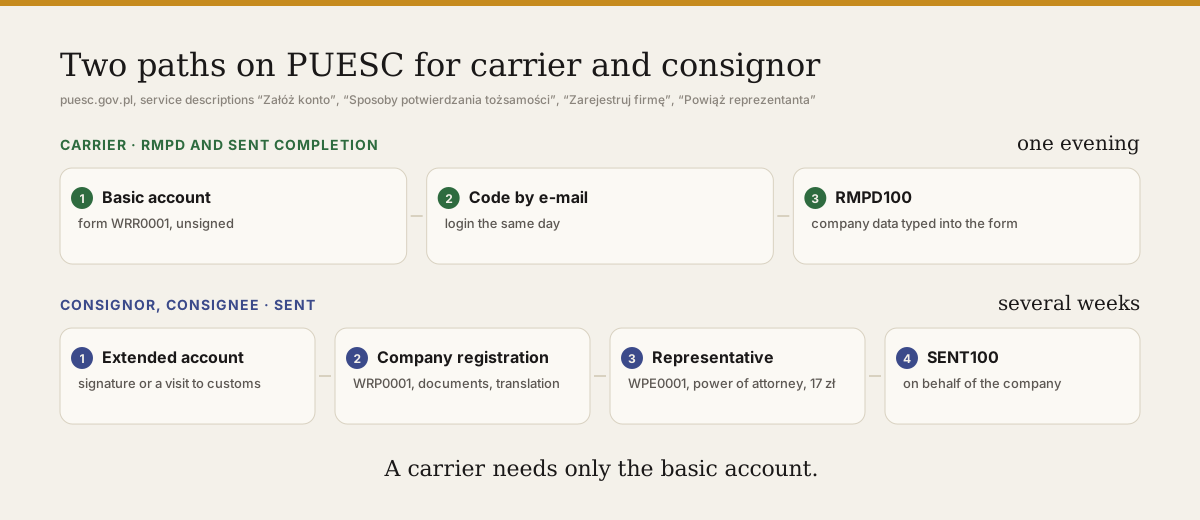
Which account a carrier needs
Basic. To file RMPD100 and to complete someone else's SENT with the carrier's data, the portal requires only a personal account with the basic scope. Company registration, a company ID SISC, an EORI number and a power of attorney are not needed for that.
The reason lies in how the duty is built. The carrier files an RMPD for every run, and the company data, name, address, tax number, go into the RMPD100 form itself (art. 28b ust. 3 pkt 1 of the Road Transport Act). The portal does not need to know the company in advance. Completing a SENT works the same way: the consignee passes the carrier a reference number and a key, and the carrier enters his data into someone else's filing (art. 6 ust. 3 of the SENT Act).
Is an extended account needed for a company with ten trucks and three dispatchers? No. Each dispatcher opens a basic account in their own name. One account for several people is forbidden by the portal, and the filing history is visible by the company's number in every form anyway.
Is an extended account needed for cross-border transit, where the carrier files the SENT? No. The portal lets a basic account "zgłosić przewozy w SENT jako przewoźnik", and a filing under art. 7 ust. 1 of the SENT Act falls under that.
Who needs an extended account
Consignors and consignees. A SENT filing as consignor (art. 5) or consignee (art. 6) can only be made on behalf of a company, and the portal says so: "Zgłoszenie SENT może złożyć tylko osoba fizyczna bezpośrednio powiązana z firmą, tj. właściciel, pracownik bądź pełnomocnik firmy" (a SENT filing may be made only by a natural person directly linked to the company: owner, employee or attorney).
That takes three separate procedures. First an extended account with identity confirmation. Then company registration through form WRP0001 with documents: for a foreign company, current registration documents and a document showing the signatory's right to represent it, with a "tłumaczenie robocze" (working translation) into Polish. Then linking a representative through form WPE0001, with a power of attorney if the representative is not the owner, and stamp duty of 17 zł per person. The portal reviews each application for "kilka dni".
A Ukrainian transport company ends up on this path in one case: when it is itself the consignor or consignee of listed goods, that is, when it trades and not only carries. Then the extended account is needed by the person who will file SENT on the company's behalf.
Why carriers lose weeks on an unnecessary procedure
Three reasons that keep coming up in carriers' questions.
First: the word "extended" sounds safer. It seems that with more rights nothing will be blocked. In practice an extended account without company registration gives a carrier the same as a basic one, only after a signature or a visit.
Second: the guides online are written for Polish companies. A Polish consignor has a profil zaufany and a company register entry, so in his guide the signature and the company registration are two clicks. A Ukrainian without a Polish PESEL number has no profil zaufany, and an EU qualified signature costs money and time. Confirmation in person means a trip to a customs office in Poland with a passport.
Third: company registration gets confused with a condition for RMPD. The RMPD100 form has a field "dane zagranicznego podmiotu" (details of the foreign operator), filled in by hand for every run. The company does not have to exist in the PUESC register for its data to sit in the filing.
What the mistake costs. While company registration drags on, the trucks keep running, and every run without an RMPD is 12,000 zł, about 143,000 ₴ at the National Bank of Ukraine rate of 11.94 ₴/zł on 14 September 2026 (Annex 3, item 3.2a). Three weeks of waiting at five runs a week is fifteen runs at risk. Who exactly must file RMPD is in the article What RMPD is and who must file it.
What to prepare for a basic account
For a person without Polish citizenship the portal asks for: the identification number issued in the country of citizenship, for a Ukrainian the tax number RNOKPP, the date of birth, the type, series and number of the ID document, the passport, an e-mail and a correspondence address with a phone number. The form is called WRR0001 Rejestracja danych osoby. After sending it unsigned, a code arrives by e-mail; logging in with the code completes the account.
Can the account be opened on a shared company e-mail? Better not. The account is personal, and that address receives the login code, notices about documents and filing confirmations. A shared mailbox means a dismissed dispatcher takes access to all the company's filings with him.
How it looks in Sigil
Sigil sends RMPD to PUESC through the official web service under the carrier's own credentials. So the same basic account is connected in Sigil: the login, that is the e-mail, and the PUESC password. Sigil does not require an extended account, company registration or a power of attorney, because the portal does not. How to connect the account is shown step by step in the help article First sign-in and setup, and how to pull the filing history from PUESC in Syncing with PUESC.
The carrier remains the declarant. Sigil does not open an account for you and holds no "shared" account of its own: every filing goes out in the name of whoever's login is connected.
What goes into each field of the RMPD100 form after logging in, and what from the CMR does not, is in the article How CMR data get into an RMPD, field by field.
What comes back when a filing from this account fails validation, and which register rules break most often, is in the article Why PUESC rejects an RMPD and what to fix by RMPD500 code.
An account does not help when PUESC itself is down: then RMPD and SENT are filed with a replacement document by e-mail, and how to do it is in What to do with RMPD and SENT when PUESC is down.
What to do
- Open a basic PUESC account for the dispatcher who will file: form WRR0001, the button "Wyślij bez podpisu", the code from the e-mail. One evening.
- Before the form, have ready the RNOKPP, the passport, that person's work e-mail and a correspondence address. Without an identification number the portal rejects the form.
- Do not register the company on PUESC if you only carry. The company data go into every RMPD100 by hand.
- If the company also sells or buys listed goods, open an extended account for the person who will file SENT, and allow several weeks for company registration and the power of attorney.
- A separate account for every dispatcher. The portal forbids two accounts for one person and provides no single account for several.
- Connect the PUESC login and password in Sigil after the first login on the portal, not before. Sigil checks them with PUESC at once.
- Once a year check that the account's e-mail is still accessible. The login code and PUESC notices go there and nowhere else.
What not to do
- Do not pick the extended account "just in case". Without a signature or a visit it will not work, and for RMPD it gives nothing beyond basic.
- Do not wait for company registration to file the first RMPD. Every run without a filing is 12,000 zł.
- Do not open one account for the whole company. The account is personal, and losing it with an employee means losing access to the filings.
- Do not pay stamp duty for a power of attorney unless you will file SENT as consignor or consignee. A carrier needs no power of attorney.
- Do not confuse the test environment test.puesc.gov.pl with the live one. An account and filings on the test system count for nothing on the road.
Where Sigil fits in
Sigil files RMPD100, amends, closes and cancels filings through the PUESC web service under the login and password of the carrier's basic account, after the dispatcher has confirmed the data from the CMR. Registration on the portal stays with you; Sigil checks the credentials as soon as they are connected and says if PUESC rejected them. Sigil does not file SENT as consignor or consignee: those need an extended account and a company registered on PUESC.
Sigil handles RMPD declarations. The SENT notification for the goods is filed by the consignor or the consignee from their company's extended account.
A demo or training for your team
30 minutes online. We show how Sigil™ files an RMPD from a CMR and answer questions about your runs.
Frequently asked questions
- Is a basic PUESC account enough for a carrier to file RMPD?
- Yes. The RMPD service page on PUESC tells the carrier to choose the basic scope, and the description of scopes lists “zgłosić przewozy w SENT jako przewoźnik lub kierowca” among what a basic account allows. An extended account, company registration and a power of attorney are not needed for RMPD.
- Does a carrier have to register the company on PUESC to file RMPD?
- No. The company data go into every RMPD100 form (art. 28b ust. 3 pkt 1 of the Road Transport Act). Company registration is needed only by those who file SENT as consignor or consignee on behalf of a company.
- What is needed for an extended account without a Polish profil zaufany?
- A qualified electronic signature or a visit in person. The application can be sent unsigned, but then identity has to be confirmed at a customs and tax office or a customs branch in Poland with an ID document. A carrier does not need this path.
- Can one dispatcher file from one account for several carriers?
- Yes, for RMPD. The account is personal and the carrier's data go into the form. In Sigil one user can manage several carriers, and every filing goes out under the PUESC login that is connected.
- How much does a power of attorney for a company representative on PUESC cost?
- 17 zł of stamp duty per authorised person. It is paid when linking a representative through form WPE0001, and the SENT authorisation must be written into the power of attorney explicitly. A carrier needs no power of attorney for RMPD.
Sources
Service descriptions on the PUESC portal, as of the date of publication:
- Załóż konto lub sprawdź swoje dane, PUESC: form WRR0001, data for a person without Polish citizenship, the “Wyślij bez podpisu” button, code by e-mail, review time.
- Sposoby potwierdzania tożsamości osoby, PUESC: what the basic and extended scopes allow, including “zgłosić przewozy w SENT jako przewoźnik lub kierowca”; ways of confirming identity.
- Zarejestruj firmę – uzyskaj numer EORI, PUESC: form WRP0001, documents for a foreign company, review time.
- Powiąż reprezentanta z firmą, PUESC: form WPE0001, when a power of attorney is needed, 17 zł stamp duty, working translation of a foreign company's documents.
- Wyślij zgłoszenie przewozu w przypadku międzynarodowego przewozu drogowego rzeczy, PUESC: “Wybierz PODSTAWOWY ZAKRES UPRAWNIEŃ” for the carrier.
- Wyślij zgłoszenie przywozu towaru do Polski, PUESC: basic scope for the carrier, extended for the consignee; who may file SENT on behalf of a company.
Legislation, as in force on the date of publication:
- Ustawa z dnia 6 września 2001 r. o transporcie drogowym, ISAP, consolidated text: art. 28b ust. 1 and 3, załącznik nr 3 (lp. 3.2a).
- Ustawa z dnia 9 marca 2017 r. o systemie monitorowania drogowego i kolejowego przewozu towarów oraz obrotu paliwami opałowymi, ISAP, consolidated text: art. 5 ust. 1 and 4, art. 6 ust. 1 and 3, art. 7 ust. 1, art. 9 ust. 2, art. 22 ust. 2.
Exchange rate: official hryvnia to złoty rate, National Bank of Ukraine, 11,94 ₴/zł on 14.09.2026.
Read next
- Registering on PUESC as a non-EU carrier, step by stepHow a non-EU carrier opens a PUESC account for Polish RMPD filings. Which account, what to prepare, every form screen, the e-mail code, ID SISC and three traps.
- What an RMPD is and who must file itRMPD from scratch: what the filing is, who must file it since 1 November 2024, when it is not needed, how it differs from SENT, what happens at entry without it
- Why PUESC rejects an RMPD and what to fix by RMPD500 codeRMPD500 rejection codes across 242 filings: R01 Cyrillic, R02 postal code, R06 dates, R30 locator not activated, crossing outside the dictionary. What to fix.
- What to do with RMPD and SENT when PUESC is downWhen Poland's PUESC portal is down, RMPD and SENT are filed with a replacement document by e-mail to GITD or KAS. Addresses, format, proof, can the driver go.
Sigil™ turns a CMR into an RMPD declaration and files it with PUESC — with every field checked against the original.
More on this topic: PUESC