RMPD
Three ways to file RMPD and what each one costs
Three ways to file RMPD: yourself, through a representative or with your own system. What each costs in time and money, and who pays the penalty for a mistake.
Published · Author: Makaiev Kostiantyn Oleksandrovych, founder of Sigil RMPD

A carrier won a first Polish run and learned about the filing duty two days before departure. This article is about the three ways to file an RMPD and how they differ. Opening PUESC showed a Polish form of some thirty fields, and the question that stopped the work was a simple one: register and file in person, or ask somebody who already knows how. RMPD is the filing a non-EU carrier sends to the Polish monitoring register before entering Poland, and the answer decides not only speed but also who ends up holding the documents and who pays if one field is wrong.
In short: the PUESC service itself is free, what is paid for is time or somebody else's labour, never the filing · the RMPD form needs only a basic permission scope, the extended one is not required · a person filing for a company must be electronically linked to it as its representative, on form WPE0001, and the authority compares the application against the power of attorney · a power of attorney carries 17 zł of stamp duty per relationship of representation, and where the principal has no seat in Poland the duty goes to the account of the City of Warsaw · there are three forms: RMPD100 to register, RMPD aktualizacja to amend and cancel, RMPD406 to check validity together with the last GPS position · instead of the form, a filing may travel as an XML file by email to puesc@mf.gov.pl, be uploaded on the account, or be handed over through a web service · the 12,000 zł penalty always falls on the carrier, because art. 28b ust. 1 of the Road Transport Act names the carrier, and handing over the typing does not hand over the liability.
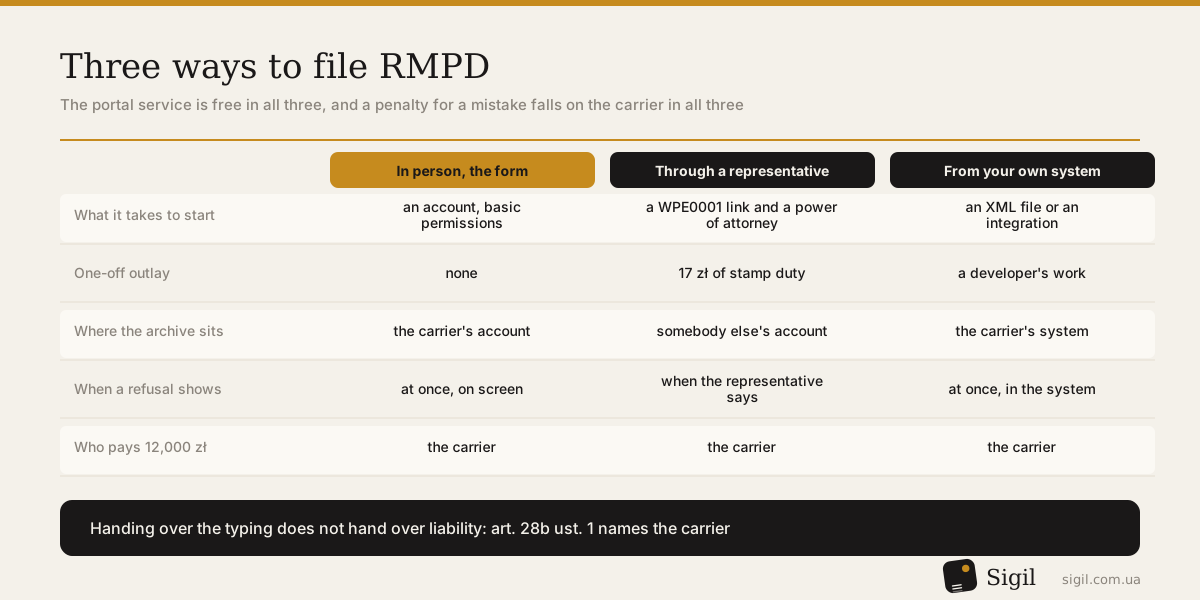
A filing can be made by three routes: in person through the form on PUESC, through a representative linked to the company on the portal, or from the carrier's own system as an XML file. The portal service is free in all three, and the difference sits in time, in where the archive ends up, and in who notices a mistake before a roadside check does. Liability does not differ at all.
Who files under the statute
The filing is made by the foreign carrier performing the carriage, and the statute makes no provision for anyone to take that duty over. Art. 28b ust. 1 of the Road Transport Act places it on the foreign entity performing the carriage, not on whoever presses the button. Choosing a route is therefore a question of how work is organised, not a question of liability.
Representation is recognised expressly, yet the consequences stay with the carrier. Art. 9 ust. 3 of the SENT Act provides that sending, supplementing and updating a filing by a statutory representative or an attorney produce effects for the represented party. Put plainly: somebody else's hands, the carrier's penalty.
The driver carries a duty of their own in this chain, and it does not depend on the route chosen. Art. 28c ust. 1 requires the carrier to hand the driver the reference number before carriage starts, and ust. 2 obliges the driver to refuse to set off if the number has not arrived.
Route one, in person through the PUESC form
Filing in person takes a PUESC account with a basic permission scope and nothing more. The service page on puesc.gov.pl says in its preliminary step to choose exactly the basic permission scope, adding that the form may also be filed from an account with the extended one. Extended permissions are not needed for RMPD, and arranging them is most often wasted time at the start. Which account opens what is taken apart in the piece on PUESC account types.
The service holds three forms and each has its own job. RMPD100 registers the filing and yields the reference number. RMPD aktualizacja supplements, amends and cancels a filing and shows its status. RMPD406 checks the validity of a filing together with the last GPS position.
Confirmation with the number arrives by three paths at once: on the screen, in the Mój pulpit | Dokumenty tab of the filing account, and by email, though the last of these only where an address was entered in the form. The address field is not mandatory, and that is precisely why carriers sometimes end up with no copy in their mailbox.
The price of this route is time and language. The form is completed in the Latin alphabet with Polish letters, because Cyrillic draws a refusal, and the data comes from the CMR consignment note one to one. How long one cycle really takes, and where it drags, is set out in the piece on the time an RMPD filing takes.
Route two, through a representative on the portal
A representative has to be electronically linked to the company, because without that link the portal will not let them in. The permissions page on puesc.gov.pl says it directly: a person who is to represent a company must be electronically linked to that company as its representative, and the portal reads the permissions and thereby checks that it is dealing with a properly authorised person. The link is created by an application on form WPE0001 Rejestracja aktualizacja reprezentacji firmy.
The authority verifies the permissions rather than taking them on trust. It compares the application to register the representation against the content of the power of attorney submitted, and the scope of the permissions must follow from that content. The original goes to the Central Registration Division of the Tax Administration Chamber in Poznań, together with proof that the stamp duty has been paid.
The duty exists, and for a carrier from outside Poland it has a peculiarity. A power of attorney carries stamp duty of 17 zł for each relationship of representation, about 196 hryvnia at the NBU rate of 11.52 ₴/zł on 14.10.2026 (Stamp Duty Act, Annex, part IV). Where the principal has no seat in Poland, which is exactly how a Ukrainian company stands, the duty is paid to the account of the City of Warsaw rather than a local authority.
The price of this route is dependence. The filing goes under another person's login, the carrier holds no access to that account, and the confirmation lands wherever the filing went from. It is worth agreeing in advance in what form and when the carrier receives the reference number and the confirmation, because those are what the driver needs before departure.
Route three, from your own system as an XML file
A filing need not pass through the form at all, and the service page says so in a section of its own. A filing, its supplement or its update may be sent as an electronic document in XML format. The finished file travels by three paths: as an attachment to a message sent to puesc@mf.gov.pl, by uploading the file on the carrier's own PUESC account, or by direct exchange of messages between the company's system and the portal, that is through a web service.
The first two paths call for no development work. An XML file can be built once as a template and then emailed or uploaded on the account, and both variants leave the filing on the carrier's own account. The specification of the document sits on the web services page, in the System SENT section.
The third path calls for a developer and pays for itself only against a stream of runs. In exchange it gives what the first two do not: filings, statuses and refusals arrive in the company's own system automatically, and the archive builds itself.
How much time each route takes
The time of filling the form in person is the one quantity worth measuring before choosing. Across our own platform the median of the full cycle from a photograph of the CMR note to the reference number is 6.0 minutes: 126 declarations with automatic sending, created between 31 July and 19 September 2026. Half fall between 4.2 and 8.3 minutes, and one in ten runs beyond 14. These are data of the carriers working through our platform, not a market average.
Filling the portal form by hand takes longer, and the reason does not lie in the number of fields. Three fields are absent from the CMR note altogether: the goods code, the number of the permit or ECMT carnet, and the locator number. Gathered before the run, they turn filling in into transcription rather than into searching, and where the permit number itself comes from is set out separately.
A single run and a stream of runs give different answers. For one run a year the portal form is cheaper than any integration. For several runs a week the filling time multiplies, and the chance of one mistake in one field multiplies with it.
How each route ends when something is wrong
A penalty for a discrepancy in the data falls on the carrier in all three routes alike, 12,000 zł, about 138,000 hryvnia at the same rate (Annex 3, item 3.2a to the Road Transport Act). A total across several breaches is computed at once by the SENT and RMPD penalty calculator. The difference between the routes lies not in the size of the penalty but in how fast the problem becomes known.
Filing in person shows the refusal immediately, on screen, with the code and the name of the field. Which codes arrive most often and what each one means is collected in the piece with carriers' questions and the rejection codes. Filing through a representative sends the refusal to their account, and the carrier learns of it when the representative says so.
A third consequence concerns evidence rather than money. Two years after the end of the year of filing, the register deletes an RMPD filing, while a penalty may still be imposed for five years. A copy held on the carrier's own account, or in the carrier's own system, is therefore the only evidence certain to be theirs.
What to do
- Open a PUESC account of your own with a basic permission scope, even if somebody else is going to do the filing.
- Count your runs per month, because for one run the portal form is cheaper than an integration and for twenty it is dearer.
- Enter an email address in the form, because without it the confirmation with the number will not reach your mailbox.
- Agree with the representative in what form and when you receive the reference number, the confirmation and the text of a refusal.
- Pay the stamp duty on the power of attorney to the account of the City of Warsaw if your company has no seat in Poland.
- Keep a copy of every filing yourself, because the register deletes its own before the time limit for a penalty runs out.
- Hand the driver the reference number before departure, whichever route you chose.
What not to do
- Do not order extended permissions for RMPD. The basic scope is enough for the form, and the extended ones cost time while the authorisation is verified.
- Open an account with the basic scope and start filing straight away.
- Do not assume that handing over the typing hands over the liability. Art. 9 ust. 3 of the SENT Act leaves the consequences with the represented party.
- Check the data in a filing before sending it exactly as you would check your own signature.
- Do not rely on somebody else's archive. An intermediary's mailbox is not access to the register, and an intermediary can shut down.
- Keep your own copy of the filing, the confirmation and the reference number for every run.
- Do not pay the stamp duty to a local authority's account when the company sits outside Poland. For such a principal the account is a different one.
Sigil handles RMPD declarations. A SENT filing is submitted by the sender or the consignee of the goods.
A demo or training for your team
30 minutes online. We show how Sigil™ files an RMPD from a CMR and answer questions about your runs.
Frequently asked questions
- Can a freight forwarder file instead of the carrier
- They can, but the penalty stays with the carrier. Art. 9 ust. 3 of the SENT Act provides that sending and updating a filing through a representative or an attorney produce effects for the represented party, while art. 28b ust. 1 of the Road Transport Act places the duty itself on the foreign carrier performing the carriage. A forwarder may fill the form in, yet the 12,000 zł penalty is the carrier's.
- What PUESC account does the RMPD form need
- One with a basic permission scope. The service page on puesc.gov.pl says in its preliminary step to choose exactly the basic scope, adding that the form may also be filed with the extended one. Extended permissions grant access to the SISC system and require the authority to verify a power of attorney, so for RMPD alone they are a needless step.
- What does filing an RMPD on PUESC cost
- Nothing. The service page on puesc.gov.pl states in its fees section, in those words, that the service is free. The only charge that may arise is the stamp duty on a power of attorney, 17 zł per relationship of representation, and only where an attorney is to do the filing.
- Is the form on the portal mandatory
- No, three other paths exist. A filing may be sent as an XML file: as an attachment to a message to puesc@mf.gov.pl, by uploading the file on the carrier's own account, or by direct exchange of messages between the company's system and the portal. The specification sits on the web services page, in the System SENT section.
- Where is the stamp duty paid for a Ukrainian company
- To the account of the City of Warsaw. That is how the page on linking a representative to a company resolves the case where the principal has no seat in Poland and the power of attorney is filed electronically through PUESC. For a principal seated in Poland the account is a different one, that of the local authority.
Sources
Legislation, in force on the date of publication:
- Road Transport Act of 6 September 2001, ISAP, consolidated text Dz.U. 2025 poz. 1490: art. 28 ust. 1 and 1a, art. 28b ust. 1 and 2, art. 28c ust. 1 and 2, art. 29 ust. 1, Annex 3 (item 3.2a).
- Act of 9 March 2017 on the system for monitoring road and rail carriage of goods, ISAP, consolidated text Dz.U. 2024 poz. 1218: art. 8, art. 9 ust. 1-4.
- Stamp Duty Act of 16 November 2006, ISAP: Annex, part IV (17 zł per relationship of representation).
Authorities:
- Send a carriage filing for international road carriage of goods or cabotage carriage of goods, puesc.gov.pl: permission scope, forms RMPD100, RMPD aktualizacja and RMPD406, other ways of using the service, no charge.
- Permissions on PUESC, puesc.gov.pl: the duty to link a representative to a company electronically, form WPE0001.
- Link a representative to a company, puesc.gov.pl: verification of the power of attorney by the authority, where the original goes, the stamp duty accounts.
Own data:
- Time of the full cycle from a photograph of the CMR note to the reference number, from the Sigil platform: 126 declarations with automatic sending, created between 31.07.2026 and 19.09.2026. These are data of the carriers working through Sigil, not market statistics.
Rate: NBU, 11.5245 ₴/zł on 14.10.2026.
Read next
- Which PUESC account a carrier needsBasic or extended PUESC account: what each allows, what it takes, how long. A carrier needs only basic for RMPD; company registration is for consignors only.
- Registering on PUESC as a non-EU carrier, step by stepRegistering on PUESC as a non-EU carrier, step by step. Which account to choose, what to prepare, every form screen, the e-mail code and three traps.
- How long an RMPD really takes, from CMR photo to numberRMPD filing time on our own data: median 6 minutes from CMR photo to PUESC number, one in ten over 14. Why the median, what it consists of, what drags on.
- RMPD questions, answers and PUESC rejection codesRMPD questions answered: the legal basis, the deadlines and the real PUESC rejection codes, ranked by frequency from our own data.
- What an RMPD is and who must file itRMPD from scratch: what the filing is, who must file it since 1 November 2024, when it is not needed, how it differs from SENT, what happens at entry without it
- What to do with RMPD and SENT when PUESC is downWhen Poland's PUESC portal is down, RMPD and SENT are filed with a replacement document by e-mail to GITD or KAS. Addresses, format, proof, can the driver go.
Sigil™ turns a CMR into an RMPD declaration and files it with PUESC, with every field checked against the original.
More about RMPD