RMPD
How CMR data get into an RMPD, field by field
Which CMR box goes into which RMPD100 field, what the CMR lacks (type of carriage, permit, border), what the RMPD lacks (goods, CN). Three fields that diverge.
Published · Author: Makaiev Kostiantyn Oleksandrovych, founder of Sigil RMPD

A dispatcher copies a CMR into the RMPD100 form on the PUESC portal. Box 2 says "Lubin"; he types "Lublin", because that is the name he knows. Box 4 gives the loading date as 12 September, so he sets the start of carriage in Poland to 12 September too, although the truck will cross the border on the 13th. The stamp in box 1 shows two addresses; he takes the upper one. Three fields, three discrepancies, and none of them looks like a mistake to him. At a lay-by near Zamość an inspector puts the CMR and a printout of the filing side by side.
The RMPD100 form has about forty fields, and only some of them exist on a CMR. Boxes 1, 2, 3, 4, 16, 21 and the number in the top right corner go into the filing one to one. The rest, type of carriage, type of permit, border crossings, locator number, coordinates of the place in Poland, come not from the consignment note but from PUESC dictionaries and the carrier's own documents. The fine applies not only to a missing filing but to data "niezgodne ze stanem faktycznym", inconsistent with the facts, so the data are copied as they are, not as they should be.
In short: from the CMR into RMPD100 go the consignor (box 1), the consignee (2), the place of unloading (3), the place and date of loading (4), the carrier (16), the note's number and date (21 and the CMR number), the tractor and trailer plates · goods, weight and CN code are not in RMPD100: the form only asks whether the truck is loaded · type of carriage, type of permit, border crossings, locator number and coordinates of the place in Poland come from PUESC dictionaries and the carrier's documents, not from the CMR · CMR data are copied verbatim, even with a mistake: a discrepancy between filing and note is 12,000 zł (Annex 3, item 3.2a) · the fields that diverge most often are registration plates, the parties' names and addresses, and the place and date of the start of carriage · a space in a plate number or an empty address field is an RMPD500 rejection before registration even happens.
How the RMPD100 form is built
The form on PUESC has eight sections, and their numbers appear both in RMPD500 rejections and in inspection reports: 1 carrier, 2 vehicle, 3 permit information, 4 consignor of the goods, 5 consignee of the goods, 6 additional information, 7 reply channels, 8 declarations. Section 3 is the longest: transport dates (3.1), country of loading and unloading (3.2), transport document (3.3), carriage and permit (3.4, 3.5, 3.6), place where the journey in Poland starts (3.7) and ends (3.8).
The scope of data is written in the act: art. 28b ust. 3 of the Road Transport Act lists twelve groups, from the carrier's details to the locator number. The technical rules, the plate format, the word BRAK in an empty address, nine days for the start date, are in the Technical Specification of RMPD System Messages of 20 November 2024. What each document of the RMPD family does is in the article RMPD100, 101, 103, 104 and which document to file when.
Which CMR box goes into which RMPD field
The box numbers are the same on every CMR form under the 1956 convention, whatever the language of printing.
| CMR box | Contents | Where in RMPD100 | Watch out for |
|---|---|---|---|
| 1 Sender | consignor's name and address | 4.1 and 4.2 consignor of the goods | a stamp with two addresses, registered and actual; the RMPD takes the address in the box |
| 2 Consignee | consignee's name and address | 5.1 and 5.2 consignee of the goods | the box may hold a forwarder and the final consignee; copy whoever is written there |
| 3 Place of delivery | place of unloading | 3.8 end of the journey in Poland; 3.2 country of unloading | if unloading is outside Poland, 3.8 is the exit point from Poland |
| 4 Place and date of taking over | place and date of loading | 3.7 start of the journey in Poland; 3.2 country of loading | the start date in 3.1 is the date of entry into Poland, not the loading date in Ukraine |
| 5 Documents attached | invoice, packing list | not transferred | |
| 6–12 goods | marks, quantity, packaging, description, code, weight, volume | not transferred | RMPD100 has no goods fields; only a "loaded" flag |
| 16 Carrier | carrier's name and address | 1.1 and 1.2 carrier | name and address as on the stamp; tax number by the PUESC dictionary of identifier types |
| 21 Established in | place and date of issue | 3.3 date of the transport document | |
| CMR number | form number, top right corner | 3.3 number of the transport document | not to be confused with the number in box 5 |
| 25, 26 or box 16 | tractor and trailer plates | 2 vehicle | no spaces or hyphens: AC4533HP, not AC 4533 HP |
| 22, 23 stamps | signatures of consignor and carrier | nothing; the stamp's address only confirms boxes 1 and 16 |
Can the address be taken from the stamp in box 22 when the address in box 1 is incomplete? No. Section 4.2 is box 1. The stamp may confirm it is the same company, but the address is copied from the box, and an incomplete box is completed through the consignor, not by guessing.
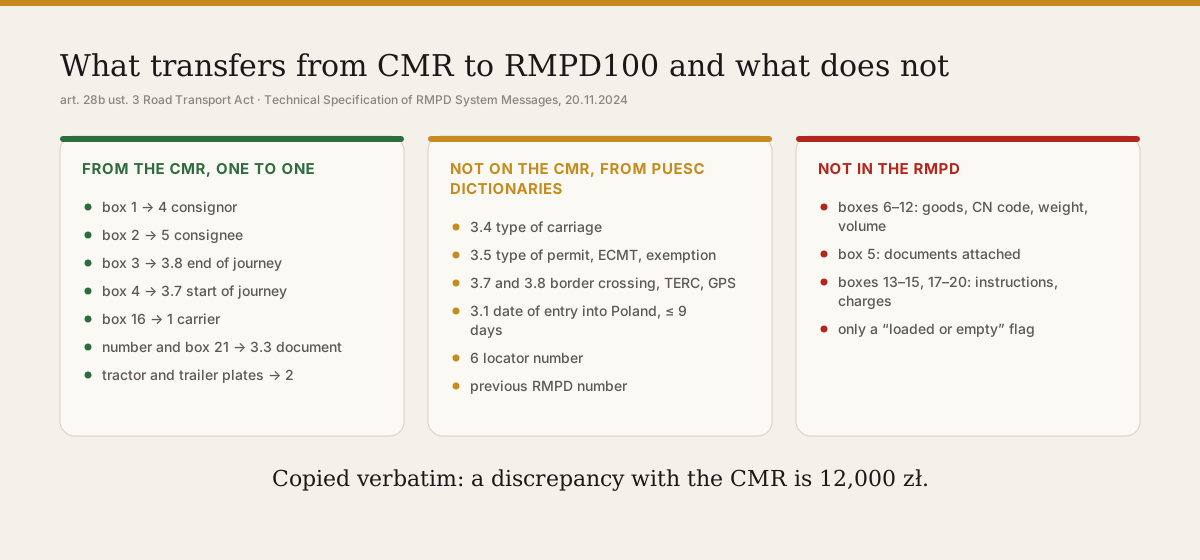
What the CMR lacks and where it comes from
Roughly half of the RMPD100 form has no counterpart on the consignment note. These fields are filled from PUESC dictionaries and the company's documents, and this is where a new dispatcher spends the most time.
Type of carriage (3.4). A dictionary of four values: bilateral (BILATERAL_TRANSPORT), transit (TRANSIT_TRANSPORT), to or from a third country (THIRD_COUNTRY_TRANSPORT), cabotage (CABOTAGE). It follows from the route: Lutsk to Lublin is bilateral, Lutsk to Berlin through Poland is transit.
Type of permit (3.5, 3.6). Road permit (ROAD_PERMISSION), ECMT licence (EKMT_PERMISSION), permit exemption (NOT_OBLIGED) with a legal basis from a PUESC dictionary. For ECMT the form asks for the licence number, validity period and issuing country. For an exemption the basis field is mandatory and the permit number field must stay empty, otherwise RMPD500.
Border crossings (3.7, 3.8). When the country of loading is not Poland, the start of the journey in Poland is an entry point from the PUESC dictionary of border crossings, with a road number. When unloading is in Poland, the end of the journey is the address from box 3, but with a TERC province code and GPS coordinates, which the CMR does not have.
Dates (3.1). The start date is the day of entry into Poland, not the loading day from box 4. It cannot be more than 9 days from the day of filing. The end date is the planned day of unloading or exit.
Locator number (6). The number of the SENT-GEO device or external system, with a checksum. It is never on a CMR.
Previous RMPD number. When the previous filing's number has expired and the run continues, the form asks for it (art. 28b ust. 4).
Is a CN code needed in the RMPD? No. RMPD100 has no goods fields, so the CN code, weight and description from boxes 6–12 go nowhere. The CN code is needed for something else: it decides whether the goods fall under SENT. What to do with it is in the article Goods under SENT monitoring.
Why the data are copied verbatim rather than corrected
The fine of 12,000 zł, about 143,000 ₴ at the National Bank of Ukraine rate of 11.94 ₴/zł on 14 September 2026, applies to two different breaches in one line of the act: carriage without a filing, and "zgłoszenie danych i informacji niekompletnych lub niezgodnych ze stanem faktycznym", incomplete or inaccurate data (Annex 3, item 3.2a). The inspector on the road has three things: the filing in the register, the CMR in the cab and the truck in front of him. A discrepancy between any two of them is grounds for a report.
Hence the rule: the filing takes what the consignment note says, even if it looks wrong. The consignee in box 2 is written with a misspelt name? The RMPD carries the same misspelling, and the correction is requested from the consignor who issued the CMR. A dispatcher who "corrected it to the right one" has created a discrepancy between the filing and the document, and that is what the inspector sees first.
In case II GSK 677/21 a carrier was fined 10,000 zł for data in a filing inconsistent with the facts; in 2024 the Supreme Administrative Court sent the case back because the authority had not considered waiving the fine on grounds of proportionality. Nobody in that case disputed that a discrepancy means a fine: the argument was only whether it could be reduced. What errors inspectors actually found in filings and what they cost is in the article One digit in an RMPD costs 12,000 zł.
Can an RMPD be corrected when the CMR was changed at loading? Yes, with an RMPD101 before entry. A swapped trailer, a rewritten box 2, a second unloading place added: the filing is updated, not left "as filed". Updating is a duty (art. 8 ust. 1 of the SENT Act via art. 28b ust. 5).
The three fields where discrepancies arise most often
Registration plates. The trailer was swapped in the morning at loading, and the filing still has yesterday's. Or the plate was typed with a space, a hyphen, or in Cyrillic: АС4533НР with the Ukrainian letters A, C, H, P is a different number to the register than the Latin AC4533HP. The specification allows only Latin letters and digits, no spaces; a format error yields an RMPD500 rejection, and a wrong plate that got through yields 12,000 zł on the road.
Names and addresses of the parties. Box 1 with two addresses on the stamp, box 2 with a forwarder and a final consignee on two lines, a company name with quotation marks, an apostrophe and the legal form in a different order. The filing takes the spelling that is in the box and the address that is in the box, with BRAK in place of a street or house number if the stamp has none.
Place and date of the start of carriage. The dispatcher puts the loading date from box 4 into 3.1 instead of the date of entry into Poland, and the loading town in Ukraine into 3.7 instead of the border crossing. The register accepts it, because formally the dates are valid, and the inspector sees a filing in which the carriage in Poland "started" in Lutsk a day before the border.
Which of these fields the register rejects most often, and how to read an RMPD500 rejection, is shown on our own data in the article Why PUESC rejects an RMPD and what to fix by RMPD500 code.
What to do
- Put the CMR next to the form and copy boxes 1, 2, 3, 4, 16, 21 and the form number verbatim, mistakes included. Ask whoever issued the note to correct it.
- Check the plates character by character: Latin letters and digits only, no spaces or hyphens, tractor and trailer separately with the country of registration.
- Fill an empty street or house number with the word
BRAK. The register rejects an empty field. - Set the start date to the day of entry into Poland, not the loading day, and no more than 9 days from the day of filing.
- Choose the type of carriage and permit from the dictionary by the route and the document in the cab, not by habit. For a permit exemption fill in the basis and leave the permit number empty.
- For the place in Poland take the address from box 3 or 4 and add the TERC code and coordinates; for the border crossing pick the crossing from the dictionary with its road number.
- After any change to the CMR or at loading, send an RMPD101 before entry. The filing has to match the note at the moment of inspection, not at the moment of filing.
What not to do
- Do not "correct" CMR data to the right values. A discrepancy between filing and note is 12,000 zł, and a mistake on the note is for the consignor to fix.
- Do not take the address from the stamp instead of the box. Section 4.2 is box 1, section 1.2 is box 16.
- Do not carry the loading date into the start-of-carriage date. The start date is entry into Poland.
- Do not type plates in Cyrillic or leave spaces. The register reads Cyrillic
АСas different letters. - Do not look for CN code or weight fields in the RMPD. There are none; SENT describes the goods, the RMPD asks only "loaded or empty".
Where Sigil fits in
Sigil reads the consignment note from a photo or PDF and shows the dispatcher the CMR data next to the image of the document for a one-to-one check. The system corrects nothing on a person's behalf: the dispatcher confirms every value or corrects it himself against the original. Fields the CMR lacks are filled from the carrier's profile and PUESC dictionaries, and the filing is checked before sending so that a formal error does not reach the register as an RMPD500.
Sigil handles RMPD declarations. The SENT notification for the goods, with the CN code and weight, is filed by the consignor or the consignee.
A demo or training for your team
30 minutes online. We show how Sigil™ files an RMPD from a CMR and answer questions about your runs.
Frequently asked questions
- Is there a field in RMPD100 for the CN code or the weight of the goods?
- No. RMPD100 does not describe the goods: the form asks only whether the carriage is loaded or empty (art. 28b ust. 3 pkt 8). CMR boxes 6–12 go nowhere. The CN code serves a different duty, SENT, which is filed by the consignor or the consignee.
- What goes into the start-of-carriage date when loading was in Ukraine?
- The day of entry into Poland. The date in section 3.1 is the start of carriage on Polish territory, not the loading date from CMR box 4. It cannot be more than 9 days from the day the filing is made.
- The CMR has a mistake in the consignee's name. Correct it in the RMPD?
- No. The filing takes what the consignment note says, and the correction is requested from the consignor who issued the CMR. A filing that is “better” than the document is a discrepancy, and that is what the 12,000 zł fine is for (Annex 3, item 3.2a).
- What if the consignor's stamp has no street or house number?
- Enter `BRAK`. The RMPD specification requires the word
BRAKin a street or house number field that the address does not have (rule R04). The register rejects an empty field as RMPD500. - Can the plate be typed as on the CMR, with a space?
- No. The register accepts only Latin letters and digits, no spaces or special characters:
AC4533HP. A space or hyphen yields an RMPD500 rejection, and a Cyrillic letter that looks Latin is a different number to the register.
Sources
Legislation, as in force on the date of publication:
- Ustawa z dnia 6 września 2001 r. o transporcie drogowym, ISAP, consolidated text: art. 28b ust. 3, 4 and 5, załącznik nr 3 (lp. 3.2a).
- Ustawa z dnia 9 marca 2017 r. o systemie monitorowania drogowego i kolejowego przewozu towarów oraz obrotu paliwami opałowymi, ISAP, consolidated text: art. 8 ust. 1.
- Konwencja o umowie międzynarodowego przewozu drogowego towarów (CMR), Genewa, 19 maja 1956 r., ISAP, Dz.U. 1962 nr 49 poz. 238: art. 6 (list of consignment note particulars from which the box numbering derives).
Technical documentation:
- Specyfikacja Techniczna Komunikatów Systemu RMPD, wersja 1.0, Izba Administracji Skarbowej w Zielonej Górze, 20.11.2024: list of RMPD100 fields, dictionaries of type of carriage and permit, rules R01–R14 (Latin script,
BRAK, plate format, 9 days, TERC and coordinates, border crossings). - Zgłoszenie przewozu w przypadku międzynarodowego przewozu drogowego rzeczy, PUESC: service description, list of data to prepare, portal form with sections 1–8.
Case law, Central Database of Administrative Court Rulings (CBOSA):
Exchange rate: official hryvnia to złoty rate, National Bank of Ukraine, 11,94 ₴/zł on 14.09.2026.
Read next
- RMPD100, 101, 103, 104 and which document to file whenRMPD documents by code: 100 registration, 101 amendment, 103 closing, 104 cancellation, 406 GPS check. When to file each, the 9-day rule, what open filings do.
- What gets fined when one digit in an RMPD costs 12,000 złA wrong digit or date in an RMPD costs 12,000 zł, the same as not filing. Provisions with article numbers, three 2025 roadside checks and what a carrier can do.
- Why PUESC rejects an RMPD and what to fix by RMPD500 codeRMPD500 rejection codes across 242 filings: R01 Cyrillic, R02 postal code, R06 dates, R30 locator not activated, crossing outside the dictionary. What to fix.
Sigil™ turns a CMR into an RMPD declaration and files it with PUESC — with every field checked against the original.
More on this topic: RMPD