PUESC
A CMR with no number now stalls the transit
Since 3 August 2026 the Polish NCTS passes safety data to ICS2, and a missing or repeated CMR number gets the declaration rejected. What to check at loading.
Published · Author: Makaiev Kostiantyn Oleksandrovych, founder of Sigil RMPD

A driver collected a load near Warsaw and went on to customs clearance. The number box on the CMR read "BRAK", Polish for "none", because the sender had issued the note in a hurry and given it no number. The customs agent lodged the transit declaration, the Polish system accepted it and passed the safety data on, and back came a refusal from the other side: that transport document number already exists. The truck waited until the sender issued a new consignment note with a number.
Since 3 August 2026 the Polish NCTS2 PLUS has been running in phase 6 of the NCTS and passes safety and security data to ICS2 by itself. The transport document number, which for a road carrier means the number of the CMR consignment note, has stopped being a formality: it has to be there and it must not repeat. A carrier does not issue the note and does not assign its number, but the carrier receives it at loading, and it is the carrier's truck that waits when the number turns out to be empty or duplicated.
A note for a reader meeting these systems for the first time. NCTS is the EU computerised transit system and ICS2 is the EU system that collects advance cargo safety data before goods enter. PUESC is the Polish customs portal through which both are reached.
In brief: since 3 August 2026 the Polish NCTS2 PLUS runs in phase 6 and passes safety data to ICS2, so the CMR number is now checked by two systems, not one · a transit declaration carrying safety data replaces a separate entry summary declaration, but the data must never be filed in both systems at once · the NCTS rules R0083 and R0067 require the transport document number to be unique within the declaration, not within a year · the 365 day horizon comes from ICS2 and counts per Holder of the Transit Procedure, not per consignor · on 12 August 2026 PUESC confirmed a discrepancy between NCTS and ICS2 in that rule and asked for unique numbers at Consignment level as well · "bez numeru", "b/n" and "BRAK" break the filing not because they are words but because they repeat · a type D declaration in road transport is lodged at least one hour before the goods reach the customs office of departure.
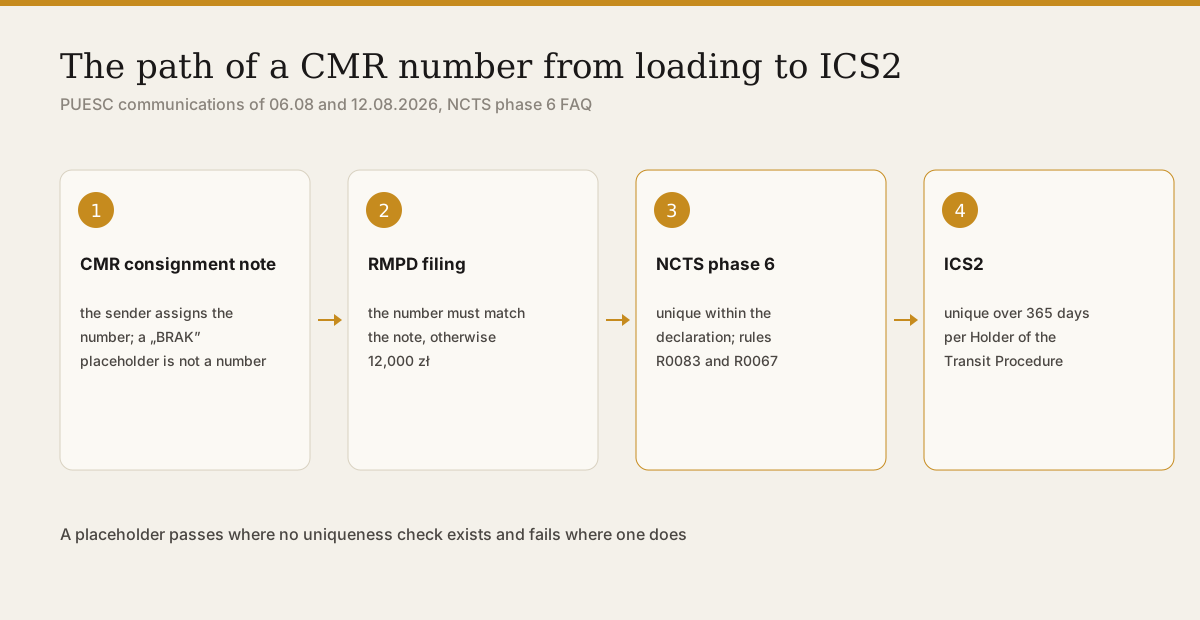
What changed on 3 August 2026
On 3 August 2026 at 00:00 the Polish NCTS2 PLUS started running in phase 6 of the NCTS. PUESC confirmed the date in a communication of 22 July 2026, after the original date of 1 June had turned into a transitional period instead. The distinction matters, because letters circulating among companies still name June: 1 June 2026 opened the transitional period, and phase 6 has applied in Poland since 3 August 2026.
The change that matters to a carrier is not the message structure but where the data goes. A transit declaration may now carry safety and security data, and the Polish system passes it to ICS2 on its own, so no separate entry summary declaration is needed. An advance transit declaration of type D carrying safety data satisfies the obligation to lodge that entry summary declaration.
The other side of that convenience is double validation. A declaration now passes both the Polish NCTS rules and the rules of the central ICS2 component, and a refusal can arrive from the second side even when the first side accepted the declaration. The transport document number is where this bites.
Does a CMR number have to be unique within a year
The claim that a CMR number must be unique within a year is true of ICS2, not of NCTS, and it does not count per consignor. In the phase 6 NCTS rules the requirement reads differently: the transport document number must be unique within the declaration. PUESC stated this plainly in its phase 6 FAQ, answering a question about rule R0083, and repeated it in the answer about rule R0067.
The one year horizon belongs to ICS2. In the FAQ of 15 April 2026 PUESC set out a working proposal for the rule, under consultation with DG Taxud. For declarations carrying safety data the transport document number is to be unique per Holder of the Transit Procedure for the last 365 days. The UCR is to be unique for the last 3 months. The Holder of the Transit Procedure is the party lodging the transit declaration, in practice usually the customs agency, not the consignor and not the carrier.
Does that mean a consignor may give the same number to two different carriers? Formally yes, in practice risky. The collision is counted against the party lodging the declaration, so two of your runs carrying the same number through the same agency will clash with each other even if different consignors issued the notes.
Why PUESC asks for uniqueness at Consignment level too
On 12 August 2026 PUESC reported a discrepancy it had found between NCTS and ICS2 in the wording of the rule on validating the uniqueness of the transport document number. To avoid a rejection from ICS2, the service asks filers to declare unique transport document numbers at the Consignment level as well, not only where the Polish rule requires it.
Two more points in the same communication matter to a carrier. First, safety data goes either into the transit declaration or into a separate entry summary declaration to ICS2, and the two must not be combined; PUESC treats modifying data in order to file in both systems as contrary to art. 15 of the Union Customs Code. Second, the service asks filers to complete transport document data regardless of the declaration type, including where their own software does not mark the field as mandatory, because otherwise foreign offices of destination struggle to handle the operation.
The practical conclusion for a dispatcher is short. The CMR number field is always filled in, even when the system lets it through empty, and the number has to be a real one rather than a placeholder.
Why "no number" breaks the filing
A placeholder in the number box breaks the filing not because it is text but because it repeats. The rule does not forbid the word "BRAK" as such: it requires the value not to coincide with another one in the same declaration, and in ICS2 additionally within 365 days for the same Holder of the Transit Procedure. A second "BRAK" through the same agency is already a collision, and the declaration bounces.
Hence a rule worth pinning up in the dispatch office: "bez numeru", "b/n", "brak", a dash and a zero are not numbers. They pass where no uniqueness check exists and fail where one does. A single consignment note carrying such an entry can hold up not only your own run but the next run that the same agency files with the same entry.
What to check at loading
Four things are worth checking, and all four are visible on paper before the truck leaves the loading place.
| What to check | Why it matters |
|---|---|
| The number box is filled and is not a placeholder | "BRAK", "b/n", a dash and a zero break the uniqueness check |
| The number does not repeat your earlier run | the collision counts per Holder of the Transit Procedure over 365 days |
| The number on the CMR matches what goes into the filing | a mismatch with the consignment note costs 12,000 zł in RMPD |
| The goods description is specific, not "goods" or "parts" | ICS2 rejects safety data over the quality of the description |
The cheapest moment to fix this is the loading place: the driver is still there, the sender is next door, and a note can be reissued in five minutes. The most expensive moment is the customs office, where the truck is already queuing and the agent is waiting for data. How each field of the note reaches the declaration is taken apart in What transfers from CMR to RMPD100 and what does not.
What to do when the sender hands over a CMR with no number
When the note carries no number, the number is assigned by the sender, not by the driver and not by the dispatcher. It is the sender's document and the sender's duty, which is why a number written in by the driver in the cab creates a worse problem than an empty box. The sender is left with a note that has no number, the filing carries a number that appears in none of the sender's documents, and any inspection will find the mismatch.
In practice it works like this. The driver calls the dispatcher straight away, not after departure. The dispatcher calls the sender or the forwarder and asks for a note with a number. If the sender insists that no number is needed, pointing to the PUESC communication of 12 August 2026 works better than an explanation, because the service itself asks for transport document data to be completed regardless of the declaration type.
Can the truck leave and have the number added on the road? No. The number is needed earlier than the border: an advance transit declaration of type D in road transport is lodged at least one hour before the goods reach the customs office of departure. PUESC restated this on 6 August 2026, because a large share of declarations were arriving a few minutes before the goods were presented.
Why the goods description decides as much as the number
The goods description decides as much as the number, because ICS2 rejects safety data over an insufficient quality of description. PUESC described this in its communication of 6 August 2026: a large share of declarations carried too general a description of the goods, and the data that NCTS2 PLUS passed to ICS2 was rejected for "insufficient data quality".
The list of "stop words" for ICS2 is published on the CircaBC portal, and ICS2 recognises both the English entries and their translations into other languages. "Goods", "parts", "spare parts" and "groupage cargo" are exactly that case. What is needed instead is a description that shows what is travelling: not "parts" but "brake pads for trucks".
For a carrier this has a direct effect, because the description in the filing is taken from the consignment note. If the CMR says "goods", the agent will either rewrite it in their own words or collect a refusal, and either way time is lost.
What our own data shows
On our platform's data, a placeholder in the CMR number box is not a rarity but a habit. Across 4,158 RMPD declarations carrying a transport document number, for the period from 30 October 2024 to 27 September 2026, from twenty carriers, only 3,164 numbers are unique (recounted on 28 September 2026). The rest are repeats.
The most frequent "number" in that set is the word "BRAK", 261 times. Then an empty value 62 times, "B/N" 56, "Brak" 49, "brak" 24, "b/n" 5. Together 457 declarations out of more than four thousand, one in nine, arrived with a document that effectively has no number. Repeats of the number plus company pair come to 211, and 203 of them fall inside a 365 day window.
One qualification: these are RMPD declarations, not transit declarations. The RMPD register accepted such entries and still does, because it holds no uniqueness check. That is exactly why the habit looks safe until the same note reaches NCTS and ICS2, where the check exists. These are our platform's data, not the market's: twenty companies are not a cross-section of the industry.
How to organise the check inside a transport company
A CMR number check works only when it sits in two places: with the driver at loading and with the dispatcher before the data goes out. One place always lets something through, because the driver cannot see the history of past runs and the dispatcher cannot see the paper in the driver's hands.
The driver needs one line in the loading checklist: is there a number on the note, and is it not "BRAK". That question costs five seconds and saves hours. The dispatcher needs a search by number across the company's own declarations for the last year before the number travels any further. If the number has been used, the problem is solved before departure rather than at the customs office.
The third element is an agreement with the sender and the forwarder, written into the order. One line in the transport order about the note carrying a number and a specific goods description removes most cases. Why the register refuses filings and what the codes mean is taken apart in The most frequent reasons PUESC rejects filings.
How this differs from RMPD and SENT
The number from one consignment note travels into at least three systems, and their requirements differ. In RMPD the transport document number is a field of the filing, and the demand there is different: it has to match the note. A mismatch costs 12,000 zł, roughly 140,000 ₴ at the National Bank of Ukraine rate of 11.67 ₴/zł on 27 September 2026. In SENT the document number accompanies the carriage of listed goods. In NCTS and ICS2 the uniqueness requirement is added, and neither of the first two has it.
Hence the conclusion that misleads most often: the fact that the RMPD register accepted "BRAK" does not mean the note is in order. It only means that RMPD holds no such check. What transit through Poland looks like from the inspection side is described in SENT transit through Poland and a summons to inspection. Which type of carriage to enter in the filing, and which basis fits it, is taken apart in Transit or third-country carriage, how to tell.
What to do
- Check the number box on the consignment note at the loading place, before departure.
- Ask the sender to assign a number when the box is empty or carries a placeholder.
- Call the dispatcher straight away rather than after departure, because at the loading place the problem costs five minutes.
- Search your own declarations from the last year for the number before it goes into a filing.
- Ask the sender for a specific goods description instead of "goods" or "parts".
- Write the requirement for a number and a description into the transport order, so it is not renegotiated every time.
- Pass transport document data to the customs agent always, including when their software does not mark the field as mandatory.
What not to do
- Do not write your own number onto someone else's consignment note. The sender keeps a document with no number and you carry a number with no document.
- Do not accept "BRAK" in the number box. A second "BRAK" through the same agency is a collision and a refusal from ICS2.
- Do not leave the clearance to the border. A type D declaration goes in an hour before the goods reach the office of departure.
- Do not file safety data both in the transit declaration and in a separate declaration to ICS2. PUESC prohibits combining the two.
- Do not treat an accepted RMPD as proof that the CMR is correct. RMPD holds no uniqueness check, NCTS and ICS2 do.
Where technology fits in
Sigil carries the transport document number from the CMR into the RMPD filing one to one and shows it to the dispatcher for confirmation, because what RMPD penalises is precisely a mismatch with the document. The system does not correct a placeholder on its own: substituting a "proper" number on the carrier's behalf would create a mismatch with the document that sits in the driver's cab.
A company's declaration history stays in the system, so a number already used on an earlier run is visible in the list before filing rather than after a refusal.
Sigil handles RMPD declarations. Transit declarations to NCTS and declarations to ICS2 are lodged by the customs agency or by the carrier itself on PUESC, and the platform does not file them.
A demo or training for your team
30 minutes online. We show how Sigil™ files an RMPD from a CMR and answer questions about your runs.
Frequently asked questions
- Does a CMR number really have to be unique within a year?
- Not in NCTS. The phase 6 rules R0083 and R0067 require uniqueness within the declaration. The 365 day horizon comes from ICS2 and counts per Holder of the Transit Procedure, that is the party lodging the declaration, usually the customs agency.
- What should be done when the number box on the CMR reads "BRAK"?
- Ask the sender to issue a note with a number. The number belongs to the issuer of the document; a number written in by the driver leaves the sender with a document that has none and the filing with a number no document carries.
- Can safety data be filed both in the transit declaration and separately to ICS2?
- No. In its communication of 12 August 2026 PUESC prohibits combining the two, and treats modifying data in order to file in both systems as contrary to art. 15 of the Union Customs Code.
- How long before arrival is a type D declaration lodged?
- At least one hour before the goods reach the customs office of departure in road transport. PUESC restated this on 6 August 2026, because many declarations were arriving minutes before the goods were presented.
- If the RMPD register accepted a note reading "BRAK", is the note in order?
- No. RMPD holds no uniqueness check on the transport document number, so the entry passes. NCTS and ICS2 do hold one, and there the same note ends in a refusal.
Sources
Legislation:
- Commission Delegated Regulation (EU) 2015/2446, articles 105 to 109: time limits for lodging the entry summary declaration.
- Regulation (EU) 952/2013, the Union Customs Code, art. 15 and art. 127.
- Road Transport Act of 6 September 2001, ISAP: Annex 3, item 3.2a.
Authorities:
- Launch of phase 6 functionality in NCTS2 PLUS, PUESC, 2 April 2026.
- Deployment of NCTS phase 6 in Poland, PUESC, 22 July 2026: the date of 3 August 2026.
- Deployment of NCTS phase 6 in Poland, errors in declarations, PUESC, 6 August 2026.
- Filing safety and security data in combined transit declarations in NCTS phase 6, PUESC, 12 August 2026.
- NCTS2 PLUS phase 6, FAQ, PUESC, 15 April 2026: rules R0083 and R0067.
Rate: official hryvnia to zloty rate, 11.67 ₴/zł on 27 September 2026.
Read next
- How CMR data get into an RMPD, field by fieldWhich CMR box goes into which RMPD100 field, what the CMR lacks (type of carriage, permit, border), what the RMPD lacks (goods, CN). Three fields that diverge.
- Why PUESC rejects an RMPD and what to fix by RMPD500 codeRMPD500 rejection codes across 242 filings: R01 Cyrillic, R02 postal code, R06 dates, R30 locator not activated, crossing outside the dictionary. What to fix.
- SENT transit through Poland, the control summons and borderIn transit the carrier files SENT (SENT300). "Coordinates for the control" is an art. 12a summons: vehicle at customs on the exit day, call first, or 20,000 zł.
- Transit or third-country carriage, how to tellLoading in Poland and unloading in Germany is third-country carriage for a Ukrainian operator, and the EU Ukraine agreement does not cover it.
- Filling the RMPD replacement document field by fieldThe GITD form used when PUESC is down has 46 fields. Field by field: the 1A number, the Polish leg, Latin characters and what counts as proof.
Sigil™ turns a CMR into an RMPD declaration and files it with PUESC — with every field checked against the original.
More about PUESC