RMPD
What gets fined when one digit in an RMPD costs 12,000 zł
A wrong digit or date in an RMPD costs 12,000 zł, the same as not filing. Provisions with article numbers, three 2025 roadside checks and what a carrier can do.
Published · Updated · Author: Makaiev Kostiantyn Oleksandrovych, founder of Sigil RMPD

A dispatcher at a Ukrainian haulier was preparing an RMPD before a run. Every entry was correct. In one field he picked the wrong country: the goods had been loaded in Portugal, the filing said Spain. Both countries were on the same route, and the hand chose the wrong one. The truck was stopped on the A4 motorway near Opole on 3 March 2025. The inspector collected a 12,000 zł deposit on the spot and opened penalty proceedings.
This article explains, for a reader who has never met the Polish system, why this happens to experienced people, what it really costs, and what a carrier can do about it.
In short: one wrong digit, letter or date in an RMPD costs the carrier 12,000 zł, about 143,000 UAH · that is the same amount as for not filing at all · a missing geolocation signal is a separate 10,000 zł, and the driver pays 2,000 zł on top · a Ukrainian carrier pays it on the roadside as a deposit; without the deposit the truck goes to a guarded car park · the amount is fixed, the inspector has nothing to reduce · the case is dropped only if the carrier had no influence on the mistake · the way to lower the price of a mistake is not a more careful dispatcher but a process in which nobody retypes the data.
What an RMPD is and who must file it
RMPD, Rejestr Międzynarodowych Przewozów Drogowych, is the Polish Register of International Road Carriage. Since 1 November 2024 a carrier established outside the EU, Switzerland and EFTA must record in it every carriage of goods it performs on Polish territory. The filing goes through the PUESC customs portal, into the same register Poland uses for its SENT goods-monitoring system, and returns a numer referencyjny (reference number) the driver must carry.
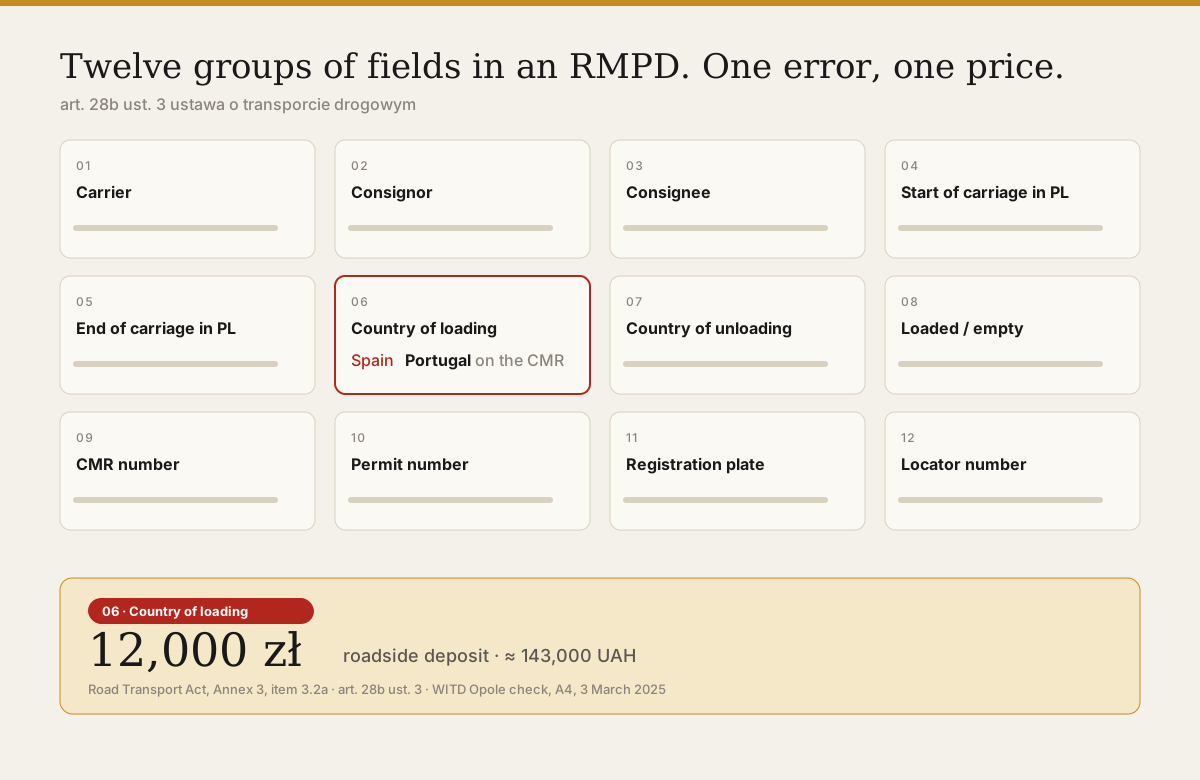
The filing has to be sent before the carriage in Poland begins. That is the Road Transport Act, ustawa o transporcie drogowym (art. 28b ust. 1). The same act lists what the filing contains: carrier, consignor and consignee details, place and date of the start and end of the carriage in Poland, country of loading and unloading, whether the truck is loaded, the CMR number, the permit number, the registration plate, the locator number (art. 28b ust. 3). Twelve groups of fields. An error in any of them is "data inconsistent with the facts".
One more thing carriers learn on the road: where the run requires a permit or an ECMT carnet, a carriage without a filing is treated as a carriage without a permit (art. 28b ust. 10). A valid permit or ECMT licence does not help if there is no number.
How much one mistake in an RMPD costs
A mistake in an RMPD costs 12,000 zł. So does having no RMPD at all. The law does not distinguish "forgot to file" from "mixed up the date": both cases sit in one line of the penalty schedule.
| Breach | Amount | Who pays | Where it is written |
|---|---|---|---|
| No RMPD filing, or a filing with incomplete or inaccurate data | 12,000 zł (≈ 143,000 UAH) | carrier | Annex 3, item 3.2a to the Road Transport Act |
| A filing exists, but geolocation data is not transmitted | 10,000 zł (≈ 119,000 UAH) | carrier | Annex 3, item 3.2b and art. 10a ust. 1 of the SENT Act |
| Driver did not switch the locator on, or switched it off too early | 2,000 zł (≈ 24,000 UAH) | driver | Annex 1, item 2b |
| Driver did not present the reference number | 1,500 zł (≈ 18,000 UAH) | driver | Annex 1, item 2a |
NBU rate 11.94 ₴/zł on 14 September 2026, amounts rounded to the nearest thousand hryvnia.
What inspectors actually collected 12,000 zł for in 2025
Three real checks. All described by the inspectorate or by regional press quoting it. None involved an attempt at fraud, only a field in a form.
Opole, A4, 3 March 2025. Spain instead of Portugal in the "country of loading" field. Deposit 12,000 zł, penalty proceedings.
Garwolin, S17, 4 May 2025. A Ukrainian carrier entered a wrong planned end date of the carriage. The driver got a 2,000 zł fine, the carrier paid a 12,000 zł deposit. 14,000 zł in total for one date.
Garwolin, the same S17, 19 May 2025. Two trucks of one Ukrainian operator. In the register the country of unloading was Ukraine; in the documents, Moldova. Deposit 24,000 zł, 12,000 zł per truck. The regional inspector put it in one sentence: "Błędne wypełnienie danych w formularzu zgłoszenia do rejestru SENT - RMPD stanowi naruszenie ustawy o transporcie drogowym", that is, incorrectly completed data in the filing is a breach of the Road Transport Act.
Portugal instead of Spain. One date. One country. None of these errors gave the carrier any advantage. Each cost 12,000 zł.
Why it is the experienced dispatcher who slips, not a novice
RMPD mistakes are made by people who know the system. They are the ones filing dozens of entries a day.
Do the maths. A dispatcher copies twelve groups of data from the CMR into the PUESC form for every truck. Five trucks a day is more than fifty fields. Twenty trucks is more than two hundred. Each read off paper or a photo, sometimes handwritten, and typed again.
The error looks trivial. 3-7 instead of 7-3. The letter "O" instead of a zero in a plate. "15" instead of "25" in a date. Spain instead of Portugal, because both are on the same route.
The person does not see it. Not for lack of competence. After six hours of the same work, with a phone ringing and a driver waiting at the border for a number, the dispatcher looks at the form with the same eyes as in the morning. Only tired ones. That is how every haulage company works, and no instruction changes it.
The law does not take this into account. The line about 12,000 zł contains no word "intentionally". The amount is the same however many fields are wrong. The inspector has nothing to weigh: the act gives him only a ceiling of 12,000 zł (art. 92a ust. 1), and the annex sets the exact figure.
What the driver sees when GPS drops at night
Nothing. That is the whole problem with geolocation.
The carrier must ensure that the truck's position is transmitted for the entire route (art. 10a ust. 1 of the SENT Act, applied to RMPD through art. 28b ust. 5). It is the carrier's duty, not the driver's, and the carrier pays for it: 10,000 zł.
The driver has rules of his own. He switches the locator on when the carriage in Poland begins and off no earlier than at unloading or exit (art. 10b). If the locator fails for more than an hour, he must stop at the nearest car park or lay-by (art. 10c ust. 1). Breaking these rules costs him 2,000 zł.
Now picture it at night on a motorway. The app has lost its connection. The phone sits in its holder. The driver watches the road, because that is what he is responsible for. He learns about the lost signal when he looks at the screen. Or when he is pulled over. The one-hour clock runs whether he knows about it or not. A driver cannot steer a forty-tonne rig and watch a satellite icon at the same time. The law requires that somebody watches.
If the PUESC register itself was down, the law treats it in two ways. For SENT filings there is an explicit exemption: no geolocation fine if the register was at fault (art. 22 ust. 2b of the SENT Act). For the RMPD fine there is no such rule. A register outage has to be proven as a circumstance beyond the carrier's control. The proof starts with a simple question: was the register really down. That is visible on the PUESC status page, which Sigil measures every five minutes, keeping a history of outages.
There is a third case too: the register was up, the driver's app showed green, yet the data never reached the system. For such a four-hour gap the Kraków court quashed a 10,000 zł fine on 13 May 2026 because the authority never tried to find the cause; what follows for a carrier is analysed in Court quashes 10,000 zł GPS fine.
What it means for a small haulier
12,000 zł is about 143,000 UAH. For a company with three to five trucks that is not "a fine". It is a month of one truck's work. It is several months of a dispatcher's pay. It is a set of tyres for the tractor and the trailer. It is fuel for several runs to Poland and back. With the driver's fine the total reaches 14,000 zł, about 167,000 UAH, all for one roadside stop. Other combinations can be worked out in the fine calculator.
The money leaves the company on the road, not after a decision. Ukraine has no mutual enforcement agreement with Poland. So from a Ukrainian carrier the inspector collects a deposit equal to the expected fine right away, in cash or by transfer (art. 94 ust. 3). Without the deposit the truck is sent to a guarded car park (art. 95). It is released once the deposit is paid. The roadside choice is one: pay 12,000 zł now, or pay for the car park and lose the run.
A dispatcher who files twenty entries a day and errs in one out of a hundred produces five such deposits a year. That is 60,000 zł.
Is there official statistics on RMPD fines
There is no separate official statistics on RMPD fines. As of September 2026 neither the Chief Inspectorate of Road Transport (GITD) nor the Ministry of Finance has published how many filings the register holds, how many were checked, how many deposits were collected, or how many concerned Ukrainian carriers. There is no data on appeals or court cases about RMPD either. This article does not invent any.
There are general figures of the Road Transport Inspectorate for 2024 and 2025, presented at the Chief Inspector's meeting with hauliers on 30 October 2025: 210,400 roadside checks in 2024, more than 177,000 in the first nine months of 2025. 55 % of checks involve foreign carriers. In 72 % of checks inspectors raise no objections. Every second truck stopped on a Polish road is foreign. And a Ukrainian one has had one more item to check since 1 November 2024.
Law firms serving carriers report a marked rise in RMPD checks and collected deposits since the start of 2025. That is an observation from practice, not a figure from an authority.
Can an RMPD fine be appealed
It can. But the grounds are narrower than for "ordinary" SENT fines, and it is better to know this before a check.
An RMPD fine is imposed under the Road Transport Act, not the SENT Act. That is the whole difference. The SENT Act has a waiver clause: the authority may decide not to fine where a significant interest of the carrier or the public interest requires it (art. 22 ust. 3 and art. 24 ust. 3). That is what carriers win on in court. The closest example to our topic is case II GSK 677/21. A carrier was fined 10,000 zł for data in a filing inconsistent with the facts. The authority refused a waiver. On 5 September 2024 the Supreme Administrative Court set aside both the lower court's judgment and the decision: the authority should have considered a waiver with regard to proportionality, and had not. In case II GSK 1621/21 the same court asked the authority directly whether there really is a public interest in punishing a lawfully operating carrier for a formal defect that posed no threat to the treasury.
The Road Transport Act has no such clause. It has only one: the case is dropped if the carrier had no influence on the breach and the breach resulted from events it could not foresee (art. 92c ust. 1 pkt 1). A dispatcher who mixed up a date is the carrier's influence. A lost connection in a tunnel, a register outage, a locator broken by the operator are arguments. Each has to be proven with documents. And proven after the deposit has already been taken.
Is there a chance of recovering 12,000 zł for one transposed digit? Small. The provision does not ask about the dispatcher's fatigue; it asks about the carrier's influence.
Where every field of the filing comes from, and why the data from the consignment note are copied verbatim, is in the article How CMR data get into an RMPD, field by field. A mistake noticed before entry is fixed with an RMPD101, not a new filing: RMPD100, 101, 103, 104 and which document to file when. And when the run also carries a SENT, the fines are counted separately for each filing: The difference between SENT and RMPD nobody explains.
What to do
- File the RMPD before entering Poland, not at the border. The driver must refuse to set off without the reference number (art. 28c ust. 2).
- Check the filing against the CMR field by field, not "at a glance". Country of loading, country of unloading, end date: the three fields behind three real deposits in 2025.
- Copy data from the consignment note, not from memory. If the CMR says Portugal, the RMPD says Portugal. Even if the dispatcher "knows" the goods were collected in Spain.
- Update the filing as soon as anything changes. An old end date after a route change becomes "inaccurate data".
- Hand the driver the reference number in writing before departure and test the locator before the border. The 1,500 zł and 2,000 zł are his, but it is your truck that gets stopped.
- Keep proof of any outage: a screenshot of the register status, the locator operator's notice, the time. It is the only material for getting the case dropped.
- Count how many fields your dispatcher types by hand in a day. Every one of them is a place where 3-7 will one day become 7-3.
What not to do
- Do not "correct" data after OCR or from memory. The fine is not for the RMPD differing from reality. It is for the RMPD differing from the documents the driver carries.
- Do not reuse a reference number from the previous run. That is what a driver stopped by WITD Radom near Radzymin on 9 April 2025 had done. It is 12,000 zł, the same as no filing.
- Do not rely on the driver "noticing" a lost GPS signal. After an hour he should already be parked. Someone in the company has to learn about the outage before the inspector does.
- Do not count on the "significant interest of the carrier" as in SENT cases. For RMPD there is no such ground in the law.
- Do not refuse the deposit on principle. The car park costs more and kills the run, and the fine decision will come anyway.
Where technology fits in
If one transposed digit costs a month of a truck's work, the question is not whether the dispatcher is careful. The question is how many digits he retypes by hand at all. Every field typed from paper is a field where a person will one day make a mistake. The law will not ask why.
Sigil is built around that single idea. Data from the CMR is read from a photo and carried into the RMPD one to one, without "corrections". The dispatcher confirms it rather than retyping it. That step cannot be switched off, because it is a person who answers to the inspector. Before submission to PUESC the declaration is checked against the official schema. After registration the system itself polls SENT-GEO for the truck's position and alerts when the signal disappears. So that the dispatcher learns about it before the inspector does. How this looks in declaration statuses is described in the help article Checking RMPD statuses.
Sigil does not replace the dispatcher and does not relieve the driver of the duty to switch the locator on. It removes retyping from their work. The part in which a person is most exposed to a mechanical slip. For a carrier who has already paid 12,000 zł for one date, this is not a matter of convenience. It is a matter of whether he wakes up at night wondering "what if I got one digit wrong somewhere".
Sigil handles RMPD declarations. The SENT notification for the goods is filed by the consignor or the consignee.
A demo or training for your team
30 minutes online. We show how Sigil™ files an RMPD from a CMR and answer questions about your runs.
Frequently asked questions
- Is a mistake in an RMPD fined the same as not filing at all?
- Yes. Both cases sit in one line of Annex 3, item 3.2a to the Road Transport Act: carriage without a filing, or a filing with incomplete or inaccurate data, 12,000 zł. The law does not distinguish a deliberate error from a mechanical one.
- Can an RMPD mistake be corrected after entering Poland?
- Yes, before a check. A filing is updated under art. 8 of the SENT Act, applied to RMPD through art. 28b ust. 5 of the Road Transport Act. A mistake the inspector has already recorded in the protocol remains a breach; updating after being stopped does not undo it.
- Does a Ukrainian carrier have to pay the deposit on the spot?
- Yes. Under art. 94 ust. 3 of the Road Transport Act, from a carrier established in a state without a mutual enforcement agreement the inspector collects a deposit equal to the expected fine, in cash or by transfer. Without it, under art. 95 ust. 1 pkt 1 the truck is sent to a guarded car park at the carrier's cost.
- Is the driver liable for the dispatcher's mistake in the RMPD?
- Not for the data; for the number and the locator, yes. The 12,000 zł fine for inaccurate data is imposed on the carrier. Under Annex 1 the driver pays 1,500 zł for not presenting the reference number (item 2a) and 2,000 zł for a locator not switched on or switched off too early (item 2b). In 2025 checks drivers were fined even when the error was in the data, so check the number and the locator before departure.
Sources
Legislation, as in force on the date of publication:
- Ustawa z dnia 6 września 2001 r. o transporcie drogowym, ISAP, consolidated text: art. 28b, art. 28c, art. 87 ust. 1 pkt 8, art. 92a, art. 92c, art. 93, art. 94 ust. 3, art. 95, załącznik nr 1 (lp. 2a, 2b), załącznik nr 3 (lp. 3.2a, 3.2b).
- Ustawa z dnia 9 marca 2017 r. o systemie monitorowania drogowego i kolejowego przewozu towarów oraz obrotu paliwami opałowymi, ISAP, consolidated text: art. 8, art. 10a, art. 10b, art. 10c, art. 22 ust. 2b and 3, art. 24 ust. 1 pkt 2 and ust. 3.
- Zgłoszenie przewozu w przypadku międzynarodowego przewozu drogowego rzeczy, PUESC, service description and legal basis of the duty.
Enforcement authorities:
- Nowe obowiązki zagranicznych przewoźników w rejestrze zgłoszeń SENT, WITD Radom, gov.pl.
- Zatrzymany transport bez zgłoszenia do rejestru SENT – RMPD, WITD Radom, gov.pl, check of 9.04.2025.
- Podsumowanie działań ITD podczas spotkania Głównego Inspektora z przewoźnikami, GITD, gov.pl, 30.10.2025, number of checks.
2025 roadside checks in regional sources quoting the inspectorate:
- Ukraiński przewoźnik z naruszeniem w Rejestrze Międzynarodowych Przewozów Drogowych, prostozopolskiego.pl, 8.03.2025, based on materials of WITD Opole.
- Błąd w rejestrze SENT kosztował przewoźnika 14 tysięcy złotych, etransport.pl, May 2025, based on materials of Mazowiecki WITD.
- Ciężarówki ukraińskiego przedsiębiorcy zatrzymane w pobliżu Garwolina, egarwolin.pl, 19.05.2025, based on materials of Mazowiecki WITD.
Case law, Central Database of Administrative Court Rulings (CBOSA):
Exchange rate: official hryvnia to złoty rate, National Bank of Ukraine, 11.94 ₴/zł on 14 September 2026.
Read next
- SENT and RMPD fines 2026, amounts, who pays, how to appealEvery SENT and RMPD fine in one table: amount in złoty and hryvnia, who pays, article number with a link. Appeal deadlines and the difference between two acts.
- What an RMPD is and who must file itRMPD from scratch: what the filing is, who must file it since 1 November 2024, when it is not needed, how it differs from SENT, what happens at entry without it
- How CMR data get into an RMPD, field by fieldWhich CMR box goes into which RMPD100 field, what the CMR lacks (type of carriage, permit, border), what the RMPD lacks (goods, CN). Three fields that diverge.
- Court quashed a 10,000 zł SENT GPS fine, how to appealThe driver's app showed green while SENT saw 4 hours of silence. The Kraków court quashed the 10,000 zł fine as automatic punishment. What to do about yours.
Sigil™ turns a CMR into an RMPD declaration and files it with PUESC — with every field checked against the original.
More on this topic: RMPD