RMPD
The ECMT permit and what it means for an RMPD filing
The ECMT permit in an RMPD filing: when to name it and when an exemption, what goes into the permit field, and why one filing per run is often not enough.
Published · Author: Makaiev Kostiantyn Oleksandrovych, founder of Sigil RMPD
A firm holds ECMT permit books, so the dispatcher picks ECMT in every filing. The choice looks safe, since the permit genuinely exists. Yet the permit field does not describe what sits in the safe; it describes what this particular carriage runs on, and those are two different things.
In our base of 7,133 filings in the production environment with a carriage start date from 31 October 2024 to 24 October 2026, an ECMT permit appears in 193 and an exemption under an agreement in 6,936. A third of the firms, 6 of 18, used a permit book at least once. These are one platform's data, not the market's.
In brief: the duty to file RMPD arises in three cases and the ECMT permit is one of them (art. 28b ust. 1 of the Road Transport Act) · with an ECMT permit the filing carries three details, the permit number, its period of validity and the country where the carrier is established (ust. 3 pkt 10 lit. a) · with an exemption the legal ground from the dictionary replaces the number (lit. b) · in our data 97 per cent of exemptions rest on one code, 094, the agreement between the European Union and Ukraine · several operations within one carriage need separate filings where more than one permit is required or the ground of exemption differs (ust. 8) · a missing filing where a permit was required means the journey counts as made without a permit (ust. 10) · the road transport inspectorate runs electronic ECMT permits inside the International Transport Forum system (art. 30b).
An ECMT permit is a multilateral foreign permit issued by the International Transport Forum, and that is exactly how the Polish statute names it. For the filing what matters is not its existence but what goes into the permit field and how many filings a run requires.
Three doors into the RMPD duty
The statute lists them in a single sentence worth reading slowly. The duty to file arises where international carriage requires a permit under art. 28 ust. 1, or an ECMT permit, or where an international agreement binding on Poland exempts from holding those permits (art. 28b ust. 1).
The third case is the road most Ukrainian carriers travel. The agreement between the European Union and Ukraine on the road transport of goods exempts them from permits, which is why their filings carry a ground of exemption rather than a permit number.
Does holding an ECMT book mean ECMT must be chosen? No. What is chosen is what the particular operation runs on.
What goes into the filing with an ECMT permit
The statute names three details and the portal asks for exactly those (art. 28b ust. 3 pkt 10 lit. a). The permit number, its period of validity, and the country where the carrier is established.
The block holding them is optional in the schema, which surprises anyone expecting hard validation. Practice says the same: in our base no ECMT filing carried the full permit block, because nobody filled in the issuing country.
When the ground of exemption replaces the number
Where the duty to hold a permit is lifted, the filing states the legal ground of that exemption (art. 28b ust. 3 pkt 10 lit. b). The ground comes from the portal's dictionary, and the RMPD specification enforces this through rule R08. Where the permit type is an exemption, the ground is mandatory and must come from the dictionary, while the permit block must stay empty.
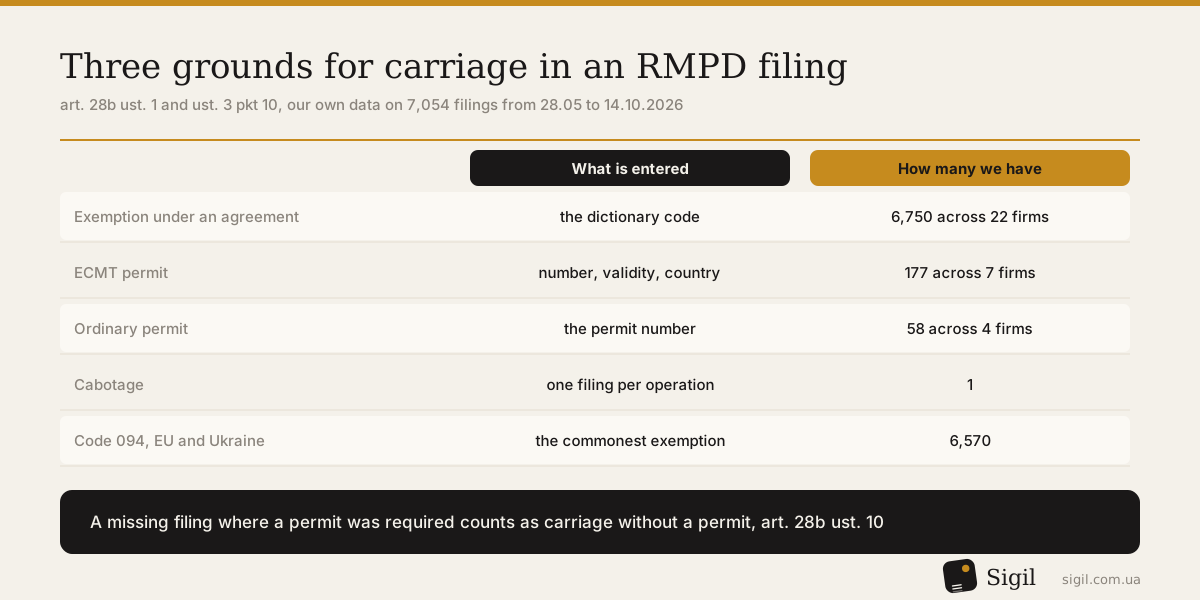
| What stands in the permit field | What else is needed | How many such filings we have |
|---|---|---|
| exemption under an agreement | the dictionary code of the ground | 6,936 across 18 firms |
| ECMT permit | number, validity, country of establishment | 193 across 6 firms |
| ordinary permit | the permit number | 4 at one firm |
| cabotage | a separate filing per operation | 0 |
Inside the exemptions the picture narrows further. Code 094, carriage under the agreement between Ukraine and the European Union, stands behind 6,758 of the 6,936 filings, and the rest falls to special cases, among them carriage by a vehicle with a load capacity up to 3.5 tonnes.
Where the exemption under the agreement ends
The agreement covers four cases, and the portal's dictionary lists them under separate codes. Loaded carriage between the territories of two Parties, with or without transit through a third country. Loaded carriage from the Party of establishment back to that same Party, in transit through the other Party. Loaded carriage to or from a third country, in transit through the other Party. And empty runs connected with the three above.
Outside those four the exemption does not hold. The commonest example is carriage performed entirely between two European Union states without touching Ukraine: it is not on the list, so a permit or an ECMT book is needed.
When one filing per run is not enough
Where one carriage includes several transport operations for which more than one permit is required, or where the ground of exemption differs, each such operation needs its own filing (art. 28b ust. 8). For cabotage a separate filing is due for every operation with no further conditions (ust. 9).
The second half of that rule is the least known. A differing ground of exemption splits a run into two filings by itself, even where no permit exists at all. How to tell transit from carriage to a third country is shown in a separate article.
What happens when a filing is missing and a permit was required
Here hides a consequence almost nobody writes about. A missing filing for carriage that required a permit under art. 28 ust. 1, a cabotage permit or an ECMT permit means the journey counts as performed without a permit (art. 28b ust. 10).
Driving without a permit does not double the penalty. The penalties imposed for breaches found during one roadside check may not exceed 12,000 zł in total (art. 92a ust. 3 of the Road Transport Act), so no permit (Annex 3 item 3.1) and no filing (item 3.2a) together come to 12,000 zł, not 24,000. The consequence of art. 28b ust. 10 is separate and not financial. The truck is sent to the nearest guarded car park at the carrier's cost, and the act provides for the permit to be withheld and cancelled. The truck leaves the car park only once a correctly completed permit is shown (art. 89a1 ust. 1a and 1b). Your own figure comes out of the SENT and RMPD penalty calculator, and what happens during the check itself is covered in the article on an RMPD roadside check.
For a carrier travelling under the agreement with the European Union the provision does not bite, because no permit was required. The guarded car park still applies to that carrier, but the journey may continue once the filing is sent and a reference number obtained (art. 89a1 ust. 1a). For the same carrier holding an ECMT permit art. 28b ust. 10 bites in full.
Electronic ECMT permits and the roadside check
ECMT permits now live in the International Transport Forum's system, where the Chief Road Transport Inspector acts as national coordinator (art. 30b). He opens accounts for carriers and control bodies, allocates granted permits and monitors their use.
On the road that means a concrete duty for the driver. Where an electronic ECMT permit is produced, the driver must on demand hand over the device the document is stored on (art. 87 ust. 8).
Certificates are worth remembering separately. Where the use of a foreign permit depends on meeting safety or roadworthiness requirements, the relevant certificate is issued by the Chief Inspector or a provincial road transport inspector (art. 30 ust. 10). The same certificates are shown at the permit issuing point, and how the whole procedure with the blank works is described separately.
Where our system belongs
We do not allocate permits and we are not a party to their distribution. ECMT books sit in the company profile, the dispatcher picks the one travelling on this run, and the system puts its number and validity into the filing. Where the ground is different, it puts in the dictionary code of the exemption, the same one rule R08 checks. Which document travels under which code is set out in the message dictionary.
What to do
- Choose the ground for the particular operation, not for the contents of the safe.
- Keep the book number together with its validity in the profile, since both go into the filing.
- Split a run into separate filings where the ground of exemption differs between operations.
- Carry the device holding an electronic ECMT permit so that it can be handed over.
- Check the certificates attached to a permit where its use depends on them.
What not to do
- Choosing ECMT merely because the firm holds books. The ground belongs to the carriage.
- Writing the ground of exemption in your own words. It must come from the portal's dictionary.
- Filing separately for every cabotage operation.
- Thinking the 12,000 zł penalty is the whole consequence. The journey also counts as made without a permit.
Sigil handles RMPD filings. ECMT permits are issued and allocated by the authorities, and we take no part in that.
A demo or training for your team
30 minutes online. We show how Sigil™ files an RMPD from a CMR and answer questions about your runs.
Frequently asked questions
- Must ECMT be chosen in the filing when the firm holds permit books?
- No, not if the run does not travel on one. The ground in a filing describes the particular transport operation rather than the contents of the safe. Most Ukrainian carriers travel under the European Union agreement, and then the field carries an exemption code rather than a permit number.
- What exactly goes into the filing with an ECMT permit?
- The permit number, its period of validity and the country where the carrier is established. That is what art. 28b ust. 3 pkt 10 lit. a requires. The block holding them is optional in the schema, but the statute asks for exactly these three items.
- When is one filing per run not enough?
- When there are several operations and more than one permit is needed, or the ground of exemption differs. Each operation then needs its own filing (art. 28b ust. 8). For cabotage a separate filing is due for every operation with no further conditions (ust. 9).
- What does carriage without a permit mean when the filing is missing?
- A separate consequence, and not a financial one. Where carriage required a permit and no filing exists, the journey counts as performed without a permit (art. 28b ust. 10). The penalty does not double, because penalties from one roadside check cannot exceed 12,000 zł in total (art. 92a ust. 3), but the truck goes to a guarded car park and is released only with a correctly completed permit (art. 89a1 ust. 1a and 1b). For a carrier travelling under the European Union agreement the provision does not bite, because no permit was required.
- Does the inspector get to take the phone holding an electronic ECMT permit?
- Yes, on demand. The statute requires not only producing the document but also handing over the device it is stored on (art. 87 ust. 8). The same applies to other documents required in electronic form.
Sources
Legislation:
- Act of 6 September 2001 on road transport, ISAP, consolidated text Dz.U. 2025 poz. 1490: art. 28 ust. 1 and 1a, art. 28b ust. 1, ust. 3 pkt 10 lit. a and b, ust. 8, 9 and 10, art. 29 ust. 1, art. 30 ust. 10, art. 30a, art. 30b ust. 1 and 3, art. 87 ust. 8, art. 89a1 ust. 1, 1a, 1b and 3, art. 92a ust. 3, annex 3 items 3.1 and 3.2a.
- Act of 9 March 2017 on the road and rail carriage monitoring system, ISAP, consolidated text Dz.U. 2024 poz. 1218: art. 2 pkt 4, art. 4 ust. 1 pkt 1.
Specification:
- Technical specification of RMPD system messages, version 1.0 of 20 November 2024, Fiscal Administration Chamber in Zielona Góra, rule R08 on the exemption ground field and dictionary pdr2147, from the PUESC specifications page.
Platform data: 7,133 filings by 18 firms in the PUESC production environment with a register number, cancellations excluded, carriage start date from 31 October 2024 to 24 October 2026, as of 25 October 2026, the Rmpd table. Distribution of grounds: exemption 6,936 across 18 firms, ECMT 193 across 6, ordinary permit 4 at one, cabotage 0. Within the exemptions, code 094 stands behind 6,758 filings. One platform's data, not the market's.
Read next
- Transit or third-country carriage, how to tellLoading in Poland and unloading in Germany is third-country carriage for a Ukrainian operator, and the EU Ukraine agreement does not cover it.
- What an RMPD is and who must file itRMPD from scratch: what the filing is, who must file it since 1 November 2024, when it is not needed, how it differs from SENT, what happens at entry without it
- An RMPD roadside check and what the inspector doesAn RMPD roadside check: what the inspector looks at in the filing, why last trip's number does not help, when the truck is impounded and the driver's rights.
Sigil™ turns a CMR into an RMPD declaration and files it with PUESC, with every field checked against the original.
More about RMPD