SENT
SENT for concrete after the veto and the new draft
Concrete is outside SENT, because the law was vetoed on 2 June 2026. The new draft is narrower, drops geolocation for mixers and softens SENT penalties.
Published · Author: Makaiev Kostiantyn Oleksandrovych, founder of Sigil RMPD
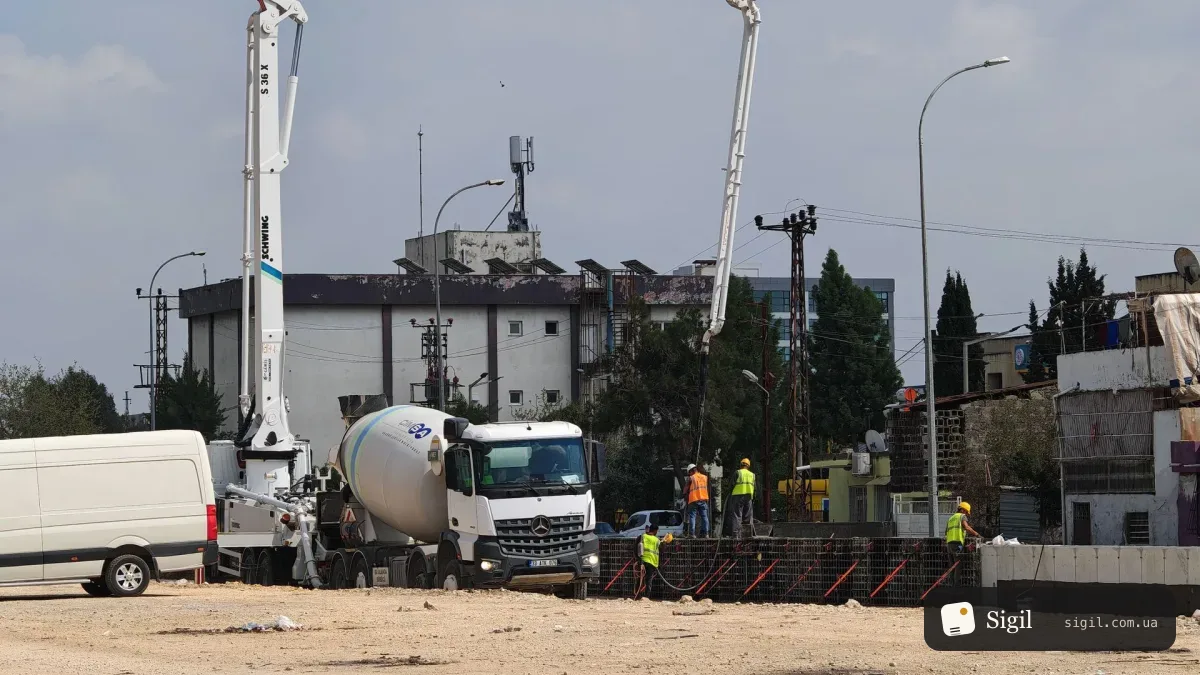
A site manager read on a law firm's page that work on "SENT beton" was in its final stage and that the rules would start to apply in the second half of 2026. So they booked training for the batching plant's dispatchers and asked the supplier about reference numbers on delivery notes. The trouble is that the text they read describes a law that does not exist: the President refused to sign it on 2 June 2026.
SENT is the Polish system for monitoring the carriage of sensitive goods, and the list of those goods lives in a ministerial regulation.
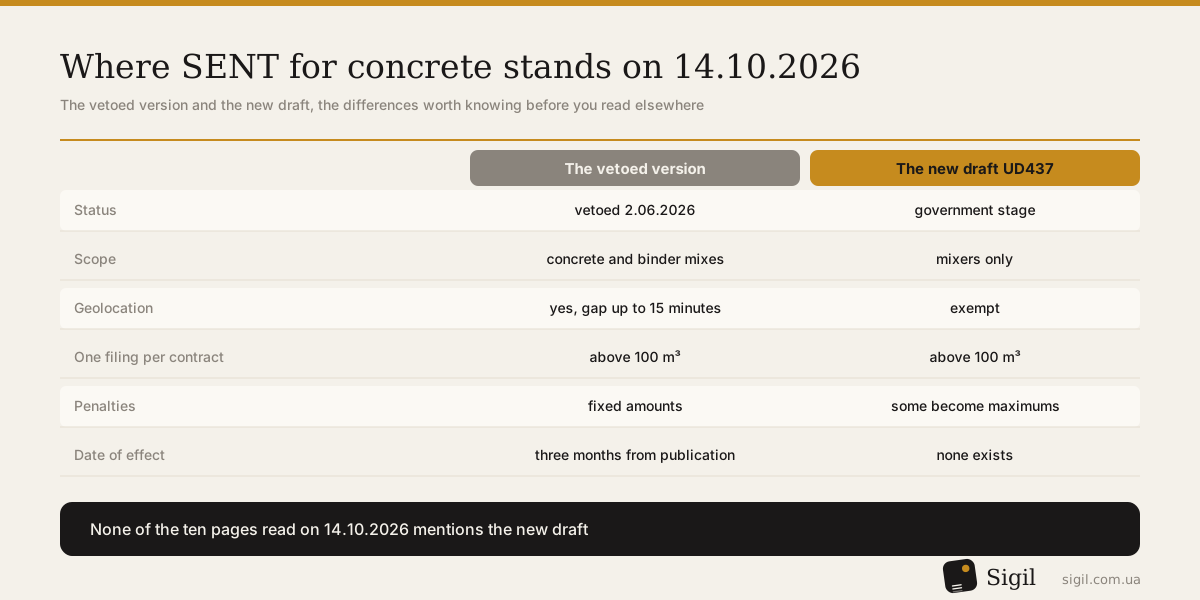
In short: concrete is not in SENT, and as at 14 October 2026 it still is not, because the law that would have added it was stopped by the veto of 2 June · the new draft is narrower and covers concrete only in concrete mixers, including those fitted with a pump · mixers are to be exempt from transmitting geolocation data, so the fifteen-minute GPS gap rule from the vetoed version falls away · for a contract above 100 m³ between businesses, one filing for the whole contract is to be possible · the draft changes penalties across the whole SENT system, not only for concrete: some of today's fixed amounts are to become maximum penalties, and on an obvious slip the authority is to be able to issue a caution instead · the milder rules are to reach some breaches committed before the rules take effect · no date of entry into force exists today, because the draft has not left the government stage.
Carrying concrete is not subject to SENT today and no filing has to be made for it. The law that would have changed this passed the whole parliament, but the President did not sign it. The Ministry of Finance has returned with a new, narrower draft, and on 14 October 2026 that draft has still not left the government stage.
What applies today
Concrete does not appear in the list of goods covered by SENT, and that is the position on the day this text is published. The list lives in a regulation of the minister of finance, and concrete never entered it; an act of parliament was to add it, not a regulation. What the list actually holds, with thresholds and CN codes, is gathered in the piece on the SENT list of goods.
A practical conclusion follows for a batching plant, a contractor and an investor alike. There is nothing to implement today: no filings, no reference numbers on delivery notes, no confirmation of concrete receipt in the system. Preparing makes sense; implementing does not. Who files for the goods that are already on the list, on which route, is set out in the piece on who submits a SENT filing.
Why the internet says concrete is already in SENT
Because nearly all of those texts describe a law that never took effect, and several present it as about to. Its route was a full one: the government adopted the draft on 11 February 2026, it reached the Sejm on 13 February as paper 2272, it passed its third reading on 17 April by 236 votes to 194, and on 15 May the Sejm accepted the Senate's amendments and sent the enacted law to the President. President Karol Nawrocki refused to sign it on 2 June 2026, saying the rules placed further administrative duties and costs on businesses while the economy needed deregulation.
One point here is written nowhere else, and it changes the picture. The vetoed law is not formally dead. A veto is not a final refusal but a reasoned motion to reconsider (Konstytucja art. 122 ust. 5). On the day this text is published the process page for paper 2272 reads "Niezakończone prace nad ustawą”, that is, work on the law is unfinished. The President's motion went to committee on 11 June 2026 and the Sejm has not voted on it.
To override the veto the Sejm must re-enact the law by a three-fifths majority, with at least half of the 460 deputies present. The arithmetic runs against that: at the third reading 236 of the 430 deputies voting supported the law, while three-fifths of 430 is 258. Two roads are therefore open at once, and the second one is worth knowing about.
On 14 October 2026 we read ten pages that surface on queries about SENT and concrete, from transport and tax law firms to construction portals. Not one mentions the new draft. Four describe the old one as about to take effect. Two mention the veto at all.
That yields a simple freshness test for anything you read. Where a piece on SENT for concrete speaks of a broad definition of concrete, or of a GPS duty, it is describing the vetoed version rather than what is on the table now.
What fell with the veto
The vetoed version was broader than what is proposed now, and it is worth knowing what it would have covered. SENT was to take in ready-mixed concrete and other mineral-binder mixes in the form of a mass ready to be poured, spread or built in: ready-mixed mortars, floor screeds, cement and sand beddings and CBGM mixes, known on site as screeds.
The vetoed version carried a threshold of its own, worth knowing because it shows how far the rules reached: the exemption from SENT duties covered masses other than ready-mixed concrete offered in unit packages of up to 50 kg. Finished concrete products were not to be covered and are not: paving blocks, kerbstones, slabs. The line runs by whether the goods are a mass that sets in place or already a finished product.
The veto stopped more than concrete. The same act carried rules on moving goods between the warehouses of one entity, on confirming receipt, and on wider use of the data gathered in SENT.
What the new draft contains
The new draft, in the government's list of legislative work since 21 July 2026, narrows the scope to the manner of carriage. SENT is to take in ready-mixed concrete only in vehicles of the concrete mixer type, including mixers fitted with a pump. The ministry sets no minimum threshold: SENT is to apply regardless of the quantity of concrete in the mixer.
Two points in the draft are worth knowing beyond the concrete trade, because they show how the ministry now thinks. First, mixers are to be exempt from the duty to transmit geolocation data, which the ministry justifies by the nature of the goods and of their carriage. Second, for a contract between businesses covering more than 100 m³ of concrete, the sending party is to be able to submit one filing for the whole contract, covering many vehicles, loading places and delivery places.
Deliveries to natural persons not in business are to be covered as well, yet the recipient need neither open an account nor close the filing. Confirming receipt is to fall to the sending party, that is to the supplier.
What the draft changes in penalties across SENT
The most important part of the draft does not concern concrete at all. The ministry assessed how effective, proportionate and adequate the sanctions in force since 2017 have been, and wants some penalties now fixed in amount to become maximum penalties. The authority would then be able to weigh the circumstances of the case rather than impose the same sum on everyone.
The draft also provides for waiving a sanction for some formal errors arising from an obvious slip. The authority could then issue a caution instead of imposing a financial penalty. For basic filing breaches the draft keeps the mechanism based on 46 percent of the gross value of the goods, or of the difference in that value. For some goods other than excise products the penalty is to be capped at 20,000 zł. The deposit changes along with the penalties. It is to be taken at the level of the maximum future penalty rather than a fixed amount (art. 31 ust. 1 and 3 of the SENT Act as drafted), so the sum demanded on the road depends on the penalty the authority could impose. A total across several breaches is computed at once by the SENT and RMPD penalty calculator.
One point here deserves a sentence of its own. The milder rules are to apply to some breaches committed before the new provisions take effect. For anyone with an open SENT penalty case today, that means the case is worth running rather than paying and forgetting. The procedure and the deadlines are taken apart in the piece on appealing a SENT or RMPD penalty.
What stage this has reached
On 20 October 2026 the draft has not left the government stage. Public consultations and the opinion round closed on 16 September, the interministerial round on 5 October, and every box from the Standing Committee of the Council of Ministers upwards sits empty in the government register. The list of legislative work envisaged adoption by the Council of Ministers in the third quarter of 2026, and that quarter ended on 30 September with no adoption. The draft has therefore not reached the Sejm.
This can be checked directly, and that is how we checked it. The register of prints of the tenth-term Sejm holds no new government bill on SENT since the veto. The only later print carrying the word monitoring is 3134 of 28 September 2026, and it concerns fuel quality, a different act.
From that follows the only honest conclusion about dates. No date of entry into force exists today, because it depends on whether the draft is passed, signed and published. The previous version was to enter into force three months after publication, so if the new one follows the same route the time to prepare will be the same.
The ministry grounds the need for change in the risk of tax irregularities. Analysis of JPK_VAT files and of industry data points to a grey economy in the concrete trade, and customs and tax inspections in 2025 confirmed it. During the earlier parliamentary work the ministry put unrecorded turnover at no less than 1.2 billion zł a year.
What to do
- Check whether your goods sit in the SENT list today, by CN code rather than by the name on the invoice.
- Implement nothing for concrete in SENT until the provision is published in the Journal of Laws.
- Keep running an open SENT penalty case, because the draft promises milder rules for older breaches too.
- When reading someone else's piece on SENT for concrete, check whether it mentions the veto of 2 June 2026; if not, it describes a position that is out of date.
- If you plan large deliveries, work out in advance whether you fall within the draft's 100 m³ threshold, the one procedural relief it retains.
What not to do
- Do not trust a date of entry into force from a text that does not cite the Journal of Laws. No such date exists today.
- Look for a mention of the veto of 2 June 2026; its absence is a sign the text is old.
- Do not carry the fifteen-minute GPS gap rule over to concrete. The new draft exempts mixers from geolocation entirely.
- Check the GPS rules for your own goods, because for the rest of the list they do not change.
- Do not pay a SENT penalty "for peace of mind" while the case is open. The draft promises milder rules for some older breaches too.
- Keep the documents and the deadlines, and decide on payment once it is clear whether the provision passed.
Sigil handles RMPD declarations. A SENT filing is submitted by the sender, the consignee or the carrier, depending on the route.
A demo or training for your team
30 minutes online. We show how Sigil™ files an RMPD from a CMR and answer questions about your runs.
Frequently asked questions
- Is concrete already covered by SENT
- No. On 14 October 2026 concrete does not appear in the list of goods covered by SENT. Parliament passed the law that would have added it, but the President refused to sign on 2 June 2026. The new, narrower draft has not left the government stage.
- From when will SENT apply to concrete
- No such date exists today. It depends on whether the draft is passed, signed and published in the Journal of Laws. The previous version was to take effect three months after publication, so if the new one follows the same route the time to prepare will be the same.
- Will a concrete mixer have to carry a locator
- Under the new draft, no. Mixers are to be exempt from the duty to transmit geolocation data, which the ministry justifies by the nature of the goods and of their carriage. That is why the fifteen-minute GPS gap rule described in older texts comes from the vetoed version.
- Can one filing cover a whole contract
- Yes, above 100 m³ and between businesses. The draft provides that for a contract covering more than 100 m³ of concrete the sending party submits one filing for the whole contract, covering many vehicles, loading places and delivery places. It is the one procedural relief the draft retains.
- Do the penalty changes concern only concrete
- No, the whole SENT system. The draft would turn some penalties now fixed in amount into maximum penalties, and would let the authority issue a caution on an obvious slip. The milder rules are to reach some breaches committed before the provisions take effect.
Sources
Legislation, in force on the date of publication:
- Act of 9 March 2017 on the system for monitoring road and rail carriage of goods, ISAP, consolidated text Dz.U. 2024 poz. 1218: art. 3 ust. 11 (the delegation for the goods regulation), art. 8, art. 21 ust. 1, art. 22 ust. 1.
- Regulation of the Minister of Finance of 25 April 2022 on goods whose carriage is covered by the monitoring system, ISAP, consolidated text Dz.U. 2024 poz. 1157, as amended by Dz.U. 2025 poz. 1244 and 1704 and Dz.U. 2026 poz. 589: § 1 pkt 1. Concrete does not appear in the list.
The legislative process:
- The Constitution of the Republic of Poland of 2 April 1997, ISAP: art. 122 ust. 5 (a veto as a motion to reconsider, and the three-fifths majority).
- Paper 2272, course of the process, sejm.gov.pl: received 13.02.2026, third reading 17.04.2026 (236 for, 194 against), Senate amendments 7.05.2026, amendments accepted and the law sent to the President 15.05.2026, veto 2.06.2026 (paper 2666), referral to committee 11.06.2026, and the status "Niezakończone prace nad ustawą” as at 14.10.2026.
- The government adopted the draft act on the system for monitoring the carriage of goods, SENT, Ministry of Finance, gov.pl: adoption of the draft by the Council of Ministers on 11.02.2026 and a description of its scope.
- Draft UD437, the government legislative process, RCL, explanatory memorandum dated 17.08.2026: concrete in mixers, including those with a pump, the geolocation exemption, one filing for a contract above 100 m³, maximum penalties in place of fixed ones in art. 21 ust. 2d and art. 22a, the criteria for setting the amount in art. 26 ust. 2a, a caution in place of a penalty in art. 26 ust. 2b, and a deposit at the level of the maximum future penalty in art. 31. The stage was read from that page on 20.10.2026. A draft is not a provision, so the stage has to be checked afresh.
Read next
- The 2026 list of goods under SENT monitoringThe 2026 SENT goods list with thresholds and CN codes: fuels, oils, grain, honey, poultry, clothing and footwear in 2026. Why Ukrainian goods count.
- SENT and RMPD fines 2026, amounts, who pays, how to appealEvery SENT and RMPD fine in one table: amount in złoty and hryvnia, who pays, article number with a link. Appeal deadlines and the difference between two acts.
- How to appeal a SENT or RMPD penalty step by stepHow to appeal a SENT or RMPD penalty: two procedures, 14 and 30 day deadlines, what the letter must say, the enforcement trap and what 2026 rulings show.
- Who files SENT, the consignor, the consignee or the carrierThe role in SENT follows the route, not the contract. Who files on import, export and transit, what the carrier completes and who pays for another's mistake.
- What SENT is in Poland and who the system applies toSENT is the Polish register of carriage of sensitive goods. What is monitored, who files the notification, where the reference number comes from, what it costs.
- What gets fined when one digit in an RMPD costs 12,000 złA wrong digit or date in an RMPD costs 12,000 zł, the same as not filing. Provisions with article numbers, three 2025 roadside checks and what a carrier can do.
Sigil™ turns a CMR into an RMPD declaration and files it with PUESC, with every field checked against the original.
More about SENT