SENT
Who files SENT, the consignor, the consignee or the carrier
The role in SENT follows the route, not the contract. Who files on import, export and transit, what the carrier completes and who pays for another's mistake.
Published · Author: Makaiev Kostiantyn Oleksandrovych, founder of Sigil RMPD

A carrier in Kovel takes oil from Gdansk to Lublin. The consignor writes: "SENT is on you, you are the carrier." The carrier looks at the route and says no. Both are right to the extent that they have read the act: the word carrier does appear in SENT, but a carrier files the notification in only one of three situations. In the other two it merely completes someone else's. The price of that conversation is 20,000 zł, and it is not paid by whoever argued louder.
This article takes the roles apart: who files on each type of route, what exactly the carrier completes, who closes the carriage after unloading, and who pays when no notification exists. For a reader outside Poland: SENT is the Polish register that monitors carriage of listed goods, and PUESC is the portal through which everything is filed.
In brief: the role in SENT follows the route, not the arrangement: a carriage starting in Poland is the consignor (art. 5 ust. 1), one ending in Poland is the consignee (art. 6 ust. 1), transit through Poland is the carrier (art. 7 ust. 1) · a consignor and a consignee in the sense of the act can only be an entity that runs a business (art. 2 pkt 6 and 7) · in the first two cases the carrier files nothing, yet must complete the notification with nine items, the locator number included (art. 5 ust. 4) · the consignee closes the carriage with the information on receipt of the goods, no later than the working day after delivery (art. 5 ust. 5) · everyone updates only their own part of the data, goods data are not updated at all, and a cancelled run is closed with a statement of withdrawal (art. 8) · without a reference number the carrier must refuse to accept the goods (art. 10 ust. 1) · the fine falls on whoever failed their own duty: carrier 20,000 zł (art. 22 ust. 1), consignor or consignee 46 % of the gross value and never less than 20,000 zł (art. 21 ust. 1).
The route decides the role. If the carriage begins on Polish territory, the consignor files. If it ends on Polish territory, the consignee files. If it both begins and ends outside Poland, that is transit, the carrier files. What the parties agreed changes nothing: the act addresses the duty to a specific role, and the fine goes to that role.
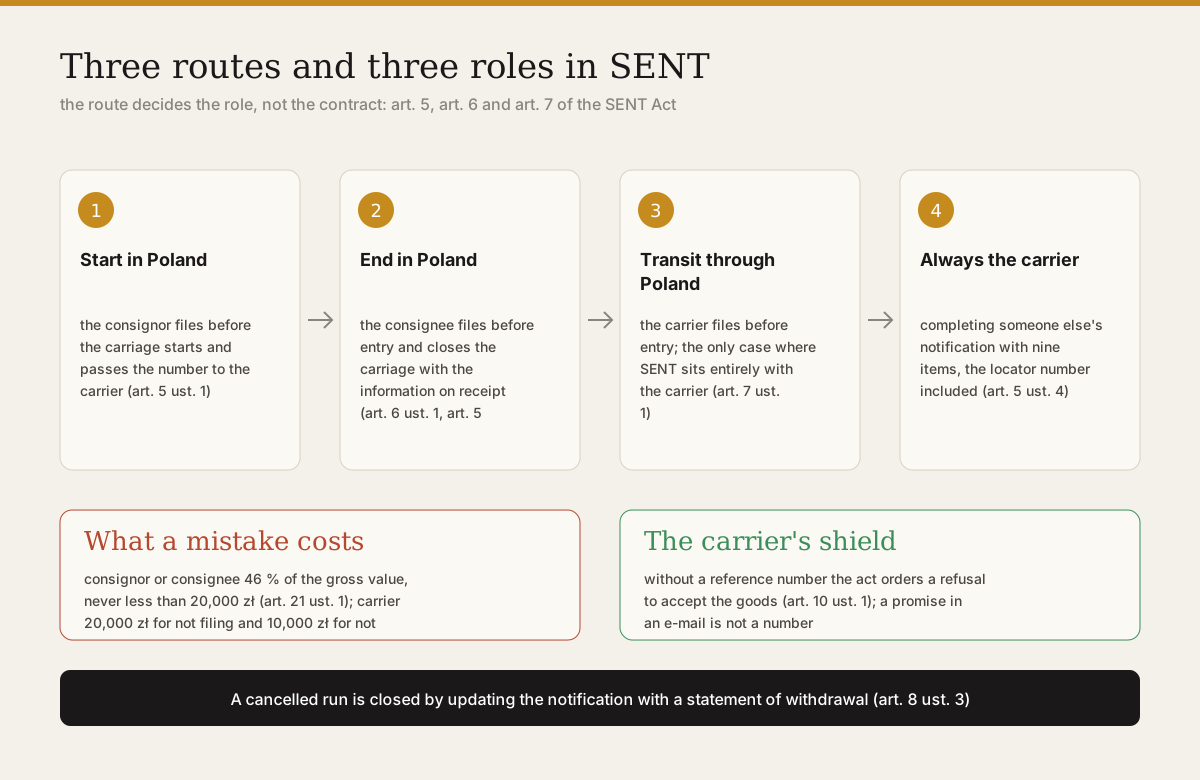
Who files on which route
The act describes three situations, and in each the duty sits with someone else. A carriage beginning on Polish territory: the consignor files before the carriage starts, receives the reference number and passes it to the carrier, and on a supply of goods also to the consignee (art. 5 ust. 1). A carriage beginning abroad and ending in Poland: the consignee files before the carriage on Polish territory starts and passes the number to the carrier (art. 6 ust. 1). A carriage beginning and ending outside Poland, that is transit: the carrier files before the carriage on Polish territory starts (art. 7 ust. 1).
Who files for a Gdansk to Lublin run between two Polish companies? The consignor. The carriage begins in the country, which is the art. 5 case. The carrier files nothing here and only completes the notification with its own data once the number arrives.
Who files for oil from Germany to Ukraine through Poland? The carrier. The carriage begins and ends outside Poland, so it is art. 7, the one case where SENT sits entirely with the carrier. What such a run looks like when a control summons arrives is described in SENT transit through Poland, the control summons and border.
Whom the act treats as consignor and consignee
Consignor and consignee in SENT are not the boxes of a CMR but roles with definitions. The consignor (podmiot wysyłający) is an entity running a business that makes a supply of goods, an intra-Community supply or an export (art. 2 pkt 7). The consignee (podmiot odbierający) is an entity running a business that makes an intra-Community acquisition, an import or an acquisition of goods (art. 2 pkt 6).
The words that matter are "runs a business". If one end of the carriage is a person or an organisation that does not, the carriage is not subject to the system, which PUESC confirms in answer 02.19. That is why part of the humanitarian runs fall outside SENT before the list of goods is even checked, as taken apart in Does humanitarian aid need a SENT notification in Poland.
The carrier (przewoźnik) is an entity running a business that performs carriage of goods (art. 2 pkt 8). The driver is a separate figure in the act, kierujący (art. 2 pkt 2), with duties and fines of their own.
What the carrier completes in someone else's notification
A carrier who files nothing still has a duty, and it is the one most often forgotten. Once the reference number arrives, the carrier completes the notification with nine items (art. 5 ust. 4). These are the name and address, the tax identification number, the registration plates of the vehicle, the actual date the carriage started and the planned date it ends. Then the number of the permit, certificate or licence where these are required, the address of the place of delivery or of the end of the carriage, the number of the transport document, and the number of the locator or device.
The last item matters most: it is the carrier who enters the locator number in the register, and without it the geolocation stream will not attach to this carriage. Where that number comes from and how the device is activated is covered in What SENT-GEO demands of the carrier and the locator.
Can a notification be completed without a PUESC account? No. Only a registered user of the portal may file, complete or update a notification (art. 9 ust. 2), so a basic account is needed even by someone who never files anything of their own.
Who closes the carriage and who updates the data
The consignee closes the carriage. On a supply of goods, the consignee completes the notification with the information on receipt no later than the working day following delivery (art. 5 ust. 5). For heating fuels the deadline is tighter: on the day of delivery, together with the quantity received and the status of the entity (art. 5 ust. 6).
Updating follows the same principle as filing. Each party updates without delay only the data it was obliged to file (art. 8 ust. 1). Goods data are not updated at all (art. 8 ust. 2): if the goods change, that is a new carriage and a new notification. If the carriage never starts, the notification is updated with a statement of withdrawal from the carriage (art. 8 ust. 3), and that is the clean way to close a number that is no longer needed.
Who pays when there is no notification
The one who failed their own duty pays, and someone else's role is no defence. A consignor or consignee who failed to file pays 46 % of the gross value of the goods, and never less than 20,000 zł (art. 21 ust. 1). A carrier who failed to file in transit pays 20,000 zł (art. 22 ust. 1). A carrier who failed to complete someone else's notification with its own data pays 10,000 zł (art. 22 ust. 2). A driver who set off without the reference number pays 5,000 to 7,500 zł (art. 32 ust. 1).
That is about 233,000 ₴ for 20,000 zł and 117,000 ₴ for 10,000 zł at the NBU rate of 11.67 ₴/zł on 25.09.2026. The full table with the legal bases is collected in SENT and RMPD fines 2026.
Does a promise from the consignor protect the carrier? No. The duty to refuse the goods without a reference number is the carrier's (art. 10 ust. 1), and it is the carrier who answers for setting off without one. A promise in an e-mail is not a reference number.
What to do
- Read the route, not the contract: start in Poland is the consignor, end in Poland is the consignee, transit is you.
- In transit, file the notification yourself before entering Poland and collect the number.
- In the other cases, demand the reference number before loading, in writing.
- Complete the other party's notification with the nine items, the locator number included.
- Hand the number to the driver before the carriage starts, together with the documents.
- Remind the consignee to close the carriage on the working day after delivery.
- If the run is cancelled, ask for the notification to be updated with a statement of withdrawal.
What not to do
- Do not agree to "take the SENT on yourself" on a route where the consignor files. The register will not accept your notification, and their duty will not disappear.
- Do not set off with a promise instead of a number. Without one the act tells you to refuse the goods.
- Do not forget the completion. A notification without your data is 10,000 zł even when the number exists.
- Do not update the goods data. The act does not allow it, and an inspector will see the discrepancy.
- Do not leave a cancelled run with a live number. Update the notification with the withdrawal.
Where technology fits in
Sigil handles RMPD declarations, a separate duty of a non-EU carrier that runs alongside SENT and does not depend on the role within it. CMR data go into the RMPD100 form one to one, the dispatcher confirms every field, and only then does the filing go to PUESC. The locator number, which the carrier enters both in the RMPD and in someone else's SENT notification, is kept in the system with the vehicle, so it does not have to be hunted down before every run.
Sigil neither files nor completes SENT notifications: that is done by the consignor, the consignee or the carrier in transit, each from their own PUESC account.
Sigil handles RMPD declarations. The SENT notification is filed by the consignor or the consignee, and in transit by the carrier itself on PUESC.
A demo or training for your team
30 minutes online. We show how Sigil™ files an RMPD from a CMR and answer questions about your runs.
Frequently asked questions
- Who files SENT when goods leave Poland?
- The consignor. The carriage begins on Polish territory, so the duty sits with the party shipping the goods (art. 5 ust. 1 of the SENT Act). The carrier completes the notification with its own data after receiving the number.
- Who files SENT when goods are brought into Poland?
- The consignee. The carriage ends in Poland and the consignee files before the carriage on Polish territory starts (art. 6 ust. 1). The consignee also closes it with the information on receipt.
- When does the carrier file SENT?
- In transit only. The carriage begins and ends outside Poland (art. 7 ust. 1). That is the one case where the notification sits entirely with the carrier.
- What must the carrier complete in someone else's notification?
- Nine items (art. 5 ust. 4): name and address, tax identification number, registration plates, actual start date, planned end date, number of the permit or licence, address of the place of delivery, number of the transport document and the locator number.
- Who pays the fine if the consignor did not file?
- The consignor, 46 % of the gross value and never less than 20,000 zł (art. 21 ust. 1). But a carrier who set off without a reference number breached its own duty to refuse the goods (art. 10 ust. 1) and answers as well.
Sources
Legislation, as in force on the publication date:
- Act of 9 March 2017 on the system for monitoring the road and rail carriage of goods (SENT Act), ISAP, consolidated text Dz.U. 2024 poz. 1218: art. 2 pkt 2, 6, 7 and 8, art. 5 ust. 1, 4, 5 and 6, art. 6 ust. 1, art. 7 ust. 1, art. 8, art. 9 ust. 1 and 2, art. 10 ust. 1 and 2, art. 21 ust. 1, art. 22 ust. 1 and 2, art. 32 ust. 1.
- Regulation of the Minister of Finance of 25 April 2022 on goods covered by the monitoring system, ISAP, consolidated text Dz.U. 2024 poz. 1157 as amended by 2025 poz. 1244 and 1704 and 2026 poz. 589, 813 and 814: § 1 and § 2.
- Act of 6 September 2001 on road transport, ISAP: art. 28b ust. 1 (the RMPD duty of a non-EU carrier).
Authorities:
- Carriage of goods covered by monitoring (SENT), PUESC: service descriptions, notification forms and the roles of the parties.
- SENT FAQ, PUESC: answer 02.19 on the status of the parties (ID 782111321).
- List of goods covered by SENT, PUESC: the list in force, with thresholds.
Rate: official hryvnia to zloty rate, National Bank of Ukraine, 11.67 ₴/zł on 25.09.2026.
Read next
- What SENT is in Poland and who the system applies toSENT is the Polish register of carriage of sensitive goods. What is monitored, who files the notification, where the reference number comes from, what it costs.
- The difference between SENT and RMPD nobody explainsSENT follows the goods, RMPD follows a non-EU carrier. Who files which, when both meet on one run, and what a missing one costs: 12,000 and 20,000 zł.
- SENT transit through Poland, the control summons and borderIn transit the carrier files SENT (SENT300). "Coordinates for the control" is an art. 12a summons: vehicle at customs on the exit day, call first, or 20,000 zł.
- Does humanitarian aid need a SENT notification in PolandSince 20 June 2026 humanitarian clothing and footwear are outside SENT. What exactly was exempted, what stays monitored and why RMPD is filed anyway.
Sigil™ turns a CMR into an RMPD declaration and files it with PUESC — with every field checked against the original.
More on this topic: SENT