SENT
Does humanitarian aid need a SENT notification in Poland
Since 20 June 2026 humanitarian clothing and footwear are outside SENT. What exactly was exempted, what stays monitored and why RMPD is filed anyway.
Published · Author: Makaiev Kostiantyn Oleksandrovych, founder of Sigil RMPD
Dorohusk, March 2026. Four trucks of the Swedish organisations Filippus and Power Up, carrying generators and charging stations, have been unable to cross the border for several days. Generators have nothing to do with SENT, but the organisations had filled the spare space with used clothing and footwear, and clothing had entered the monitored list days earlier with a 10 kg threshold. According to the Nasz Wybir portal the fines ran into thousands of euros, comparable to the value of the aid itself. Since then the opposite extreme circulates in carrier chats. "Humanitarian cargo does not need SENT at all any more."
This article sorts out what actually changed on 20 June 2026, which cargo the exemption covers and which it does not, and why a carrier from outside the EU still files an RMPD notification. For a reader outside Poland: SENT is the Polish register that monitors carriage of listed goods. RMPD is the separate notification every non-EU carrier files for a run through Poland. The provisions were checked against the texts in the Polish Journal of Laws and the PUESC answers as of 22.09.2026.
In brief: the humanitarian exemption covers only clothing and footwear from § 1 pkt 10 of the goods regulation and applies from 20.06.2026 (Dz.U. 2026 poz. 813) · the condition is that the carriage runs under art. 6 (bringing goods into Poland) or art. 7 (transit) of the SENT Act, which is the usual aid run from the EU into Ukraine · fuels, oils, grain, alcohol and the rest of the list stay monitored no matter that the cargo is free of charge · a separate rule from PUESC FAQ 02.19 applies: if at least one of the parties does not run a business, no SENT notification is due · the same amendment raised the clothing threshold from 10 kg to 31.5 kg, footwear from 20 to 64 items, and took postal operators' parcels out of monitoring · RMPD has no humanitarian exemption at all: a non-EU carrier files it for every run (art. 28b ust. 1 of the Road Transport Act) · a run without RMPD costs 12,000 zł, about 141,000 ₴ at the NBU rate of 11.74 ₴/zł on 21.09.2026, a run without a required SENT notification 20,000 zł.
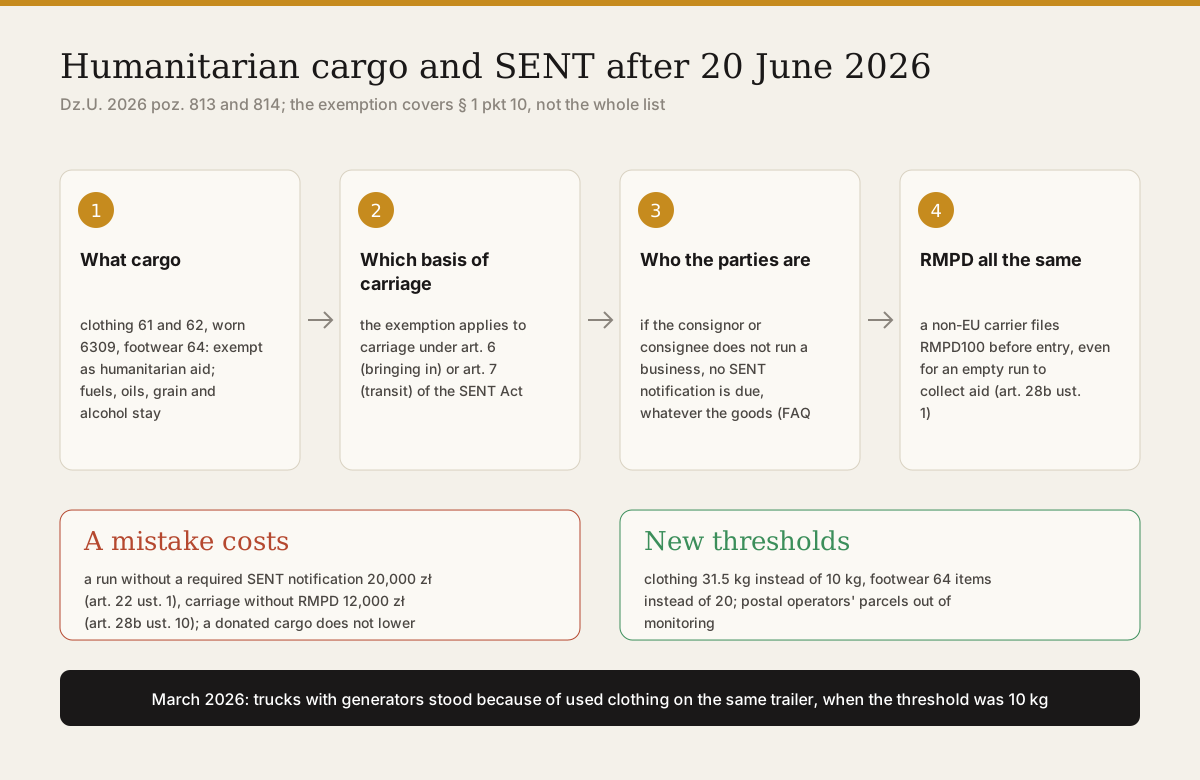
Clothing and footwear that constitute humanitarian aid have been outside SENT since 20 June 2026, provided the carriage runs under art. 6 or art. 7 of the SENT Act. The rest of the listed goods stay monitored, and the fact that the cargo is donated changes nothing by itself. RMPD is filed in every case, because a non-EU carrier's duty does not depend on what is carried or for whom.
What changed on 20 June 2026
On 20 June 2026 an amendment took effect that took humanitarian clothing and footwear out of SENT. It is the regulation of the Minister of Finance and Economy of 18 June 2026 (Dz.U. 2026 poz. 813), published on 19 June and in force from the following day. It rewrote § 2 ust. 10 of the goods regulation, and among the cases to which § 1 pkt 10 does not apply there is now point 3: goods constituting humanitarian aid whose carriage is performed under art. 6 or art. 7 of the monitoring act.
The same amendment changed three other things. The threshold for clothing of chapters 61 and 62 and for worn clothing 6309 went up from 10 kg to 31.5 kg gross per consignment. For footwear of chapter 64 the limit is now 64 items instead of 20. And parcels carried by postal operators in postal packages left monitoring as well (§ 2 ust. 10 pkt 4).
A second amendment appeared the same day, Dz.U. 2026 poz. 814, working in the opposite direction: it repealed the exemption for micro-entrepreneurs carrying clothing and footwear to marketplaces, which had been introduced on 13 May 2026. Anyone who planned a market run under that exemption is back under SENT from 20 June.
Which cargo the exemption does not cover
The humanitarian exemption works for clothing and footwear only, because it is written as an exception to § 1 pkt 10 and not to the act as a whole. Fuels and oils (2710, 2707), LPG 2711, ethyl alcohol 2207, oils and fats 1507 to 1517, grain and rapeseed 1001, 1005, 1205, coal 2701 and coke 2704, dried tobacco and the listed medicines all stay monitored. That the cargo is donated changes nothing here. The full list with thresholds and legal bases is collected in Goods under SENT monitoring and in the table SENT goods.
The generators from the March story are a good example. Generators are not subject to SENT at all, because they are not on the list; what stopped the truck was the used clothing on the same trailer. After 20 June the same run would pass with no notification, while before it needed a SENT300 filing for every consignment of clothing above 10 kg.
Does the status of humanitarian aid exempt fuel from SENT? No. Neither the act, nor the goods regulation, nor the exclusions regulation knows the notion of humanitarian aid for the rest of the list: it appeared only in § 2 ust. 10 pkt 3 and only for clothing and footwear. Diesel in barrels for a community's generators is an ordinary SENT good with a 500 l threshold.
When humanitarian aid is outside SENT anyway
Humanitarian aid often falls outside SENT before the list is even checked, and the reason is the status of the parties. PUESC explains it in answer 02.19: if the consignor and the consignee both run a business, the carriage is subject to notification; if at least one of them does not, there is no duty to file. The rule behind it is simple: carriage from or to a person or entity that does not run a business is not subject to the system.
For an aid run this means the following. A foundation without business activity, a parish, an association, a hospital as a recipient without commercial turnover: no SENT notification, whatever the goods. PUESC immediately advises, however, carrying documents that make this status plausible during a check. There is no separate field for it in the register, so the evidence travels with the driver.
Is writing "humanitarian aid" in the CMR enough? No. The inspector checks who the consignor and the consignee are and whether they run a business. A letter from the foundation, a decision on the donation, the statutes or an extract from the register of the organisation weigh more than an entry in box 6.
What about RMPD for a non-EU carrier
RMPD is filed always, and it has no humanitarian exemption. The duty of a carrier from outside the EU comes from art. 28b ust. 1 of the Road Transport Act: the notification is due when the carriage requires a permit, or when an international agreement exempts the carrier from holding one. For a Ukrainian carrier the second case applies. The European Union and Ukraine agreement on the carriage of freight by road removes permits and runs until 31.03.2027, so an RMPD100 is filed before entering Poland. The form states the legal basis of that exemption (art. 28b ust. 3 pkt 10 lit. b).
A separate exemption from the permit for humanitarian carriage does exist in Polish law: art. 35 ust. 1 of the Road Transport Act allows the Chief Inspector of Road Transport to exempt a carrier by decision. That, however, is an exemption from the permit, not from the notification: the RMPD is filed all the same, and it states the basis of the exemption. Who files an RMPD and when is taken apart in What RMPD is and who must file it.
Is an RMPD needed for an empty run to collect aid? Yes. RMPD is not about the goods but about the run: the form has no fields for a CN code or the weight of the cargo, and asks instead whether the vehicle is loaded or empty. An empty run across Poland is notified too.
What documents to carry on an aid run
The documents of an aid run answer three separate questions, and the inspector checks them separately. First: is there a notification where one is due. That means the SENT reference number from the consignor or consignee if the goods are listed, and the RMPD number the carrier obtains itself. Second: is the cargo really humanitarian and are the parties what they claim to be. Here a letter or a decision of the organisation on the donation, the recipient's documents and a CMR naming the same parties do the work. Third: is the locator on, if an active SENT or RMPD notification exists.
The Ukrainian side has a procedure of its own. A recipient from the register of humanitarian aid recipients files a declaration in the national system (AS HD) and receives a unique code on which Ukrainian customs clears the cargo. The declaration is valid for 30 days. Polish SENT does not know that code and does not ask for it, but it is easier for the driver when both sets of documents travel together.
Does the Ukrainian humanitarian code protect against a Polish fine? No. These are two separate regimes: Polish SENT checks the list of goods and the status of the parties, the Ukrainian registration is needed for clearance in Ukraine. Both have to be met.
What a mistake costs
A run without a required SENT notification costs the carrier 20,000 zł, about 235,000 ₴ at the NBU rate of 11.74 ₴/zł on 21.09.2026 (art. 22 ust. 1 of the SENT Act). A consignor or consignee who failed to file pays 46 % of the gross value of the goods, and never less than 20,000 zł (art. 21 ust. 1). Carriage without an RMPD is 12,000 zł, about 141,000 ₴, from the tariff annexed to the Road Transport Act (załącznik nr 3, lp. 3.2a). The amounts do not depend on the cargo being donated, and that is exactly why the March story cost the foundations more than the aid itself.
The other side has a price too. A needless SENT notification for goods that are not listed is not fined, but it creates an open carriage in the register with a duty to transmit geolocation. If the locator goes silent, a gap in the data already costs 10,000 zł (art. 22 ust. 2a), and it is the carrier who pays, not whoever filed the needless notification.
What to do
- Check the goods against the SENT list before loading, not at the border: the table SENT goods searches by code and by name.
- Ask whether the consignor and the consignee run a business; if at least one does not, no notification is due (PUESC FAQ 02.19).
- For clothing and footwear check the date: until 20.06.2026 the thresholds were 10 kg and 20 items, after it 31.5 kg and 64 items plus the humanitarian exemption.
- Collect the documents proving the donation and the status of the parties: the organisation's letter, the decision on the donation, the recipient's details.
- File the RMPD before entering Poland, with the legal basis of the permit exemption, even when no SENT notification is due.
- Keep the locator on for the whole Polish leg whenever an active notification exists.
- Give the driver the numbers and documents on the phone, not only on paper.
What not to do
- Do not extend the clothing exemption to fuel, oils or grain. For those the words "humanitarian aid" do not appear in the provisions.
- Do not fill the spare space with used clothing without checking the weight and the parties. That is exactly how the trucks stood in March 2026.
- Do not rely on an entry in the CMR. The status of the parties is proved by the organisation's documents, not by a box on the consignment note.
- Do not skip the RMPD because "it is only aid". An exemption from the permit is not an exemption from the notification.
- Do not file a SENT notification "just in case". An open carriage in the register brings the geolocation duty and a fine for silence.
Where technology fits in
Sigil handles RMPD declarations, and for an aid run the procedure is the same as for a commercial one. CMR data go into the RMPD100 one to one, the dispatcher confirms every field, and only after that confirmation does the filing go to PUESC. An empty run to collect the cargo is filed too, because the form asks about the run, not about the goods. While the declaration is active the system watches the position in SENT-GEO and warns when the register stops seeing it. What to do then is described in What a driver should do when GPS loses signal in Poland.
Sigil does not file the SENT notification for humanitarian cargo: that is done by the consignor or the consignee, and they decide whether the goods are on the list.
Sigil handles RMPD declarations. The SENT notification is filed by the consignor or consignee, and the status of humanitarian aid is proved by the organisation's documents.
A demo or training for your team
30 minutes online. We show how Sigil™ files an RMPD from a CMR and answer questions about your runs.
Frequently asked questions
- Does used clothing carried as humanitarian aid need a SENT notification?
- No, since 20 June 2026. Clothing and footwear constituting humanitarian aid are not subject to SENT if the carriage runs under art. 6 or art. 7 of the SENT Act (§ 2 ust. 10 pkt 3 of the goods regulation, Dz.U. 2026 poz. 813; PUESC FAQ 12.39).
- Is humanitarian aid exempt from SENT in general?
- No, the exemption covers clothing and footwear only. Fuels, oils, grain, alcohol and the other listed goods stay monitored however the cargo is donated. Separately, the general rule applies: if at least one party does not run a business, no notification is due (PUESC FAQ 02.19).
- Does an aid run need an RMPD?
- Yes. The duty of a non-EU carrier has no exception for humanitarian carriage (art. 28b ust. 1 of the Road Transport Act). Even a decision exempting from the permit under art. 35 does not exempt from the notification.
- What thresholds apply to clothing and footwear now?
- 31.5 kg gross per consignment and 64 items of footwear. Until 20.06.2026 it was 10 kg and 20 items. Parts of clothing 6117 90 00, 6212 90 00, 6217 90 00 and parts of footwear 6406 are not monitored.
- What does a run without a notification cost?
- 20,000 zł for SENT and 12,000 zł for RMPD. That is about 235,000 ₴ and 141,000 ₴ at the NBU rate of 11.74 ₴/zł on 21.09.2026 (art. 22 ust. 1 of the SENT Act, załącznik nr 3 lp. 3.2a of the Road Transport Act).
Sources
Legislation, as in force on the publication date:
- Regulation of the Minister of Finance and Economy of 18 June 2026 amending the regulation on goods covered by the monitoring system, ISAP, Dz.U. 2026 poz. 813: the new wording of § 1 pkt 10 and § 2 ust. 10, including pkt 3 (humanitarian aid) and pkt 4 (postal parcels); in force from 20.06.2026.
- Regulation of the Minister of Finance and Economy of 18 June 2026 amending the regulation on exclusions from certain notification duties, ISAP, Dz.U. 2026 poz. 814: repeal of the marketplace exclusion, in force from 20.06.2026.
- Regulation of the Minister of Finance of 25 April 2022 on goods covered by the monitoring system, ISAP, consolidated text Dz.U. 2024 poz. 1157 as amended by 2025 poz. 1244 and 1704 and 2026 poz. 589 and 813: § 1 pkt 1 to 10, § 2.
- Act of 9 March 2017 on the system for monitoring the road and rail carriage of goods (SENT Act), ISAP, consolidated text Dz.U. 2024 poz. 1218: art. 5, art. 6, art. 7, art. 21 ust. 1, art. 22 ust. 1 and 2a.
- Act of 6 September 2001 on road transport, ISAP, consolidated text Dz.U. 2024 poz. 1539 as amended by Dz.U. 2024 poz. 1544: art. 28b ust. 1, ust. 3 pkt 10 lit. b and ust. 10, załącznik nr 3 lp. 3.2a, art. 35 ust. 1.
Authorities:
- SENT FAQ, PUESC: answer 02.19 on the status of the parties and humanitarian aid (ID 782111321) and 12.39 on clothing and footwear as humanitarian aid (ID 770966149).
- List of goods covered by SENT, PUESC: the list in force.
Press, only for the description of one case:
- Humanitarian cargo stuck at the Polish border over the new SENT rules, Nasz Wybir portal, 26.03.2026: four trucks of Filippus and Power Up at Dorohusk.
Rate: official hryvnia to zloty rate, National Bank of Ukraine, 11.74 ₴/zł on 21.09.2026.
Read next
- The 2026 list of goods under SENT monitoringThe 2026 SENT goods list with thresholds and CN codes: fuels, oils, grain, honey, poultry, clothing and footwear in 2026. Why Ukrainian goods count.
- The difference between SENT and RMPD nobody explainsSENT follows the goods, RMPD follows a non-EU carrier. Who files which, when both meet on one run, and what a missing one costs: 12,000 and 20,000 zł.
- What an RMPD is and who must file itRMPD from scratch: what the filing is, who must file it since 1 November 2024, when it is not needed, how it differs from SENT, what happens at entry without it
- What a driver should do when GPS loses signal in PolandThe SENT locator went silent on the road. What to check in the first ten minutes, when art. 10c says stop, what the dispatcher does, what to show an inspector.
Sigil™ turns a CMR into an RMPD declaration and files it with PUESC — with every field checked against the original.
More on this topic: SENT