GPS monitoring
What SENT-GEO demands of the carrier and the locator
What Poland's SENT-GEO demands of carrier and driver: a locator on the whole Polish leg, three ways to transmit (e-TOLL PL, OBU, ZSL), on and off times, fines.
Published · Author: Makaiev Kostiantyn Oleksandrovych, founder of Sigil RMPD
An inspector at the Korczowa crossing opens form SENT406 on PUESC, the map of the truck's positions. The map is empty: not a single point since entry into Poland. The driver shows his phone: the e-TOLL PL app is open, the icon is green. The dispatcher says on the phone that the locator number is in the notification. Three people are sure everything works, and the register sees silence.
This article explains exactly what SENT-GEO, the geolocation part of Poland's SENT monitoring system, demands: who is responsible for transmitting the position, which devices are allowed, where the locator number comes from and how it is activated, when to switch on and off, what to do in a failure, what the inspector sees and what each mistake costs.
In brief: the carrier must ensure transmission of current geolocation data for the whole Polish leg of a carriage under SENT and under RMPD (art. 10a of the SENT Act, art. 28b ust. 5 of the Road Transport Act) · three permitted ways: the free e-TOLL PL app, an on-board unit OBU or an external localisation system ZSL, registered in the SENT service on PUESC (PUESC FAQ 11.03) · the locator number goes into the notification; an OBU/ZSL activates automatically the first time its business number is entered in a notification (FAQ 07.11) · the driver switches the locator on when the carriage starts on Polish territory and off no earlier than when it ends (art. 10b); rest breaks are allowed, but the next transmission starts from the place of the last stop (FAQ 04.27) · a failure longer than an hour means stopping at the nearest car park (art. 10c ust. 1) · fines: 10,000 zł for the carrier for a gap in data (art. 22 ust. 2a), 5,000 to 7,500 zł for the driver for a locator not switched on (art. 32 ust. 1) · in our data from 571 carriages from 1.08 to 21.09.2026 the register queried the position a median of 120 times per run, so silence shows within minutes, not hours.
SENT-GEO asks one thing of the carrier: that the truck's position reaches the register without interruption from the start to the end of the carriage on Polish territory. The carrier chooses the means: the e-TOLL PL app on the driver's phone, an OBU or a ZSL from an operator. The number of the chosen device is entered in the SENT or RMPD notification, and from that moment the register expects positions. A gap longer than an hour obliges the driver to stop and can cost the carrier 10,000 zł.
Who is responsible for transmitting the position
The carrier is, and the act phrases it as an obligation of result: for the whole route of a carriage covered by a notification the carrier must ensure transmission of current geolocation data of the means of transport (art. 10a ust. 1 of the SENT Act, ustawa o systemie monitorowania drogowego i kolejowego przewozu towarów). The carrier must fit the vehicle with a locator unless the data reach the register from an external localisation system (art. 10a ust. 2 and 3). For an RMPD the same provisions apply accordingly (art. 28b ust. 5 of the Road Transport Act), and PUESC confirms that one locator serves both SENT and RMPD (FAQ 11.04).
The driver has duties of his own: to switch the locator on and off at the set moments (art. 10b) and to stop in a failure (art. 10c). The OBU/ZSL operator is responsible for registering the device and sending the data, but before the register the carrier answers: PUESC advises checking that the operator registered the device in the SENT service and not only in e-TOLL (FAQ 07.15). The carrier cannot manage devices on PUESC; the operator does (FAQ 07.16).
Does a green icon in the driver's app relieve the carrier of responsibility? No. The duty under art. 10a concerns data in the register, not an icon on a phone. What the Kraków court did with that in a case of four hours of silence is in Court quashed a 10,000 zł SENT GPS fine, how to appeal.
Which devices are allowed and where the locator number comes from
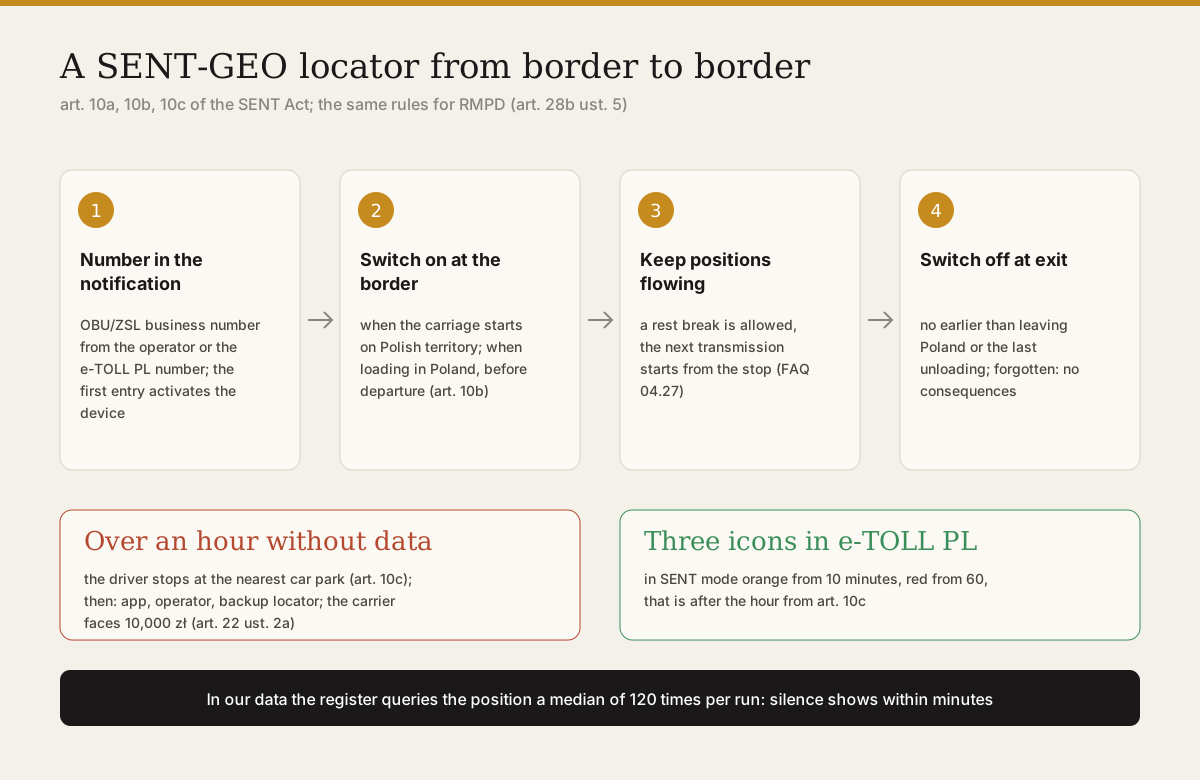
Three ways, all equal (FAQ 11.03). First: the free e-TOLL PL app on the driver's phone, configured for SENT. Second: an on-board unit OBU of the GNSS class. Third: an external localisation system ZSL, that is a telematics operator's GPS tracker. OBUs and ZSLs are registered on PUESC only by the operator, in the ZSL service (forms ZSL100 and ZSL105), and at registration the operator chooses what the device serves: e-TOLL, SENT or both (FAQ 07.05). In return the operator receives the device's business number in the format U/Znn-xxnnxx-n and passes it to the carrier.
The carrier enters that business number in the SENT notification in the field "Numer lokalizatora" (locator number) or in the RMPD. Activation is automatic: the first entry of the number in a notification switches on data recording from that device (FAQ 07.11). Until the number is in a notification, the device does not exist for the register, however well it transmits. In the e-TOLL PL app the driver reads the number from the app itself and passes it to the dispatcher. The notification also has a field "Numer zapasowego lokalizatora GPS" (backup GPS locator number), and if both are filled in, the register collects data from both (FAQ 07.14).
Can one device pay e-TOLL and transmit the position to SENT? Yes, if the operator registered it for both services and sends data to both interfaces (FAQ 07.08). Two different devices in one truck are also allowed (FAQ 07.09).
When to switch the locator on and off
The moment of switching on depends on the route (art. 10b pkt 1). Carriage starting in Poland: before the carriage starts, and with several loading places from departure from the first. Entry into Poland or transit: when the carriage starts on Polish territory, that is at the border. Switching off is allowed no earlier than delivery to the delivery place in Poland, with several places the last one, or no earlier than the end of the carriage on Polish territory, that is exit (art. 10b pkt 2). Forgot to switch off after leaving? No consequences (FAQ 04.28).
Breaks are allowed where driving-time rules require them: a rest at a car park, a night at an ADR parking area. PUESC says such breaks do not breach the duty, with one proviso: the next transmission must start from the place of the last stop, not from another place (FAQ 04.27). Uncoupling the tractor for the break and using it for another job is also allowed, but on return the positions must continue from the place of the break (FAQ 04.36). For such breaks PUESC recommends the e-TOLL PL app, where transmission is started and stopped with the buttons "Rozpocznij przejazd" and "Zakończ przejazd".
The app shows its state with three icons. Battery: green from 50 %, orange 20 to 50 %, red below 20 %. GPS and internet in the "Przejazd SENT" mode: green when the position is current, orange with a delay over 10 minutes, red over 60 minutes. A red icon means the hour from art. 10c has already passed, so act on orange.
What to do in a failure longer than an hour
If the locator or the external system does not work for longer than an hour, the driver must stop without delay at the nearest car park or lay-by (art. 10c ust. 1); with dangerous goods under ADR the stop must take account of chapters 8.4 and 8.5 of the agreement (ust. 2). The carriage may continue after one of four events: the locator works again; the goods are transferred to a vehicle with a working locator; the vehicle is fitted with a working locator; customs applies seals or orders a convoy (art. 10c ust. 3).
In practice the hour is time for three things. Check the app: is "Przejazd SENT" on, is the right notification number selected, are internet and GPS there, has battery saving put the system to sleep. Call the OBU/ZSL operator: the operator receives no error messages from the register, so it learns of the failure from you (FAQ 07.20). Switch on the backup locator if its number is in the notification; if it is not, the dispatcher can add it by updating the notification, because carrier data may be updated (art. 8 ust. 1). If the gap is caused by unavailability of the register and not by the device, PUESC asks you to follow the notices on the portal, and the act waives the fine for such a gap (art. 22 ust. 2b).
What the inspector sees and what a mistake costs
The inspector opens form SENT406 on PUESC and sees the truck's positions on a map. PUESC warns that data may appear there with a slight delay, depending on processing by the interfaces and the quality of the locator's transmission (FAQ 07.20). In our data from 571 carriages with an active RMPD in the period from 1.08 to 21.09.2026 the register queried the position a median of 120 times per run. In 10 % of runs it was over 471 times, with a median monitoring time of 1.7 days. How long such monitoring lasts and what it looks like in numbers is in How many times the system asks for your position.
| Breach | Amount | Who pays | Basis |
|---|---|---|---|
| Gap in geolocation data transmission | 10,000 zł (≈ 117,000 ₴) | carrier | art. 22 ust. 2a of the SENT Act |
| Locator not switched on or switched off too early | 5,000 to 7,500 zł (≈ 59,000 to 88,000 ₴), on-the-spot fine | driver | art. 32 ust. 1 pkt 2 |
| No stop in a failure longer than an hour | 5,000 to 7,500 zł (≈ 59,000 to 88,000 ₴), on-the-spot fine | driver | art. 32 ust. 1 pkt 3 |
| RMPD driver did not switch the locator on or switched it off too early | 2,000 zł (≈ 23,000 ₴) | driver | Annex 1, item 2b of the Road Transport Act |
NBU rate 11.74 ₴/zł on 21.09.2026, amounts rounded to the nearest thousand hryvnia. The authority may waive the 10,000 zł fine for an important interest of the carrier or the public interest (art. 22 ust. 3), and that is what appeals rest on when the device transmitted and the register did not receive. Other combinations are in the fine calculator.
What exactly the driver does minute by minute when the locator goes silent on the road, from the orange icon to the stop on a car park, is laid out in What a driver should do when GPS loses signal in Poland.
What to do
- Choose the means of transmission before the first run: e-TOLL PL on the driver's phone, an OBU or a ZSL from an operator. For an OBU/ZSL get the business number from the operator and written confirmation that the device is registered in the SENT service.
- Enter the locator number in the SENT or RMPD notification, and the app number in the backup locator field. The first entry activates the device.
- Driver: switch transmission on at the border or before loading in Poland, check the three icons in the app, disable battery saving for e-TOLL PL.
- Before every rest break stop transmission with the button, after the break resume from the same place.
- On a red icon or a failure: app, internet, GPS, call to the operator, backup locator. More than an hour without data means a stop at a car park.
- Switch the locator off no earlier than after leaving Poland or after the last unloading.
- After the run keep the transmission history from the app or the operator: in a fine case it is proof that data were flowing.
What not to do
- Do not rely on a green icon. The duty concerns data in the register; when in doubt, have the dispatcher check the position in SENT406.
- Do not enter in the notification the number of a device registered only for e-TOLL. The SENT register will not see it (FAQ 07.15).
- Do not switch the app off at the buffer car park before the border. The queue at the crossing is still Polish territory.
- Do not drive on with a red icon "because it is not an hour yet". The hour counts from the start of the failure, not from the moment you noticed it.
- Do not resume transmission from a different place after a break. Positions must continue from the place of the last stop (FAQ 04.27).
Where technology fits in
Sigil files the RMPD with CMR data one to one and enters in the declaration the locator number from the vehicle profile, which the dispatcher confirms. After registration the system polls SENT-GEO for the truck's position and notifies the dispatcher when positions stop arriving, that is before the hour from art. 10c runs out. Sigil does not transmit the geolocation data itself: the carrier's app, OBU or ZSL does. How those notifications look in the declaration statuses is in the help article Checking RMPD statuses.
Sigil handles RMPD declarations. The SENT notification and the transmission of geolocation data are the carrier's, with the carrier's own locator.
A demo or training for your team
30 minutes online. We show how Sigil™ files an RMPD from a CMR and answer questions about your runs.
Frequently asked questions
- Is a separate GPS device required for SENT?
- No. The free e-TOLL PL app on the driver's phone, configured for SENT, is enough. An OBU or a ZSL from an operator are alternatives with the same standing (PUESC FAQ 11.03). The same locator serves an RMPD (FAQ 11.04).
- Where do I get the locator number for the notification?
- From the operator or from the app. For an OBU/ZSL the operator, after registering in the SENT service, gives a business number in the format U/Znn-xxnnxx-n (PUESC FAQ 07.05). For e-TOLL PL the app itself shows the number. The first entry of the number in a notification activates the device (FAQ 07.11).
- Can the locator be switched off for the night?
- Yes, for a rest under driving-time rules. Such a break does not breach the duty if the next transmission starts from the place of the last stop (PUESC FAQ 04.27). Easiest with the buttons "Zakończ przejazd" and "Rozpocznij przejazd" in e-TOLL PL.
- What to do if the locator has not transmitted for more than an hour?
- Stop at the nearest car park (art. 10c ust. 1 of the SENT Act). Then: check the app, call the operator, switch on the backup locator. Driving may continue after transmission is restored, the goods are transferred, the device is replaced or customs applies seals (art. 10c ust. 3).
- What is the fine for a gap in GPS data?
- 10,000 zł for the carrier (art. 22 ust. 2a of the SENT Act), about 117,000 ₴. For the driver, an on-the-spot fine of 5,000 to 7,500 zł for a locator not switched on or no stop in a failure (art. 32 ust. 1). A gap caused by unavailability of the register is not fined (art. 22 ust. 2b).
Sources
Legislation, as in force on the publication date:
- Act of 9 March 2017 on the system for monitoring the road and rail carriage of goods (SENT Act), ISAP, consolidated text Dz.U. 2024 poz. 1218: art. 8 ust. 1, art. 10a, art. 10b, art. 10c, art. 22 ust. 2a, 2b and 3, art. 32 ust. 1.
- Act of 6 September 2001 on road transport, ISAP, consolidated text Dz.U. 2024 poz. 1539 as amended by Dz.U. 2024 poz. 1544: art. 28b ust. 5, Annex 1 item 2b.
Authorities:
- Send vehicle geolocation data to the SENT register with the e-TOLL PL mobile app, PUESC, service description, updated 23.04.2026: steps, buttons, battery, GPS and internet icons.
- SENT FAQ, PUESC, answers 04.27, 04.28, 04.35, 04.36, 07.01 to 07.20, 11.03, 11.04.
Own data: Sigil platform, 571 carriages with an active RMPD, 1.08 to 21.09.2026, 121,122 position queries; median 120 queries per run, p90 471, median monitoring 1.7 days.
Exchange rate: official hryvnia to zloty rate, National Bank of Ukraine, 11.74 ₴/zł on 21.09.2026.
Read next
- How often SENT-GEO checks your truck's position in PolandGPS monitoring in SENT on our own data: 212 position checks per transport, where the signal really gets lost, how much silence is a problem, what to do.
- Court quashed a 10,000 zł SENT GPS fine, how to appealThe driver's app showed green while SENT saw 4 hours of silence. The Kraków court quashed the 10,000 zł fine as automatic punishment. What to do about yours.
- SENT transit through Poland, the control summons and borderIn transit the carrier files SENT (SENT300). "Coordinates for the control" is an art. 12a summons: vehicle at customs on the exit day, call first, or 20,000 zł.
- What a driver should do when GPS loses signal in PolandThe SENT locator went silent on the road. What to check in the first ten minutes, when art. 10c says stop, what the dispatcher does, what to show an inspector.
Sigil™ turns a CMR into an RMPD declaration and files it with PUESC — with every field checked against the original.
More on this topic: GPS monitoring