RMPD
How long to keep RMPD and SENT records after a trip
The register deletes an RMPD filing after two years, yet a penalty can be imposed for five. What to keep, for how long, and what proves the filing was right.
Published · Author: Makaiev Kostiantyn Oleksandrovych, founder of Sigil RMPD
A Ukrainian truck entered Poland through the Dołhobyczów crossing at 06:55 on 11 May 2025. The run finished, the driver went home, the cargo arrived and the freight was paid. Four and a half months later, on 29 September, a letter arrived. The head of a customs and fiscal office was opening proceedings for a 12,000 zł penalty over data in the RMPD filing that did not match the facts. That is about 137,800 ₴ at the National Bank of Ukraine rate on 12.10.2026. The decision came on 18 December, the appeal was lost on 9 February 2026, and the court dismissed the complaint on 2 June.
This article explains how long the Polish register keeps a filing, how long the authorities have to impose a penalty, and why those two periods do not match.
In brief: the register keeps a SENT filing for five years and an RMPD filing for only two years, counted from the end of the calendar year of the filing · geolocation data disappears sooner still, after at most 12 months from the end of the carriage · a penalty under the SENT Act can be imposed within five years of the breach, and the same five years apply to RMPD · that leaves a gap of two to three years in which proceedings are still possible although the state no longer holds a copy of the filing · the Road Transport Act does not contain the word "limitation" at all, the five years come from the Code of Administrative Procedure, and whether that chapter applies is now before a panel of seven judges · in real cases the letter opening proceedings arrived four and a half to six months after the roadside check · after those retention periods the only complete proof that a filing was made, and made correctly, is the one the carrier kept.
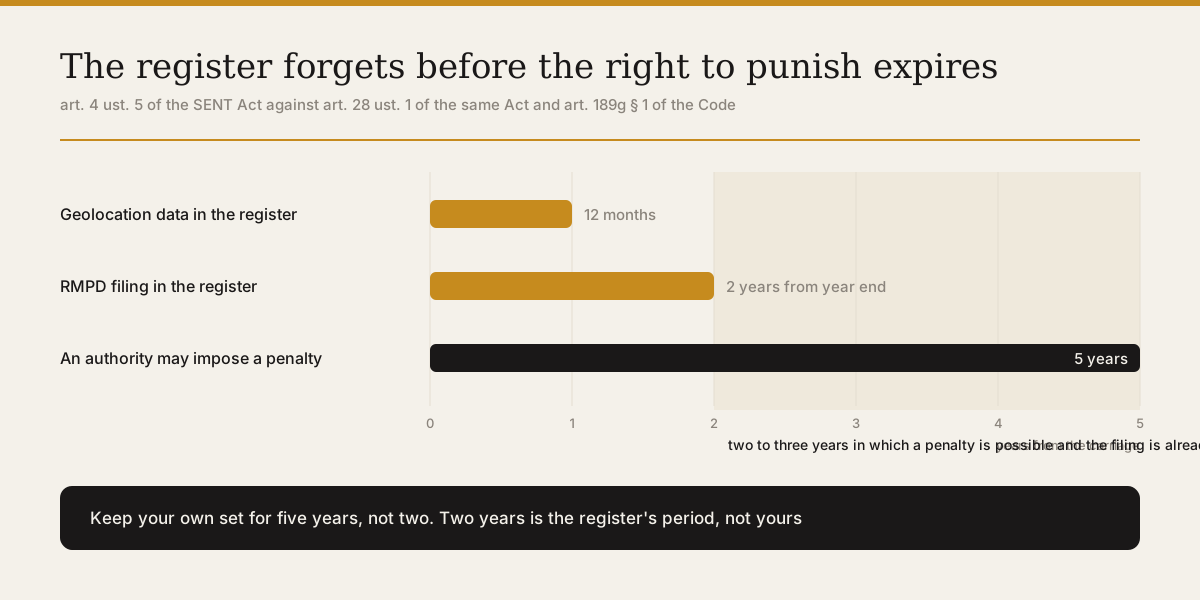
Records should be kept for at least five years from the day of the carriage, because that is how long an authority has to impose a penalty. The register does not keep them that long: an RMPD filing is deleted after two years and locator data after twelve months. Once those periods pass, the only complete set of evidence that the carriage was properly notified sits with the parties, not with the state. Amounts for a specific set of breaches can be worked out in the SENT and RMPD penalty calculator.
How long the register keeps a filing
Both retention periods sit in a single provision of the SENT Act, and RMPD filings have their own, shorter one written into it.
| What the register holds | For how long | Legal basis |
|---|---|---|
| A SENT filing, its supplements and updates | 5 years from the end of the calendar year of the filing | art. 4 ust. 5 pkt 1 of the SENT Act |
| An RMPD filing and a cabotage filing under art. 28b of the Road Transport Act | 2 years from the end of the calendar year of the filing | the same provision, a separate exception |
| Records of checks carried out | together with the filing, so 5 or 2 years | art. 4 ust. 5 pkt 1 |
| Geolocation data from a locator or an external locating system | no longer than 12 months from the end of the carriage | art. 4 ust. 5 pkt 2 |
The two-year period for RMPD did not exist from the start. It was introduced by art. 43 pkt 1 of the Act on posting drivers in road transport (Dz.U. 2023 poz. 1523) and has applied since 1 January 2025. Before that date the register kept everything for five years.
There is one exception to the twelve months. Where administrative proceedings in which the geolocation data is necessary begin before that period expires, the data is kept until the proceedings end with a final ruling. In other words, the data survives when the authority needs it, not when the carrier needs it.
How long an authority has to impose a penalty
For SENT the deadline is written into the Act. A penalty cannot be imposed once five years have passed from the day the obligation was not fulfilled (art. 28 ust. 1 of the SENT Act). The obligation to pay a penalty already imposed expires separately, also after five years, counted from the end of the year in which the payment deadline fell (ust. 2).
For RMPD the Road Transport Act contains no such rule at all. The word "limitation" does not appear in it once. The five-year figure comes from the Code of Administrative Procedure instead: a penalty may not be imposed once five years have passed from the day of the breach or of the occurrence of its effects (art. 189g § 1 of the Code), and a further five years apply to enforcement (§ 3).
Here begins something worth knowing in advance. Chapter IVa of the Code does not apply where separate provisions regulate the same matters themselves (art. 189a § 2 of the Code). Authorities and courts treat art. 92c of the Road Transport Act as exactly such a separate provision. On 14 July 2026 the Supreme Administrative Court referred to a panel of seven judges the question whether that provision excludes the whole chapter (order II GSK 255/26). As of 12 October 2026 no resolution appears in the CBOSA database. If the answer is that it excludes the chapter in its entirety, penalties for RMPD would carry no limitation period whatsoever. That is not a forecast but an open question, and it is precisely why records are worth keeping longer than seems reasonable.
Why the filing disappears before the right to punish does
Put the two tables above side by side and a gap appears that nobody designed.
An RMPD filing made in May 2025 will be deleted from the register after 31 December 2027. A penalty for a breach committed in May 2025 can be imposed until May 2030. Between those two dates lie two years and five months in which proceedings remain possible although the state no longer holds its own copy of the filing. The span depends on the month of the filing and runs from two to three years, because the register's period counts from the end of the year while the penalty period counts from the day of the breach.
With geolocation the gap is wider still. Locator data is erased twelve months after the carriage ends unless proceedings started earlier. The evidence capable of clearing the carrier therefore disappears first, while the power to punish remains for another four years.
SENT has no such mismatch. Five years of retention against five years to impose a penalty, and the two periods meet.
When the letter actually arrives
The distance between the trip and the first letter is not theoretical. Three cases of Ukrainian carriers that reached the courts in 2026 show the same order of magnitude.
| Check | Proceedings opened | First instance decision | Court judgment |
|---|---|---|---|
| 21.01.2025, leaving Poland | 17.06.2025, after 5 months | 31.07.2025 | 04.08.2026 |
| 11.05.2025, Dołhobyczów | 29.09.2025, after 4.5 months | 18.12.2025 | 02.06.2026 |
| 15.02.2025, Hrebenne | not dated in the judgment | 17.07.2025, after 5 months | 12.02.2026 |
From the check to a first instance judgment took between twelve and nineteen months. SENT cases run longer: in one of them a 20,000 zł penalty, about 229,600 ₴, was imposed on 29 September 2020 and the Supreme Administrative Court dismissed the cassation complaint only on 5 February 2026.
A decision can arrive much later than that. In a case involving a Polish consignee the check took place on 26 July 2023 at 01:50. The SENT filing stated 11,650 kg of live poultry while the CMR waybill stated 7,170 kg. The 20,000 zł penalty was imposed on 19 August 2024, thirteen months after the check. The court in Kraków quashed the decision and on 14 July 2026 the Supreme Administrative Court dismissed the authority's cassation complaint. Three years passed between the check and the final judgment.
The practical conclusion is blunt. The driver who ran that trip may have left the company five months later. Phones with photographs get lost and messenger threads get cleared. The documents are needed exactly when nobody remembers the trip any more.
A summons to present the vehicle at the end of the carriage
Sometimes the register itself demands to see the vehicle. Where analysis of the data in the register shows that a carriage carries increased risk, the consignor, the consignee or the carrier receives a summons to present the means of transport. The summons arrives together with the reference number or with the confirmation of a data update (art. 12a ust. 1 of the SENT Act), and the consignor and consignee must pass its content on to the carrier (ust. 2).
The vehicle is presented on the date the carriage ends, at the place of delivery or at the nearest branch of a customs and fiscal office, and the carrier notifies the authority by telephone about the planned delivery (ust. 3 and 5). Failing that obligation costs the carrier 20,000 zł (art. 22 ust. 1 pkt 3).
The obligation itself is discharged at the end of the run, yet liability for failing it lives on for years. A German carrier filed its notification on 30 May 2023 for 15,500 kg of waste under code 200110, moving in transit from Germany to Lithuania. It did not present the vehicle on the summons and did not provide geolocation along the whole route. The decision imposing 20,000 zł and 10,000 zł came on 30 January 2024, eight months after the filing. The court in Białystok dismissed the complaint on 20 November 2024, and the Supreme Administrative Court dismissed the cassation complaint on 9 July 2025. Twenty five months from the filing to the final ruling.
Who may look at the data in the register
The register is run by the Head of the National Revenue Administration, who is also the controller of the data it holds (art. 4 ust. 3 of the SENT Act). The list of bodies entitled to use it is closed and long (art. 12).
For checks on the carriage itself the data is used by officers of the Customs and Fiscal Service, the Police, the Border Guard and the Road Transport Inspectorate. Revenue administration staff also use it in tax proceedings and in tax and customs audits. The Head of the administration may release the data free of charge to the Police, the Road Transport Inspectorate, the Border Guard and the Minister of National Defence. The same applies to the energy and strategic reserves regulators, the transport minister and, on request, the security services. Courts and prosecutors are listed separately, in connection with pending proceedings (ust. 3a).
One conclusion follows for a carrier. The filing is read by many authorities rather than one, throughout the whole retention period, and a query from any of them can start proceedings a year after the trip.
What exactly has to be kept
What has to be kept is whatever proves two things: that the filing was made on time, and that the data in it matched the transport documents.
- The reference number of the filing, with the date and time it was issued.
- The RMPD_110 confirmation, carrying the official RMPD number and the carrier key. That is the document by which the register confirmed the registration, and it shows which data the authority accepted.
- The CMR waybill the filing was built from. A penalty is imposed for a discrepancy between the filing and the documents, so without the waybill there is nothing to show that no discrepancy existed.
- Updates to the filing, with their dates, where anything changed en route.
- The inspection report and the deposit receipt, if the vehicle was stopped. How that money is recovered is covered in the article on RMPD and SENT deposits.
- Evidence that the locator worked, where the run was under GPS: app screenshots, position history, correspondence with the operator. The register will not hold any of it after a year.
Set the retention period at five years from the day of the carriage, not two. Two years is the register's period, not yours.
Where the proof sits when an intermediary filed
Two models exist, and they answer the question "where is my document" very differently.
In the first, the service files under its own PUESC account. The carrier's data is then merely the content of the filing, and the filing never appears in the carrier's own PUESC profile at all. The confirmation goes to the service, and the carrier receives it from the service. In the second model the filing goes under the carrier's own login and appears in the carrier's profile exactly as a manually submitted one would.
The difference shows up a year later, not on the day of filing. If the intermediary closes, changes its terms or simply stops answering, a carrier on the first model is left without the very thing an authority asks for. On the second model the carrier holds its own access to the portal, and that access does not depend on another company.
The second model has a price of its own, and it deserves a clear head. A login and password open everything the account can do on the portal, not only RMPD. Ask how the password is stored and who inside the service can reach it.
What to do
- Save the reference number and the RMPD_110 confirmation as soon as the filing is registered, not at the end of the trip.
- Keep the filing and the CMR together, linked by the order number. What has to be proved is that they match each other.
- Set the retention period at five years from the date of the carriage, not two years and not "until the end of the year".
- Pull locator data every month where runs are under GPS. After twelve months the register will not hand it over.
- Check whose account your filings go under, and whether you can see them in your own PUESC profile.
- Keep the inspection report and the deposit receipt apart from the rest, because the appeal deadline depends on them.
- Appoint someone to receive mail from Polish authorities. Letters arrive months later and the appeal deadline runs from service, not from the day somebody read it.
What not to do
- Do not match your retention period to the register's. The register keeps RMPD for two years while a penalty can be imposed for five.
- Do not assume the state "has it on file". After two years it does not, and the burden of showing a correct filing still falls on the carrier.
- Do not leave GPS evidence for later. It disappears first, after twelve months.
- Do not keep the only copy on a driver's phone. Five months on, that may be somebody else's phone.
- Do not hand over a PUESC login without an answer on how it is stored and who can reach it.
- Do not ignore a letter opening proceedings. Explanations are filed before the decision, not after it.
Where technology belongs in this
Sigil files under the carrier's own account. Each company enters its own PUESC login and password, both held encrypted at rest, and every call to the portal goes under them. No shared intermediary account exists in the system at all. Because of that the filing is visible in the carrier's own PUESC profile and the carrier remains the party making the declaration.
Once a filing is registered, the system keeps together the set the register will not hold after two years. That set is the XML that was sent and the portal's reply, plus the RMPD_110 confirmation with its number and carrier key. It also holds the CMR scan the data came from, the change history of the declaration and the recorded GPS positions. The privacy policy commits us to keeping CMR scans, declaration data and the PUESC call trail for ten years, which is twice as long as the period in which an authority can impose a penalty.
Four things can be downloaded for each declaration: the filing XML, a PDF of the registered declaration with its RMPD number, a PDF of the GPS history and the CMR scan. The GPS history PDF is drawn from our own position records, so it can still be produced once the register has deleted its copy. There is no bulk export of the whole history in a single file; downloads go one declaration at a time.
Where filings were made earlier and by other means, the history can be pulled from PUESC for the last 365 days, bringing in tractors, trailers, locator numbers, consignors, consignees and places along with the declarations. Differences against what the company already holds are reported rather than overwritten. Anything older than a year cannot be recovered this way, so there is nothing to gain by waiting. Why the register sometimes refuses a filing is explained in the article on PUESC rejection codes, and the price of one wrong field is set out in the article on the penalty for one mistake.
Sigil handles RMPD declarations. A SENT filing is made by the consignor or the consignee of the goods.
A demo or training for your team
30 minutes online. We show how Sigil™ files an RMPD from a CMR and answer questions about your runs.
Frequently asked questions
- How many years should RMPD records be kept?
- Five years from the day of the carriage. That is how long an authority has to impose a penalty: for SENT it follows directly from art. 28 ust. 1 of the SENT Act, for RMPD from art. 189g § 1 of the Code of Administrative Procedure. The register keeps an RMPD filing for only two years, so beyond that point the complete proof exists only with the carrier.
- Can an authority impose a penalty a year after the trip?
- Yes. In three Ukrainian carrier cases decided in 2026 the letter opening proceedings arrived four and a half to six months after the roadside check, and a first instance judgment followed twelve to nineteen months after it. The statutory limit is five years, not a few months.
- Does the register keep the GPS data from my carriage?
- For no longer than twelve months. Art. 4 ust. 5 pkt 2 of the SENT Act sets that period, counted from the end of the carriage. The data is kept longer only where administrative proceedings requiring it began before the period expired.
- What happens if the intermediary shuts down and I hold no documents?
- The burden of showing a correct filing stays with the carrier. Where the filing went under the service's own account, it never appeared in the carrier's PUESC profile, so once the register deletes the record after two years no complete set exists anywhere. That is why it is worth checking whose account your filings go under.
- Who else can see the data in the register?
- A closed list of bodies under art. 12 of the SENT Act. The Customs and Fiscal Service, the Police, the Border Guard and the Road Transport Inspectorate for checks on the carriage, revenue administration staff in tax proceedings, and on request also courts, prosecutors and the security services. The access lasts for the whole retention period.
Sources
Legislation, in force on the date of publication:
- Act of 9 March 2017 on the system for monitoring road and rail carriage of goods, ISAP, consolidated text Dz.U. 2024 poz. 1218: art. 4 ust. 3 and ust. 5, art. 12, art. 12a, art. 22 ust. 1 pkt 3 and ust. 2a, art. 28 ust. 1 and 2.
- Road Transport Act of 6 September 2001, ISAP, consolidated text: art. 28b, art. 92a ust. 1, art. 92c ust. 1, art. 93 ust. 1.
- Act of 28 July 2023 on posting drivers in road transport, ISAP, art. 43 pkt 1: the two-year period for RMPD filings, in force since 01.01.2025.
- Code of Administrative Procedure of 14 June 1960, ISAP: art. 189a § 2, art. 189f § 1, art. 189g § 1 and § 3.
Case law, Central Database of Administrative Court Rulings:
- Judgment of the Regional Administrative Court in Rzeszów of 4.08.2026, II SA/Rz 1580/25, check on 21.01.2025, proceedings opened 17.06.2025.
- Judgment of the Regional Administrative Court in Lublin of 2.06.2026, III SA/Lu 226/26, check on 11.05.2025, proceedings opened 29.09.2025.
- Judgment of the Regional Administrative Court in Lublin of 12.02.2026, III SA/Lu 630/25, check on 15.02.2025, decision 17.07.2025.
- Judgment of the Supreme Administrative Court of 5.02.2026, II GSK 1571/22, a 20,000 zł penalty dated 29.09.2020, cassation complaint dismissed 5.02.2026.
- Order of the Supreme Administrative Court of 14.07.2026, II GSK 255/26, the question on art. 92c of the Road Transport Act and the application of chapter IVa of the Code referred to a panel of seven judges.
- Judgment of the Supreme Administrative Court of 14.07.2026, II GSK 139/26 and judgment of the Regional Administrative Court in Kraków of 17.09.2025, III SA/Kr 452/25, check on 26.07.2023, a 20,000 zł penalty imposed on 19.08.2024, decision quashed.
- Judgment of the Regional Administrative Court in Białystok of 20.11.2024, II SA/Bk 457/24 and judgment of the Supreme Administrative Court of 9.07.2025, II GSK 286/25, filing of 30.05.2023, penalties of 20,000 zł and 10,000 zł, complaints dismissed.
Our own documents:
- Sigil privacy policy, the retention table.
Exchange rate: official hryvnia to złoty rate, National Bank of Ukraine, 11.4813 ₴/zł on 12.10.2026.
Read next
- RMPD and SENT deposits, how much and how to recoverWho holds an RMPD or SENT deposit, when it comes back and what to file to get it. Provisions, accounts, deadlines and court rulings from 2025 and 2026.
- What gets fined when one digit in an RMPD costs 12,000 złA wrong digit or date in an RMPD costs 12,000 zł, the same as not filing. Provisions with article numbers, three 2025 roadside checks and what a carrier can do.
- Why PUESC rejects an RMPD and what to fix by RMPD500 codeRMPD500 rejection codes across 242 filings: R01 Cyrillic, R02 postal code, R06 dates, R30 locator not activated, crossing outside the dictionary. What to fix.
- What SENT-GEO demands of the carrier and the locatorWhat Poland's SENT-GEO demands of carrier and driver: a locator on the whole Polish leg, three ways to transmit (e-TOLL PL, OBU, ZSL), on and off times, fines.
- How long an RMPD really takes, from CMR photo to numberRMPD filing time on our own data: median 6 minutes from CMR photo to PUESC number, one in ten over 14. Why the median, what it consists of, what drags on.
Sigil™ turns a CMR into an RMPD declaration and files it with PUESC, with every field checked against the original.
More about RMPD