RMPD
How to appeal a SENT or RMPD penalty step by step
Two different procedures, two different appeals and one trap over enforcement. Deadlines, what the letter must contain, grounds, and what 2026 rulings show.
Published · Author: Makaiev Kostiantyn Oleksandrovych, founder of Sigil RMPD

At 01:50 on 26 July 2023 a truck carrying live poultry from Slovakia was stopped for a check. The SENT filing stated 11,650 kg gross, the CMR waybill stated 7,170 kg. The 20,000 zł penalty was imposed thirteen months later, on 19 August 2024, and the second instance upheld it. The company went to court. The Regional Administrative Court in Kraków quashed both decisions, and on 14 July 2026 the Supreme Administrative Court dismissed the authority's cassation complaint. Three years, and the company won.
This article walks through that road step by step and explains why an appeal against an RMPD penalty is not the same as an appeal against a SENT one.
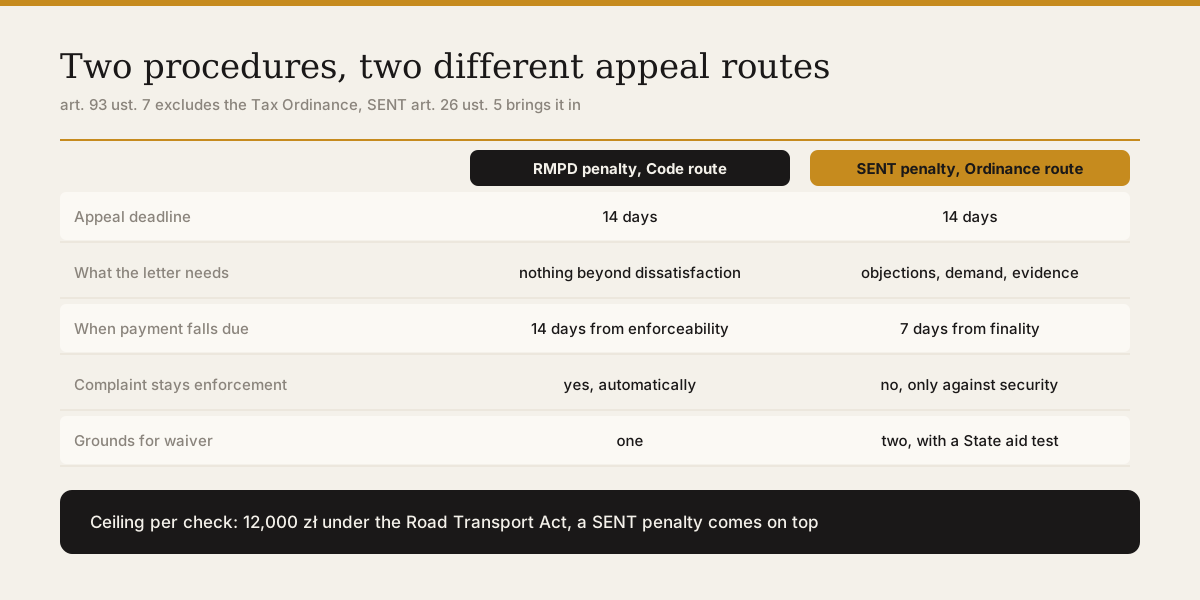
In brief: an RMPD penalty is reviewed under the Code of Administrative Procedure and a SENT penalty under the Tax Ordinance, and that is not a formality · both appeals run on 14 days, and a court complaint on 30 · an RMPD appeal needs no reasoning at all, while a SENT appeal must set out objections, the substance of the demand and the evidence · a court complaint stays enforcement of an RMPD penalty automatically, and stays a SENT penalty not at all until security has been accepted · an RMPD penalty has one ground for waiver, a SENT penalty two, but the second runs into State aid rules · penalties from a single roadside check cannot exceed 12,000 zł in total.
An appeal goes to the second instance authority within 14 days of service of the decision. If the second instance upholds the penalty, a complaint to a regional administrative court remains, and that runs on 30 days. After that only a cassation complaint to the Supreme Administrative Court is left.
Why RMPD and SENT penalties run on different tracks
The difference lies not in the amount but in which code governs the proceedings. The Road Transport Act excludes the Tax Ordinance from its own penalties (art. 93 ust. 7 and art. 94 ust. 9), so an RMPD penalty runs under the Code of Administrative Procedure. The SENT Act does the opposite: in matters it does not regulate itself, the Tax Ordinance applies to its penalties (art. 26 ust. 5).
Three practical differences follow, and each one costs money if it is not known in advance.
| Point | RMPD penalty | SENT penalty |
|---|---|---|
| Second instance authority | the Chief Inspector of Road Transport, or the director of the tax administration chamber where a customs and fiscal office issued the decision | the chamber director for the seat of the head who issued the decision (art. 26 ust. 4a) |
| Appeal deadline | 14 days from service (Code art. 129 § 2) | 14 days from service (Tax Ordinance art. 223 § 2 pkt 1) |
| What the appeal must contain | nothing beyond dissatisfaction with the decision (Code art. 128) | objections, the substance and scope of the demand, and evidence (Tax Ordinance art. 222) |
| When payment falls due | 14 days from the day the decision became enforceable (art. 94 ust. 2) | 7 days from the day the decision became final (SENT Act art. 27 ust. 1) |
| Does a court complaint stay enforcement | yes, the authority stays it of its own motion (art. 93 ust. 2) | no, a separate mechanism is needed (Tax Ordinance art. 239e and 239f) |
| Ground for waiving the penalty | absence of influence only (art. 92c ust. 1 pkt 1) | important interest of the carrier or public interest (SENT art. 22 ust. 3), subject to a State aid test (art. 26 ust. 3) |
How an RMPD appeal differs from a SENT appeal
The difference in what the letter must say is the largest and the least known. The Code of Administrative Procedure is explicit: an appeal requires no detailed reasoning, and it is enough that dissatisfaction with the decision follows from it (art. 128). A single sentence formally suffices.
The Tax Ordinance asks for more. An appeal should contain objections against the decision, define the substance and scope of the demand and indicate the evidence supporting it (art. 222). A one sentence letter in a SENT case is a defective letter.
The practical conclusion follows. In an RMPD case, meet the 14 days even with a short letter and send the full reasoning afterwards. In a SENT case that will not work, so the substance has to be ready from day one.
Whether a court complaint stays enforcement
Here lies the costliest trap, because the two procedures answer the question in opposite ways.
Under RMPD a complaint stays enforcement. A final decision becomes enforceable 30 days after service, but the authority that issued it stays enforcement of its own motion once the party files a complaint with an administrative court (art. 93 ust. 2). Nothing has to be applied for and nothing has to be paid in.
Under SENT a complaint stays nothing. A final decision is enforceable (Tax Ordinance art. 239e). The first instance authority will stay it only once an application is filed and the authority accepts security for the obligation together with default interest, or once a compulsory mortgage or a tax lien is entered of the authority's own motion (art. 239f § 1). The application is dealt with within 14 days at the latest, and if the authority misses that deadline, enforcement is stayed until the decision on the application is served (§ 2).
One difference favours the payer: a non-final SENT decision is not enforceable at all unless it has been given immediate enforceability (art. 239a). While the appeal is pending, nothing is collected.
What to argue to win
The available grounds are few and narrow. There is no choosing between them, because each penalty has its own provision.
RMPD has a single ground. Proceedings are discontinued where the carrier had no influence over the breach and the breach followed from events it could not have foreseen (art. 92c ust. 1 pkt 1). An employee's mistake does not fit, and the courts say so plainly. A lost connection, a registry outage or a locator broken by its operator do fit, and each has to be proved with documents from third parties.
One more objection is worth raising even though authorities currently reject it. Carriers invoke art. 189f § 1 of the Code, which allows an authority to refrain from a penalty where the breach is of negligible gravity. Authorities answer that chapter IVa of the Code does not apply, because art. 92c of the Road Transport Act is a separate provision within the meaning of art. 189a § 2 pkt 2. On 14 July 2026, however, the Supreme Administrative Court referred that question to a panel of seven judges (order II GSK 255/26), and as of 13 October 2026 no resolution exists. Without that objection on the file, a favourable resolution cannot be used in your own case.
SENT has two grounds, and the second one surprises. An authority may refrain from the penalty where the important interest of the consignor, the carrier or the public interest requires it (art. 22 ust. 3, art. 24 ust. 3). A second gate follows: refraining is possible only where it does not constitute State aid or falls within de minimis aid (art. 26 ust. 3). Even a convincing argument about the carrier's interest has to pass the State aid regime as well.
How much a single check can cost
A ceiling exists and few people know it. The penalties imposed for breaches found during a single roadside check cannot exceed 12,000 zł in total (art. 92a ust. 3 of the Road Transport Act). That covers penalties under that Act, so it covers the RMPD penalty.
A SENT penalty comes from a different Act and does not count against that ceiling. A check that finds both a discrepancy in a SENT filing and a shortcoming in an RMPD one can therefore end above 12,000 zł. What a specific combination comes to is worked out by the SENT and RMPD penalty calculator.
What the case law shows
Winning is possible, and not only in theory.
A case won. A check on 26 July 2023, a discrepancy in the gross weight of goods under CN 2710, a 20,000 zł penalty dated 19 August 2024. The court in Kraków quashed the decisions and on 14 July 2026 the Supreme Administrative Court dismissed the authority's cassation complaint. The judgment is final.
A second win, on GPS. The carrier produced app screenshots showing the locator switched on, and the authority refused to examine why the data never reached the system. The court in Kraków quashed both decisions on 13 May 2026. What that looked like step by step is set out in the article on a gap in the GPS signal.
Cases lost. An employee's error in a trailer plate: the court in Rzeszów dismissed the complaint on 4 August 2026. One wrong character in a semi trailer plate: the court in Lublin dismissed the complaint on 12 February 2026. Data corrected 28 minutes after entry but already during the check: the court in Lublin dismissed the complaint on 2 June 2026. The price of one wrong field is covered separately in the article on the penalty for one mistake.
The pattern is simple. Cases are won where the party showed with documents that the cause lay outside the company. They are lost where the argument was human inattention.
What to do
- Record the date the decision was served. The 14 days run from that date, not from the date on the decision.
- File the appeal through the authority that issued the decision, because that is the route to the second instance.
- In a SENT case put objections, the substance of the demand and the evidence into the appeal. In an RMPD case a short letter will do, with the reasoning sent afterwards.
- Gather evidence from third parties rather than your own statements: correspondence with the locator operator, confirmation of a registry outage, a service report.
- File the court complaint within 30 days if the second instance upheld the penalty.
- In a SENT case file an application to stay enforcement together with the complaint and offer security. The complaint alone will not stay anything.
- Raise the art. 189f objection even where the authority rejects it, because without it on the file the future resolution of the seven judges will be of no use to you.
What not to do
- Do not let the 14 days pass while gathering evidence. The deadline runs from service and is not extended.
- Do not send a one sentence letter in a SENT case. The Tax Ordinance requires objections, the substance of the demand and evidence.
- Do not assume that a court complaint alone protects the money in a SENT case. Without security it does not.
- Do not build a defence on the breach being minor. The statute does not grade the gravity of a discrepancy, and the courts confirm it.
- Do not rely on somebody else's decision in a similar case without a copy of it. A court does not examine what was never produced.
- Do not delay over GPS evidence. The register deletes locator data after twelve months, which is covered in a separate article on retention periods.
Where technology belongs in this
An appeal begins not on the day of the decision but on the day of the carriage. The party that wins is the one that still holds the set a year later: the reference number, the registry confirmation, the CMR the data came from and the recorded locator positions. An authority is shown documents, not recollections.
Sigil keeps that set with every declaration and files under the carrier's own account, so the party making the declaration remains the carrier. The GPS history PDF is drawn from our own position records, so it can still be produced once the register has deleted its copy. The gap is measurable: the register deletes RMPD filings 2 years after the end of the year of filing, while a penalty may be imposed for 5 years. How a deposit taken at the roadside is recovered is covered in the article on RMPD and SENT deposits.
Sigil handles RMPD declarations. A SENT filing is made by the consignor or the consignee of the goods, and Sigil does not act as a representative in administrative proceedings.
A demo or training for your team
30 minutes online. We show how Sigil™ files an RMPD from a CMR and answer questions about your runs.
Frequently asked questions
- How long is there to appeal a penalty?
- 14 days from service of the decision for the appeal and 30 days for a court complaint. For RMPD the appeal deadline comes from art. 129 § 2 of the Code of Administrative Procedure, for SENT from art. 223 § 2 pkt 1 of the Tax Ordinance, and the complaint to a regional administrative court is filed under art. 53 § 1 of the Law on Proceedings before Administrative Courts. The clock runs from service, not from the date on the decision.
- Is a one sentence appeal enough?
- In an RMPD case yes, in a SENT case no. The Code of Administrative Procedure states that an appeal requires no detailed reasoning and that expressed dissatisfaction with the decision suffices (art. 128). The Tax Ordinance requires objections, the substance and scope of the demand and the evidence (art. 222), so a short letter in a SENT case is defective.
- Does the penalty have to be paid while the court case runs?
- Under RMPD no, under SENT yes unless security has been accepted. Under RMPD the authority stays enforcement of its own motion once a court complaint is filed (art. 93 ust. 2 of the Road Transport Act). Under SENT a final decision is enforceable (Tax Ordinance art. 239e), and a stay follows only after security is accepted or a compulsory mortgage is entered (art. 239f § 1).
- Can a single check produce more than 12,000 zł?
- Not under the Road Transport Act alone, but yes together with SENT. Penalties for breaches found during one roadside check cannot exceed 12,000 zł in total (art. 92a ust. 3 of that Act). A SENT penalty comes from a different Act and does not count against that ceiling, so the combined figure can be higher.
- Is it worth arguing that the breach was negligible?
- Yes, even though the authority will reject it. Authorities exclude chapter IVa of the Code, treating art. 92c of the Road Transport Act as a separate provision (art. 189a § 2 pkt 2). On 14 July 2026, however, the Supreme Administrative Court referred that question to a panel of seven judges (II GSK 255/26), and without the objection on the file a future resolution cannot be relied on.
Sources
Legislation, in force on the date of publication:
- Road Transport Act of 6 September 2001, ISAP, consolidated text Dz.U. 2025 poz. 1490: art. 92a ust. 1 and 3, art. 92c ust. 1 pkt 1, art. 93 ust. 1, 2 and 7, art. 94 ust. 2 and 9.
- Act of 9 March 2017 on the system for monitoring road and rail carriage of goods, ISAP, consolidated text Dz.U. 2024 poz. 1218: art. 22 ust. 3, art. 24 ust. 3, art. 26 ust. 3, 4a and 5, art. 27 ust. 1.
- Code of Administrative Procedure of 14 June 1960, ISAP: art. 128, art. 129 § 2, art. 189a § 2 pkt 2, art. 189f § 1.
- Tax Ordinance of 29 August 1997, ISAP: art. 222, art. 223 § 2 pkt 1, art. 239a, art. 239e, art. 239f § 1 and § 2.
- Law on Proceedings before Administrative Courts of 30 August 2002, ISAP: art. 53 § 1.
Case law, Central Database of Administrative Court Rulings:
- Judgment of the Supreme Administrative Court of 14.07.2026, II GSK 139/26 and judgment of the Regional Administrative Court in Kraków of 17.09.2025, III SA/Kr 452/25, a 20,000 zł penalty quashed, the authority's cassation complaint dismissed.
- Judgment of the Regional Administrative Court in Kraków of 13.05.2026, III SA/Kr 289/26, a 10,000 zł penalty under art. 10a quashed together with the first instance decision; final.
- Judgment of the Regional Administrative Court in Rzeszów of 4.08.2026, II SA/Rz 1580/25, an employee's error is not absence of influence, art. 189f of the Code does not apply.
- Judgment of the Regional Administrative Court in Lublin of 12.02.2026, III SA/Lu 630/25 and judgment of 2.06.2026, III SA/Lu 226/26, complaints dismissed.
- Order of the Supreme Administrative Court of 14.07.2026, II GSK 255/26, the question on art. 92c of the Road Transport Act and chapter IVa of the Code referred to a panel of seven judges.
Read next
- RMPD and SENT deposits, how much and how to recoverWho holds an RMPD or SENT deposit, when it comes back and what to file to get it. Provisions, accounts, deadlines and court rulings from 2025 and 2026.
- How long to keep RMPD and SENT records after a tripThe register deletes an RMPD filing after two years, yet a penalty can be imposed for five. What to keep, for how long, and what proves the filing was right.
- What gets fined when one digit in an RMPD costs 12,000 złA wrong digit or date in an RMPD costs 12,000 zł, the same as not filing. Provisions with article numbers, three 2025 roadside checks and what a carrier can do.
- Court quashed a 10,000 zł SENT GPS fine, how to appealThe driver's app showed green while SENT saw 4 hours of silence. The Kraków court quashed the 10,000 zł fine as automatic punishment. What to do about yours.
- SENT and RMPD fines 2026, amounts, who pays, how to appealEvery SENT and RMPD fine in one table: amount in złoty and hryvnia, who pays, article number with a link. Appeal deadlines and the difference between two acts.
Sigil™ turns a CMR into an RMPD declaration and files it with PUESC, with every field checked against the original.
More about RMPD