RMPD
CMR consignment note, a practical guide
The CMR consignment note under the Convention: three originals, boxes 1–24, reservations, the 8.33 SDR/kg limit, claim deadlines, e-CMR, insurance and RMPD.
Published · Author: Makaiev Kostiantyn Oleksandrovych, founder of Sigil RMPD
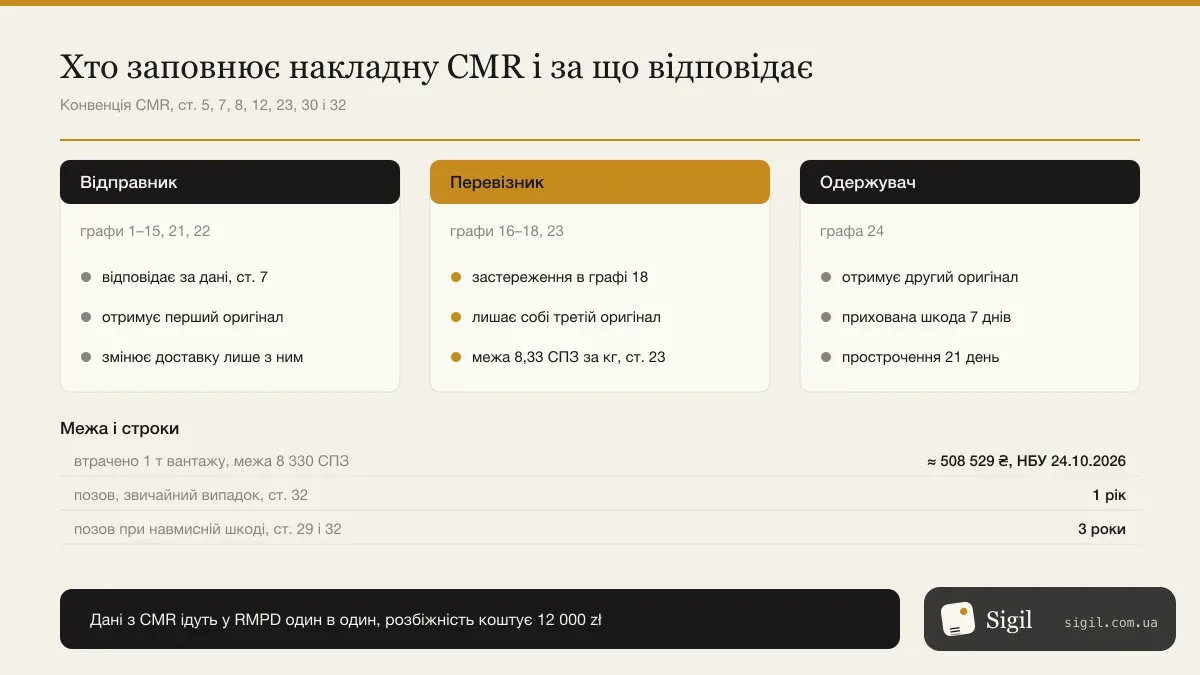
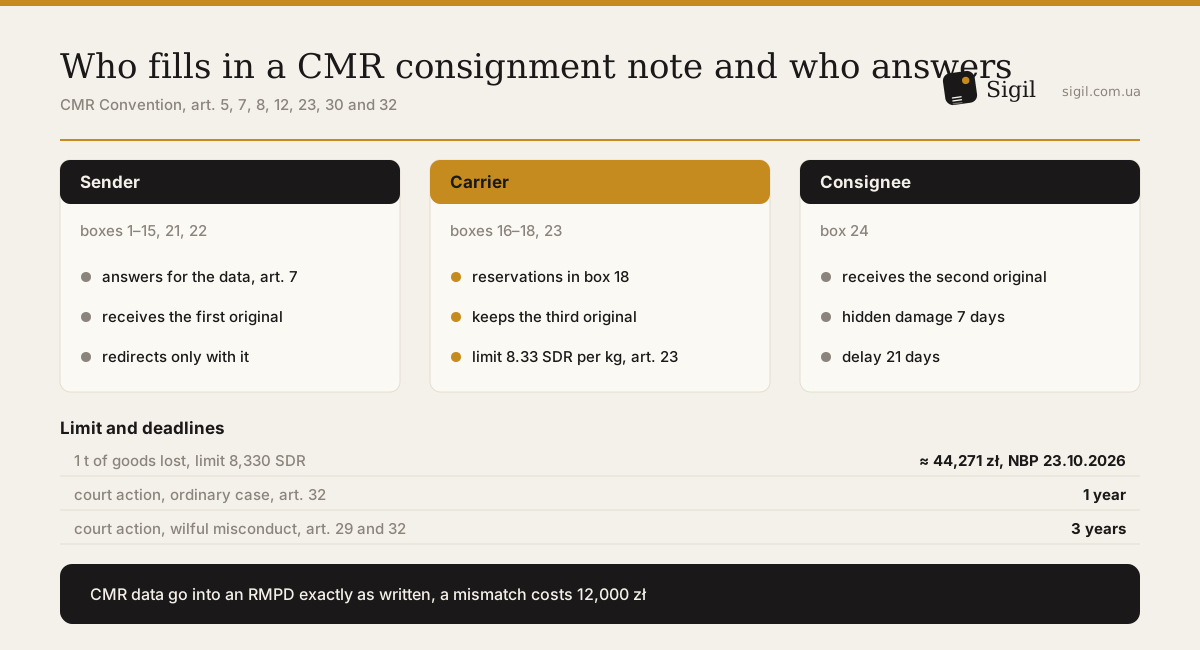
The CMR consignment note confirms a contract for the international carriage of goods by road under the 1956 Convention. It is made out in three originals (art. 5), and reservations about the goods go into box 18. What is written at loading decides who pays for damage, and the carrier's liability is capped at 8.33 SDR per kilogram (art. 23).
In brief: the CMR consignment note confirms the contract of carriage, but without it the contract does not disappear and the Convention still applies (art. 4) · there are three originals: the first for the sender, the second travels with the goods to the consignee, the third stays with the carrier (art. 5) · torn packaging and unchecked package counts go into box 18 with reasons, otherwise the goods are presumed to have been taken over in good order (art. 8, 9) · the carrier's liability for loss is capped at 8.33 SDR per kilogram of gross weight, about 509 hryvnias or 44 zł per kilogram at the rates of 23 and 24 October 2026 (art. 23) · hidden damage is notified in writing within 7 days, delay within 21 days, and a court action must be brought within a year (art. 30, 32) · «CMR insurance» is carrier's liability insurance, not cargo insurance · the data in the note go into an RMPD filing exactly as written, and a discrepancy costs 12,000 zł.
Near Zhytomyr a driver takes on twenty pallets of household chemicals. On two of them the stretch film is torn and the cartons underneath are crushed. The sender is in a hurry, so the driver signs the consignment note and leaves box 18 empty. In Poznań the consignee finds broken bottles and sends the carrier a claim. Nothing shows that the cartons were crushed at loading: the note carries no reservation at all.
What is a CMR consignment note and when is it needed
The CMR Convention applies to every contract for the carriage of goods by road for reward between two different countries. At least one of them, the country of taking over or the country of delivery, has to be a party to the Convention (art. 1 para 1). The nationality of the carrier and where the companies are registered make no difference. A run from Lutsk to Lublin falls under the Convention just as a run from Kyiv to Madrid does.
The full name is the Convention on the Contract for the International Carriage of Goods by Road. Ukraine acceded by Law No. 57-V of 1 August 2006 and deposited its instrument with the United Nations on 16 February 2007. Poland signed it in 1956 and ratified it in 1962. According to the UN depositary on 24 October 2026, the Convention has 58 parties.
Three kinds of carriage are excluded: carriage under international postal conventions, funeral consignments and furniture removal (art. 1 para 4). Everything else, from grain to spare parts, travels under its rules.
Can a truck run without a consignment note if the contract was signed separately? Legally the contract stands; in practice, no. Article 4 states that the absence, irregularity or loss of the note does not affect the existence or validity of the contract. But Ukrainian customs ask for the international consignment note as a transport document (art. 335 of the Customs Code of Ukraine), and in Poland its number goes into the RMPD filing.
How many originals does a CMR have and who keeps which
A CMR consignment note is made out in three originals, each with its own owner (art. 5 para 1). The sender receives the first. The second travels with the goods and passes to the consignee at delivery. The carrier keeps the third. All three are signed by the sender and the carrier, and the signatures may be replaced by stamps if the law of the country where the note is made out allows it.
Blank forms are sold in sets of six, nine and twelve sheets, but the Convention recognises only three of them as originals. The rest are copies for customs agents, forwarders or accounts.
The first copy is more than paperwork for the file. A sender who wants to change the place of delivery or stop the carriage has to produce it (art. 12 para 5(a)). A carrier who follows a new instruction without being shown the first copy is liable for the resulting loss to the person entitled to the goods (art. 12 para 7). The sender's right of disposal ends when the second copy is handed to the consignee (art. 12 para 2).
If the goods are loaded on several vehicles or are of different kinds or lots, the sender or the carrier may require a separate consignment note for each vehicle or lot (art. 5 para 2).
Who fills in the boxes of a CMR
The sender fills in most boxes and is responsible for the accuracy of the particulars about the parties, the goods and the instructions (art. 7 para 1). The Convention does not number the boxes; it only lists what the note must contain (art. 6). The numbers 1–24 come from the standard blank form used by carriers across Europe.
| Box | What it holds | Filled in by |
|---|---|---|
| 1 | sender, name and address | sender |
| 2 | consignee, name and address | sender |
| 3 | place of delivery | sender |
| 4 | place and date of taking over | sender |
| 5 | documents attached (invoice, certificates) | sender |
| 6–12 | marks, number of packages, packing, nature of goods, statistical number, gross weight, volume | sender; carrier checks packages and apparent condition |
| 13 | sender's instructions, customs included | sender |
| 14 | instructions as to payment for carriage | sender |
| 15 | cash on delivery | sender |
| 16 | carrier, name and address | carrier |
| 17 | successive carriers | successive carrier |
| 18 | carrier's reservations and observations | carrier |
| 19 | special agreements, such as declared value | parties together |
| 20 | to be paid by | sender and carrier |
| 21 | place and date the note was established | sender |
| 22 | signature and stamp of the sender | sender |
| 23 | signature and stamp of the carrier | carrier |
| 24 | goods received, signature, stamp, date | consignee |
Some forms in circulation in Ukraine label boxes 14–15 and 22–23 differently, for example «Return» in box 14, and add boxes 25–29 for the vehicle's plates, make and tariff. Boxes 1–12, 16–18 and 21 are the same in both variants, so read the box label before signing, not only its number.
A carrier who fills in the sender's boxes at the sender's request is deemed, unless the contrary is proved, to have done so on the sender's behalf (art. 7 para 2). This is routine when a driver copies an address from the invoice. Liability for inaccuracies in those particulars stays with the sender.
The Convention also requires the note itself to state that the carriage is subject to the Convention (art. 6 para 1(k)). Printed forms already carry that statement. If it is missing, the carrier is liable for any loss this causes to the person entitled to the goods (art. 7 para 3).
What a filled-in CMR looks like, box by box
The easiest way to show a completed note is the run from our opening scene: twenty pallets of household chemicals from Zhytomyr to Poznań. The company names, addresses and numbers below are made up, and each particular sits in the box where the standard 1–24 form expects it. The empty boxes are part of the example too, because a box left blank is a decision, not an oversight. A blank form and a separate filled-in sample, in PDF and in Ukrainian or Polish alongside English, can be downloaded free from CMR form PDF download, blank and filled-in sample, where the boxes that go into the RMPD filing are tagged.
| Box | What the example shows | What to watch |
|---|---|---|
| 1 | Zrazok LLC, 1 Promyslova St, 10001 Zhytomyr, Ukraine | the full name as on the invoice, because that is what goes into the RMPD filing |
| 2 | Przykład Sp. z o.o., ul. Magazynowa 5, 60-001 Poznań, Poland | the consignee under the contract, not the forwarder |
| 3 | Poznań, ul. Magazynowa 5, Poland | the place of delivery, which may differ from the address in box 2 |
| 4 | Zhytomyr, Ukraine, 02.11.2026 | where and when the goods were actually taken over |
| 5 | invoice No 145 of 01.11.2026, packing list | only documents that really travel with the truck |
| 6–9 | no marks, 20 packages, pallets in stretch film, washing preparations | the driver counts the packages himself |
| 10 | 3402 | the code from the invoice, not from memory |
| 11 | 9,600 kg | gross weight including the pallets |
| 12 | blank | the Convention does not require volume (art. 6) |
| 13 | customs clearance in Poland at destination | instructions without which the goods will not be cleared |
| 14 | carriage paid by the sender | terms of payment for carriage |
| 15 | blank | no cash on delivery |
| 16 | Carrier-Zrazok LLC, Lutsk, Ukraine | the firm that actually carries the goods |
| 17 | blank | no successive carrier |
| 18 | "2 pallets, film torn, cartons crushed" | the reservation missing from our scene |
| 19 | blank | no special agreements |
| 20 | blank | the sender pays everything under box 14 |
| 21 | Zhytomyr, 02.11.2026 | place and date the note was made out |
| 22 | signature and stamp of Zrazok LLC | |
| 23 | driver's signature and carrier's stamp | the driver signs after the entry in box 18 |
| 24 | blank until unloading | filled in by the consignee in Poznań |
Where the form has boxes 25–29, they take the registration numbers of the tractor unit and trailer, in the example AA 1234 BB and AA 5678 XT. The number of the note itself is printed on the form, and together with the parties and places from boxes 1–4 and 16 it later goes into the RMPD filing unchanged. The whole example therefore comes down to one rule: whatever is written at loading stays in the documents until the end of the trip.
What does the driver check at loading
On taking over the goods, the carrier checks two things: whether the number of packages, their marks and numbers match the note, and the apparent condition of the goods and their packaging (art. 8 para 1). The carrier does not have to check weight or contents. The sender may ask for either to be checked, but then pays for it (art. 8 para 3).
Anything the driver could not check, or that looks wrong, goes into box 18 with reasons (art. 8 para 2). A bare «goods not checked» does little. Specifics work: «2 pallets, film torn, cartons crushed», «packages not counted, load sealed by the sender», «loaded by the sender».
Without a reservation the law presumes that the goods and packaging were in apparent good condition and that the number of packages matched the note (art. 9 para 2). That presumption is what lost the claim for the driver in our opening scene. Reservations bind the sender only if the sender has expressly agreed to them in the note (art. 8 para 2), but even an unsigned reservation defeats the presumption in art. 9.
Is the carrier exposed for damage caused by poor packing when box 18 is empty? Yes, the risk grows. The sender is liable to the carrier for damage caused by defective packing, but not where the defect was apparent or known to the carrier at taking over and no reservation was made (art. 10).
What does the carrier pay for loss or damage
The carrier is liable for loss, damage and delay from the moment of taking over the goods until delivery (art. 17 para 1). The only exemptions are those in art. 17 paras 2 and 4: the claimant's own fault, inherent vice of the goods, circumstances the carrier could not avoid, an open vehicle agreed in the note, missing or defective packing, loading by the sender. The burden of proving them lies on the carrier (art. 18 para 1). A defect in the carrier's own vehicle is no excuse (art. 17 para 3).
Compensation for loss is based on the value of the goods at the place and time of taking over (art. 23 para 1), capped at 8.33 units of account per kilogram of gross weight short (art. 23 para 3). The unit of account is the Special Drawing Right of the International Monetary Fund. The SDR limit was introduced by the 1978 Protocol, in force for Poland since 21 February 2011 and for Ukraine since 13 September 2020.
| What happened | Limit, SDR | ≈ ₴ at the NBU rate of 24.10.2026 | ≈ zł at the NBP rate of 23.10.2026 |
|---|---|---|---|
| 1 kg lost | 8.33 | 509 | 44 |
| 500 kg pallet damaged | 4,165 | 254,265 | 22,136 |
| 1 t lost | 8,330 | 508,529 | 44,271 |
| 20 t lost | 166,600 | 10,170,580 | 885,429 |
The National Bank of Ukraine rate on 24.10.2026 is 61.0479 hryvnias per SDR; the National Bank of Poland rate on 23.10.2026 is 5.3147 zł per SDR. The limit follows weight, not value. It covers twenty tonnes of crushed stone in full, but a 500 kg pallet of smartphones only in part.
On top of the limit the carrier refunds the carriage charges, customs duties and other charges incurred in respect of the carriage (art. 23 para 4). For delay, if the claimant proves a loss, compensation may not exceed the carriage charges (art. 23 para 5). Goods not delivered within 30 days of the agreed time limit, or within 60 days of taking over where none was agreed, may be treated as lost (art. 20 para 1).
The limit does not apply in two cases. First, where the sender declared a higher value or a special interest in delivery in the note and paid a surcharge (art. 24, 26). Second, where the damage was caused by wilful misconduct or by default that the court treats as equivalent (art. 29). The carrier then pays the full loss, and the limitation period rises to three years.
What are the deadlines for claims and court action
CMR deadlines are short, and missing one costs more than the size of the loss. The Convention sets them as follows (art. 30, 32):
| Situation | Deadline | Form |
|---|---|---|
| apparent damage | at delivery | notice to the carrier |
| hidden damage | 7 days from delivery, Sundays and public holidays excepted | in writing |
| delay | 21 days from placing the goods at the consignee's disposal | in writing |
| court action, ordinary case | 1 year | court |
| court action, wilful misconduct | 3 years | court |
Without a notice in time, taking delivery is prima facie evidence that the consignee received the goods in the condition described in the note (art. 30 para 1). No compensation is payable for delay at all without written notice within 21 days (art. 30 para 3).
The one-year period runs from delivery in cases of partial loss, damage or delay, and in a total loss from the thirtieth day after the agreed time limit (art. 32 para 1). A written claim suspends the period until the carrier rejects it in writing and returns the documents (art. 32 para 2). Further claims on the same grounds do not suspend it again.
What is CMR insurance
What the Ukrainian market sells as «CMR insurance» is carrier's liability insurance under the CMR Convention, not insurance of the goods. The policy pays what the carrier owes the sender or consignee under articles 17 to 29, usually within 8.33 SDR per kilogram of gross weight. Cargo insurance is a separate policy on the goods themselves, bought by the cargo owner.
Ukrainian law places the two risks in different classes. Liability arising from the use of a land vehicle, including carrier's liability, is class 10; insurance of property in transit, including cargo, is class 7 (art. 4 of the Law of Ukraine on Insurance No. 1909-IX). The carrier buys the first policy; the cargo owner usually buys the second.
What a carrier's liability policy covers
A carrier's liability policy covers exactly the sums the Convention places on the carrier. There are four of them, each with its own article.
| What the carrier owes | How much | Article of the Convention |
|---|---|---|
| loss of the goods between taking over and delivery | value at the place of taking over, capped at 8.33 SDR per kg gross | art. 17 para 1, art. 23 paras 1 to 3 |
| damage to the goods | the loss in value, capped at the amount payable for loss of the whole consignment or of the damaged part | art. 25 |
| carriage charges, customs duties and other charges of the carriage | in full for total loss, in proportion for partial loss | art. 23 para 4 |
| delay in delivery | the proven loss, capped at the carriage charges | art. 23 para 5 |
On top of that the claimant may ask for interest at 5 per cent a year on the compensation, running from the day the written claim was sent (art. 27 para 1). Whether the policy pays that interest depends on its terms.
The policy pays nothing where the Convention does not make the carrier liable. That covers circumstances the carrier could not avoid, inherent vice of the goods, bad packing and loading by the sender (art. 17 paras 2 and 4). The loss then stays with the cargo owner or the owner's cargo insurer.
How cargo insurance differs from CMR insurance
Cargo insurance protects the goods; a CMR policy protects the carrier's balance sheet. Everything else follows from that, from who buys the policy to how much it pays.
| Feature | CMR policy (carrier's liability) | Cargo insurance |
|---|---|---|
| who buys it | the carrier | the sender, the consignee or a forwarder |
| what is insured | the carrier's duty to make good the loss | the goods themselves |
| when it pays | only when the carrier is liable under the Convention | on an insured event, whether or not the carrier is at fault |
| payment cap | 8.33 SDR per kg unless a value was declared (art. 23, 24) | the sum insured, usually the invoice value |
| class under Law No. 1909-IX | 10 | 7 |
A 500 kg pallet of smartphones worth 175,000 zł shows the gap. The art. 23 cap is 4,165 SDR, about 22,136 zł at the National Bank of Poland rate of 23.10.2026. The CMR policy pays no more than that, and only cargo insurance covers the remaining 152,864 zł. If the carrier could not have avoided the loss, the CMR policy pays nothing at all.
When the 8.33 SDR limit falls away and what happens to the policy
The 8.33 SDR limit falls away in two cases, and in both the carrier may have to pay far more. The first is a higher value of the goods or a special interest in delivery declared in the note against a surcharge (art. 24, 26). The carrier is then liable up to the declared amount.
The second case is article 29. The carrier loses the limit and the exemptions if the damage was caused by wilful misconduct, or by default that the law of the court seized treats as equivalent to wilful misconduct. The same applies when the driver, another employee or a subcontractor of the carrier acted that way (art. 29 para 2). The carrier then pays the full loss, and the limitation period is three years (art. 32 para 1).
Before a run with valuable goods, find both cases in the policy terms. Check whether the policy covers a value declared in the note and liability under article 29, and up to what amount. If the sender asks to enter a value in box 19, tell the insurer before departure.
What Polish shippers require from a CMR policy
A Polish sender or forwarder writes the insurance requirement into the transport order (zlecenie) and calls the policy OCP, short for the carrier's civil liability insurance. A Ukrainian class 10 CMR policy is exactly that. The Convention does not require one; the obligation comes from the contract.
Before loading, the Polish side usually asks to see and checks the following:
- a copy of a valid policy and proof that the premium was paid, because an unpaid policy may not be in force;
- a sum insured (suma gwarancyjna) no lower than the value of the goods;
- whether that sum applies to each event or is one aggregate for all events in the policy year;
- a period of cover that includes the transport dates in the order;
- a territorial scope covering Ukraine, Poland and the transit countries;
- the type of goods, because policies exclude some cargo or cover it only for an extra premium.
Read separately whether the policy still applies when a subcontractor performs the run. A clause giving the carrier the benefit of insurance of the goods taken out by the sender is null and void (art. 41 para 2), so the sender's cargo policy never replaces the carrier's own liability cover.
A policy is no substitute for a reservation in box 18. The insurer pays what the carrier owes, and without a reservation the carrier owes more.
Does the electronic e-CMR work between Ukraine and Poland
The electronic consignment note is governed by the Additional Protocol to the Convention of 20 February 2008, in force since 5 June 2011. Poland acceded on 13 June 2019 and the Protocol has applied to it since 11 September 2019. Ukraine acceded by Law No. 660-IX of 3 June 2020, and the Protocol has applied to it since 8 October 2020. On 24 October 2026 the Protocol has 42 parties.
An electronic consignment note made out under the Protocol has the same evidentiary value as a paper one (art. 2 para 2 of the Protocol). It is authenticated by a reliable electronic signature (art. 3), contains the same particulars as the paper note (art. 4), and any change to it must be detectable (art. 4 para 3).
The Protocol does not make e-CMR compulsory. The parties to the contract have to agree on the platform, how the note is issued and delivered, how delivery is confirmed, and how it is replaced by a paper note if something fails (art. 5). Without that agreement with the sender and the consignee, the paper form remains the only workable option. The Customs Code of Ukraine accepts transport documents in paper or electronic form (art. 335 para 1). Spain made an electronic document compulsory from 5 October 2026, but only for domestic carriage and cabotage, and an international trip there still runs on a CMR, as the text on Spain's DeCA explains.
How the CMR connects to an RMPD filing in Poland
For a Polish RMPD filing the CMR consignment note is the main source of data. The sender, the consignee, the places of loading and unloading, the carrier, and the number and date of the note go into the filing word for word, errors included. Which box goes into which RMPD100 field, and what the note lacks, is set out in the article How CMR data get into an RMPD, field by field.
A roadside inspector puts the note and the filing side by side. A discrepancy costs the carrier 12,000 zł, about 138,481 hryvnias at the NBU rate of 11.5401 hryvnias per złoty on 24.10.2026 (Annex 3, item 3.2a of the Polish Road Transport Act). Which errors have already cost firms that amount is collected in One digit in an RMPD costs 12,000 zł, and the SENT and RMPD fines calculator works out your own figure.
The note's own number has stopped being a formality too. «BRAK», Polish for «none», in the number box passes in an RMPD filing but breaks transit clearance; why is explained in A CMR with no number now stalls the transit.
What to do
- Check the number of packages, marks and apparent condition of the goods at loading before signing box 23.
- Enter every torn film, dent or uncounted package in box 18 with reasons, and ask the sender to sign under the reservation.
- Compare boxes 1, 2, 3, 4 and 16 with the transport order, because these are the boxes that go into the RMPD filing.
- Keep the third original and make sure the second reaches the consignee.
- Ask the consignee to write the date and any remarks in box 24 if damage is visible at unloading.
- Answer a written claim in writing and return the documents, because that decides when the limitation period starts running again.
- Read the limit, territory and exclusions in the carrier's liability policy before a run with valuable cargo.
What not to do
- Do not leave box 18 empty when the packaging is damaged. Without a reservation the goods are presumed to have been taken over in good order (art. 9).
- Do not follow a new delivery address from the sender without seeing the first original. The carrier pays for the resulting loss (art. 12 para 7).
- Do not wait more than 7 days to give written notice of hidden damage. After that, the note counts as evidence that the goods arrived intact (art. 30 para 1).
- Do not mistake a CMR policy for cargo insurance. It covers the carrier's liability within the Convention, not the full value of the goods.
- Do not correct the data from the note when you copy them into an RMPD. A discrepancy between the filing and the CMR costs 12,000 zł.
Where technology fits in
Sigil reads a CMR consignment note from a photo or PDF and shows the dispatcher the data next to the image of the document for a one-to-one check. The system corrects nothing on anyone's behalf: the dispatcher confirms each value or edits it from the original, and only then does the RMPD filing go to PUESC. Sigil does not issue the note, the box 18 reservations or the insurance policy; those belong to the parties to the contract.
Sigil handles RMPD filings. The CMR consignment note is made out by the sender and the carrier, and the SENT notification is filed by the consignor or the consignee.
A demo or training for your team
30 minutes online. We show how Sigil™ files an RMPD from a CMR and answer questions about your runs.
Frequently asked questions
- Can an international run be done without a CMR consignment note?
- The contract stands, but driving without one is a bad idea. Article 4 of the Convention says the absence of a note does not affect the validity of the contract of carriage. Ukrainian customs, however, ask for the international consignment note as a transport document (art. 335 of the Customs Code), its number goes into the Polish RMPD filing, and without reservations in the note the carrier cannot prove the condition of the goods at taking over.
- Who is liable for a mistake in the note, the sender or the driver?
- The sender, if the mistake is in the sender's particulars. The sender answers for the accuracy of the particulars about the parties, the goods, the weight and the instructions (art. 7 para 1). If the driver entered them at the sender's request, the driver is deemed to have acted on the sender's behalf (art. 7 para 2). The carrier answers for boxes 16, 18 and 23.
- How much does the carrier pay for a lost tonne of goods?
- No more than 8,330 SDR. The art. 23 limit is 8.33 SDR per kilogram of gross weight, about 508,529 hryvnias per tonne at the NBU rate of 61.0479 hryvnias per SDR on 24.10.2026, or 44,271 zł at the NBP rate of 23.10.2026. If the goods are worth less, their value is paid. The limit falls away where value was declared in the note (art. 24) or the damage was wilful (art. 29).
- Is CMR insurance compulsory?
- The Convention does not require it. The obligation comes from the contract, when a client or forwarder writes a carrier's liability policy into the order. Such a policy covers the carrier's liability under the Convention, usually within 8.33 SDR per kilogram, and is not cargo insurance (classes 10 and 7 in art. 4 of Ukrainian Law No. 1909-IX).
- Can an e-CMR replace the paper note on a run to Poland?
- Yes, if the parties have agreed on a platform. The e-CMR Protocol has applied to Poland since 11.09.2019 and to Ukraine since 08.10.2020. An electronic note has the same force as a paper one (art. 2 of the Protocol), but the sender, carrier and consignee must agree how it is issued, signed and how delivery is confirmed (art. 5).
Sources
International agreements:
- Konwencja o umowie międzynarodowego przewozu drogowego towarów (CMR), Genewa, 19 maja 1956 r., ISAP, Dz.U. 1962 nr 49 poz. 238: art. 1, 4–10, 12, 17, 18, 20, 23–27, 29, 30, 32, 41.
- Convention on the Contract for the International Carriage of Goods by Road (CMR), United Nations Treaty Series, vol. 399, No. 5742, authentic English text: art. 17, 23–27, 29, checked 01.11.2026.
- Convention on the Contract for the International Carriage of Goods by Road, official Ukrainian translation, zakon.rada.gov.ua; Law of Ukraine No. 57-V of 01.08.2006 on accession.
- Protocol of 5 July 1978, Ukrainian text, zakon.rada.gov.ua: art. 2 (8.33 SDR), in force for Ukraine since 13.09.2020; Protokół z 5 lipca 1978 r. and Oświadczenie rządowe z 1.02.2011, ISAP, Dz.U. 2011 nr 72 poz. 382 and 383: in force for Poland since 21.02.2011.
- Additional Protocol concerning the Electronic Consignment Note, 20 February 2008 and Oświadczenie rządowe z 26.06.2019, ISAP, Dz.U. 2019 poz. 1487 and 1488: art. 2–5 and 8 of the Protocol, in force for Poland since 11.09.2019; Ukrainian official translation, zakon.rada.gov.ua: accession by Law No. 660-IX of 03.06.2020, in force for Ukraine since 08.10.2020.
- Status with the UN depositary, checked 24.10.2026: CMR Convention (58 parties, Ukraine 16.02.2007), 1978 Protocol (Ukraine 15.06.2020, Poland 23.11.2010), e-CMR Additional Protocol (42 parties, Ukraine 10.07.2020, Poland 13.06.2019).
National legislation:
- Customs Code of Ukraine, zakon.rada.gov.ua: art. 335 para 1 item 1(b).
- Law of Ukraine on Insurance No. 1909-IX of 18.11.2021, zakon.rada.gov.ua: art. 4 para 1, classes 7 and 10.
- Ustawa z dnia 6 września 2001 r. o transporcie drogowym, ISAP, consolidated text: Annex 3, item 3.2a.
Exchange rates: National Bank of Ukraine, 61.0479 hryvnias per SDR (XDR) and 11.5401 hryvnias per złoty on 24.10.2026; National Bank of Poland, 5.3147 zł per SDR on 23.10.2026, table 207/A/NBP/2026.
Read next
- How CMR data get into an RMPD, field by fieldWhich CMR box goes into which RMPD100 field, what the CMR lacks (type of carriage, permit, border), what the RMPD lacks (goods, CN). Three fields that diverge.
- A CMR with no number now stalls the transitSince 3 August 2026 the Polish NCTS passes safety data to ICS2, and a missing or repeated CMR number gets the declaration rejected. What to check at loading.
- What gets fined when one digit in an RMPD costs 12,000 złA wrong digit or date in an RMPD costs 12,000 zł, the same as not filing. Provisions with article numbers, three 2025 roadside checks and what a carrier can do.
- An RMPD roadside check and what the inspector doesAn RMPD roadside check: what the inspector looks at in the filing, why last trip's number does not help, when the truck is impounded and the driver's rights.
- How to fill in the RMPD100 form on PUESCHow to fill in the RMPD100 form on PUESC section by section, from the entry date and the goods box to the permit field, the driver's number and the fine.
- Spain's DeCA from 5 October, who it bindsFrom 5 October 2026 domestic carriage in Spain and cabotage need an electronic DeCA. International journeys stay on the CMR. Who the duty actually binds.
Sigil™ turns a CMR into an RMPD declaration and files it with PUESC, with every field checked against the original.
More about RMPD