RMPD
How to fill in the RMPD100 form on PUESC
How to fill in the RMPD100 form on PUESC section by section, from the entry date and the goods box to the permit field, the driver's number and the fine.
Published · Author: Makaiev Kostiantyn Oleksandrovych, founder of Sigil RMPD
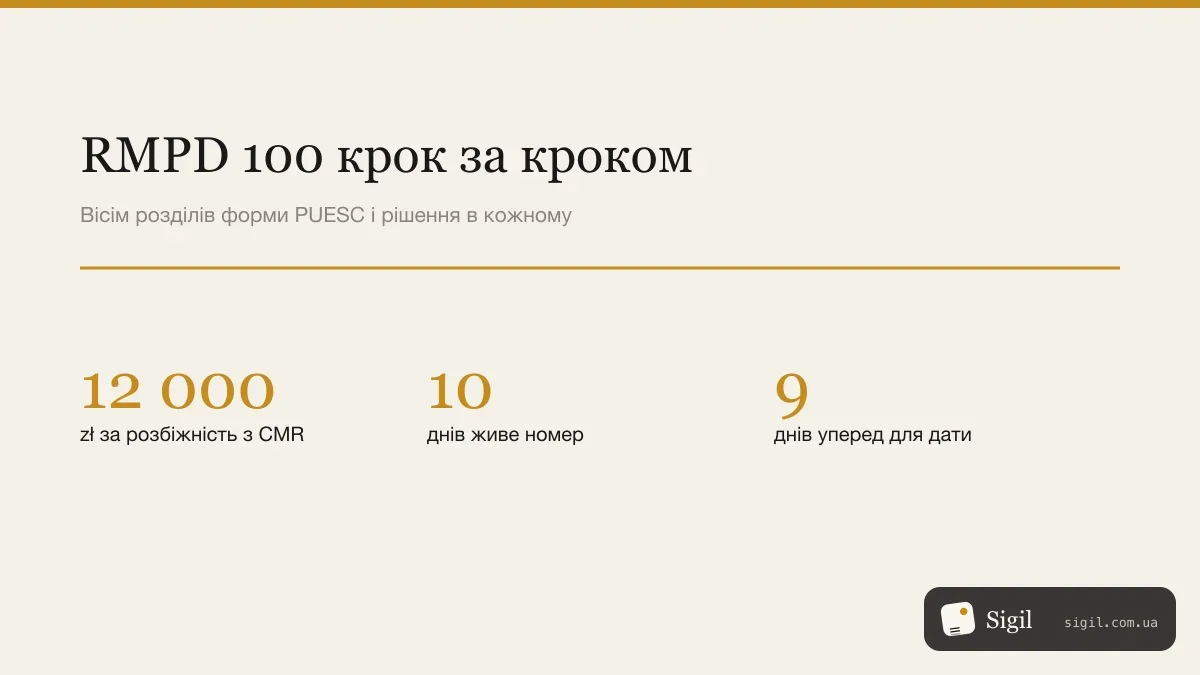
A dispatcher in Lutsk, in western Ukraine, opens PUESC, the Polish customs and tax e-services portal, at nine in the evening. The freight forwarder in Lublin has written two words, «file RMPD». The form is in Polish or English, has eight sections and red asterisks. Not one sentence on it says whether the start date means the day of loading or the day of the border.
This article shows how to fill in RMPD100, walking through the RMPD100 form from logging in to the reference number the driver shows at a roadside check. Which box of the CMR consignment note goes into which field is covered separately in the map of CMR boxes to RMPD fields; here the subject is the order of decisions.
In brief: the form is called «RMPD100 - Rejestracja przewozu przez przewoźnika», sits on PUESC under the Formularze tab, and the basic scope of rights is enough to use it · the start date is the day of entry into Poland, not the day of loading, and it cannot lie in the past or more than 9 days after the day of filing · the reference number is valid for 10 days from the day it is issued (art. 11 ust. 1 of the SENT Act), so a filing made a week before the border leaves three days for the trip · with goods on board you tick «Przejazd z ładunkiem» in field 3.2 and fill in sections 4 and 5; running empty, you leave the box blank · one permit and several consignees in Poland means the details of the last unloading point, and a transit with several CMRs means one document of your choice · a new trailer or a new date is an update to the same number, not a second RMPD100 · a missing filing, or data that does not match the CMR and the vehicle, costs the carrier 12,000 zł (załącznik nr 3, lp. 3.2a).
RMPD100 is filled in on PUESC before entry, eight sections in turn, from the carrier to the declaration of authority. The register checks the form against the rules of its technical specification and returns either a reference number or a refusal with a rule code. The carrier hands the number to the driver before the carriage starts, and without it the driver must refuse to drive (art. 28c of the Road Transport Act).
Where to open the RMPD100 form and what access you need
The RMPD100 form sits on PUESC under the Formularze (forms) tab, in the alphabetical catalogue under the letter R. Two more sit next to it: «RMPD - Aktualizacja» for changes and cancellation, and RMPD406 for checking that a number is valid, with the last GPS position. The portal runs in Polish and English. On the test portal test.puesc.gov.pl the same forms can be tried without consequences, but a filing made there does not entitle anyone to drive.
An account with the basic scope of rights (podstawowy zakres uprawnień) is enough for the form; the extended scope is not needed. One condition remains: the person filing on behalf of the company has to be linked to it as a representative, and the register checks this. Who may file in your place and who carries the liability then is covered in the article on ways to file RMPD.
PUESC itself lists the data you need on the service page, and it is worth having it at hand before logging in. The list starts with the carrier's details with address and tax number, the consignor and consignee with addresses, and the places and dates of the start and end of the carriage in Poland. Then come the countries of loading and unloading, the transport document number, the permit or ground of exemption, the vehicle and the locator number. The RMPD100 form is only the first document of the RMPD family, and what 101, 104 and 406 do is described in the article on RMPD document types.
How to fill in RMPD100 section by section
The form has eight sections, and each has one main decision. The numbering is visible on the form itself: the goods box sits in field 3.2, the consignor in section «4. Nadawca towaru», the consignee in section «5. Odbiorca towaru».
| Section | What it holds | The decision you make |
|---|---|---|
| 1 Carrier | name, address, identifier type and number | a Ukrainian company uses type INNY with its ЄДРПОУ code; with no street or building number you write BRAK |
| 2 Vehicle | country and number of the tractor and trailer, locator number, spare locator | plates in Latin letters and digits only, no spaces; the locator is mandatory and the register checks its checksum |
| 3 Permit information | dates (3.1), countries and the goods box (3.2), document (3.3), type of carriage and of permit (3.4, 3.5, 3.6), places in Poland (3.7, 3.8) | entry date, type of carriage, permit number or ground of exemption, border crossing |
| 4 Nadawca towaru | consignor from the CMR | active only with goods |
| 5 Odbiorca towaru | consignee from the CMR | active only with goods |
| 6 Additional information | remarks and your own filing number | optional |
| 7 Feedback channels | up to three e-mail addresses | without an address the number will not arrive by e-mail |
| 8 Declarations | declaration of authority, first and last name of the filer | the filer confirms the right to act for the carrier |
The word BRAK («none» in Polish) has two legitimate places in the form. The first is an empty street or building number in an address, and the portal prompts it under those fields (rule R04 of the specification). The second is a consignor or consignee without an identifier, where the identifier type and number are both BRAK (rule R03). The carrier itself cannot be BRAK.
The register accepts number plates only in Latin letters and digits, without spaces or hyphens: AC4533HP, not «AC 4533 HP» and not in Cyrillic. The locator number comes not from the CMR but from the device registered for SENT, Poland's goods monitoring system, and the main and spare numbers cannot be identical (rule R22).
Which start date to enter and how long the number lives
The start date in RMPD100 is the day the vehicle begins the carriage on Polish territory, which for a trip from Ukraine is the day of entry. The Act says so: the filing contains the place and date of the start of the carriage in the territory of the Republic of Poland (art. 28b ust. 3 pkt 4 of the Road Transport Act). The loading day in Lutsk sits in box 4 of the CMR and does not go into field 3.1.
The register puts two limits on the date. It cannot be earlier than the day of filing or more than 9 days later, and it cannot fall after the end date (rule R06 of the RMPD specification of 20.11.2024). The end date is the planned day of unloading in Poland or of leaving it.
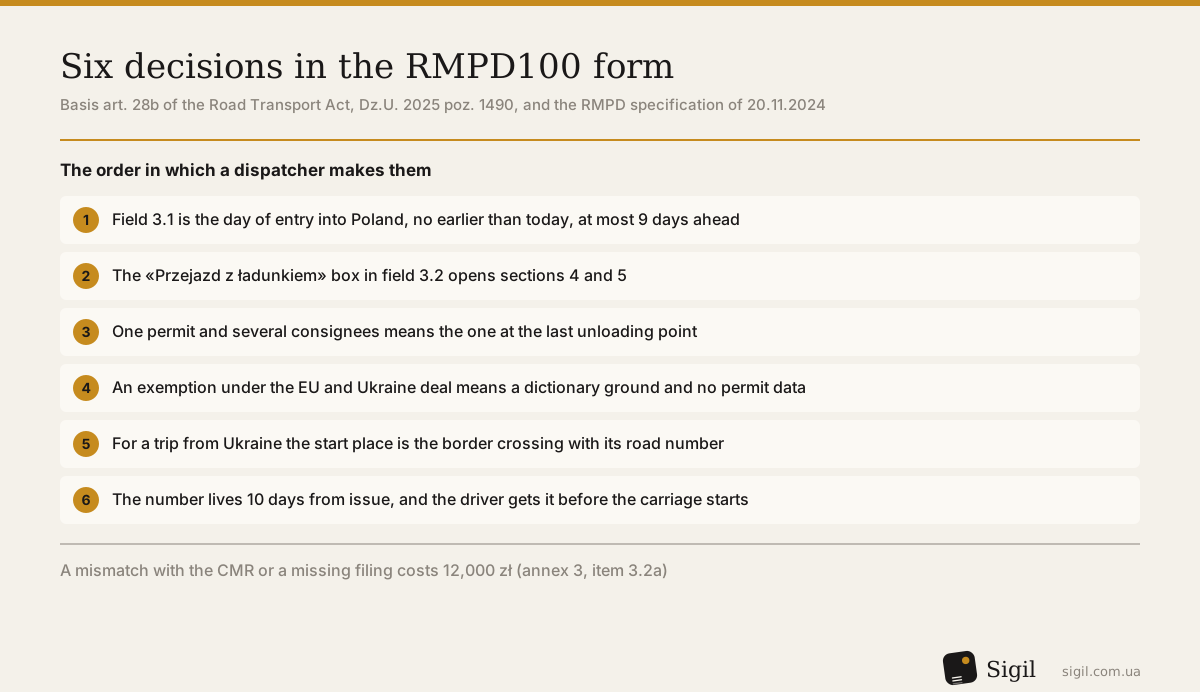
The reference number is valid for 10 days from the day it is issued, not from the start date (art. 11 ust. 1 of the SENT Act, applied through art. 28b ust. 5 of the Road Transport Act). A filing made a week before the border leaves three days for the trip through Poland itself. So file for the real day of entry, not for a booking made two weeks earlier.
Does field 3.1 take the loading date from the CMR? No. Loading on Tuesday sits in box 4 of the consignment note, while field 3.1 takes Wednesday, when the truck crosses the border. The Act asks for the start of the carriage on Polish territory, and that is the date an inspector compares with the vehicle's movement.
How to mark goods, an empty run and several CMRs
For a carriage with goods, tick «Przejazd z ładunkiem» in field 3.2; the English version of the portal labels it «Journey with goods». Sections 4 and 5 then become active and must be filled in. For an empty run the box stays blank and sections 4 and 5 are inactive. The road transport inspectorate GITD says so in its instructions for the form, and the specification adds that with goods the transport document details are mandatory too (rule R07).
GITD separately describes three situations where dispatchers hesitate most.
- One permit, several consignees in Poland. Sections 4 and 5 take the consignee or consignor at whose premises the last unloading in Poland takes place.
- Transit, several consignors or consignees. Sections 4 and 5 take the consignor and consignee from only one transport document, chosen by the carrier. Two companies are not merged into one field.
- An empty run after unloading in Poland to collect goods elsewhere in Poland for export to another country. Such a run needs a separate filing.
Does an empty run across Poland, from unloading to a new export loading, need its own RMPD100? Yes. It is a separate carriage with the goods box blank and its own start date, and no consignor goes into it «just in case».
What to choose for the type of carriage and permit
The type of carriage (3.4) has four values from the dictionary: bilateral, transit, to or from a third country, and cabotage. Lutsk to Lublin is bilateral. Lutsk to Berlin across Poland, with no unloading in Poland, is transit. How transit differs from carriage to a third country is covered in the article Transit or third-country carriage.
The type of permit has four values as well: a single-journey permit, an ECMT permit, a cabotage permit and an exemption from the duty to hold a permit. Bilateral carriage and transit under the agreement between Ukraine and the EU need no permit until 31.03.2027, so you choose the exemption and its legal ground from the PUESC dictionary. With an exemption the permit data block stays empty: the specification forbids filling it in together with an exemption, and such a filing comes back refused (rule R08).
For an ECMT permit the form asks for the permit number, its period of validity and the carrier's country of establishment (art. 28b ust. 3 pkt 10 lit. a of the Road Transport Act). Where several operations within one carriage need different permits or rest on different grounds of exemption, each operation gets its own filing (art. 28b ust. 8).
Where to enter the border crossing and the place in Poland
For a trip from abroad, the place where the carriage starts in Poland is the border crossing, not the town of loading. When the country of loading is not Poland, the form requires the place of entry in field 3.7 and does not accept a place inside Poland (rule R18). The crossing is chosen from the PUESC dictionary of border crossings, which makes the road number mandatory; a place outside the dictionary is entered with its province and coordinates (rules R13 and R14).
The place where the carriage ends depends on the country of unloading. With unloading in Poland, field 3.8 holds a place in Poland with a province code and GPS coordinates (rules R12 and R20). When the goods travel on, 3.8 holds the place of exit from Poland, and there is no place inside the country (rule R21).
What happens after the «Zatwierdź» button
After the «Zatwierdź» (approve) button the register checks the form and replies. If everything matches, a confirmation with the reference number arrives; if not, a refusal RMPD500 with a rule code, for example R06 for the date. What each code means and how to fix it is collected in the article on the RMPD500 refusal.
The number appears on screen and in Mój pulpit | Dokumenty (My desktop, Documents). It arrives by e-mail only when an address was entered in the form, because the field is optional. A dispatcher who files in the evening and is away from the computer in the morning leaves the driver without a number if no address was given.
The carrier must hand the number to the driver before the carriage in Poland starts (art. 28c ust. 1 of the Road Transport Act). A driver without the number must refuse to start the carriage (ust. 2). The driver can check that the number is valid on his own with the RMPD406 form.
What to change after sending and what to file again
A new trailer, a shifted date or a different place is an update to the same filing through the «RMPD - Aktualizacja» form, that is the RMPD101 message, and the number stays. The law requires changed data to be updated without delay (art. 8 ust. 1 of the SENT Act). A second RMPD100 for the same trip gives the vehicle a second number, while the first filing stays in the register.
An update does not extend the life of the number: the start date in an edit cannot move more than 9 days past the registration date (rule R15). When the number has expired and the carriage continues, a new filing is made with the previous number and the place where the carriage continues (art. 28b ust. 4 of the Road Transport Act).
A filing can be cancelled (RMPD104) only before the carriage starts (rule R26). The register does not accept closure through RMPD103 at all, because rule R16 of the specification reads «Nie jest możliwe przesłanie komunikatu RMPD_103», sending the RMPD_103 message is not possible. What follows for filings that are never closed is covered in the article on cancelling and closing RMPD.
When PUESC is down, a replacement document goes to GITD at awaria.zezwolenia@gitd.gov.pl instead of the filing (art. 28b ust. 7 of the Road Transport Act). How to fill in its field 1A and what the driver carries is described in the article on the document replacing the filing.
How much a mistake in the RMPD100 form costs
A missing filing and a filing with incomplete data, or data that does not match the facts, cost the same, 12,000 zł, which is 138,394 ₴ at the National Bank of Ukraine rate of 11.5328 ₴ per 1 zł on 31.10.2026. The SENT and RMPD fine calculator works out the amount for your own case.
| Breach | Who pays | Amount | Legal basis |
|---|---|---|---|
| no filing, or data incomplete or not matching the facts | carrier | 12,000 zł (138,394 ₴) | załącznik nr 3, lp. 3.2a |
| the locator does not transmit the position in an RMPD carriage | carrier | 10,000 zł (115,328 ₴) | załącznik nr 3, lp. 3.2b |
| the driver drives without showing the reference number | driver | 1,500 zł (17,299 ₴) | załącznik nr 1, lp. 2a |
The total of fines on the carrier for breaches found during one roadside check cannot exceed 12,000 zł (art. 92a ust. 3 of the Road Transport Act). So a missing permit and a missing filing at one check do not add up to 24,000 zł. The driver's fine for not showing the number sits outside that ceiling.
What to do
- Put the CMR next to the form and copy the consignor, consignee and document number word for word, spelling mistakes included.
- Check the number plates character by character, Latin letters and digits only, no spaces.
- Enter the day of entry into Poland in field 3.1, no earlier than today and no more than 9 days ahead.
- Tick «Przejazd z ładunkiem» when the truck carries goods and fill in sections 4 and 5; running empty, leave the box blank.
- Choose the type of carriage from the route, and with an exemption give the ground and leave the permit block empty.
- Enter an e-mail address that someone actually reads, and hand the number to the driver before departure.
- After every change at loading, send an update before entry, not a new RMPD100.
What not to do
- Do not «correct» CMR data in the filing. A mismatch with the consignment note costs 12,000 zł, and an error in the CMR is fixed by whoever issued it.
- Do not file a second RMPD100 because the trailer changed. The second filing does not cancel the first; it gives the vehicle a second number.
- Do not enter Lutsk as the place where the carriage starts in Poland. For a trip from Ukraine that place is the border crossing, and the register refuses under rule R18.
- Do not file two weeks before the trip. The start date cannot lie more than 9 days ahead, and the number lives 10 days from issue.
- Do not send the form without an e-mail address if nobody will collect the number from the portal. A driver without the number must refuse to drive.
Where technology fits in
Sigil transfers the data from the CMR into the RMPD100 filing one to one and sends it to PUESC under the carrier's own credentials, after a person has checked every field against the original. The human confirmation is not a formality. The fine is for data that does not match the facts, so nobody «corrects» anything in the background, and the carrier remains the filer. Sigil does not file SENT; the consignor or consignee does.
Sigil handles documents of the RMPD family. It does not handle SENT filings, permits, ECMT permits or tachographs.
A demo or training for your team
30 minutes online. We show how Sigil™ files an RMPD from a CMR and answer questions about your runs.
Frequently asked questions
- Is RMPD100 filed before leaving Ukraine?
- Yes. The law requires the filing before the carriage starts on Polish territory, so it can be made from home. The start date cannot lie more than 9 days after the day of filing, and the number lives 10 days from issue, so file for the real day of entry.
- Are the consignor and consignee filled in for an empty run?
- No. Without the «Przejazd z ładunkiem» box ticked in field 3.2, sections 4 and 5 are inactive, and the specification requires the consignor, consignee and document data to stay empty (rule R07).
- Do all CMRs go into a transit filing?
- No. GITD says to give the consignor and consignee from only one transport document, chosen by the carrier. Where one carriage has one permit and several consignees in Poland, you give the one at the last unloading point.
- Can a mistake in a filed RMPD100 be corrected?
- Yes. The change goes through the «RMPD - Aktualizacja» form and the number stays the same. Do it before entry, because the inspector compares what stands in the register at the time of the check, and an update does not extend the number's life.
- Does the carrier need extended access to PUESC?
- No. The basic scope of rights is enough for the RMPD100 form. The person filing on behalf of the company has to be linked to it as a representative, and the register checks this.
Sources
Legal acts as in force on the day of publication:
- Road Transport Act of 6 September 2001 (Ustawa o transporcie drogowym), ISAP, consolidated text Dz.U. 2025 poz. 1490: art. 28b ust. 1, ust. 3 pkt 4, 8 and 10 lit. a, ust. 4, 5, 7 and 8, art. 28c ust. 1 and 2, art. 92a ust. 3, annex 1 item 2a, annex 3 items 3.2a and 3.2b.
- Act of 9 March 2017 on the monitoring of road and rail transport of goods (SENT Act), ISAP, consolidated text Dz.U. 2024 poz. 1218: art. 8 ust. 1, art. 11 ust. 1 and 2.
- Decision No 3/2025 of the EU-Ukraine Joint Committee, EUR-Lex, OJ L 2025/2352: the road freight agreement applies until 31.03.2027.
Specification and authorities:
- Specyfikacja Techniczna Komunikatów Systemu RMPD (technical specification of RMPD messages), version 1.0, Revenue Administration Regional Office in Zielona Góra, 20.11.2024, with the annex «Dokumentacja schem XSD», in the network services and specifications section of PUESC: points 1.5 and 1.7, rules R03, R04, R06, R07, R08, R12, R13, R14, R15, R16, R18, R20, R21, R22 and R26, the RMPD_100 schema.
- SENT and the RMPD register, GITD, gov.pl, with the instructions for the form (English version): field 3.2, sections 4 and 5, last unloading point, one document in transit, a separate filing for an empty run, the replacement document.
- Service «Wyślij zgłoszenie przewozu w przypadku międzynarodowego przewozu drogowego rzeczy», puesc.gov.pl: basic scope of rights, list of data, the «Zatwierdź» button, confirmation on screen, in Mój pulpit | Dokumenty and by e-mail only with an address in the form.
Exchange rate: National Bank of Ukraine, 11.5328 ₴ per 1 zł on 31.10.2026.
Read next
- How CMR data get into an RMPD, field by fieldWhich CMR box goes into which RMPD100 field, what the CMR lacks (type of carriage, permit, border), what the RMPD lacks (goods, CN). Three fields that diverge.
- RMPD100, 101, 103, 104, 406 and which document to file whenRMPD100 is the registration, 101 an amendment, 103 closing, 104 cancellation, 406 a GPS check. When to file each, the 9-day rule and what open filings do.
- Filling the RMPD replacement document field by fieldThe GITD form used when PUESC is down has 46 fields. Field by field: the 1A number, the Polish leg, Latin characters and what counts as proof.
- Registering on PUESC as a non-EU carrier, step by stepRegistering on PUESC as a non-EU carrier, step by step. Which account to choose, what to prepare, every form screen, the e-mail code and three traps.
- RMPD406 form on PUESC, filing and GPS check without loginDirect link to the RMPD406 form on PUESC and how to use it without a login: three numbers, filing status, the last GPS position and how SENT406 differs.
Sigil™ turns a CMR into an RMPD declaration and files it with PUESC, with every field checked against the original.
More about RMPD