RMPD
Updating an RMPD filing, what can still be changed
Updating an RMPD filing does not extend the reference number and does not help once carriage starts. Which registry rules block it and what to do instead.
Published · Author: Makaiev Kostiantyn Oleksandrovych, founder of Sigil RMPD

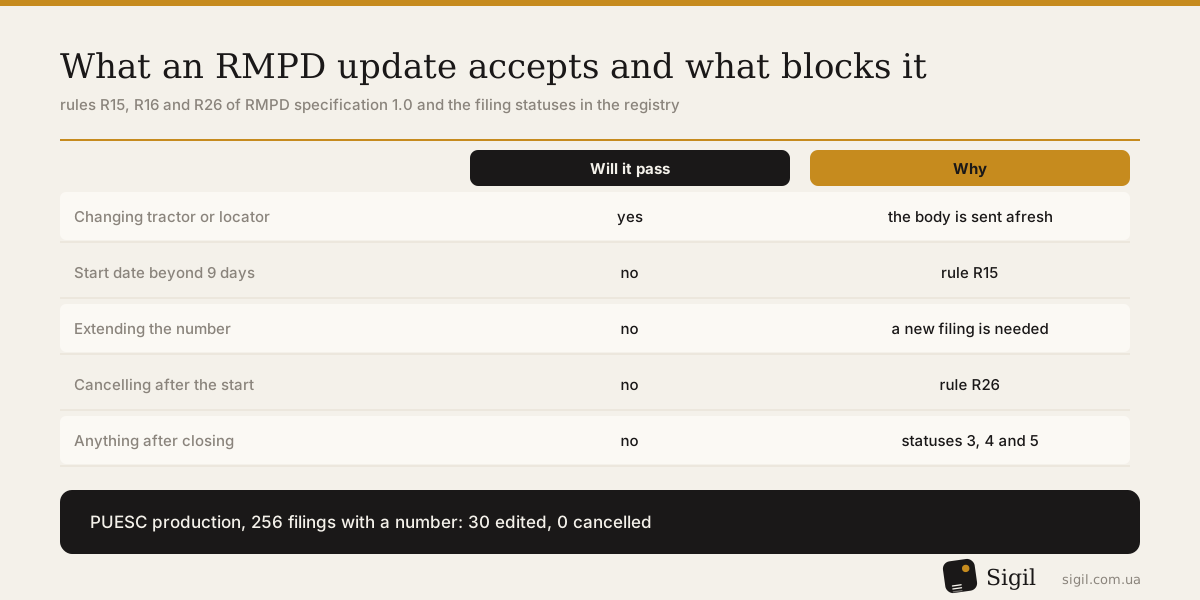
Updating an RMPD filing lets you supplement, change or cancel it, or check its status, but it does not extend the reference number. In an edit the start date may be at most 9 days later than the date the filing was registered (rule R15). Cancellation is possible only before carriage begins (R26), and a closed or cancelled filing accepts no further document.
In brief: the RMPD aktualizacja form covers four actions, supplementing, changing, cancelling and checking the status · in an edit the start date cannot be earlier than the date the filing was registered, nor more than 9 days later than it (rule R15) · an update does not extend a reference number; that takes a new filing quoting the previous one · cancellation is possible only before carriage begins (rule R26) · a filing that is closed, closed by the system or cancelled accepts no further document · of 256 filings our platform lodged in the PUESC production environment between 31.07 and 14.10.2026, 30 were edited, and the register rejected the only cancellation attempt under rule R26.
The filing went out on Monday because the client promised a load for Wednesday. The load slipped by a week, so the dispatcher opens the update form to move the date. The registry refuses with code R15, and the firm learns about the limit at the worst possible moment.
The form is called an update, and the name suggests everything can be corrected with it. The registry disagrees.
An update is not a correction to a row in a table. It is a new document that the registry accepts or rejects under its own rules. So the question of whether something can be changed always comes down to which rule the registry checks at that moment.
Four actions under one name
The PUESC service page names three forms, and the second of them, RMPD aktualizacja, covers supplementing, changing, cancelling and checking the status. In the language of messages these are separate documents: RMPD101 for an edit, RMPD104 for a cancellation, RMPD103 for closing, and RMPD406 for the status.
A line on each of them sits in the code dictionary; what matters here is something else. The word "update" on the portal covers actions that the registry governs by different rules.
What really can be changed
An edit sends the body of the filing afresh, so technically the parties, the places, the vehicle, the transport document number and the locator number can all be corrected. That is usually what happens, because a tractor unit changes hours before departure.
Does changing the tractor unit require a new filing? No. An edit is enough and the reference number stays the same.
How do you confirm the change arrived? Through the preview. An edit, a closing and a cancellation each trigger message RMPD111, the preview of the filing, and that is what shows the version the registry now holds.
What cannot be changed, and this is the heart of it
The start date carries three limits at once (rule R15 of the RMPD specification, applied to RMPD101). It cannot be earlier than the date the filing was registered. It cannot be more than nine days later than that date. And it cannot be later than the end date. Nine days look like a cushion until the truck joins the electronic queue out of Ukraine, where a wait at a large crossing reaches eight days.
From this follows something worth reading twice. A number is not extended by an update. A reference number is valid for 10 days from the day it is issued (art. 11 ust. 1 of the SENT act), and once it expires, continuing the carriage takes a new filing quoting the previous number and the place of continuation (art. 11 ust. 2 of the SENT act with art. 28b ust. 4 of the Road Transport Act).
Does an edit rescue a load that slipped by two weeks? No. That needs a new filing, while the old one is cancelled before it starts.
A run that did not fit inside ten days looks like this. The number was issued on 1 October, so it is valid until 11 October. The load is ready only on 14 October. The old filing is cancelled while it has not begun, and a new one is made quoting the previous number and the place where carriage continues.
Cancellation only before the start
A filing can be cancelled only before carriage begins, and the registry enforces this through rule R26. The portal sends it with a typo in its own name, as R26.StartTransoprtDateNotBeforeToday, and that is the spelling to search for.
What to do when the run has already started and the filing is no longer needed is explained in the article on closing and cancelling RMPD.
When a filing is already closed to changes
The registry has three states after which it accepts no document for that filing. Status (3) Zamknięty, status (4) Anulowany and status (5) Zamknięty systemowo. The system sets the last one itself, without any action by the carrier, but in our data it is rare: 3 of 7,039 finished filings in the production environment have status 5.
What remains in that state? A new filing. If the carriage continues, it is made afresh quoting the previous number, while the closed one is left as it stands.
What an R16 rejection on closing means
One case frightens people most: the rejection R16.RMPD103Rejected, saying the message sent is not currently supported. It looks like a data error or a portal fault, but it is a rule: R16 in the RMPD specification reads "Nie jest możliwe przesłanie komunikatu RMPD_103", meaning the register does not accept closures at all.
Our data bears that out. Between 2 July and 4 August 2026 our platform sent 50 closures with RMPD103, 49 to the PUESC test environment and one to production. 15 came back with an R16 rejection, none was accepted, and the rest went unanswered. Neither resending nor editing helps here: after the run the filing is simply left as it is. These are one platform's data, not the market's.
By when it has to be done
The statute sets no deadline for the update itself, and that misleads people. The limit is set by the check: an inspector compares the filed data with the actual state of affairs (art. 13 ust. 1 pkt 2 of the SENT act), and from that moment a stale field is not a detail but a discrepancy.
The price of a discrepancy is known. Incomplete data, or data at odds with the facts, is penalised like a missing filing, at 12,000 zł (annex 3 item 3.2a of the Road Transport Act).
One practical rule follows. The update happens when reality changes, not in the evening after the run, because a check fits between those two moments.
Supplementing and changing, a difference the statute makes
In the SENT system part of a filing is completed by the carrier after the consignor, and separate messages exist for it, SENT102 and SENT202. Failing that duty carries its own penalty of 10,000 zł (art. 22 ust. 2 of the SENT act).
RMPD has no such split. The filing belongs to the carrier from beginning to end, so there is no such thing as somebody else's filing that you supplement. From this follows something simple: in RMPD every change is yours and so is every mistake. How CMR data lands in the fields of a filing is shown in the field map.
How much editing actually happens
| What happened to the filing | How many | Share |
|---|---|---|
| received a reference number | 256 | the basis of the calculation |
| was edited | 30 | 12% |
| was cancelled | 0 | the register rejected the only attempt under rule R26 |
Data from the PUESC production environment: 256 filings our platform sent between 31 July and 14 October 2026 that received a number, from 9 firms. Edits and cancellations are counted as of 25 October 2026, when every one of those numbers had already expired. The PUESC test environment is left out. It is not a cross-section of the market, only of the firms that file through us.
Where our system belongs
The system keeps the history of a filing, so what changed and when is visible, not only the latest state. Before an edit it fills in the same data that already went to the registry, so the dispatcher corrects one field instead of rewriting the document. When the registry refuses, the RMPD500 answer with its rule code lands in the declaration's history, and the penalty itself can be worked out in the SENT and RMPD penalty calculator if it comes to a check.
Why filing anew is sometimes simpler
An update does not extend the life of the number. The reference number runs for ten days from the day it was assigned rather than from the declared start of carriage (art. 11 ust. 1 of the SENT Act), so a filing made a week ahead leaves three days for the trip itself. Where that is not enough, a new filing referring to the previous one is needed, not an edit of the date.
What to do
- Check the date the filing was registered, because the nine days run from it rather than from the planned departure.
- File anew, quoting the previous number, when a run does not fit inside ten days.
- Cancel a filing while the carriage has not begun.
- After an R16 rejection, do not resend the closure and do not hunt for a mistake in the data.
- Edit the tractor, the trailer and the locator freely, since those fields do change.
What not to do
- Moving the start date further than nine days from registration. Rule R15 refuses it.
- Leaving a cancellation until the day of departure. Once carriage starts it will not be accepted.
- Keeping the registry's answer to every attempt, since the reason is visible in it.
- Trying to edit a filing that is closed or cancelled. The document will not be processed.
Sigil handles the RMPD family of documents, editing, closing and cancelling among them. A SENT filing is made by the consignor or the consignee.
A demo or training for your team
30 minutes online. We show how Sigil™ files an RMPD from a CMR and answer questions about your runs.
Frequently asked questions
- Can an update extend the validity of a reference number?
- No. The number is valid for 10 days from the day it is issued (art. 11 ust. 1 of the SENT act), and rule R15 will not let the start date move further than nine days from registration. Continuation takes a new filing quoting the previous number (art. 11 ust. 2; art. 28b ust. 4 of the Road Transport Act).
- Does changing the tractor unit require a new filing?
- No, an edit is enough. Message RMPD101 sends the body of the filing afresh, so vehicle, trailer and locator data change without a new number.
- Until when can a filing be cancelled?
- Before carriage begins. The registry enforces this through rule R26, which the portal sends with a typo in its own name. Once the run has started only editing remains, and the register does not accept closures at present.
- What should I do when closing is rejected with code R16?
- Do not fix anything and do not resend. R16 is a rule of the specification that forbids RMPD103, not an error in the data. In our records the register accepted none of 50 closures sent between 2.07 and 4.08.2026, and 15 came back with R16.
- Can a closed filing be edited?
- No. The document will not be processed where the filing is closed, closed by the system or cancelled. What remains is a new filing, if the carriage continues.
Sources
Legislation:
- Act of 9 March 2017 on the road and rail carriage monitoring system, ISAP, consolidated text Dz.U. 2024 poz. 1218: art. 11 ust. 1 and 2.
- Act of 6 September 2001 on road transport, ISAP, consolidated text Dz.U. 2025 poz. 1490: art. 28b ust. 4.
Specification and service page:
- Technical specification of RMPD system messages, version 1.0 of 20 November 2024, Fiscal Administration Chamber in Zielona Góra: rules R15, R16 and R26 and the system rules on statuses 3, 4 and 5. From the PUESC specifications page.
- File a carriage notification in the RMPD register, puesc.gov.pl, the three RMPD forms and the scope of the update form.
Platform data: 256 filings with a reference number sent to the PUESC production environment between 31.07 and 14.10.2026, of which 30 were edited and one cancellation was rejected under rule R26, as of 25.10.2026; 50 RMPD_103 closures between 2.07 and 4.08.2026, 49 in the PUESC test environment and one in production, none accepted, 15 rejected under R16; statuses of 7,039 finished filings in the production environment as of 25.10.2026. The Rmpd and PuescAudit tables.
Read next
- Closing and cancelling an RMPD, deadlines and consequencesAn RMPD can be cancelled only before the carriage starts. Closing is not serviced and the register seldom closes filings. What to do with an expired number.
- RMPD100, 101, 103, 104, 406 and which document to file whenRMPD100 is the registration, 101 an amendment, 103 closing, 104 cancellation, 406 a GPS check. When to file each, the 9-day rule and what open filings do.
- RMPD questions, answers and PUESC rejection codesRMPD questions answered: the legal basis, the deadlines and the real PUESC rejection codes, ranked by frequency from our own data.
- SENT and RMPD message codes and what each one meansSENT and RMPD message codes from the official PUESC specification: SENT100, SENT300, RMPD100, RMPD406 and the rest, who files each and what to do with it.
- An RMPD roadside check and what the inspector doesAn RMPD roadside check: what the inspector looks at in the filing, why last trip's number does not help, when the truck is impounded and the driver's rights.
- Authorising someone on PUESC to act for your companyAuthorising someone on PUESC: when it is not needed, what the text must say, what the stamp duty costs and why you need not post paper for every employee.
Sigil™ turns a CMR into an RMPD declaration and files it with PUESC, with every field checked against the original.
More about RMPD