PUESC
Authorising someone on PUESC to act for your company
Authorising someone on PUESC: when it is not needed, what the text must say, what the stamp duty costs and why you need not post paper for every employee.
Published · Author: Makaiev Kostiantyn Oleksandrovych, founder of Sigil RMPD

Authorising someone on PUESC is needed for every employee who acts for the company, except a sole proprietor, a sole commercial proxy and a board member who represents the company alone. Form WPE0001 in the SZPROT subsystem makes the link. Each relationship of authority costs 17 zł in stamp duty, and the original goes to Poznań.
In brief: the owner of a sole proprietorship, a sole commercial proxy and a board member entitled to represent the company alone need no authorisation at all · the link is made by form WPE0001 in the SZPROT subsystem · filing RMPD itself needs only the basic scope of permissions, while the representation application needs the extended one · every relationship of authority costs 17 zł in stamp duty · the original authorisation with proof of payment goes to the Central Registration Division of the Fiscal Administration Chamber in Poznań · there is a way to avoid posting paper for every employee, and it is called substitution · handing over the filling in does not hand over the liability.
An owner registers on PUESC alone and files without trouble. A month later the work grows and a dispatcher takes it over. The dispatcher creates an account, signs in, and sees neither the company nor the forms. Nothing is broken: the portal simply does not know this person may act for the company.
Linking a person to a company is a separate procedure with its own form, its own price and a piece of paper that has to go by post.
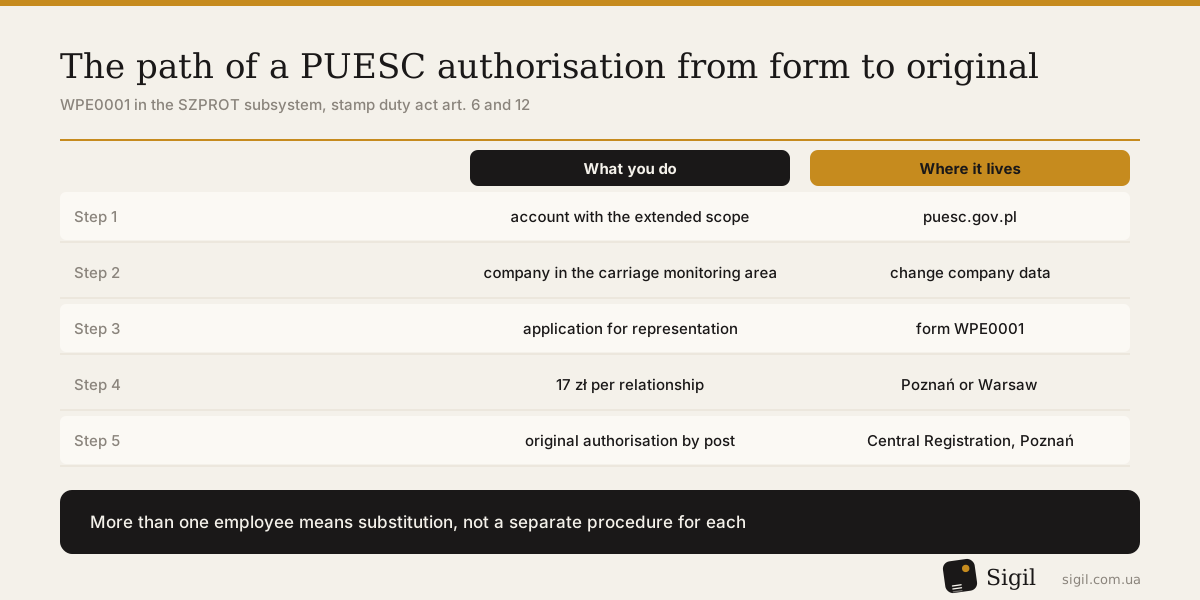
The portal reads permissions from the application itself, and the authority compares its content with the text of the authorisation. An authorisation written in general terms will therefore not grant the rights ticked in the form.
When no authorisation is needed
None is needed where you represent the company by operation of law. That covers the owner of a sole proprietorship, a sole commercial proxy and a board member with the right of sole representation entered in the court register. In that case no register extract has to be attached either.
Does that mean a small firm never needs one? No. It needs one the moment somebody outside the register starts acting for the company.
What form WPE0001 does
The form is called "Rejestracja aktualizacja reprezentacji firmy" and sits in the SZPROT subsystem. It adds a new representative, changes the scope of an existing link or removes one, and a removal states the date on which the representation ends.
SZPROT is the part of PUESC that keeps the registration of entities, representations and permits. The name is worth knowing because it appears in form captions while appearing in no statute.
Which account is required
Here sits the most common misunderstanding. Filing an RMPD notification needs only the basic scope of permissions, as the service page says. The application to link a representative needs the extended scope, and the registration application has to be signed, since an unsigned one means confirming identity in person.
The difference is logical. The basic scope lets you act in your own name; the extended one opens the company's data and therefore requires the authority to verify a power of attorney. What each one gives is set out in the article on PUESC account types.
Why the permission you need is missing from the form
Availability depends on two things. The first is the area of activity the company is registered for, such as Monitorowanie przewozu, customs EORI or excise. The second is whether the representative is a natural person or a company, because some permissions appear only for a person.
When a permission is simply absent from the list, the first reason is almost always the cause. The company has to be registered for the right area of activity first, and only then does the permission appear in WPE0001.
What the text of the authorisation must contain
Every extended and system permission ticked in the application must follow from the authorisation granted. The authority compares the two, so a general "to represent in customs matters" will not carry an application that ticks "Aktualizacja danych podmiotu".
Does UPL-1 work here? No. That form is a power of attorney for signing tax returns by electronic means, and it reaches neither SENT nor RMPD filings. Representation on PUESC is created by form WPE0001 alone.
The practical conclusion is simple. List in the authorisation the same items you will tick in the form, under the names the portal uses.
Substitution, or how to avoid paper for every employee
Among the permissions in WPE0001 stands Udzielanie substytucji w ramach pełnomocnictwa, the granting of substitution within a power of attorney. It lets you pass your own permissions to an employee, and then the original of that employee's authorisation need not be delivered at all.
For a firm with several dispatchers this is the only route without separate paper and separate stamp duty for each. One representative holding the right of substitution sets up the rest inside the portal.
What to do when a representative leaves
A link does not disappear by itself when somebody leaves the company. It is removed through the same form WPE0001, with the application stating the date on which the representation ends, and the portal has a separate service for it called Zmień lub usuń powiązania.
It is worth doing on the same day as the final settlement with the employee. While the link lives, that person still sees the company's data and can file in its name, and liability for such a filing stays with the carrier.
What it costs and where to pay
Stamp duty is 17 zł for every relationship of authority or commercial proxy, including a copy or extract of the document (Stamp Duty Act, annex, part IV). The duty arises when the document is filed with the authority, and that is when it is paid (art. 6 ust. 1 pkt 4 and ust. 2).
Where exactly depends on the form of filing, and the statute separates the cases clearly.
| How the authorisation is filed | Which authority collects | Provision |
|---|---|---|
| paper original by post to Poznań | the authority for the place of filing, so Poznań | art. 12 ust. 2 pkt 2 |
| electronically, principal established in Poland | the authority for the principal's seat | art. 12 ust. 2 pkt 3 lit. a |
| electronically, principal not established in Poland | the Mayor of the Capital City of Warsaw | art. 12 ust. 2 pkt 3 lit. b |
The third row is the case of every non-Polish firm filing electronically. Exemptions exist too, and one of them is practical here: an authorisation granted to a spouse, a parent, a child or a sibling is free of the duty.
Where the original goes
The original authorisation together with proof of payment goes to the Central Registration Division of the Fiscal Administration Chamber in Poznań. The same division keeps the central registration of entities and compares the application with the text of the authorisation.
Until the original arrives, the link waits. If work is stalled and a deadline presses, the three ways to file RMPD show which of them need no new representative.
Who is liable when a representative files
Sending and updating a filing through a representative or an attorney produces effects for the represented party (art. 9 ust. 3 of the SENT act). The duty stays with the carrier (art. 28b ust. 1 of the Road Transport Act), and no power of attorney moves it.
What it means for RMPD day to day
If the owner files, none of this is needed. If a dispatcher files, one WPE0001 link and 17 zł once are needed. If there are several dispatchers, substitution is needed rather than several separate procedures.
Our system works under the carrier's own credentials, so it replaces nothing in this procedure. It only removes the need to give every employee a separate way into the portal, because one PUESC account serves the whole firm, and who prepared a document is visible in the declaration's history.
What to do
- Check whether an authorisation is needed at all.
- Register the company for the Monitorowanie przewozu area before looking for permissions in the form.
- Copy the permission names into the authorisation exactly as WPE0001 states them.
- Pay 17 zł for each relationship and attach the proof to the original.
- Post the original to the Central Registration Division in Poznań.
- Give the first representative the right of substitution if more employees will follow.
What not to do
- Writing the authorisation in general terms. The authority compares it with the application item by item.
- Paying in Warsaw when the original goes by post to Poznań.
- Paying in Warsaw when the document goes electronically and the principal has no seat in Poland.
- Starting a separate procedure for every dispatcher. Substitution exists for that.
- Believing that handing over the filling in hands over the liability.
Sigil handles RMPD declarations and works under the carrier's credentials. Authorisations on PUESC are arranged by the carrier, and we are not a party to that procedure.
A demo or training for your team
30 minutes online. We show how Sigil™ files an RMPD from a CMR and answer questions about your runs.
Frequently asked questions
- Does the owner of the company need an authorisation?
- No. Where you represent the company by operation of law, as the owner of a sole proprietorship, a sole commercial proxy or a board member with the right of sole representation, no authorisation is needed, and no register extract has to be attached either.
- How much is the stamp duty and what exactly is it charged on?
- 17 zł for every relationship of authority or commercial proxy. That is set by part IV of the annex to the Stamp Duty Act, and the same rate covers a copy or extract of the document. The duty arises when the document is filed with the authority (art. 6 ust. 1 pkt 4).
- Where does a non-Polish firm pay it?
- It depends on how the document is filed. A paper original posted to Poznań means the authority for the place of filing, so Poznań (art. 12 ust. 2 pkt 2). A document filed electronically by a principal with no seat in Poland is paid to the Mayor of the Capital City of Warsaw (art. 12 ust. 2 pkt 3 lit. b).
- Must the original authorisation be posted for every employee?
- No, if you use substitution. The permission called Udzielanie substytucji w ramach pełnomocnictwa in form WPE0001 lets you pass your own permissions to an employee, and then the original of that employee's authorisation need not be delivered.
- Does a power of attorney remove liability for the filing?
- No. Sending and updating a filing through a representative produces effects for the represented party (art. 9 ust. 3 of the SENT act), while the duty to file stays with the carrier (art. 28b ust. 1 of the Road Transport Act).
Sources
Legislation:
- Act of 16 November 2006 on stamp duty, ISAP, consolidated text Dz.U. 2025 poz. 1154: art. 6 ust. 1 pkt 4 and ust. 2, art. 12 ust. 1 and ust. 2 pkt 2 and pkt 3 lit. a and b, annex part IV with its exemptions.
- Act of 9 March 2017 on the road and rail carriage monitoring system, ISAP, consolidated text Dz.U. 2024 poz. 1218: art. 9 ust. 3.
- Act of 6 September 2001 on road transport, ISAP, consolidated text Dz.U. 2025 poz. 1490: art. 28b ust. 1.
PUESC service pages:
- Link a representative to a company, form WPE0001 in SZPROT, the preliminary steps, the list of permissions, substitution and the address for the original.
- Permissions on PUESC, the basic and extended scopes.
- Change company data on PUESC, registering an additional area of activity.
Read next
- Which PUESC account a carrier needsBasic or extended PUESC account: what each allows, what it takes, how long. A carrier needs only basic for RMPD; company registration is for consignors only.
- PUESC errors at login, signing and permissionsPUESC errors at login and signing: three wrong passwords lock you out for 30 minutes, a new browser fixes signing, and resending never fixes a permission error.
- SENT and RMPD message codes and what each one meansSENT and RMPD message codes from the official PUESC specification: SENT100, SENT300, RMPD100, RMPD406 and the rest, who files each and what to do with it.
- An RMPD roadside check and what the inspector doesAn RMPD roadside check: what the inspector looks at in the filing, why last trip's number does not help, when the truck is impounded and the driver's rights.
Sigil™ turns a CMR into an RMPD declaration and files it with PUESC, with every field checked against the original.
More about PUESC