RMPD
The authorised economic operator status
The authorised economic operator status has given priority in the Ukrainian border queue since 17 July 2026. Two types, five criteria and the limits.
Published · Author: Makaiev Kostiantyn Oleksandrovych, founder of Sigil RMPD
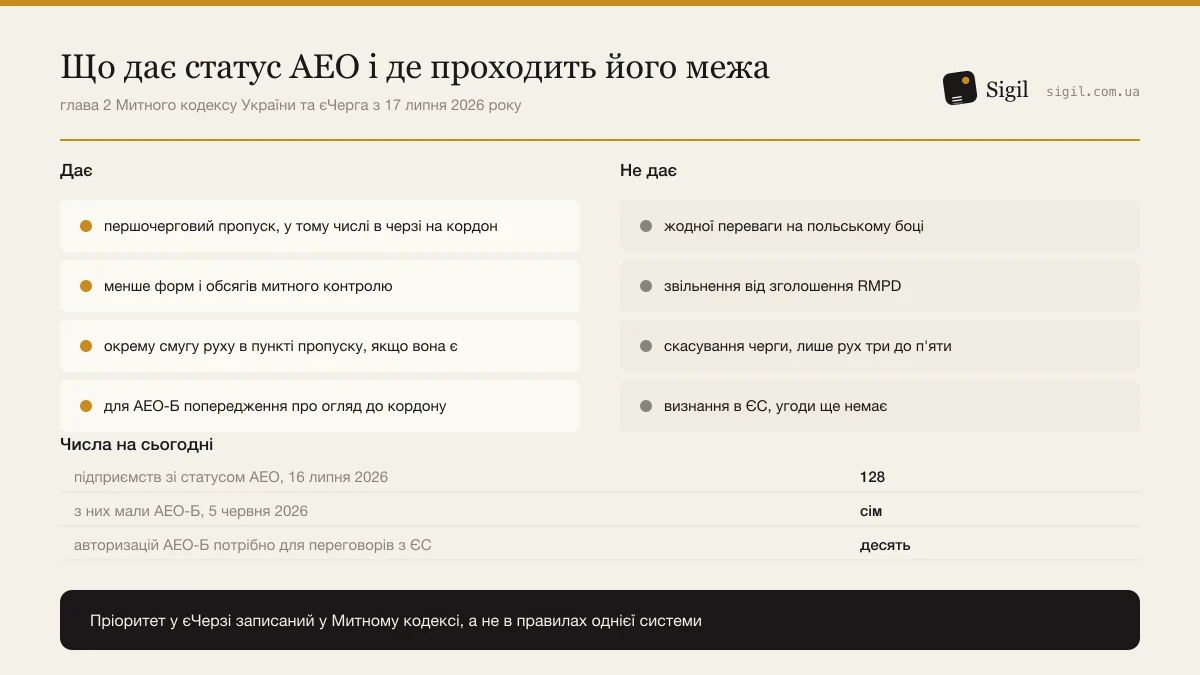
Two tractor units joined the queue at Yahodyn on the same evening. One reached the crossing the next day, the other waited four more. The difference was neither luck nor connections. The first carried goods of a company holding AEO status, and the system let it through under its priority algorithm.
This article explains what the authorised economic operator status is, what it gives a carrier at the border since 17 July 2026, and what it does not give on the Polish side of the barrier.
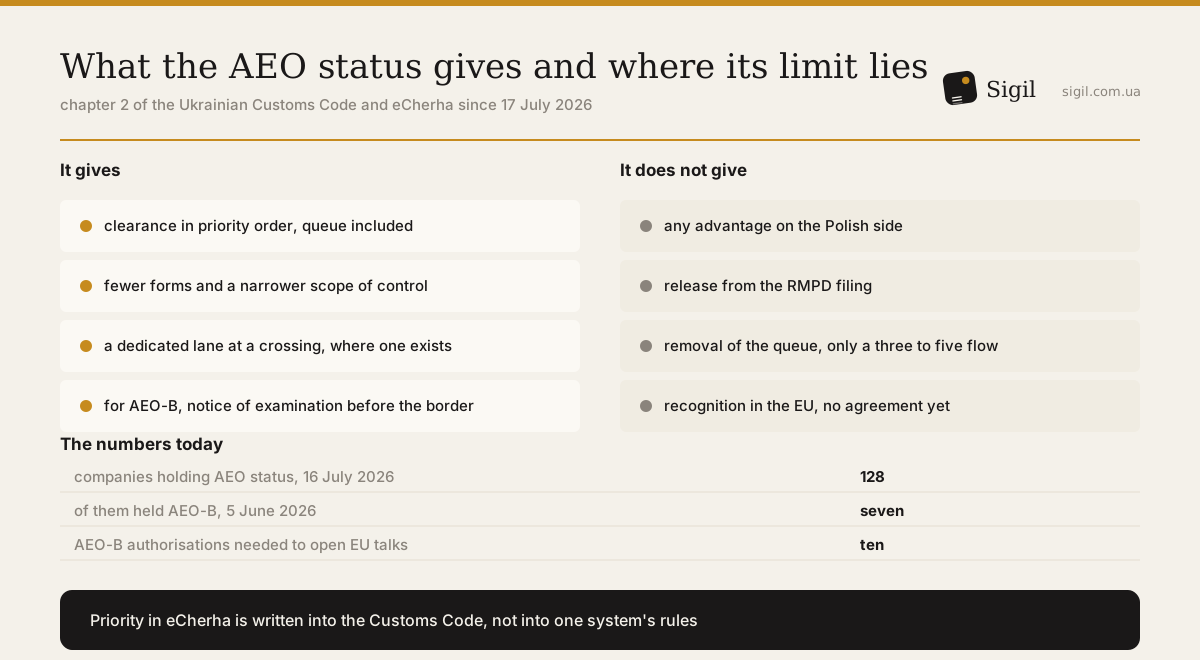
In brief: AEO is an authorisation granted by Ukrainian customs to a company in the international supply chain, and the carrier is named outright among the roles (art. 12(1) of the Ukrainian Customs Code) · there are two types, AEO-C for simplifications and AEO-B for safety and reliability, and one company may hold both · the advantages include clearance in priority order, including in the systems that govern the order of arrival at the border (art. 13(3)), which means the eCherha queue · since 17 July 2026 eCherha has been testing priority in a ratio of three priority vehicles to five ordinary ones, and under the text of the Rules AEO alone earns one of the three slots while a T1 declaration or a TIR carnet counts only together with goods subject to first-priority control · on 16 July 2026 the status was held by 128 companies, and AEO-B by only seven as of 5 June · recognition abroad requires an international agreement, and none exists with the EU yet · the status neither removes nor simplifies the RMPD filing.
Who can be an authorised economic operator
A resident company performing any role in the international supply chain that has obtained an authorisation from customs (art. 12(1) of the Code). The Code lists the roles itself: manufacturer, exporter, importer, customs representative, carrier, freight forwarder, warehouse keeper.
The carrier stands in that list outright, and it is worth saying, because most writing about AEO is addressed to importers and customs agents, which leaves the impression that the status has nothing to do with a haulier.
The authorisation applies across Ukraine. Abroad it is recognised only where an international agreement provides for it, and that is where the main limit of this status runs.
Two types of authorisation
There are two types (art. 12(2)). AEO-C grants the right to simplifications; AEO-B confirms safety and reliability. A company picks the type itself and may hold both at once.
There are five criteria, and which apply depends on the type (art. 12(3)).
| Criterion | AEO-C | AEO-B |
|---|---|---|
| compliance with customs and tax law, no criminal liability | yes | yes |
| a high level of control over operations and goods flows based on records | yes | yes |
| sound financial standing | yes | yes |
| practical standards of competence of the responsible officer | yes | no |
| compliance with safety and reliability standards | no | yes |
The company files an application and a self-assessment questionnaire (art. 12(4)), and the grant, withdrawal or annulment of an authorisation goes into the public register kept by Ukrainian customs (art. 12(5) and (6)).
What the status gives at the border
The advantages of AEO-C are listed in art. 13(3), and the first point matters most to carriage. It is passage across the customs border, customs control and formalities in priority order, including through the information systems that govern the order of arrival at the state border.
In plain words: priority in the electronic queue is written into the Customs Code, not into the rules of one particular system. Beyond that, the status reduces the forms and extent of control set by the risk management system, grants the use of a dedicated lane at a crossing where one exists, and the right to the national AEO logo.
AEO-B carries one further advantage that AEO-C lacks (art. 13(4)). Customs notify the company that its goods or vehicle have been selected for examination before the border is crossed, so the driver learns about the inspection away from the barrier.
Separate from the advantages stand the seven simplifications of art. 13(1): a comprehensive guarantee, its reduction to 50 and to 30 percent, a guarantee waiver, special type seals, simplified declaration and release at the premises. They work inside customs procedures rather than on the road.
How it works in eCherha since 17 July 2026
At 09:00 on 17 July 2026 Ukrainian customs started testing a new priority mechanism in the electronic queue for leaving the country. Priority goes to companies with AEO status and to carriage under a T1 transit declaration or a TIR carnet.
The mechanism runs on a three to five ratio: after five vehicles without priority, three priority vehicles pass. The existence and validity of the simplification is checked automatically through integration with the customs information systems, so nothing has to be proved by hand.
Those three slots are not equivalent, and the Rules describe them more precisely than the customs announcement does (p. 15 of the Rules).
- The first slot: a vehicle carrying goods subject to first-priority control, moved by an AEO or travelling under a TIR carnet or the common transit procedure.
- The second slot: a vehicle carrying goods subject to first-priority control.
- The third slot: goods moved by an AEO, an AEO's commercial vehicle, and goods under articles 250 and 360 of the Customs Code.
Two conclusions follow that the announcement leaves out. A TIR carnet or a T1 declaration on its own, without goods subject to first-priority control, earns none of the three slots under the text of the Rules. And the tractor unit of a carrier holding AEO takes the third slot by itself, whoever owns the goods.
The functionality is being tested at every crossing that handles vehicles above 3.5 tonnes. How much it saves in days depends on the particular queue, and how the border queues are built is set out separately.
Does a Ukrainian AEO work in Poland
No. Recognition of the authorisation by the customs administrations of other states follows Ukraine's international agreements (art. 12(2)), and no mutual recognition agreement with the European Union exists yet.
The condition for opening talks is known. Mutual recognition agreements rest on the AEO-B type, and Ukrainian customs stated on 5 June 2026 that negotiations with the EU become possible once ten companies hold it. At that point there were seven.
So today the status works on the way out of Ukraine, in the queue and inside Ukrainian customs procedures. On the Polish side it gives neither priority nor lighter control.
How many holders there really are
On 16 July 2026 the authorised economic operator status was held by 128 companies. On 5 June 2026, 126 companies held AEO-C, seven of which also held AEO-B.
For comparison, licensed carriers in Ukraine number in the thousands. AEO priority therefore touches a small share of the flow, which is why a three to five ratio does not wreck the queue for everyone else.
A counterparty can be checked in the public register kept and published by Ukrainian customs (art. 12(5)). That matters to a dispatcher, because priority can come either from the status of the goods owner or from the status of the carrier, whose tractor unit takes the third slot of the algorithm.
Does AEO remove the RMPD filing
No. The filing covers carriage across Polish territory and rests on a Polish provision rather than a Ukrainian authorisation. The status does not lift the duty, does not extend the life of the reference number and does not change a single field in the form.
This is where an expensive mistake is easy. A company with AEO status that decides it is "authorised anyway" pays the same 12 000 zł deposit at the roadside, and the penalty calculator will work out your own figure.
What to do
- Check whether your role in the supply chain falls under art. 12 of the Code, because the carrier is named there outright.
- Choose the type deliberately: AEO-C for simplifications, AEO-B in addition for safety and reliability.
- Count how many trips a year run through the large crossings, because that is where priority shows up in days.
- Check a counterparty's status in the register when you are counting on priority for its goods.
- File the RMPD regardless of status, in exactly the same way as without it.
- Do not expect the status to work in Poland until a mutual recognition agreement exists.
What not to do
- Treating AEO as a certificate to be bought. It is an authorisation granted against five criteria, with a self-assessment questionnaire and verification.
- Assuming a counterparty's status will pull your vehicle along. Priority follows the goods or the vehicle of a company holding the status, and the system checks that against customs data.
- Promising a client a faster crossing because of the status. A three to five ratio speeds the queue up; it does not remove it.
- Carrying the Ukrainian status over to the Polish side. There is no mutual recognition agreement with the EU yet.
- Skipping the RMPD filing because the firm holds an authorisation. These are different systems and different duties.
Sigil handles RMPD filings. The AEO authorisation is granted by the State Customs Service of Ukraine, and Sigil takes no part in that procedure.
A demo or training for your team
30 minutes online. We show how Sigil™ files an RMPD from a CMR and answer questions about your runs.
Frequently asked questions
- Can a haulier hold AEO status?
- Yes. The carrier is named outright among the roles, alongside the manufacturer, exporter, importer, customs representative, freight forwarder and warehouse keeper (art. 12(1) of the Ukrainian Customs Code). The conditions are residence and meeting the criteria for the chosen type.
- How much time does queue priority save?
- That depends on the queue rather than on the status. The system lets three priority vehicles through after five without it. At a crossing with a seven-day wait this is felt; at a small crossing with a few hours it is barely visible.
- Does a Ukrainian AEO work on the Polish side?
- No. An authorisation is recognised abroad only under an international agreement (art. 12(2)), and none exists with the EU yet. Talks become possible once ten companies hold AEO-B, and on 5 June 2026 there were seven.
- Does the status have to be proved at the border?
- No. eCherha checks the existence and validity of the simplification automatically, through integration with the customs information systems. No certificate has to travel in the cab.
Sources
Normative acts, in force on the day of publication:
- The Customs Code of Ukraine, zakon.rada.gov.ua, in the redaction of 17.09.2026, chapter 2: art. 12 (the status, the types of authorisation, the criteria, the register, recognition abroad), art. 13 (simplifications and advantages, including priority in the systems governing the order of arrival at the border).
- Ustawa z dnia 6 września 2001 r. o transporcie drogowym, ISAP, consolidated text: art. 28b ust. 1 (the RMPD filing duty), załącznik nr 3 lp. 3.2a (12 000 zł).
Authorities:
- Companies with AEO status will receive priority in the eCherha system, State Customs Service of Ukraine, 16 July 2026: the three to five mechanism, T1 and TIR, automatic verification, 128 companies holding the status.
- A seventh company has received AEO-B status, State Customs Service of Ukraine, 5 June 2026: 126 AEO-C holders, seven of them AEO-B, the threshold of ten authorisations for opening talks with the EU.
Exchange rate: National Bank of Ukraine, 11.5582 hryvnia to the zloty on 20 October 2026.
Read next
- Truck border queues into PolandTruck border queues into Poland run separately by mass, for empty vehicles and for goods of groups 1-24. Eight crossings, fifteen queues, how to read them.
- Transit or third-country carriage, how to tellLoading in Poland and unloading in Germany is third-country carriage for a Ukrainian operator, and the EU Ukraine agreement does not cover it.
- The difference between SENT and RMPD nobody explainsSENT follows the goods, RMPD follows a non-EU carrier. Who files which, when both meet on one run, and what a missing one costs: 12,000 and 20,000 zł.
Sigil™ turns a CMR into an RMPD declaration and files it with PUESC, with every field checked against the original.
More about RMPD