Tachograph
Tachograph rules for a Ukrainian carrier
The tachograph at a Ukrainian carrier: when it is compulsory, which generation suffices and why it replaces neither RMPD nor the SENT locator.
Published · Updated · Author: Makaiev Kostiantyn Oleksandrovych, founder of Sigil RMPD
A Ukrainian haulier bought a 2019 tractor unit in August 2026, registered it in Ukraine and put it on runs to Poland. The truck had a tachograph, digital and in working order. A month later, at a roadside check near Lublin, the inspector asked for the driver card and the printouts for the preceding days. The printouts for the whole period were missing, because the driver had spent the previous month in a different truck. And nobody in the office knew that for a tractor first registered in Ukraine after 30 June 2026, Ukrainian law now calls for a smart tachograph of version G2V2.
This page covers the tachograph in full: what the device is, when it is compulsory for a Ukrainian carrier, which generation is enough, what the driver produces at a check, and where the tachograph borders on RMPD and on SENT geolocation.
In brief: a tachograph is required for carriage of goods above 3.5 tonnes, national and international, under p. 3 of chapter I of the Ukrainian regulation issued by nakaz No 340 · a digital tachograph under the AETR is compulsory in vehicles first registered from 16 June 2010, while an older vehicle may cross borders with an analogue one · the G2V2 smart tachograph binds only where three conditions meet, namely first registration in Ukraine after 30 June 2026, international carriage of goods and carriage under the agreement with the EU · in EU law the smart tachograph is a permission for a Ukrainian carrier rather than a duty (art. 2 of Decision No 2/2025 of the Joint Committee) · the driver carries records for 56 days and the day of the check, because the EU has required that since 31 December 2024 and the Ukrainian regulation since 26 July 2026 · periodic verification of the device comes every two years, and a driver card runs for up to 5 years · a tachograph replaces neither an RMPD filing nor a SENT GEO locator, because it records position once every three hours of driving.
What a tachograph is
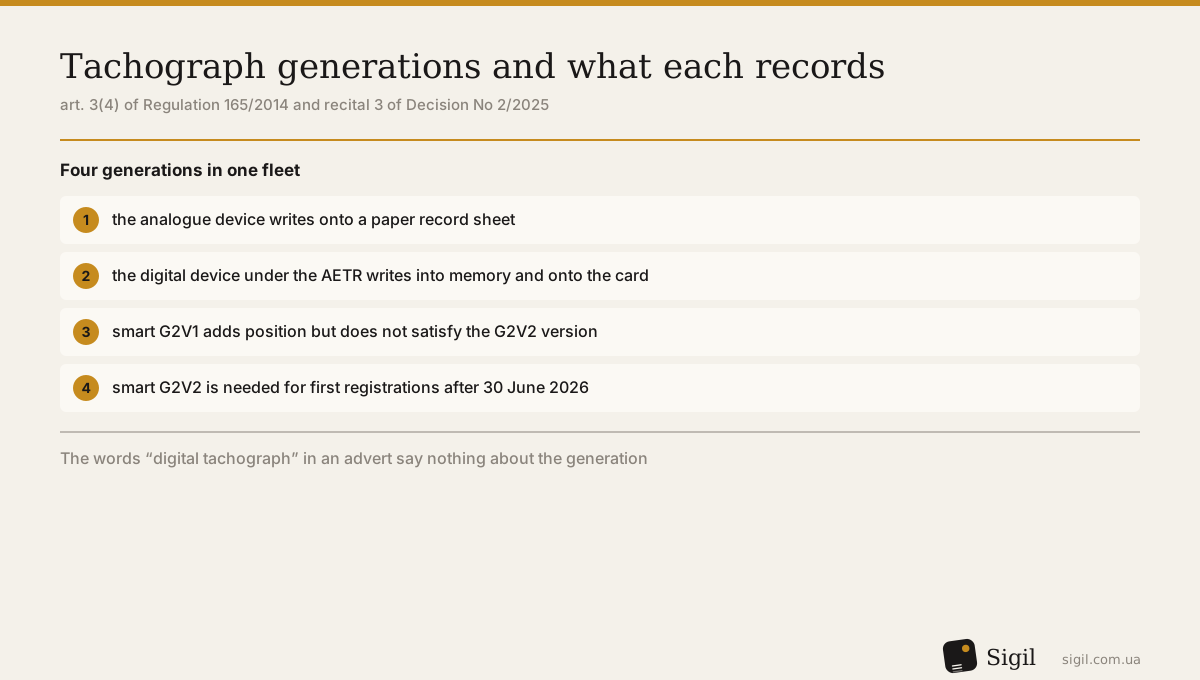
A tachograph is a device that records by itself how long the driver drove, when they rested and, in newer versions, where the vehicle was. There are several generations and they differ not in their buttons but in what they record: the analogue one writes onto a paper record sheet, the digital one into memory and onto the driver card, and the smart one adds position, remote detection of manipulation and an interface for transport systems.
The words "digital tachograph" in a vehicle advert say nothing about the generation. How the generations differ, how to identify yours and which of them the EU accepts is covered in the text on tachograph generations.
When a tachograph is compulsory for a Ukrainian carrier
The duty attaches to mass and type of carriage, not to the border. The Ukrainian regulation on drivers' working and rest time applies to national and international carriage of goods where the maximum technically permissible mass, including any trailer or semi-trailer, exceeds 3.5 tonnes (p. 3 of chapter I).
The AETR agreement sits on top of this. For a vehicle registered in Ukraine it applies along the whole route, not merely the European leg. A tachograph is therefore not a Polish requirement that begins at the barrier, and leaving Poland does not lift it.
The 3.5 tonne threshold is no coincidence, because it is the same threshold at which an RMPD filing begins. What lighter vehicles do about it is covered in the text on RMPD below 3.5 tonnes.
Which generation is enough
Three generations sit side by side in the rules, and that is what confuses people most.
| Type | Where it writes data | Who it is enough for today |
|---|---|---|
| analogue | on a paper record sheet | vehicles first registered before 16 June 2010, international trips included, if the device works and is verified |
| digital under the AETR | in memory and on the driver card | vehicles first registered from 16 June 2010 to 30 June 2026 |
| G2V2 smart tachograph | the same plus position and remote checking | vehicles first registered in Ukraine after 30 June 2026 on carriage under the EU agreement |
What makes a smart tachograph smart is defined in art. 1 of Decision No 2/2025 of the Joint Committee through arts 8, 9 and 10 of Regulation 165/2014, while the specification comes from Regulation 2016/799, where the distinguishing sign for Ukraine is "UA".
Is the smart tachograph compulsory from 1 July 2026
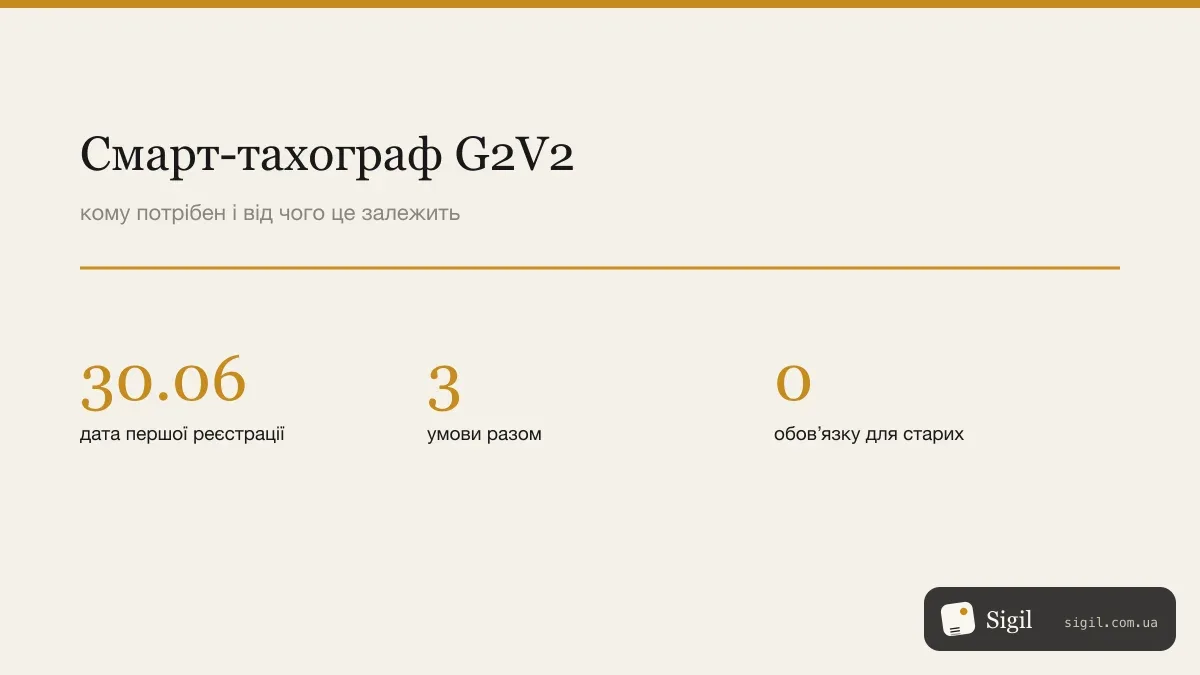
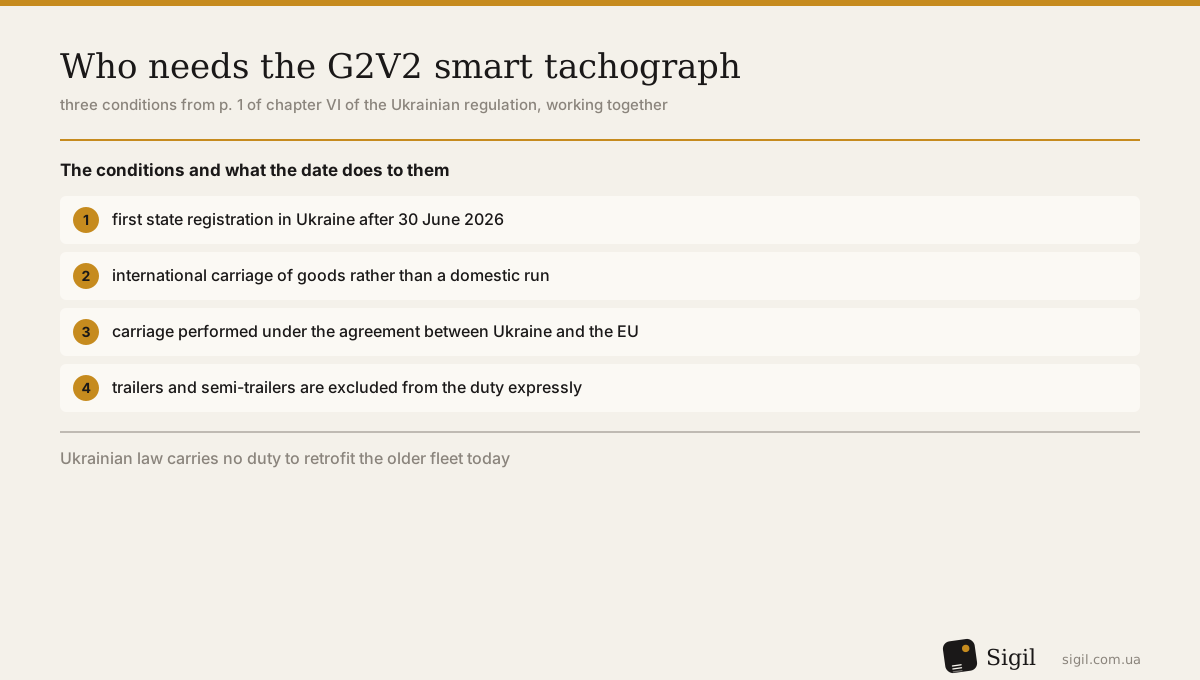
The whole fleet or only part of it? Only part. The conditions in p. 1 of chapter VI of the regulation work together: first state registration in Ukraine after 30 June 2026, international carriage of goods, and performance of that carriage under the agreement between Ukraine and the EU. Trailers and semi-trailers are excluded expressly.
If even one condition fails, G2V2 is not required and a digital tachograph under the AETR stays lawful. Ukrainian law carries no duty to retrofit the older fleet today. The full account of the three conditions, together with why this is a question of market access after 31 March 2027, sits in the text on the G2V2 smart tachograph.
What the driver produces at a check
The driver shows the driver card together with manual records and printouts for the day of the check and the previous 56 days. In the EU this period has applied since 31 December 2024, when the Mobility Package doubled the former 28 days (art. 36 of Regulation 165/2014 as amended by Regulation 2020/1054). The Ukrainian regulation has asked for the same 56 days and the day of the check since 26 July 2026. The AETR itself still speaks of 28 days, but a firm preparing 28 fails the Ukrainian duty, so the measure for a trip to Poland is 56.
The carrier additionally keeps each driver's tachograph data for 12 months from the last entry. How long the filings themselves and their documents live is gathered in the text on RMPD and SENT retention periods, and what an inspector does with this data at the roadside is described in the text on RMPD roadside inspection.
The driver card, the workshop and the deadlines
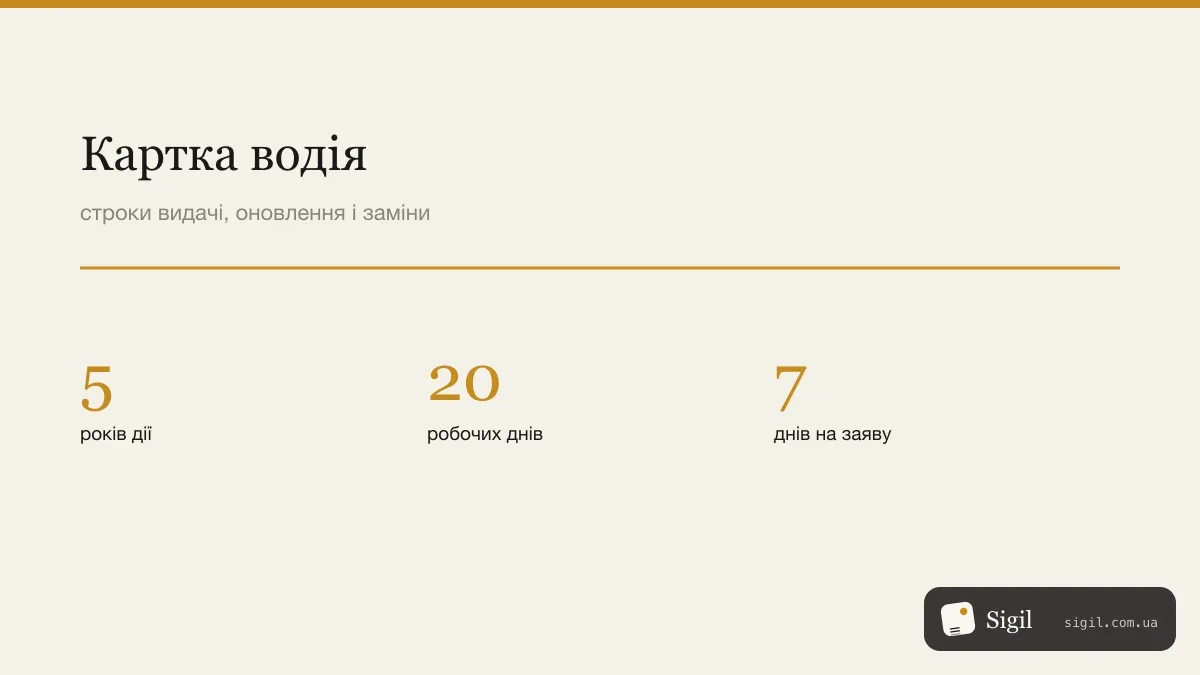
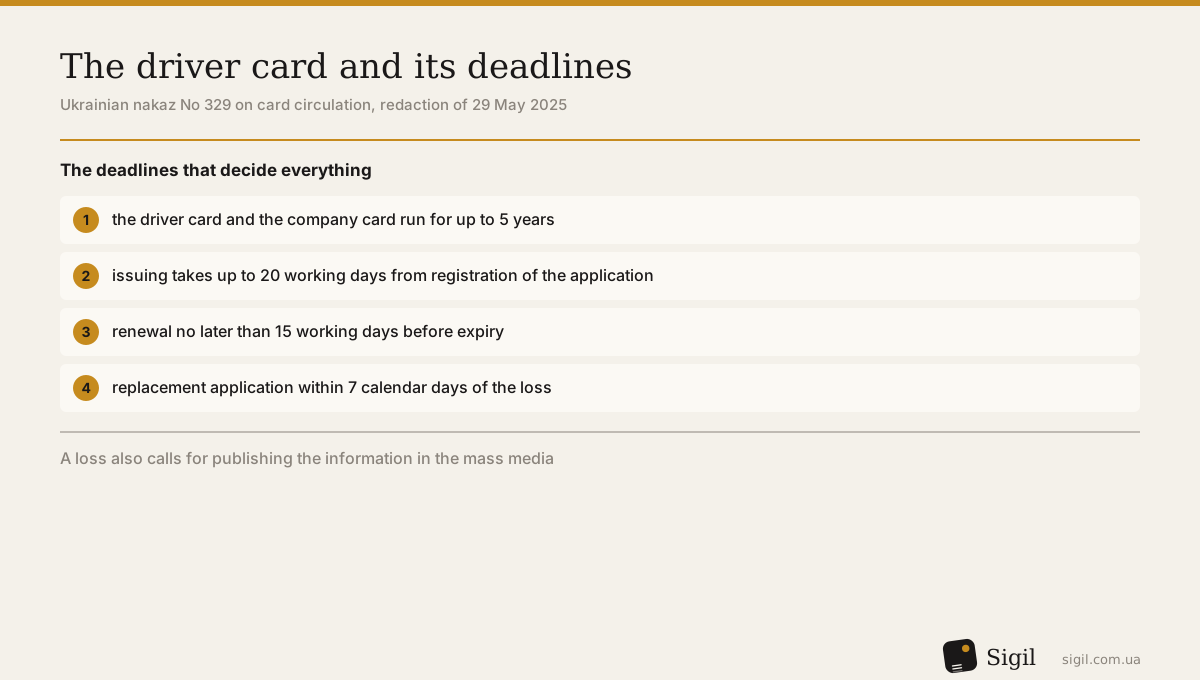
Without a driver card a digital or smart tachograph does not record who was behind the wheel. The card is issued for up to 5 years, within 20 working days of the application being registered, and on a loss the law calls not only for an application within seven days but also for publishing the information in the mass media. All the deadlines are gathered in the text on the driver card.
The device itself lives by three separate procedures that merge into one in conversation. Adaptation, which the AETR calls calibration, follows an event; periodic verification comes every two years; and metrological verification sits separately, at an authorised laboratory. Which one is needed when, and why a change of tyre type size is not a detail, is covered in the text on tachograph calibration.
How many hours the tachograph allows
Daily driving time is 9 hours, and twice a week it may be extended to 10. The weekly limit is 56 hours, and across any two consecutive weeks together no more than 90.
A break is compulsory after 4 hours 30 minutes of driving and lasts at least 45 minutes. It may be split into 15 minutes and then 30, but not the other way round.
In exceptional cases, such as a breakdown, a stop en route, weather, obstacles caused by hostilities or a lack of parking places, the driver may add an hour to reach base or home for the weekly rest. Two hours only after an uninterrupted 30 minute break. Every such hour has to be compensated by rest before the end of the third week following the one in which it was taken.
That, however, is a rule of the Ukrainian regulation and of EU Regulation 561/2006, not of the AETR. For a vehicle registered in Ukraine on an international trip the AETR applies instead of the EU regulation, for the whole journey (art. 2(3) of Regulation 561/2006), and the AETR has not taken over the Mobility Package changes. On the Polish leg, do not count on the extra hour to reach base or home: the inspector assesses excess daily driving under part 5 of the same annex 3.
One rule breaks the most plans. Daily and weekly driving time covers all driving, in Ukraine and abroad alike (p. 6 of chapter III of the Ukrainian regulation), so the hours on a run through Poland do not restart at the border.
What a tachograph breach costs in Poland
Tachograph penalties sit neither in the SENT Act nor in the RMPD part of the Road Transport Act, but in annex 3 to that act, part 6. They fall on the carrier rather than the driver, and these are the main items.
| What exactly | Penalty | Item |
|---|---|---|
| carriage in a vehicle without the required type-approved tachograph | 10,000 zł | lp. 6.1.1 |
| hiding, destroying or forging data from the tachograph or the card | 10,000 zł | lp. 6.2.2 |
| improper operation or disconnection of a working tachograph | 5,000 zł | lp. 6.2.1 |
| one person holding two valid driver cards | 3,000 zł | lp. 6.3.2 |
| a digital tachograph and a driver without their own valid card | 2,000 zł | lp. 6.3.1 |
| a tachograph not checked by an authorised workshop | 1,000 zł | lp. 6.1.5 |
| a tachograph that works incorrectly | 1,000 zł | lp. 6.1.6 |
There is something the table does not show. Most of these items carry the mark BPN or NN in the annex, that is a "very serious" or "most serious" infringement under Regulation 2016/403. Such infringements go not only on the bill but into the assessment of the carrier's good repute, and that is what decides whether the firm ever obtains a status that grants priority at the border.
What the table does not contain matters too. A digital tachograph under the AETR is not a case of "no required tachograph" under item 6.1.1, because art. 2 and recital 7 of Decision No 2/2025 expressly leave it allowed.
Why a tachograph replaces neither RMPD nor the locator
A smart tachograph records position, which creates the impression that it covers geolocation for SENT. It does not. The tachograph notes the place at the start of the daily working period, then every three hours of accumulated driving time, and at the end of the day (art. 8 of Regulation 165/2014), while the monitoring system expects positions far more often and from a separate device. Its requirements are gathered on the page about SENT GEO.
The duties also differ in nature. A tachograph is about the driver's working time, an RMPD filing is about the carriage itself, and SENT is about monitored goods. All three apply on one trip, and a penalty for each breach is counted separately. What the filing mistakes add up to is shown by the SENT and RMPD penalty calculator, but it does not count tachograph penalties, because those live in a different act.
Why a breach in Poland can come back in Ukraine
The industry rarely discusses this, and the regulation puts it plainly. The authorities hold a carrier or a driver liable also for offences committed on the territory of another state, where those were discovered in Ukraine and no penalty was imposed for them there.
The same authorities also exchange data on breaches of driving time, breaks and rest with the competent authorities of EU states and other AETR parties. The driver keeps the document confirming a penalty for two months and produces it on request. A penalty paid at the roadside does not close the matter; it becomes a record that sits somewhere.
What to do
- Check the date of first state registration in Ukraine for every vehicle running under the EU agreement. After 30 June 2026 means G2V2.
- Write the date of the last periodic verification into each vehicle's file and add two years to it.
- Check that the driver physically holds records for 56 days and the day of the check, not for 28.
- Set a reminder 15 working days before each driver card expires.
- Keep each driver's tachograph data for 12 months from the last entry.
What not to do
- Do not assume the smart tachograph is compulsory for the whole fleet. Replacing a working digital device where the three conditions do not meet is a cost without a basis.
- Do not rely on the tachograph as a source of position for SENT. A position once every three hours of driving does not meet the requirements set for a locator.
- Do not prepare records for 28 days. A Ukrainian inspector is entitled to ask for 56 days and the day of the check, and in the EU that has been the standard since 31.12.2024.
- Do not send a vehicle with a digital tachograph on a trip without a valid driver card. The regulation does not allow it.
- Do not treat a penalty paid abroad as a closed matter if nobody has seen the document confirming it.
Where technology belongs in this
Nowhere, and that is worth saying plainly. The tachograph is a device in the vehicle, the card is issued by the competent authority and the verification is done by a service point; software performs none of those acts and replaces none of them.
Sigil handles RMPD documents: registration, amendment, closing, cancellation and the RMPD406 check. The tachograph, the driver card and the workshop procedures sit outside the product, and this page exists because they stand next to the filing on one trip, not because we run them.
A demo or training for your team
30 minutes online. We show how Sigil™ files an RMPD from a CMR and answer questions about your runs.
Frequently asked questions
- Who has to have a tachograph?
- A carrier moving goods above 3.5 tonnes including the trailer. A vehicle first registered from 16 June 2010 needs a digital tachograph under the AETR on international trips, while an older one may run with an analogue device. The AETR applies along the whole route rather than only its European leg.
- How many hours may be driven under the tachograph?
- Nine hours a day, and ten twice a week. The weekly limit is 56 hours and no more than 90 across two consecutive weeks. After 4 hours 30 minutes of driving a 45 minute break is compulsory, and it may be split into 15 and then 30.
- What is the penalty for a tachograph breach?
- In Poland from 1,000 to 10,000 zł, and the carrier pays it. A digital tachograph without a valid driver card costs 2,000 zł, a device with no workshop check 1,000 zł, and a missing required tachograph or forged records 10,000 zł (annex 3 to the Road Transport Act, part 6).
- How is a tachograph used day to day?
- Insert your own driver card on the day you take the wheel and carry the records with you. That means records for 56 days and the day of the check, required by the EU since 31.12.2024 and by the Ukrainian regulation since 26.07.2026. If the device fails, the records are kept by hand on a temporary registration sheet.
- Does the G2V2 smart tachograph have to be fitted in every vehicle?
- No. Only where three conditions meet: first registration in Ukraine after 30 June 2026, international carriage of goods and operation under the agreement with the EU. Ukrainian law carries no duty to retrofit the older fleet.
Sources
Legal acts as in force on the day of publication:
- Regulation on drivers' working and rest time, Ukrainian nakaz No 340 of 07.06.2010, registered under No 811/18106, in the redaction of nakaz No 1727 of 12.12.2025 in force since 26.07.2026: p. 3 and 5 of chapter I, p. 1, 2 and 6 of chapter VI, chapter VIII p. 3 and 6.
- Instruction on the use of recording equipment, nakaz No 385 in the redaction of nakaz No 532 of 21.03.2025: periodic verification every two years, the grounds for adaptation, card types, retention periods.
- Order on the circulation of cards used in digital recording equipment, nakaz No 329 in the redaction of 29.05.2025: card validity, issuing within 20 working days, replacement and loss.
- Decision No 2/2025 of the Joint Committee, OJ L 2025/409 of 25.02.2025: recitals 3 and 7, art. 1(2), arts 2, 3 and 4.
- Regulation (EU) 165/2014, EUR-Lex, version of 20.08.2020: art. 3(4) and 3(4a), arts 8, 9, 10 and 36.
- Regulation (EU) 2020/1054, EUR-Lex: art. 2(12) (art. 36 of Regulation 165/2014, records for the day of the check and the previous 56 days) and art. 3 (applies from 31.12.2024).
- Regulation (EC) 561/2006, EUR-Lex, version of 20.08.2020: art. 2(3) (for vehicles from AETR states on an international trip the AETR applies instead of the Regulation, for the whole journey), art. 12 (extra hour to reach base or home).
- European Commission digital tachograph help desk, JRC: the digital tachograph duty covers only vehicles first registered after the set date, with no retrofitting of older ones.
- AETR and EU rules on drivers' hours, UK government, updated 04.12.2025: the exception for reaching base or home does not apply to AETR journeys.
- Decision No 3/2025 of the Joint Committee, OJ L 2025/2352 of 21.11.2025, Appendix: the version 2 smart tachograph among the conditions for a further extension of the agreement.
- Road Transport Act of 6 September 2001, ISAP, consolidated text Dz.U. 2025 poz. 1490: annex 3 (art. 92a ust. 1), part 6 on the use of tachographs, items 6.1.1, 6.1.5, 6.1.6, 6.2.1, 6.2.2, 6.3.1 and 6.3.2, together with the PN, BPN and NN marks from Regulation 2016/403.