Tachograph
The driver card for a tachograph and how to get it
A tachograph driver card runs up to 5 years and is issued in 20 working days. What about the photograph, the TachoNET check and a card lost mid-trip.
Published · Author: Makaiev Kostiantyn Oleksandrovych, founder of Sigil RMPD

The driver was refuelling near Rzeszów and lost his wallet together with his driver card. Two hundred kilometres were left to the unloading point, the truck had a digital tachograph, and the card was gone. The dispatcher called the office, the office called the workshop, and only an hour later did somebody say the thing that mattered most. A new card is issued within twenty working days, but the trip does not have to stop. On an international journey the driver may continue without the card for up to 15 calendar days, provided he can prove the card cannot be produced, carries signed tachograph printouts and has reported the loss.
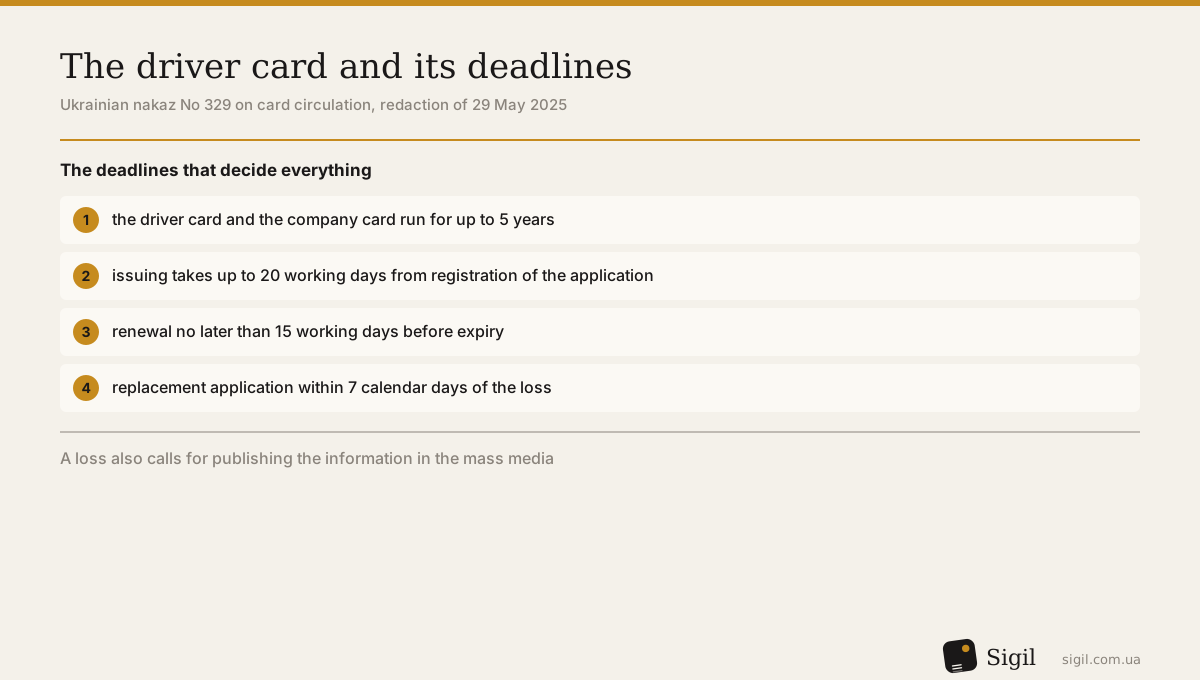
A driver card is a personal smart card without which a digital or smart tachograph does not record who was behind the wheel. In Ukraine it is issued by the card issuing centre of the competent authority for a term of up to 5 years, on application and with a photograph. A lost card is replaced on an application filed within 7 calendar days, and the new card is issued within 20 working days.
In brief: a driver card runs for up to 5 years, a company card also up to 5, a control card up to 2 and a workshop card up to 1 year · the application goes in person, by post or electronically with an electronic signature, together with a colour photograph of 3.5 × 4.5 cm on a white background · the card is issued within 20 working days of the application being registered, while checking the application itself takes up to three working days · one person may not hold two valid driver cards, which is checked in the TachoNET database of all AETR parties · a lost or stolen card calls not only for notifying the centre but also for publishing the information in the mass media · the replacement application goes in within 7 calendar days, and the old card is annulled the moment it arrives, while until the new card arrives the driver on an international trip may drive for up to 15 calendar days with signed tachograph printouts (AETR) · the validity of a replacement card is counted from the day the previous one was issued, and where less than 6 months remain, a card for a new term is issued.
Four cards and how long each one lives
The Ukrainian order on card circulation knows four types, and each has its own validity.
| Card | For whom | Validity |
|---|---|---|
| driver | the driver personally | up to 5 years |
| company | the carrier | up to 5 years |
| control | a person authorised to carry out checks | up to 2 years |
| workshop | a tachograph service point | up to 1 year |
The driver uses the personal card on every day on which they drove. They carry either the completed record sheets in the number the AETR requires, where the tachograph is analogue, or the driver card or a printout of the data, where the tachograph is digital or smart.
How to obtain a driver card
The application goes to the card issuing centre of the competent authority, and there are three ways. In person, by post, or in electronic form meeting the requirements of the law on electronic identification and trust services.
A colour photograph of 3.5 × 4.5 cm is attached to an application for the issue or renewal of a driver card. The image has to sit on a white background and to occupy between 60 and 75 percent of the photograph. The information in the application is confirmed by copies of documents, and the applicant answers for its truthfulness.
Then come the deadlines. Checking the completeness and truthfulness of the data takes up to three working days from registration of the application. The card itself is issued within 20 working days of registration, unless a refusal has been issued. Where doubts arise, the centre may call for the original documents, and an additional check of originals runs up to one month.
Renewal because the term is running out is a separate application, and it has to be filed no later than 15 working days before the expiry date. Where the data printed on the card has changed, the application goes in within 15 working days of the change. Renewal of driver and company cards takes up to 20 working days.
Why TachoNET matters more than it seems
Before issuing a card, the centre checks the single automated register of cards issued by the AETR parties, that is TachoNET, for an earlier valid card of the same type held by the applicant.
Can somebody hold a Ukrainian driver card and a Polish one at the same time? No. Where a valid card of the same type issued by another AETR party is found, the new one is issued only after the previous one is returned. A written refusal to return the old card means a decision refusing the new one.
A change of country of residence is a separate case. The card issued by another AETR party is then replaced under the procedure for issuing a new one, and the centre sends the previous card back to the authority that issued it, stating the reason.
What to do when a card is lost or stolen
The order treats this as replacement of a card whose term has not expired, and there are two grounds, namely damage or inoperability of the card, and loss or theft.
- File the replacement application within 7 calendar days of the day the ground arose. The old card is annulled the moment the application arrives.
- Return the card to the centre if you still have it. In case of loss or theft there is nothing to return, but another duty appears.
- Notify the centre and publish the information about the loss or theft in the mass media. Information on stolen and lost cards is also placed on the websites of the authority and of the centre.
- Wait up to 20 working days for the new card.
Two details that surprise firms later. The validity of a replacement card is counted from the day the previous card was issued, so replacement does not extend the life of a card. Where less than six months remain, however, the centre issues a card for a new term.
And one more, a pleasanter one. Where a card is defective or works with errors and there is no external damage, replacement is free and takes up to 20 working days. The order sets no fee for issuing a card as such, so ask the centre about the cost rather than looking for it in the act.
When a card gets annulled
The centre annuls a card during its term where control officers, in the course of state control, find forgery of the card, use of the card by a person who is not its holder, or that the card was obtained on the basis of untrue information or forged documents.
Information about the annulment goes to the competent authorities of the AETR parties and onto the websites. Annulment is therefore not a local event but a record visible in every country where the system operates.
What to do while there is no card
The driver may carry on without the card for up to 15 calendar days, and longer only where this is necessary for the vehicle to return to its base. There is one condition: he must be able to prove that the card cannot be produced or used during that period (AETR Annex, art. 13(3)). A Ukrainian truck on an international trip falls under the AETR for the whole journey, in Poland as well (art. 2(3)(a) of Regulation 561/2006). EU Regulation 165/2014 contains the same rule (art. 29(5)).
The proof has three parts. The first is the tachograph printouts: the AETR requires a printout at the end of the journey and Regulation 165/2014 one at the start as well, so print both. On each the driver writes his name and the number of his card or driving licence, adds the periods of other work, availability and rest that the device did not record, and signs (art. 35(2) of Regulation 165/2014). The second is the report of loss or theft: a theft goes to the authorities of the state where it happened, a loss to the authority that issued the card (AETR Annex, art. 13(3)). The third is the replacement application filed within 7 calendar days.
The Ukrainian regulation on working time, as a general rule, requires the proper use of the digital tachograph and the driver card (chapter VI p. 1). The AETR exception is narrower than it looks: 15 days, proof and printouts. The manual entries the instruction allows on a temporary form concern a different situation, namely a faulty tachograph. Where the tachograph is faulty, the carrier is to have it repaired at a service point before the vehicle is dispatched. Where the vehicle cannot be returned to base within a week of the breakdown, the repair is carried out on the road.
In practice this means two things. The driver travels with the printouts and a copy of the report, and the dispatcher counts the days. If on the sixteenth day there is still no new card and the vehicle is not heading back to base, it stands still or a driver with their own valid card takes it over. What an inspector looks at on the road is covered in the text on RMPD roadside inspection, and which device is needed at all in the text on tachograph rules for a Ukrainian carrier.
What a trip without a card costs
A driver card is not a formality, and in Poland it carries a price.
Carriage in a vehicle with a digital tachograph driven by somebody without their own valid card costs the carrier 2,000 zł (annex 3 to the Road Transport Act, part 6, item 6.3.1). The AETR exception protects only a driver who has the proof and the printouts; without them an inspector treats the trip as driving without a card. One person holding two valid cards costs 3,000 zł (item 6.3.2), so a spare card is not a trick but a line in the costs.
The printouts carry a price of their own, and the driver pays it. Each missing printout where the card is damaged, malfunctioning or not held costs 200 zł (annex 1, item 7.15).
The marks in annex 3, NN for item 6.3.1 and BPN for item 6.3.2, mean these breaches also enter the assessment of the firm's good repute.
What a carrier needs the company card for
The driver card belongs to the driver and the company card to the firm, and it serves to download data from the device and to close it to outsiders.
The duties around it are written out plainly. The carrier keeps each driver's tachograph data for 12 months from the last entry, and the verification and adaptation protocols and metrological certificates for a further year after they expire. What verification and adaptation actually involve is covered in the text on tachograph calibration. Beyond that, the carrier analyses the data obtained and, where breaches come to light, takes steps to stop them recurring.
There is one more duty that gets forgotten. The carrier supplies drivers setting out on a trip with the necessary number of record sheets or printer paper, matched to the type of device. How long the other trip documents live is gathered in the text on RMPD and SENT retention periods.
What to do
- Put each driver's card expiry date in their file and set a reminder 15 working days before it.
- Keep a scan of a 3.5 × 4.5 cm photograph for every driver, so that a renewal application does not wait for a photographer.
- Write an internal rule that a driver reports a lost card the same day, because the application window is only 7 calendar days.
- Obtain a company card and download the data regularly, because keeping it for 12 months is the carrier's duty, not the driver's.
- When hiring a driver holding a card issued by another AETR party, settle at once which card is being returned.
What not to do
- Do not send a vehicle with a digital tachograph on a trip without a valid driver card. The AETR exception covers only a card that is damaged, malfunctioning, lost or stolen, lasts up to 15 calendar days and requires printouts.
- Do not apply for a second driver card as a spare. TachoNET will show the valid one, and a new card follows only on return of the old.
- Do not leave the renewal application to the last day. The window is 15 working days before expiry.
- Do not assume a replacement extends the term. It runs from the day the previous card was issued.
- Do not stop at a phone call when a card is lost. The order also calls for publishing the information in the mass media.
A tachograph, an RMPD filing and SENT geolocation are three separate duties on one trip, and penalties are counted separately, as the SENT and RMPD penalty calculator shows.
What a non-EU carrier's duties consist of is gathered on the cluster pillar page.
A demo or training for your team
30 minutes online. We show how Sigil™ files an RMPD from a CMR and answer questions about your runs.
Frequently asked questions
- How long does a tachograph driver card last?
- Up to 5 years. A company card lasts as long, a control card up to 2 years and a workshop card up to 1 year. The renewal application goes in no later than 15 working days before expiry.
- How long is the wait for a driver card?
- Up to 20 working days from registration of the application. Checking the completeness and truthfulness of the data takes up to three working days, and where doubts arise the centre may check originals for up to a month.
- Can somebody hold two driver cards, a Ukrainian one and a European one?
- No. The centre checks TachoNET, and where it finds a valid card of the same type, the new one follows only on return of the previous one. A refusal to return it means a refusal to issue.
- What should be done when a driver card is lost mid-trip?
- File the replacement application within 7 calendar days and publish the information about the loss in the mass media. The old card is annulled when the application arrives and the new one takes up to 20 working days.
- May a vehicle with a digital tachograph be driven while there is no card?
- Yes, for up to 15 calendar days if the card is damaged, malfunctioning, lost or stolen. The driver must be able to prove that the card cannot be produced or used, print out the tachograph data with a signature and report the loss or theft (AETR Annex, art. 13(2) and (3); Regulation 165/2014, art. 29(5) and art. 35(2)). Longer is allowed only to bring the vehicle back to its base. In Poland each missing printout costs the driver 200 zł (annex 1, item 7.15).
Sources
Legal acts as in force on the day of publication:
- Order on the circulation of cards used in digital recording equipment, Ukrainian nakaz No 329 of 30.05.2013, registered under No 964/23496, in the redaction of 29.05.2025: chapter I (validity of the four cards), p. 3.1 (ways of filing the application), p. 3.6 (a 3.5 × 4.5 cm photograph on a white background, 60-75 percent of the area), p. 3.11-3.15 (20 working days, a check of up to three days, originals, refusal, TachoNET), p. 3.24 and 3.26 (renewal), chapter IV (replacement, 7 calendar days, publication in the media, validity counted from the day the previous card was issued, free replacement of a defective card), chapter V (annulment).
- Instruction on the use of recording equipment, nakaz No 385 in the redaction of nakaz No 532 of 21.03.2025: chapter III p. 2 (the four card types), p. 3 (daily use of the card and what the driver carries), p. 4 and 5 (a faulty device, repair before dispatch, manual entries), p. 7 (12 months of retention, record sheets and paper, analysis of the data).
- Regulation on drivers' working and rest time, nakaz No 340 in the redaction of nakaz No 1727 of 12.12.2025: p. 1 of chapter VI, which does not allow driving without the correct use of the digital tachograph and the driver card.
- Samples of cards used in digital recording equipment, nakaz No 600 of 17.08.2010 in the redaction of 29.05.2025.
- Road Transport Act of 6 September 2001, ISAP, consolidated text Dz.U. 2025 poz. 1490: annex 1 (art. 92 ust. 1), item 7.15; annex 3 (art. 92a ust. 1), part 6, items 6.1.5, 6.1.6, 6.2.2, 6.3.1 and 6.3.2.
- European Agreement concerning the Work of Crews of Vehicles engaged in International Road Transport (AETR), consolidated text ECE/TRANS/SC.1/2006/2, UNECE: Annex, art. 12(1) (replacement application within 7 calendar days), art. 13(2) and (3) (printout, report of loss or theft, 15 calendar days).
- Regulation (EU) No 165/2014 on tachographs, EUR-Lex: art. 29(4) and (5), art. 35(2).
- Regulation (EC) No 561/2006, EUR-Lex: art. 2(3)(a) (AETR for the whole journey for vehicles registered in AETR parties).
Read next
- The G2V2 smart tachograph and who needs itThe G2V2 smart tachograph binds only vehicles first registered in Ukraine after 30 June 2026. Why the older fleet needs no retrofit and when that will change.
- An RMPD roadside check and what the inspector doesAn RMPD roadside check: what the inspector looks at in the filing, why last trip's number does not help, when the truck is impounded and the driver's rights.
- What SENT-GEO demands of the carrier and the locatorWhat Poland's SENT-GEO demands of carrier and driver: a locator on the whole Polish leg, three ways to transmit (e-TOLL PL, OBU, ZSL), on and off times, fines.
Sigil™ turns a CMR into an RMPD declaration and files it with PUESC, with every field checked against the original.
More about Tachograph