Tachograph
The G2V2 smart tachograph and who needs it
The G2V2 smart tachograph binds only vehicles first registered in Ukraine after 30 June 2026. Why the older fleet needs no retrofit and when that will change.
Published · Author: Makaiev Kostiantyn Oleksandrovych, founder of Sigil RMPD
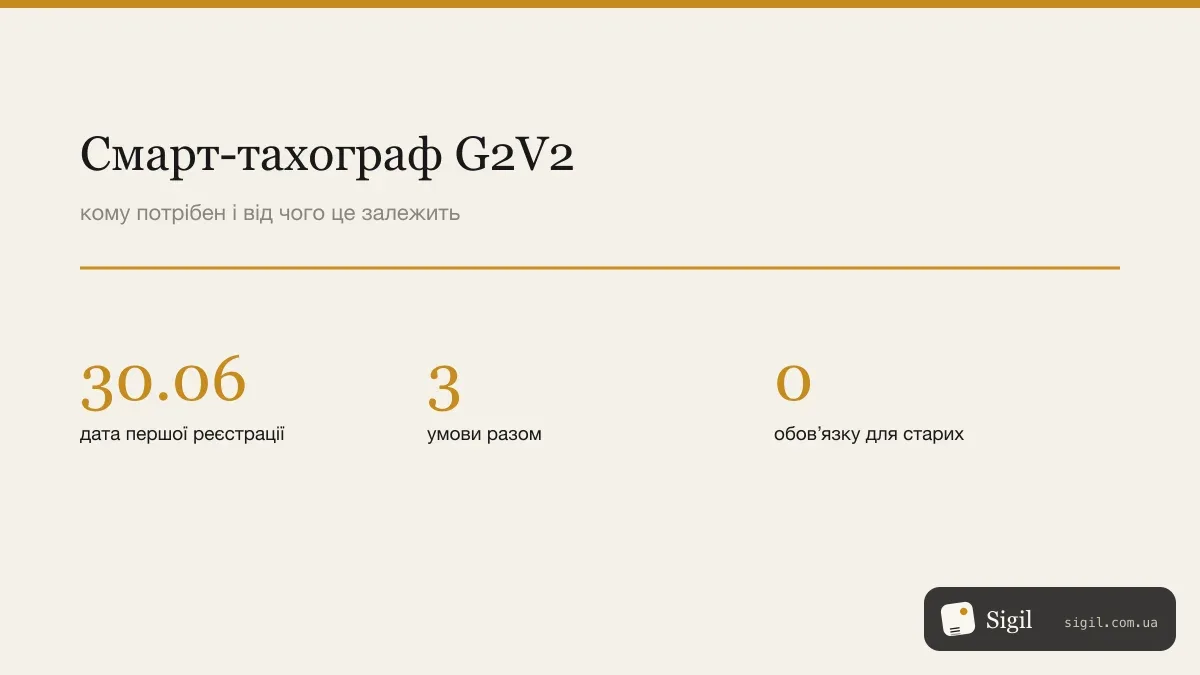
The owner of twelve trucks read in a trade feed that smart tachographs became compulsory on 1 July 2026. He called a workshop, asked the price for twelve units and started working out the loan. Not one of his trucks falls under the duty, because all twelve have been on the Ukrainian register since 2021 and 2023. The invoice he almost paid came from one word missing in the news item, and that word is "first".
A G2V2 smart tachograph is compulsory only for a vehicle that passed its first state registration in Ukraine after 30 June 2026, carries goods across a border and operates under the agreement between Ukraine and the EU. For the rest of the fleet there is no retrofit duty today. One may appear, and the text below says where from.
In brief: G2V2 is the second version of the smart tachograph and that is the version the Ukrainian regulation names · the duty covers vehicles first registered in Ukraine after 30 June 2026 in international carriage of goods under the agreement with the EU · for the older fleet Ukrainian law contains no retrofit duty, so replacing a working device is a cost without a basis · the retrofit stands in the Appendix to Decision No 3/2025 as an item Ukraine is to transpose, with workshop capacity taken into account · a smart tachograph records position, reveals attempted manipulation remotely and carries an ITS interface, as art. 1 of Decision No 2/2025 defines · cards are issued by Ukrainian transport safety centres, while the European Commission supplies the cryptographic material as the single root certification authority · whether the agreement is extended beyond 31 March 2027 depends in part on these tachograph items.
What a smart tachograph is and what the version has to do with it
A smart tachograph is a digital tachograph with three additional abilities. It records the vehicle position by itself at certain points of the working day, shows a control officer the signs of possible manipulation remotely, and carries an interface for intelligent transport systems. That is how art. 1 of Decision No 2/2025 of the Joint Committee defines it, by reference to arts 8, 9 and 10 of Regulation 165/2014.
The version is a separate matter. The device specification sits in Regulation 2016/799, and devices under it come as first generation, second generation version one, and second generation version two. The Ukrainian regulation requires version G2V2 expressly, that is the newest one. A G2V1 device, new only a few years ago, does not meet that requirement.
The specification provides Ukraine with its own distinguishing sign, "UA". It is a technical detail, but it means something simple. A Ukrainian smart tachograph is not a European device that somebody fitted in Kyiv; it is a device registered in the system under the Ukrainian sign.
Why a device from Ukraine is read at a check in Europe
The question is not theoretical. If the smart tachograph was fitted in Kyiv, why does a Polish inspector trust its records?
The answer sits in arts 3 and 4 of Decision No 2/2025. Type approval of the device follows the procedure of chapter III of Regulation 165/2014, in which the words "Member State" are read as "Member State of the European Union and Ukraine". The interoperability certificate is issued by a single laboratory under the authority and responsibility of the European Commission, and the Commission itself acts as the single European root certification authority.
Article 4 adds the rest. Chapters IV to VI and art. 38 of Regulation 165/2014, that is installation, inspection, use of the equipment and enforcement, apply with the same reading. For a carrier this means something simple. The device, the card and the rules around them are the same on both sides of the border, so an argument at a check will be about particular records rather than about whether the device counts at all.
Who the G2V2 duty covers today
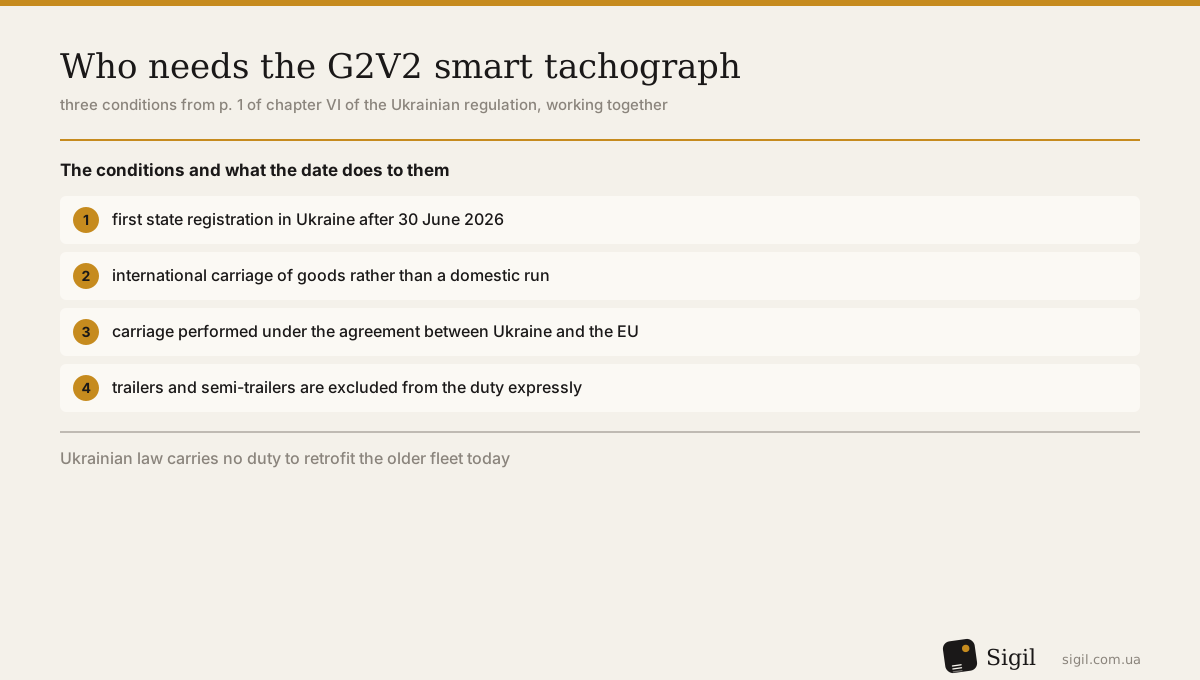
The conditions in p. 1 of chapter VI of the regulation work together. First state registration in Ukraine after 30 June 2026, international carriage of goods, and performance of that carriage under the agreement between Ukraine and the EU. Trailers and semi-trailers are excluded.
The word "first" decides everything here. A 2019 vehicle just imported and registered in Ukraine in August 2026 falls under the duty, although it is not new. A 2025 vehicle registered in Ukraine in May 2026 does not, although it is newer. The remaining conditions, and how they combine with the AETR, are covered in the text on tachograph rules for a Ukrainian carrier.
Does the older fleet have to be retrofitted
The question workshops will earn most from right now. Today it does not.
The Ukrainian regulation speaks of first registration and says nothing about retrofitting vehicles already on the register. Ukrainian law contains no retrofit duty, and until one appears, swapping a working digital tachograph for a G2V2 is a commercial decision rather than compliance with a rule.
Where do the retrofit conversations come from then? From the Appendix to Decision No 3/2025, where two of the items Ukraine is to transpose concern tachographs. The first is the version 2 smart tachograph in newly registered vehicles and it is already done. The second is the retrofit of the remaining fleet operating under the agreement, and that one has not reached Ukrainian law yet. The Appendix adds expressly, next to that item, that the availability and capacity of workshops and the training of personnel will be taken into account in the assessment.
EU law does contain such a rule and it reads as art. 3(4) and 3(4a) of Regulation 165/2014. It requires vehicles operating in a Member State other than their state of registration, which means international carriage, to be fitted with a smart tachograph within deadlines counted from the entry into force of the technical specification. That is the construction Ukraine is to transpose, and once it does, the older fleet will have a date.
Why this is a market access question rather than a technical one
Here the tachograph stops being a device. Decision No 3/2025 continued the agreement until 31 March 2027, and art. 1(2) of the same decision said that any further prolongation depends on satisfactory progress in aligning Ukrainian law with Union law in the items listed in the Appendix. Two of the seven items in the Appendix are tachograph items.
The Commission is to present its assessments on a schedule, namely an initial report on the status of implementation by 30 January 2026, an assessment of progress by 31 May 2026 and a further one by 30 November 2026. That last assessment is the document from which it will be clear whether the agreement continues.
For a carrier this translates directly. If the agreement is not extended, permits from bilateral quotas return, which means blank permits, issuing points and limits, and what that looks like in practice is described in the text on transport permits. A device costing a few thousand euro and the right to enter without a permit sit in one sentence of the same act.
What about the cards and where they come from
A smart tachograph without a driver card is a metal box. Cards for digital and smart tachographs are issued by Ukrainian transport safety centres and authorised workshops, and there are four kinds in all, for the driver, the workshop, the control officer and the company.
This works thanks to art. 3 of Decision No 2/2025. Ukraine recognised the European Commission as the single root certification authority, and the Commission supplies the Ukrainian authorities with the cryptographic material for issuing cards. Without that, a Ukrainian card would not be read by a European device.
The Ukrainian ministry reported on 1 July 2026 that more than 29 thousand cards had been issued and that there are over a hundred issuing and servicing centres. Those are figures about a service rather than a rule, so they are worth reading afresh before planning, but they do show the scale.
What to do
- Pick out the vehicles with first state registration in Ukraine after 30 June 2026. Only those need G2V2.
- When buying a vehicle not yet on the Ukrainian register, count G2V2 into the price together with registration.
- Check that the drivers on those vehicles hold valid cards and keep the expiry dates in the trip file.
- Set a reminder for December 2026 and read the Commission assessment, because both the retrofit and the agreement itself hang on it.
- Record the periodic verification date for every device, because for a smart tachograph it is the same, namely every two years.
What not to do
- Do not order a retrofit of the whole fleet in advance. Ukrainian law contains no retrofit duty today.
- Do not read the 1 July 2026 news without the word "first". It separates ten vehicles from one.
- Do not fit a G2V1 in a vehicle covered by the duty. The regulation names version G2V2 expressly.
- Do not assume a smart tachograph closes geolocation for SENT. The requirements for a locator are different and separate.
- Do not plan April 2027 on the assumption that the agreement renews itself. Decision No 3/2025 tied the extension to conditions.
A tachograph, an RMPD filing and SENT geolocation are three separate duties, and a penalty for each breach is counted separately, as the SENT and RMPD penalty calculator shows.
What a non-EU carrier's duties consist of, and in what order, is gathered on the cluster pillar page.
A demo or training for your team
30 minutes online. We show how Sigil™ files an RMPD from a CMR and answer questions about your runs.
Frequently asked questions
- Does a smart tachograph have to be fitted in vehicles already registered in Ukraine?
- No. The Ukrainian regulation requires G2V2 only for vehicles whose first state registration fell after 30 June 2026. Ukrainian law carries no retrofit duty for the older fleet today.
- How does G2V2 differ from G2V1?
- By the version of the specification. Both are smart tachographs under Regulation 2016/799, but the regulation names the second version of the second generation expressly, so G2V1 does not satisfy it.
- Does the duty cover an older vehicle just imported from Europe?
- Yes, if its first state registration in Ukraine fell after 30 June 2026. The year of manufacture is irrelevant; the date of first registration is what counts.
- Why do Ukrainian cards work in European devices?
- Because of art. 3 of Decision No 2/2025. Ukraine recognised the European Commission as the single root certification authority, and the Commission supplies the cryptographic material for issuing cards.
- When might a duty to retrofit the rest of the fleet appear?
- When Ukraine transposes that item from the Appendix to Decision No 3/2025. Workshop capacity is taken into account in the assessment, and the nearest assessment was due from the Commission by 30 November 2026.
Sources
Legal acts as in force on the day of publication:
- Regulation on drivers' working and rest time, Ukrainian nakaz No 340 in the redaction of nakaz No 1727 of 12.12.2025 in force since 26.07.2026: p. 1 of chapter VI, which holds the three conditions of the duty and names version G2V2 expressly, and the exclusion of trailers and semi-trailers.
- Decision No 2/2025 of the Joint Committee, OJ L 2025/409 of 25.02.2025: art. 1(2) (the definition of a smart tachograph through arts 8, 9 and 10 of Regulation 165/2014, and the "UA" sign), art. 2, art. 3(2), (3) and (4) (the Commission as the single ERCA and the cryptographic material for driver, workshop, company and control cards), recital 7.
- Regulation (EU) 165/2014, EUR-Lex, version of 20.08.2020: art. 3(4) and 3(4a) (retrofit of vehicles operating in a Member State other than that of registration), arts 8, 9 and 10.
- Implementing Regulation (EU) 2016/799, EUR-Lex: the device specification and Annex IC.
- Decision No 3/2025 of the Joint Committee, OJ L 2025/2352 of 21.11.2025: art. 1(1) and (2), recital 7 and the Appendix, which carries two tachograph items and, next to the fleet retrofit, mentions the availability and capacity of workshops and the training of personnel; the schedule of Commission assessments, namely 30.01.2026, 31.05.2026 and 30.11.2026.
Authorities:
- The Ukrainian ministry of communities and territories development, announcement of 1 July 2026: more than 29 thousand cards issued and over a hundred issuing and servicing centres. Figures about a service, not a rule.
Read next
- The driver card for a tachograph and how to get itA tachograph driver card runs up to 5 years and is issued in 20 working days. What about the photograph, the TachoNET check and a card lost mid-trip.
- What SENT-GEO demands of the carrier and the locatorWhat Poland's SENT-GEO demands of carrier and driver: a locator on the whole Polish leg, three ways to transmit (e-TOLL PL, OBU, ZSL), on and off times, fines.
- An RMPD roadside check and what the inspector doesAn RMPD roadside check: what the inspector looks at in the filing, why last trip's number does not help, when the truck is impounded and the driver's rights.
Sigil™ turns a CMR into an RMPD declaration and files it with PUESC, with every field checked against the original.
More about Tachograph