RMPD
EU Ukraine road transport agreement until 31.03.2027
The EU Ukraine road transport agreement runs to 31 March 2027 under Decision No 3/2025. What an extension needs, what it requires now, what happens to RMPD.
Published · Author: Makaiev Kostiantyn Oleksandrovych, founder of Sigil RMPD
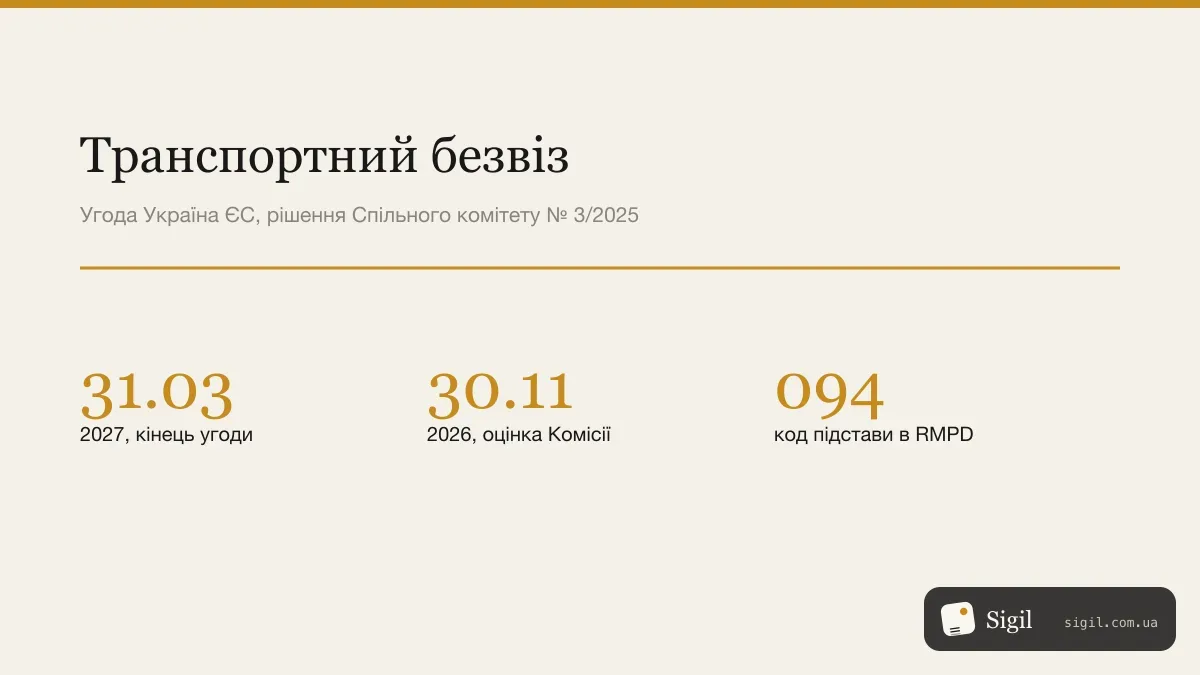
The EU Ukraine road transport agreement runs until 31 March 2027, so a Ukrainian truck needs no Polish permit for covered runs into, out of or through Poland. Decision No 3/2025 of the Joint Committee, published on 21 November 2025, sets this date. Extension is not automatic and depends on a Commission assessment due by 30 November 2026.
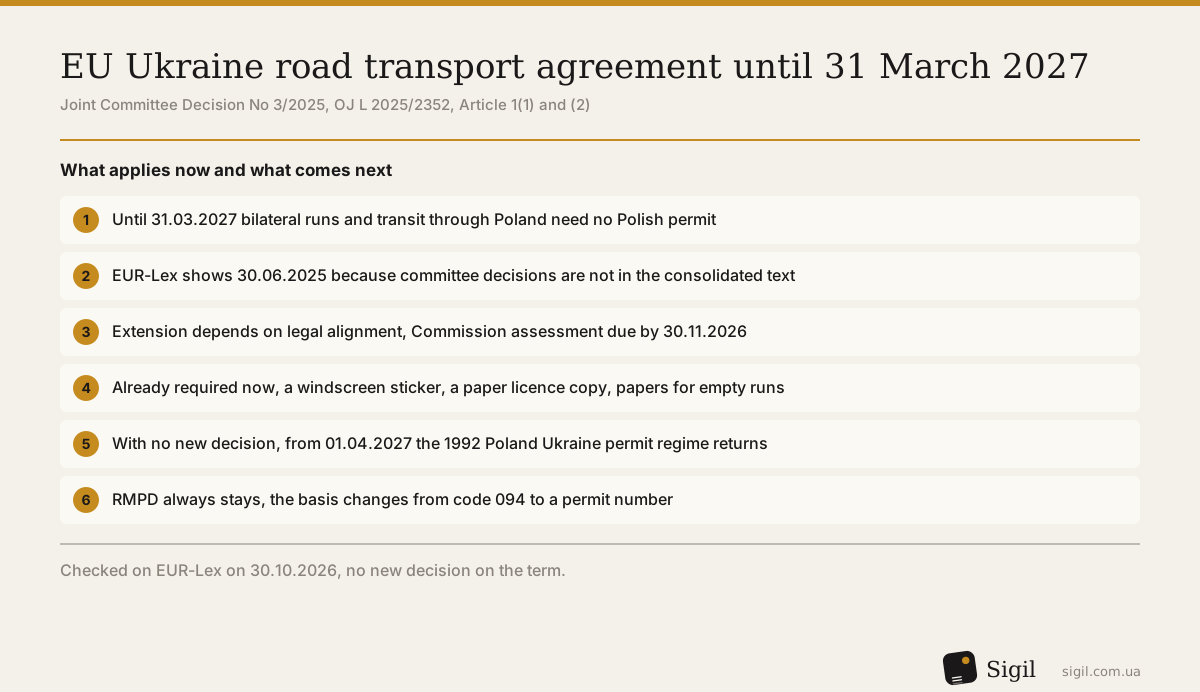
In brief: the EU Ukraine road transport agreement runs until 31 March 2027, as set by Article 1(1) of Joint Committee Decision No 3/2025 of 25 September 2025 · the consolidated text of the agreement on EUR-Lex shows 30 June 2023 and 30 June 2025, because Joint Committee decisions are not built into it · an extension beyond 31 March 2027 is not automatic, it depends on Ukraine aligning its law with EU law, and the Commission's last assessment is due by 30 November 2026 · as of 30 October 2026 there is no new decision on the term in the Official Journal of the EU · the agreement already requires a windscreen sticker, a paper copy of the operating licence and documents for empty runs · if the agreement lapses, the 1992 bilateral agreement between Poland and Ukraine applies again, and with it a permit for bilateral carriage and transit · the RMPD declaration stays either way, only the legal basis changes, from exemption code 094 to a permit number.
A dispatcher at a Ukrainian haulage firm scrolls through the drivers' group chat one evening and reads three messages in a row. One says that after March 2027 "the Polish permit forms are coming back". Another insists that the arrangement Ukrainians call the transport visa-free regime renews itself. A third posts a link to the agreement on EUR-Lex showing 30 June 2025 and asks what they are actually driving on today.
Until when does the EU Ukraine road transport agreement apply
The Agreement between the European Union and Ukraine on the carriage of freight by road applies until 31 March 2027. That is what Article 1(1) of Joint Committee Decision No 3/2025 says (OJ L 2025/2352). The decision was adopted on 25 September 2025 and entered into force on the day of adoption (Article 2).
The agreement was signed in Lyon on 29 June 2022 for one year, and since then its end date has moved four times. Recital 1 of Decision No 3/2025 retells the whole history, which also explains why so many different dates circulate among carriers.
| Document | Applies until |
|---|---|
| agreement of 29.06.2022, Article 6(1) | 30.06.2023 |
| Joint Committee Decision No 2/2023 | 30.06.2024 |
| amending agreement of 20.06.2024, Article 6(3) | 30.06.2025 plus six months automatically |
| automatic extension | 31.12.2025 |
| Joint Committee Decision No 3/2025, Article 1(1) | 31.03.2027 |
Can a run from Lutsk to Lublin on 15 March 2027 go without a Polish permit? Yes. The run falls before the end of the agreement, and carriage between Ukraine and an EU member state is the first item on its list of permitted journeys (Article 4(a) of the agreement). A run on 1 April 2027 cannot, unless the Joint Committee adopts a new decision before that day.
Why the agreement text on EUR-Lex shows a different date
The consolidated text of the agreement on EUR-Lex does not show 31 March 2027. Its latest version is dated 19 February 2026, and Article 6 there contains two end dates: 30 June 2023 in paragraph 1 and 30 June 2025 with an automatic six-month extension in paragraph 3.
A consolidated text only gathers amendments to the agreement itself, which here means the 2024 amending agreement. Decisions the Joint Committee adopts under Article 7(2) are not written into it. That is why neither Decision No 2/2023 nor Decision No 3/2025 appears there. EUR-Lex itself warns above every consolidated text that it is for information only and has no legal effect.
Anyone who reads only Article 6 sees a date that no longer governs anything. Anyone who opens Decision No 3/2025 sees 31 March 2027. A ministry statement or a trade news story may report the date correctly, but the source remains the decision, and that is the document worth bookmarking.
Will the agreement be extended after 31 March 2027
No decision to extend the agreement beyond 31 March 2027 has been taken, and none will appear on its own. Article 1(2) of Decision No 3/2025 says that any further extension should depend on satisfactory progress in aligning Ukrainian legislation with the EU acquis on the carriage of freight by road. The list of what has to be aligned is in the appendix to the decision.
The recitals give two dates. Under recital 6 the Commission will launch a study of the agreement's impact on the road haulage sector, including road safety, to be presented by 30 November 2026. Recital 7 requires satisfactory progress in legal alignment by the same day.
A footnote to the appendix sets out the timetable in more detail. The Commission presents three documents to the ad hoc working group set up under Article 7A of the agreement:
- a preliminary report on the state of implementation by 30 January 2026;
- an assessment of progress in legal alignment by 31 May 2026;
- a further assessment of progress by 30 November 2026.
As of 30 October 2026 the first two deadlines have passed and the third is still ahead. EUR-Lex holds no Joint Committee decision that moves 31 March 2027 to a later day. We do not summarise the content of the reports here, because only a committee decision sets the term of the agreement, and the committee decides by consensus of both Parties (Article 7(5) of the agreement).
What Ukraine has to carry over into its own law
The appendix to Decision No 3/2025 lists seven items, and Ukraine has to implement each of them in its own legislation:
- a national electronic register of road transport undertakings compatible with EU specifications (Article 16 of Regulation (EC) No 1071/2009);
- the requirement of an effective establishment (Article 5 of the same regulation);
- the requirement of good repute (Article 6);
- a version 2 smart tachograph in vehicles newly registered in Ukraine from 1 July 2026 and operated under the agreement (Article 8(1) of Regulation (EU) No 165/2014);
- retrofitting smart tachographs to the rest of the fleet operated under the agreement (Article 3(4) and (4a)), with the assessment taking into account the availability of workshops and staff training;
- driving times, breaks and rest periods under Articles 6–9 of Regulation (EC) No 561/2006;
- drivers' working time under Directive 2002/15/EC.
Retrofitting an older fleet appears in the appendix as a task for the state, not as an obligation on the carrier. Joint Committee Decision No 2/2025 already allows vehicles with a smart tachograph to operate under the agreement (Article 2), and its recital 7 expressly keeps AETR digital tachographs in use as well. The obligation already in force in Ukrainian law is narrower and covers new vehicles, as explained in the article on the G2V2 smart tachograph.
What the agreement already requires before 31 March 2027
No permit does not mean no paperwork. The 2024 amending agreement added three requirements that roadside checks look for today.
The first is a sticker on the windscreen following the model in Annex I (Article 5c(1)). The agreement states plainly that a run under the agreement without the sticker is not in line with it (Article 5c(2)). The second is a certified copy or extract of the authorisation to carry out international road haulage, kept in paper form in the vehicle (Article 5a(1)). For a Ukrainian carrier that authorisation is the operating licence.
The third requirement concerns empty runs. An empty vehicle that has left Ukraine for the EU complies with the agreement only if the driver carries documents for the next job, meaning a signed contract or order with the consignor's name, address and contact details (Article 5b(1) and (2)). On the way home the carrier must be able to prove that in the EU it carried out only bilateral or transit operations. CMR consignment notes, customs declarations, TIR carnets and tachograph records count as proof, and the driver may phone the office while the check is still running (Article 5b(3) and (4)).
The limits of the agreement are unchanged too. Carriage within a member state and between two member states is expressly outside its scope (Article 2(1)), and how to classify such a run is covered in the article on transit, third-country carriage and cabotage. Under the Polish tariff, carriage contrary to the provisions of an international agreement costs 12,000 zł, which is 138,394 ₴ (annex 3, item 3.2).
Can the agreement stop applying earlier
Yes, through three mechanisms that rarely come up in carrier chats. Either Party may terminate the agreement by written notice, and it then ends two weeks later, or at most two months later (Article 12(1)). The Joint Committee may recommend a temporary suspension where the agreement's objectives are manifestly no longer being met, and each Party may then suspend it with effect 15 days after notification (Article 7(1)).
The third mechanism is the narrowest. A Party may suspend the agreement in part of its territory where the road haulage market in that area faces serious disturbance, for up to three months (Article 9a). The right of transit through that area is preserved. Each such step is formally notified between the Parties, so a report of a suspension deserves the same check against the official text as a report of an extension.
What changes on 1 April 2027 if there is no decision
If the agreement lapses, the regime that applied before it returns. Article 12(4) of the agreement says its expiry does not make market access more restrictive than on the day before it entered into force. In the absence of a later agreement, the bilateral agreements between EU member states and Ukraine apply again.
For Poland that means the agreement between the Governments of Poland and Ukraine on international road transport of 18 May 1992. Its Article 5 allows bilateral carriage and transit, and Article 6(1) says such carriage may only be performed under permits issued in advance. Article 7 lists the exceptions, for example household removals or damaged vehicles.
A vehicle that is on EU territory on the day the agreement expires may return home in transit (Article 12(2)). A new run from 1 April 2027 without a new decision will need a Polish permit, and how a Ukrainian carrier obtains one is set out in the article on getting a road transport permit. The other route is an ECMT permit, and what it means for the declaration is explained in the article on the ECMT permit and RMPD.
Does the RMPD obligation disappear with the agreement
No, the duty to file does not depend on the agreement. Article 28b(1) of the Polish Road Transport Act (ustawa o transporcie drogowym) names three situations: a permit is required, an ECMT permit is required, or an international agreement exempts the carriage from a permit. The end of the agreement moves a run from the third situation to the first, but the declaration stays.
One field changes. Under an exemption the declaration states the legal basis of the exemption, under a permit it states the permit number (Article 28b(3)(10)). In the PUESC dictionary the basis under the agreement has code 094, and in our own data it appears on 6,758 of 7,133 declarations with a carriage start date between 31 October 2024 and 24 October 2026. That is one platform's data, not the market, but it shows how many runs hang on a single date.
PUESC validation rule R08 does not accept an exemption together with a permit block. So every run from 1 April 2027, if the agreement no longer applies, has to be filed with a permit number. Who exactly must file is set out in the article on who must file RMPD.
A missing declaration, or one with data that does not match reality, costs the carrier 12,000 zł, which is 138,394 ₴ at the National Bank of Ukraine rate of 11.5328 ₴ per 1 zł on 31.10.2026 (annex 3, item 3.2a). The SENT and RMPD fines calculator works out the amount for a specific case. Fines from a single roadside check cannot exceed 12,000 zł in total (Article 92a(3)). Once a permit is required again, however, a run without a declaration is treated as a run without a permit (Article 28b(10)), and the truck is sent to a guarded car park at the carrier's expense (Article 89a1(1a)).
What to do
- Use code 094 in RMPD only for runs covered by the agreement that start no later than 31 March 2027.
- Check that every vehicle running under the agreement carries the windscreen sticker, a paper copy of the licence and documents for any empty run.
- Plan April 2027 contracts in two versions, under the agreement and with a permit.
- Look for the Joint Committee decision on EUR-Lex after 30 November 2026 rather than a summary in a chat.
- Order permits for April in advance if no new decision has appeared by March 2027.
- Enter the permit number in RMPD from 1 April 2027 instead of the exemption code if the agreement no longer applies.
What not to do
- Do not quote Article 6 of the consolidated text as the end date. Anyone who believes in 30 June 2025 will start ordering and paying for permits the run does not need.
- Do not tell drivers the extension is automatic. The automatic mechanism in Article 6(3) worked once, up to 31 December 2025, and after that only a committee decision counts.
- Do not present retrofitting the whole fleet with smart tachographs as an obligation under Decision No 3/2025. In the appendix it is a task for the state, and the firm would spend money earlier than the law requires.
- Do not send a vehicle out under the agreement without the sticker. The agreement treats such a run as non-compliant, which opens the way to a fine under item 3.2.
- Do not drop RMPD on the day the permit comes back. Without a declaration the run counts as one without a permit, and the truck waits in a guarded car park.
- Do not leave code 094 on a run after the agreement ends. The declaration data will not match reality, which means 12,000 zł under item 3.2a.
Where technology fits in
Sigil transfers the data from the CMR into the RMPD100 form one to one and enters the legal basis the dispatcher has confirmed: the exemption code under the agreement or a permit number. The system does not choose the type of carriage on a person's behalf, because that is a decision about the run, not about the document. The declaration goes to PUESC under the carrier's own credentials, and after the agreement ends only the basis field changes, which the dispatcher confirms in the same way.
Sigil handles RMPD declarations. We neither issue nor order permits or ECMT permits, and SENT is filed by the consignor or consignee.
A demo or training for your team
30 minutes online. We show how Sigil™ files an RMPD from a CMR and answer questions about your runs.
Frequently asked questions
- Did the EU Ukraine road transport agreement end on 30 June 2025?
- No. That date appears in Article 6 of the consolidated text on EUR-Lex, because Joint Committee decisions are not built into it. The current end date is 31 March 2027 under Article 1(1) of Decision No 3/2025.
- Has the agreement already been extended beyond 31 March 2027?
- No. As of 30 October 2026 the Official Journal of the EU holds no decision that moves this date. The next point set in the act is the Commission assessment due by 30 November 2026, and after it a separate Joint Committee decision is needed.
- Does transit through Poland need a permit before 31 March 2027?
- No, as long as the run falls under Article 4 of the agreement. Carriage within the EU, meaning between two member states, and cabotage stay outside the agreement and need a permit already now.
- Will the RMPD obligation disappear on 1 April 2027?
- No. The duty comes from Article 28b(1) of the Polish Road Transport Act and covers both runs under a permit and runs exempted by an agreement. The end of the agreement only changes the legal basis in the declaration, from code 094 to a permit number.
Sources
Legal acts as in force on the day of publication:
- Decision No 3/2025 of the Joint Committee established by the Agreement between the European Union and Ukraine on the carriage of freight by road, of 25.09.2025, OJ L 2025/2352 of 21.11.2025: recitals 1, 5, 6 and 7, Article 1(1) and (2), Article 2, appendix with footnote (deadlines 30.01.2026, 31.05.2026, 30.11.2026).
- Agreement between the European Union and Ukraine on the carriage of freight by road of 29.06.2022, OJ L 179 of 6.7.2022: Article 2(1), Article 4, Article 6(1), Article 7(2) and (5), Article 12(1), (2) and (4).
- Amending agreement of 20.06.2024, OJ L 2024/1878: Article 5a(1), Article 5b(1) to (4), Article 5c, Article 6(3), Article 7(1), Article 7A, Article 9a.
- Consolidated text of the agreement as of 19.02.2026, EUR-Lex, for information only: Article 6(1) and (3).
- Joint Committee Decision No 2/2025 of 17.01.2025, OJ L 2025/409: recital 7, Article 2.
- Agreement between the Government of the Republic of Poland and the Government of Ukraine on international road transport of 18.05.1992, ISAP, M.P. 2002 nr 6 poz. 125: Article 5, Article 6(1), Article 7.
- Polish Road Transport Act of 6 September 2001 (ustawa o transporcie drogowym), ISAP, consolidated text Dz.U. 2025 poz. 1490: Article 28b(1), (3)(10) and (10), Article 89a1(1a), Article 92a(3), annex 3 items 3.2 and 3.2a.
Own data: RMPD declarations in the Sigil production environment with a PUESC reference number, excluding cancelled ones, carriage start date 31.10.2024–24.10.2026, as of 25.10.2026.
Exchange rate: National Bank of Ukraine, 11.5328 ₴ per 1 zł on 31.10.2026.
Read next
- Transit or third-country carriage, how to tellLoading in Poland and unloading in Germany is third-country carriage for a Ukrainian operator, and the EU Ukraine agreement does not cover it.
- The ECMT permit and what it means for an RMPD filingThe ECMT permit in an RMPD filing: when to name it and when an exemption, what goes into the permit field, and why one filing per run is often not enough.
- What an RMPD is and who must file itRMPD from scratch: what the filing is, who must file it since 1 November 2024, when it is not needed, how it differs from SENT, what happens at entry without it
- The G2V2 smart tachograph and who needs itThe G2V2 smart tachograph binds only vehicles first registered in Ukraine after 30 June 2026. Why the older fleet needs no retrofit and when that will change.
Sigil™ turns a CMR into an RMPD declaration and files it with PUESC, with every field checked against the original.
More about RMPD