RMPD
Cabotage rules in Poland and Ukrainian carriers
Cabotage in Poland rules in short. Three operations in seven days for a Community licence holder, none for a Ukrainian licence. The fine is 12,000 zł per check.
Published · Author: Makaiev Kostiantyn Oleksandrovych, founder of Sigil RMPD
The cabotage rules in Poland give a carrier established in Ukraine no right to cabotage on its own licence. There are two lawful routes, a Community licence or an individual GITD permit, and neither comes automatically. The EU–Ukraine agreement does not change this, because carriage within a Member State is outside its scope (art. 2(1)). Cabotage without a permit costs 12,000 zł (Annex 3, item 3.5).
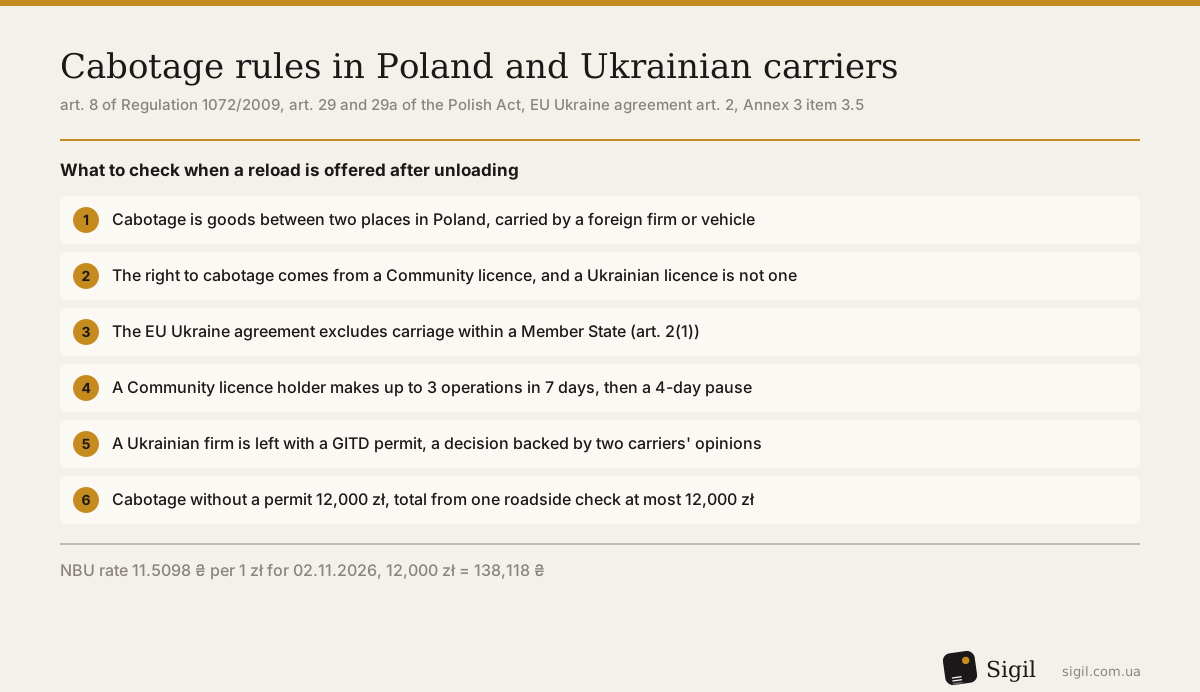
In brief: cabotage in Poland is the carriage of goods between two places in Poland by a firm from outside the EU or by a vehicle registered abroad (art. 4 pkt 12 of the Polish Road Transport Act) · the right to cabotage in the EU comes from a Community licence, and a Ukrainian international haulage licence is not one (art. 8(1) of Regulation 1072/2009) · the EU–Ukraine road freight agreement does not open cabotage, because carriage within a Member State is outside its scope (art. 2(1) of the agreement) · a Community licence holder may make up to three cabotage operations within seven days after an international delivery, and the same vehicle then waits four days (art. 8(2) and 8(2a)) · a Ukrainian firm is left with a single route, a GITD permit issued by administrative decision on the strength of two positive opinions from carriers' organisations (art. 29 ust. 1 and 2 of the Act) · cabotage without a permit costs 12,000 zł, which is 138,118 ₴ at the NBU rate for 02.11.2026 (Annex 3, item 3.5) · cabotage under a permit still needs an RMPD filing, a separate one for each operation (art. 28b ust. 2 and 9).
A freight forwarder in Łódź takes delivery of a load from Lutsk in Ukraine and asks the carrier's dispatcher a favour. "The truck is standing here anyway, take these pallets to Wrocław." The dispatcher sees an empty leg filled and agrees. What he has just agreed to is cabotage, and a Ukrainian operating licence does not cover it.
What is cabotage in Poland
Cabotage is a carriage of goods in which both loading and unloading take place in Poland, performed by a foreign firm or a foreign vehicle. The Polish Road Transport Act (ustawa o transporcie drogowym, the Act below) gives several variants of the definition in art. 4 pkt 12. For a carrier from Ukraine two of them matter. The first is carriage between places in Poland by a firm established outside the EU and outside the EFTA states of the European Economic Area. The second is the same carriage by a vehicle registered abroad, unless a Polish firm has hired that vehicle.
Cabotage and bilateral carriage are told apart by the addresses on the CMR consignment note, not by the flag on the cab door. A journey from Lutsk to Łódź is bilateral carriage between Ukraine and the EU. A journey from Łódź to Wrocław with the same truck, after unloading, starts in Poland and ends in Poland.
Are pallets from Łódź to Wrocław, picked up straight after the Ukrainian load, still part of the bilateral journey? No. The bilateral carriage ended when the goods from Ukraine were unloaded. What follows is a new contract of carriage with two Polish addresses, which makes it cabotage.
An empty run looks similar but is not cabotage. If after Łódź the truck drives empty to Rzeszów to load goods for Ukraine, that is an empty journey connected with bilateral carriage. The EU–Ukraine agreement covers such journeys (art. 4(d)). A customer's empty pallets in the trailer are no longer an empty run but goods carried for payment.
Who is entitled to cabotage in Poland
The right to cabotage in Poland, as everywhere in the EU, comes from a Community licence, in Polish licencja wspólnotowa (art. 8(1) of Regulation (EC) No 1072/2009). An EU Member State issues it to a haulier established in that state and authorised there to carry goods internationally under its law (art. 4(1)). A Ukrainian licence for international carriage of goods is not a Community licence, however many vehicles it lists.
The driver matters as well. When a firm with a Community licence puts a national of a third country behind the wheel, that driver needs a driver attestation, in Polish świadectwo kierowcy (art. 5 and art. 8(1)). That is the route for a Polish or Lithuanian firm employing Ukrainian drivers, not for a firm from Lutsk driving its own tractor unit.
The Agreement between the European Union and Ukraine on the carriage of freight by road of 29 June 2022 does not open cabotage. Article 2 expressly leaves carriage within an EU Member State, and between Member States, outside the agreement. Article 4 lists four permitted types of journey, and cabotage is not among them. How those four types map onto bilateral carriage, transit and third-country carriage is explained in the article on transit, third-country carriage and cabotage.
Polish law also knows cabotage without a permit on the basis of an international agreement (art. 29a of the Act). That provision only works when the agreement grants such a right. The agreement in force with the EU does not grant it, so art. 29a does not apply to a Ukrainian carrier.
What cabotage rules apply to a Community licence holder
For a Community licence holder the rule after Regulation (EU) 2020/1055 is short. After delivering the goods of an incoming international carriage in Poland, the haulier may perform up to three cabotage operations with the same vehicle. The last unloading in cabotage must take place within seven days of the last unloading of the international carriage in Poland (art. 8(2) of Regulation 1072/2009).
The second subparagraph of the same paragraph lets the haulier spread these operations across several Member States. In that case only one operation is allowed per state, and only within three days of entering that state unladen.
A pause follows cabotage. The same vehicle may not return to cabotage in the same Member State for four days after the previous cabotage ended (art. 8(2a)). Polish law applies the same pattern to cabotage under an international agreement, meaning three operations in 7 days and a four-day pause (art. 29a ust. 2 and 2a of the Act).
The burden of proof lies with the carrier. Cabotage counts as compliant only when the carrier can produce evidence of the preceding international carriage and of each cabotage operation that followed (art. 8(3)). This is usually the CMR note, and the regulation also accepts an electronic e-CMR. During a check the driver may call the office so that the evidence is sent before the check ends (art. 8(4a)). How the check itself runs is covered in the article on an RMPD roadside check.
Do three unloadings in Poland fit the limit if the third falls on the eighth day after the international delivery? No. The eighth day is already outside the seven-day window. A fourth operation does not fit the limit even on the second day.
In Spain, since 5 October 2026, each such operation also needs an electronic document, covered separately in DeCA in Spain. Polish cabotage has no such document.
Can a Ukrainian carrier get a cabotage permit in Poland
A Ukrainian carrier can apply, but what it may receive is an administrative decision, not a blank form from a quota. Cabotage in Poland by a firm established outside the EU, Switzerland and the EFTA states requires a cabotage permit, zezwolenie na przewóz kabotażowy. It is issued by Główny Inspektor Transportu Drogowego, the Chief Inspector of Road Transport, known as GITD (art. 29 ust. 1 pkt 1 of the Act). The application must include at least two positive opinions from nationwide organisations of road hauliers (art. 29 ust. 2).
The same provision catches a case that firms forget. A GITD permit is also needed when cabotage is performed with a vehicle registered outside the EU, Switzerland and the EFTA states (art. 29 ust. 1 pkt 2). A Polish firm with a Community licence that takes over your Ukrainian-registered truck "for three days" needs a permit too.
A carrier that repeatedly breaks the cabotage rules receives a GITD ban on cabotage in Poland for 2 years (art. 29 ust. 3 and 4).
A permit does not replace the filing. Cabotage under a GITD permit needs an RMPD filing before the carriage starts (art. 28b ust. 2 of the Act), separately for each transport operation (ust. 9). Without a filing, the journey is treated as performed without a permit (ust. 10). How a permit is entered in the filing, and when one journey splits into several filings, is covered in the article on ECMT permits and RMPD.
Sigil's data contain no cabotage either. In 7,133 filings by 18 firms in the PUESC production environment, with a carriage start date from 31.10.2024 to 24.10.2026, a cabotage permit does not appear once. The exemption under the agreement appears in 6,936, ECMT in 193 and an ordinary permit in 4. These are one platform's figures, not the market's. Sigil also does not send cabotage filings, so this zero describes the platform's clients only, and the rule itself comes from the law.
How much does unauthorised cabotage cost
Cabotage without the required permit costs the carrier 12,000 zł. Cabotage in breach of the conditions set for it costs the same. Both entries sit in the penalty table, that is Annex 3 to the Road Transport Act (items 3.5 and 3.6).
| Breach | Amount | Basis |
|---|---|---|
| Cabotage without the required permit | 12,000 zł (138,118 ₴) | Annex 3, item 3.5 |
| Cabotage in breach of its conditions | 12,000 zł (138,118 ₴) | Annex 3, item 3.6 |
| Carriage without an RMPD filing, or with data that do not match the facts | 12,000 zł (138,118 ₴) | Annex 3, item 3.2a |
| Total from one roadside check | no more than 12,000 zł (138,118 ₴) | art. 92a ust. 3 |
Hryvnia amounts use the NBU rate of 11.5098 ₴ per 1 zł for 02.11.2026.
The three rows do not add up. Penalties for breaches found during one roadside check may not exceed 12,000 zł in total (art. 92a ust. 3 of the Act). Cabotage without a permit plus a missing filing from the same stop therefore comes to 12,000 zł, not 24,000. You can check your own figure in the SENT and RMPD penalty calculator.
The money is also taken at once. A carrier from a state that has no agreement with Poland on mutual recovery of claims pays a deposit on the spot equal to the expected penalty (art. 94 ust. 3 of the Act). For a firm from Ukraine that means 12,000 zł before any decision, and how it comes back is explained in the article on the RMPD and SENT deposit. Carriage without a filing adds a guarded car park at the carrier's expense until the filing is sent and a reference number received (art. 89a1 ust. 1a).
The carrier is not the only party liable. A freight forwarder, consignor, consignee or subcontractor who ordered the carriage is subject to a penalty if they knew, or should have known, that the service ordered involved a breach (art. 92a ust. 11 of the Act, art. 14a of Regulation 1072/2009). The request "take these pallets to Wrocław" makes the customer a party to the breach.
What to do when a reload is offered after unloading
- Check the addresses in the order. If both loading and unloading are in Poland, decline, because a Ukrainian licence does not cover the journey.
- Suggest that the customer gives the load to a firm with a Community licence and its own EU-registered vehicle.
- Look for a return load to Ukraine. The EU–Ukraine agreement covers the empty run to it.
- Keep the CMR note of the international carriage in the cab, so the inspector can see where the bilateral carriage ended.
- If the firm does take the GITD permit route, gather the two opinions of carriers' organisations in advance and send a separate filing for each operation.
What not to do
- Do not take goods between two Polish warehouses after a journey from Ukraine. It means 12,000 zł and a deposit on the spot, not a favour to a customer.
- Do not treat the EU–Ukraine agreement as a cabotage permit until 31.03.2027. Article 2 excludes carriage within a Member State for as long as the agreement applies.
- Do not apply the three-operations-in-seven-days rule to a firm with a Ukrainian licence. Those numbers concern a Community licence holder.
- Do not hand a Ukrainian-registered truck to a Polish firm for cabotage. Without a GITD permit it is the same cabotage without a permit (art. 29 ust. 1 pkt 2).
- Do not describe a reload as transit in the RMPD filing. Transit has neither loading nor unloading in Poland, and data that do not match the facts are a separate item, 3.2a.
Where technology fits in
Sigil transfers the data from the CMR into the RMPD100 filing one to one, and the dispatcher confirms them. The filing then goes to PUESC, the Polish customs and tax portal, under the carrier's own credentials. The type of carriage is set by the addresses on the CMR, meaning bilateral carriage, transit or carriage to a third country, and the dispatcher confirms it as well. Sigil does not send cabotage filings. We do not arrange Community licences, GITD permits or ECMT permits. The system does not correct CMR data either, so bilateral carriage will not turn into cabotage, nor the other way round.
Cabotage in Poland on a Ukrainian licence is never a job done "on the way". The right comes from a Community licence or a GITD decision, and the EU agreement is neither. Sigil handles RMPD filings, while SENT is filed by the consignor or the consignee.
A demo or training for your team
30 minutes online. We show how Sigil™ files an RMPD from a CMR and answer questions about your runs.
Frequently asked questions
- Can a carrier from Ukraine carry out cabotage in Poland?
- No, not on a Ukrainian licence. The right to cabotage comes from a Community licence, which an EU Member State issues to a firm established there. The other route is a GITD permit issued by decision, backed by two positive opinions from carriers' organisations (art. 29 ust. 1 and 2 of the Road Transport Act). The EU–Ukraine agreement does not cover cabotage (art. 2(1)).
- How many cabotage operations are allowed after an international delivery?
- Up to three, and only for a Community licence holder. They are made with the same vehicle, and the last unloading must take place within seven days of unloading the international carriage (art. 8(2) of Regulation 1072/2009). The same vehicle then makes no cabotage in the same state for four days (art. 8(2a)).
- Can a reload from Łódź to Wrocław be filed as transit?
- No. Transit has neither loading nor unloading in Poland. Goods between two Polish addresses are cabotage, and a type of carriage that does not match the facts in an RMPD filing is also item 3.2a.
- Does one roadside check cost 24,000 zł for cabotage plus a missing RMPD filing?
- No. Cabotage without a permit (item 3.5) and a missing filing (item 3.2a) are 12,000 zł each, but penalties from one roadside check may not exceed 12,000 zł in total (art. 92a ust. 3 of the Act). A carrier from Ukraine pays a deposit of that amount on the spot.
- Is the forwarder who asked for the reload liable?
- Yes, if they knew or should have known of the breach. The Act extends the penalty to the forwarder, consignor, consignee and subcontractor who ordered such carriage (art. 92a ust. 11 of the Act, art. 14a of Regulation 1072/2009).
Sources
Legislation:
- Act of 6 September 2001 on road transport, ISAP, consolidated text Dz.U. 2025 poz. 1490: art. 4 pkt 12, art. 28b ust. 2, 9 and 10, art. 29 ust. 1, 2, 3 and 4, art. 29a ust. 1, 2 and 2a, art. 89a1 ust. 1a, art. 92a ust. 3 and 11, art. 94 ust. 3, annex 3 items 3.2a, 3.5 and 3.6.
- Regulation (EC) No 1072/2009 on common rules for access to the international road haulage market, consolidated text of 21.02.2022, EUR-Lex: art. 2(6), art. 4(1), art. 5, art. 8(1), (2), (2a), (3) and (4a), art. 14a.
- Regulation (EU) 2020/1055, EUR-Lex: amendments to art. 8 of Regulation 1072/2009, including paragraph 2a.
- Agreement between the European Union and Ukraine on the carriage of freight by road, OJ L 179 of 06.07.2022: art. 2(1), art. 4.
- Decision No 3/2025 of the Joint Committee, OJ L 2025/2352: art. 1(1), the agreement applies until 31.03.2027.
Platform data: 7,133 filings by 18 firms in the PUESC production environment with a register number, cancellations excluded, carriage start date from 31.10.2024 to 24.10.2026, as of 25.10.2026. In the permit field the exemption appears 6,936 times, ECMT 193, an ordinary permit 4, a cabotage permit 0. One platform's data, not the market's.
Exchange rate: NBU, 11.5098 ₴ per 1 zł for 02.11.2026.
Read next
- Transit or third-country carriage, how to tellLoading in Poland and unloading in Germany is third-country carriage for a Ukrainian operator, and the EU Ukraine agreement does not cover it.
- Spain's DeCA from 5 October, who it bindsFrom 5 October 2026 domestic carriage in Spain and cabotage need an electronic DeCA. International journeys stay on the CMR. Who the duty actually binds.
- The ECMT permit and what it means for an RMPD filingThe ECMT permit in an RMPD filing: when to name it and when an exemption, what goes into the permit field, and why one filing per run is often not enough.
- What an RMPD is and who must file itRMPD from scratch: what the filing is, who must file it since 1 November 2024, when it is not needed, how it differs from SENT, what happens at entry without it
- RMPD and SENT deposits, how much and how to recoverWho holds an RMPD or SENT deposit, when it comes back and what to file to get it. Provisions, accounts, deadlines and court rulings from 2025 and 2026.
- The difference between SENT and RMPD nobody explainsSENT follows the goods, RMPD follows a non-EU carrier. Who files which, when both meet on one run, and what a missing one costs: 12,000 and 20,000 zł.
Sigil™ turns a CMR into an RMPD declaration and files it with PUESC, with every field checked against the original.
More about RMPD