SENT
Coal and charcoal from Poland under SENT, ADR, or neither
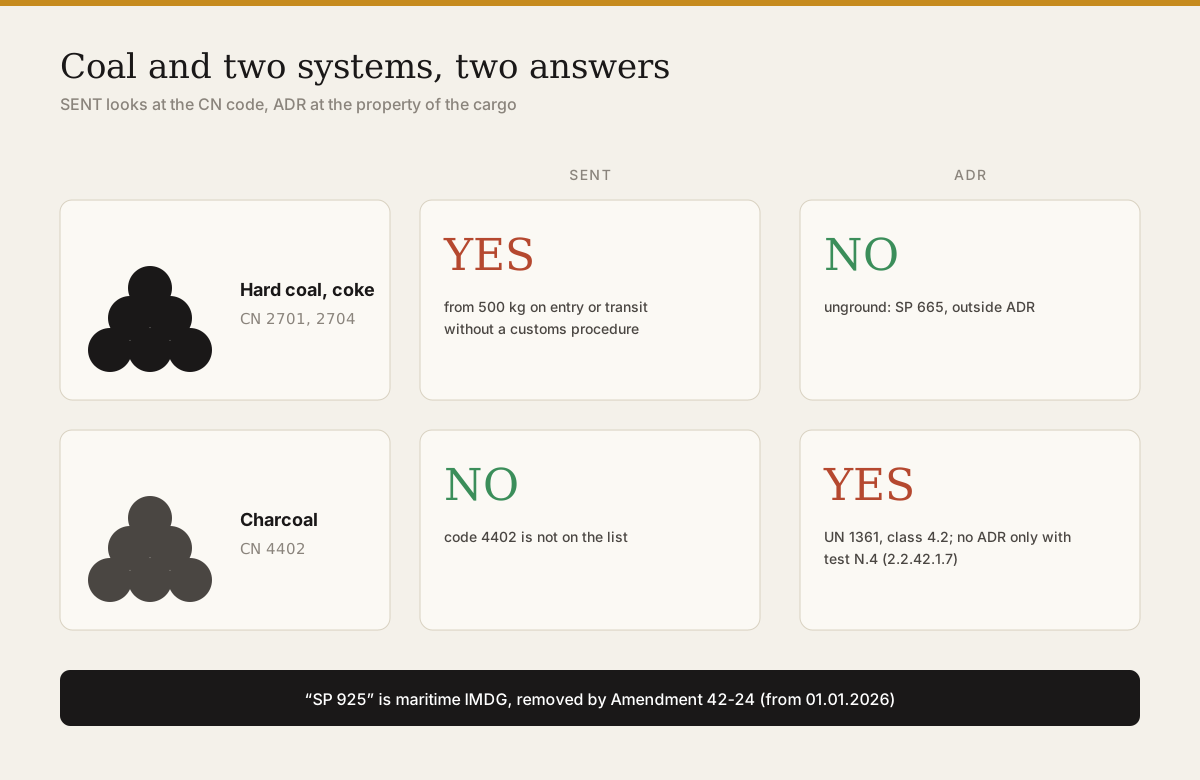
Hard coal 2701 is under SENT, charcoal 4402 is not. Charcoal is UN 1361 class 4.2 under ADR until test N.4 excludes it. "SP 925" is maritime, void since 2026.
Published · Updated · Author: Makaiev Kostiantyn Oleksandrovych, founder of Sigil RMPD
In a carriers' chat someone asks whether anyone has hauled a container of charcoal from Poland. The answer comes fast and confident: "UN 1361, class 4.2, spontaneously combustible, but with a self-heating test certificate it travels as ordinary cargo and the CMR says Not restricted according to Special Provision 925". Three sentences mixing three different systems: Poland's tax monitoring SENT, the road agreement ADR and the maritime IMDG Code. Each of them answers the word "coal" differently.
This article takes them apart: which coal is under SENT, which under ADR, when charcoal really can travel without ADR, and why "SP 925" no longer works in 2026, even at sea.
In brief: SENT looks at the CN code: hard coal 2701 and coke 2704 are on the list from 500 kg, charcoal 4402 is not on the list · coal leaving Poland (art. 5) is outside SENT, as is coal under a customs procedure; SENT applies on entry into Poland and in transit without a customs procedure · ADR looks at the property: charcoal is UN 1361, class 4.2, packing group II or III; unground hard coal, coke and anthracite are not subject to ADR (SP 665) · charcoal can travel without ADR if laboratory test N.4 shows it does not self-heat (ADR 2.2.42.1.7); the certificate travels with the driver · "SP 925" is the maritime IMDG Code, not ADR, and since Amendment 42-24 (mandatory from 1 January 2026) test N.4 no longer exempts at sea · a container going on by sea needs a full dangerous goods declaration from the shipper.
Charcoal from Poland is not under SENT, because code 4402 is not on the list, but it is under ADR as UN 1361 class 4.2 until a laboratory test shows the batch does not self-heat. Hard coal is the reverse: it is on the SENT list (2701) and not subject to ADR. The line about "SP 925" belongs to sea transport, and since 2026 it does not help there either.
What SENT is and which coal it covers
SENT is Poland's monitoring system for sensitive goods: fuels, alcohol, chemicals, farm produce, clothing. It asks only about the CN code. The list of monitored goods has two coal entries: 2701, hard coal, briquettes and similar solid fuels from coal, and 2704, coke and semi-coke. Both from 500 kg gross per consignment, unit packages up to 25 kg do not count (§ 1 pkt 8 of the goods regulation, regulation of the Minister of Finance of 25.04.2022). Charcoal has code 4402 and is not on the list. PUESC confirms this in its SENT FAQ: the notification concerns headings 2701 and 2704.
Whether hard coal is under SENT depends on direction and customs procedure. Carriage starting in Poland (art. 5 of the SENT Act) is exempt for coal (§ 2 ust. 8 pkt 1). So is coal under the customs procedure of transit, storage, temporary admission, processing, export or re-export (§ 2 ust. 8 pkt 2). Two cases remain: coal entering Poland (art. 6, the consignee files) and coal crossing Poland in transit without a customs procedure (art. 7, the carrier files).
Does 22 tonnes of hard coal from a Polish mine to Ukraine need SENT? No. The carriage starts in Poland and § 2 ust. 8 pkt 1 removes the duty. Does the same coal from Czechia to Ukraine through Poland without T1 need SENT? Yes, and the carrier files it (art. 7). Which entry is covered and with which exceptions, the CN code search shows, and the full list with dates of changes and thresholds is taken apart in SENT goods 2026.
Which coal is under ADR
ADR looks not at the code but at the property: can the load heat up and ignite by itself. Charcoal appears in ADR Table A as UN 1361 CARBON, animal or vegetable origin, class 4.2, packing group II or III. The ADR 2025 text in force in Poland is published by the Ministry of Infrastructure (ADR Agreement, text in force from 1 January 2025).
Hard coal, coke and anthracite are not subject to ADR when unground: so says special provision 665 in chapter 3.3, assigned to UN 1361 packing group III. That is why a truck from a mine runs without orange plates, while a truck of barbecue charcoal, in principle, does not.
The packing group decides how much paperwork rides in the cab. For UN 1361 packing group III, Table A gives transport category 4, which has no quantity limit under 1.1.3.6. The load travels with simplifications: no orange plates, no ADR driver certificate, but with marked packages, a transport document with the UN number and a 2 kg extinguisher in the cab. Packing group II is transport category 2 with a limit of 333 kg per transport unit; above that full ADR applies. The consignor assigns the group on the basis of tests (ADR 2.2.42.1.8).
When charcoal can travel without ADR
Charcoal can travel without ADR, and that is a rule, not a trick. ADR 2.2.42.1.7 says that on the basis of tests under the Manual of Tests and Criteria, Part III, sub-section 33.4, and the criteria in 2.2.42.1.5, a substance listed by name may be found not subject to class 4.2. Test N.4 keeps a 10 cm cube sample at 140 °C for 24 hours: if the sample does not ignite and does not exceed 200 °C, the material is not class 4.2.
Two further reliefs sit in the notes to 2.2.42.1.5. Packages up to 3 m³ are excluded from class 4.2 if the test at 120 °C is negative. Packages up to 450 litres are excluded if the test at 100 °C is negative. Ten-kilogram bags of barbecue charcoal on a pallet are exactly that case, which is why producers order the test for a batch or a process.
What it means for the carrier. The consignor classifies the goods and is responsible for it (ADR 1.4.2.1). If the consignor provides a laboratory certificate with a negative test result, the load travels without ADR: no orange plates, no instructions in writing, no driver certificate. The consignor writes on the CMR that the goods are not subject to ADR under 2.2.42.1.7, and the certificate rides in the cab. Without the certificate, an inspector sees UN 1361 and counts everything that is missing.
Is the consignor's word "it doesn't burn" enough? No. A document from tests under 33.4 of the Manual of Tests and Criteria is needed. Words on the CMR without a certificate are an invitation for a fine.
Where "SP 925" came from and why it no longer works
Special Provision 925 is a provision of the maritime IMDG Code, not of ADR. Chapter 3.3 of ADR has no such number: ADR special provisions end in the six hundreds. So the entry "Not restricted according to Special Provision 925" on a CMR for road carriage has no basis. It came from sea documents, where for years it genuinely allowed tested charcoal to travel as ordinary cargo.
The maritime exception has ended. IMDG Amendment 42-24, voluntary from 1 January 2025 and mandatory from 1 January 2026, removed SP 925 and states outright that test N.4 cannot be used to exempt UN 1361. SP 978 applies instead. Charcoal gets at least packing group III without testing and must weather for 14 days under cover before packing or be cooled and packed under inert gas. Temperature at packing no higher than 40 °C, and 30 cm of headspace in the container. That is how dangerous goods advisers describe it; the IMDG text itself is paid.
For the carrier from the chat it means: a container of charcoal that goes on by sea after Poland needs a full IMDG dangerous goods declaration from the shipper, regardless of the test. The road leg to the port runs under ADR, and there test N.4 still works.
What it costs
For ADR breaches in Poland the inspector fines according to the table in the dangerous goods act: from 200 zł to 10,000 zł per breach (art. 107 ust. 1 of the Act on the carriage of dangerous goods). A few items from the annex that come up most with coal:
| Breach | Amount | Who pays |
|---|---|---|
| Consigning incorrectly classified dangerous goods | 6,000 zł (≈ 70,000 ₴) | consignor |
| Carriage without a transport document | 800 zł (≈ 9,000 ₴) | carrier |
| UN number, packing group or name missing from the document | 500 zł (≈ 6,000 ₴) | carrier |
| Vehicle without the required plates and marks | 2,000 zł (≈ 23,000 ₴) | carrier |
| Driver without the required ADR certificate | 2,000 zł (≈ 23,000 ₴) | carrier |
| No instructions in writing | 300 zł (≈ 4,000 ₴) | carrier |
| Required extinguishers missing | 500 zł (≈ 6,000 ₴) | carrier |
SENT mistakes cost what they cost everywhere: 20,000 zł, about 235,000 ₴, for transit of hard coal without a notification (art. 22 ust. 1 pkt 1 of the SENT Act). NBU rate 11.74 ₴/zł on 21.09.2026, amounts rounded to the nearest thousand hryvnia. Other combinations are in the fine calculator. What a SENT transit with a control summons and a deposit at the border looks like is in SENT transit through Poland.
What to do
- Establish the CN code before loading. 2701 and 2704 are SENT, 4402 is not. The consignor takes the code from the invoice, not from the name in the order.
- Check direction and procedure for hard coal. From Poland under art. 5 without SENT; into Poland or through Poland without a customs procedure with SENT.
- Demand an ADR classification from the consignor: UN 1361 with a packing group, or a test N.4 certificate excluding class 4.2.
- Carry the certificate in the cab with the CMR, where the consignor has written the basis: ADR 2.2.42.1.7. Not "SP 925".
- If the classification is UN 1361 group III, check package marking and the transport document; for group II above 333 kg it is full ADR with a certified driver.
- If the container goes on by sea, ask the shipper for the IMDG declaration before loading. The port will demand it, and you will be the one waiting.
- A Ukrainian carrier on this run also files an RMPD before the carriage starts in Poland; who and when is in What an RMPD is and who must file it.
What not to do
- Do not copy "Not restricted according to SP 925" from someone else's CMR. On the road it is no basis; at sea it is no longer valid.
- Do not treat charcoal as "just firewood". Without a certificate it is UN 1361 and class 4.2.
- Do not file SENT for charcoal. Code 4402 is not on the list, and a needless notification can bring a control summons.
- Do not forget SENT for hard coal entering Poland or in transit without T1. That is 20,000 zł.
- Do not rely on the consignor's verbal assurances. Classification is their duty under ADR 1.4.2.1, but the roadside fine lands on the carrier.
Where technology fits in
Sigil does not classify dangerous goods and does not file SENT. It does one thing on this run: a non-EU carrier files an RMPD before the carriage starts in Poland, and Sigil carries the CMR data into the declaration one to one, the dispatcher confirms, PUESC returns the number. The CN code you established for SENT is needed in the RMPD too, and it must match the CMR. Step by step it is described in the help article Creating an RMPD.
Sigil handles RMPD declarations. ADR classification is the consignor's job; the SENT notification is filed by the consignor, consignee or carrier as the act provides.
A demo or training for your team
30 minutes online. We show how Sigil™ files an RMPD from a CMR and answer questions about your runs.
Frequently asked questions
- Does charcoal need SENT?
- No. Charcoal has CN code 4402, and the SENT goods list carries only hard coal 2701 and coke 2704 (§ 1 pkt 8 of the regulation). A needless notification for 4402 brings nothing but the risk of a control summons.
- Does hard coal leaving Poland need SENT?
- No. Carriage of coal starting in Poland (art. 5 of the SENT Act) is exempt under § 2 ust. 8 pkt 1 of the regulation. SENT is needed when coal enters Poland (art. 6) or crosses it in transit without a customs procedure (art. 7).
- Is charcoal a dangerous good under ADR?
- Yes, until shown otherwise. In ADR Table A it is UN 1361, class 4.2, packing group II or III. Under ADR 2.2.42.1.7 the consignor may establish by test N.4 (Manual of Tests and Criteria, 33.4) that the batch is not class 4.2, and then ADR does not apply. The certificate must be in the cab.
- What does "Not restricted according to SP 925" on a CMR mean?
- A maritime exemption that no longer exists. SP 925 is a provision of the IMDG Code, not of ADR. IMDG Amendment 42-24, mandatory from 1 January 2026, removed it and forbade exempting UN 1361 on the basis of test N.4. For road the basis is different: ADR 2.2.42.1.7.
- Is hard coal subject to ADR?
- Not if unground. ADR special provision 665 takes unground hard coal, coke and anthracite out of ADR. A truck from a mine runs without orange plates, but with SENT when it enters Poland or transits without T1.
Sources
Legislation, as in force on the publication date:
- Act of 9 March 2017 on the system for monitoring the road and rail carriage of goods (SENT Act), ISAP, consolidated text: art. 3 ust. 6, art. 5, art. 6, art. 7, art. 22 ust. 1 pkt 1.
- Regulation of the Minister of Finance of 25 April 2022 on goods covered by the monitoring system, ISAP, consolidated text Dz.U. 2024 poz. 1157 as amended: § 1 pkt 8, § 2 ust. 8.
- Act of 19 August 2011 on the carriage of dangerous goods, ISAP, consolidated text Dz.U. 2024 poz. 643: art. 107 ust. 1, annex (fine tables).
- ADR Agreement, text in force from 1 January 2025, Ministry of Infrastructure, gov.pl: 1.1.3.6, 1.4.2.1, 2.2.42.1.5, 2.2.42.1.7, 2.2.42.1.8, 3.3 (SP 646, 665), Table A (UN 1361, UN 1362).
Authorities:
- Dangerous goods, Ministry of Infrastructure, gov.pl, page with the ADR texts in force.
- SENT FAQ, PUESC, answers 09.xx on coal and coke (2701, 2704).
IMDG Code, per dangerous goods advisers (the IMDG text itself is paid):
- Shipping Charcoal? Get Onboard with IMDG Code Updates, ICC Compliance Center: Amendment 42-24, removal of SP 925, new SP 978.
Exchange rate: official hryvnia to zloty rate, National Bank of Ukraine, 11.74 ₴/zł on 21.09.2026.
Read next
- The 2026 list of goods under SENT monitoringThe 2026 SENT goods list with thresholds and CN codes: fuels, oils, grain, honey, poultry, clothing and footwear in 2026. Why Ukrainian goods count.
- SENT transit through Poland, the control summons and borderIn transit the carrier files SENT (SENT300). "Coordinates for the control" is an art. 12a summons: vehicle at customs on the exit day, call first, or 20,000 zł.
- What an RMPD is and who must file itRMPD from scratch: what the filing is, who must file it since 1 November 2024, when it is not needed, how it differs from SENT, what happens at entry without it
- The difference between SENT and RMPD nobody explainsSENT follows the goods, RMPD follows a non-EU carrier. Who files which, when both meet on one run, and what a missing one costs: 12,000 and 20,000 zł.
Sigil™ turns a CMR into an RMPD declaration and files it with PUESC — with every field checked against the original.
More on this topic: SENT