RMPD
Poland border booking for trucks from 2027
Poland border booking for trucks under draft UD339: 20 zł, mandatory from 1 March 2027, no 7.5 t threshold. What the draft settles and what it leaves open.
Published · Author: Makaiev Kostiantyn Oleksandrovych, founder of Sigil RMPD
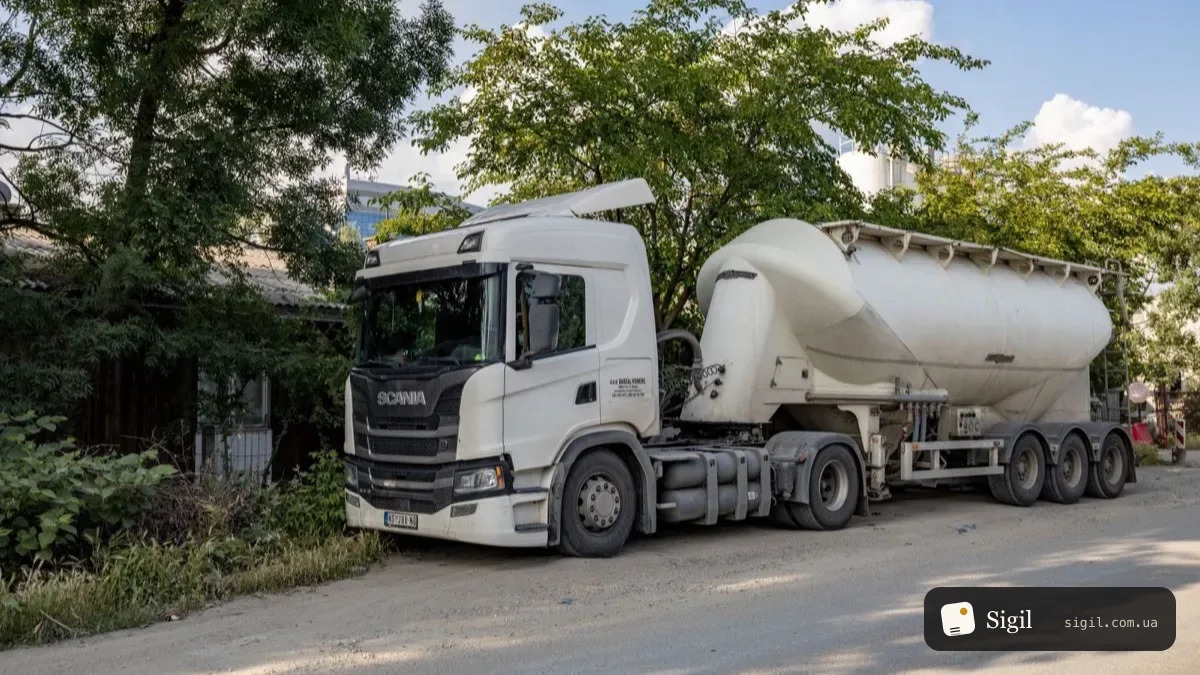
Poland border booking for trucks under draft act UD339 is a paid electronic booking of the exit, 20 zł or about 228 UAH, not a charge for crossing the border itself. It will apply to goods vehicles leaving Poland across the EU external border at the crossings that a regulation will designate. The duty applies from 1 March 2027. As of 14 November 2026 this is a draft that the Polish government has not adopted.
In brief: the duty concerns leaving Poland, not entering, and only those road crossings on the EU external border that a regulation of the finance minister will name (Article 15a(1) and Article 15g(1) of the draft) · the text sets no weight threshold, the explanatory memorandum covers all goods traffic regardless of tonnage, and 7.5 t comes from the government work-list entry of December 2025 · under the draft the act enters into force on 1 February 2027 and the duty applies from 1 March 2027 (Articles 4 and 5), with February set aside in the memorandum for testing the system · the fee is 20 zł per booking, about 228 UAH, payable electronically only and not refunded after a cancellation or a no-show · the driver books in their own name, or a company registered on PUESC books through its representative (Article 15c) · the text has no separate fine for leaving without a booking, and the crossings, booking types and payment methods are left to regulations that do not exist yet · eCherha and the Polish booking do not replace each other, because the first covers leaving Ukraine and the second leaving Poland.
In December 2025 a dispatcher in Lutsk read that Poland would introduce a mandatory paid border booking for trucks over 7.5 tonnes. He was already working out the monthly cost for his fleet and assumed his two vans were not affected. In September 2026 the draft text appeared, and it says something else: there is no weight threshold, the duty will apply only at designated crossings, and the act itself has not been passed.
This article sets out what draft UD339 actually says, what it leaves undecided, and how the Polish booking differs from Ukraine's eCherha queue.
What does the Poland border booking for trucks actually charge for
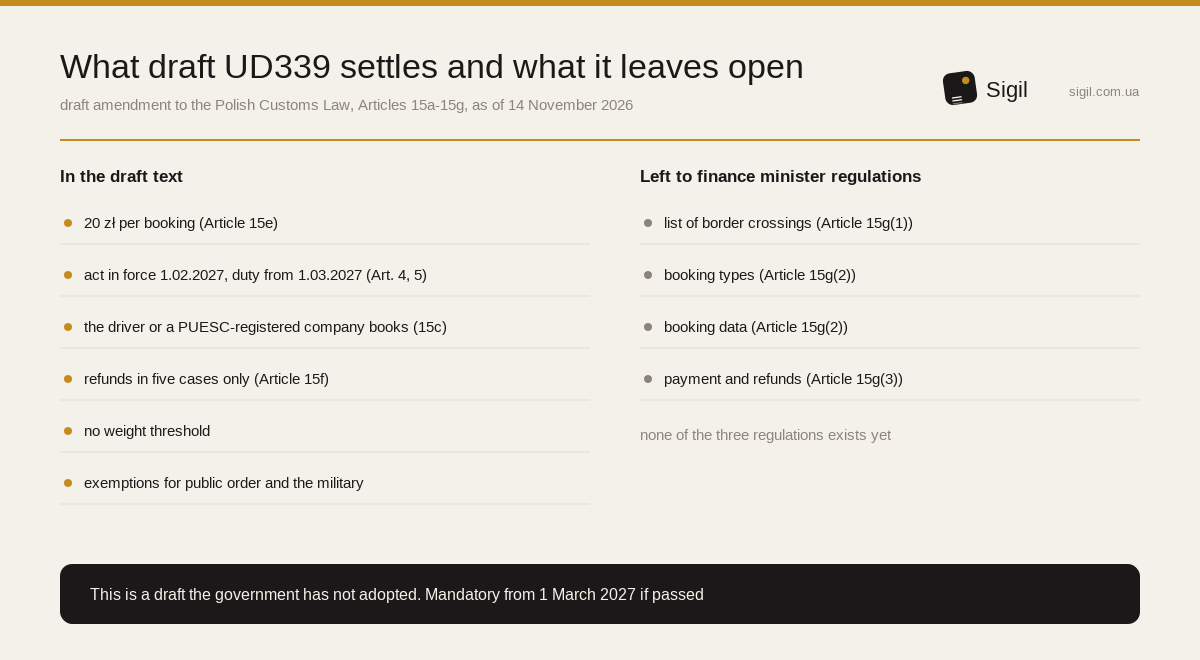
The Poland border booking for trucks in draft UD339 is a fee for a booking, not for crossing the border. The draft adds seven new articles, 15a to 15g, to the Polish Customs Law (Prawo celne). The core rule is a single sentence. At designated road crossings on the EU external border, a goods vehicle leaving Poland must have an electronic booking of its place and time of arrival at the crossing (Article 15a(1) of the draft).
The external border means the border as defined in the Schengen Borders Code. For Poland that is the land border with Ukraine, Belarus and the Kaliningrad region of Russia. Bookings go through an IT system (Article 15b). The explanatory memorandum adds that this will be PUESC, the Polish customs and tax e-services portal, or a dedicated mobile app, which the regulatory impact assessment (OSR) calls e-Awizacja.
The impact assessment states the aim most concretely. Goods vehicles on the exit direction wait up to several dozen hours, and the Polish carriers' association ZMPD puts the cost of one day of truck downtime at about 300 euros. The system is meant to spread arrivals across the day so that the crossing receives an even flow.
The draft grows out of a failed experiment. The voluntary eBooking Truck system ran from 5 October 2015 at two crossings, Koroszczyn and Grzechotki. In the memorandum's own account, booked trucks could not reach the crossing because hundreds of unbooked trucks blocked the access road. The new scheme is therefore mandatory and paid, modelled on Lithuania and Estonia.
When will booking become mandatory
Under the draft the booking duty applies from 1 March 2027 (Article 4(1)). The act itself enters into force on 1 February 2027 (Article 5), and formally booking is possible from that day (Article 4(2)). The memorandum adds, however, that actually taking a place in the queue will be possible from 1 March 2027, and that the one-month gap is there to test the system.
In the draft, 1 February is the date the act enters into force, not the start of the duty. One September 2026 report spoke of new rules from 1 February, a phrasing that is easy to read as the start of the duty. In February 2027 a truck can, on the text, still leave Poland without a booking.
Both dates sit in a draft, not in law in force. To hold, the draft has to pass the government, the Sejm, the Senate and the President's signature before 1 February 2027. The Polish revenue administration KAS published an e-services plan on 28 October 2026 that schedules the e-Awizacja launch for the first half of 2027, with no exact day.
Who has to book, and is there a 7.5 tonne threshold
Booking applies to every vehicle in goods traffic that leaves Poland through a designated crossing. The draft sets no weight threshold. The memorandum says so expressly: the intention is to cover all goods traffic by lorries without distinguishing tonnage categories.
So where does 7.5 tonnes come from? The threshold of a permissible maximum mass above 7.5 t appeared on 2 December 2025 in the UD339 entry of the Council of Ministers' legislative work list, and Polish media repeated it the same week. The entry's version of 17 August 2026 still carries it, along with the police or the Border Guard directing unbooked vehicles to book. The draft text of 3 September 2026 contains neither the threshold nor that mechanism, and it is the text of the act that creates the duty.
Does a 3.5 tonne loaded van leaving Poland through Dorohusk need a booking? On the draft text, yes, if Dorohusk is on the regulation's list of crossings. The regulation will define booking types by the kind of goods carried, not by the vehicle's mass (Article 15g(2)).
There are two exemptions (Article 15a(2)). The first applies where public order, state security or public health require it. The second covers vehicles of the Polish Armed Forces, the armed forces of NATO and Partnership for Peace states, multinational headquarters, and the forces of EU member states acting under the common security and defence policy. There is no commercial exemption: for perishable goods the memorandum plans a priority booking type, not a waiver.
Which border crossings will require a booking
The act itself contains no list of crossings. A regulation of the finance minister will set it (Article 15g(1)), and as of 14 November 2026 no draft of that regulation has been published.
The impact assessment gives a pointer. It estimates annual volume at about 1,271 thousand vehicles, counted from exits through nine crossings: Koroszczyn, Dorohusk, Hrebenne, Medyka, Korczowa, Kuźnica, Bobrowniki, Bezledy and Grzechotki. Four of them are on the Ukrainian border: Dorohusk, Hrebenne, Medyka and Korczowa. This is the basis for a budget estimate, not a legal list.
The smaller crossings to Ukraine, Zosin, Dołhobyczów, Krościenko and Budomierz, do not appear in the estimate, but the regulation may include them. Which masses and queues each of these crossings handles on the Ukrainian side is set out in the article on truck border queues into Poland.
A Polish booking system already exists in pilot form. PUESC offers a service to book a border clearance slot (forms SAT101, SAT102 and SAT107), but only at Bezledy and Grzechotki, on the border with the Kaliningrad region. From 11 to 15 May 2026 the Polish customs and tax service also tested e-Awizacja for departures at Dorohusk, according to a notice from the State Border Guard Service of Ukraine of 8 May 2026.
Who can book, the driver or the company
The booking may be made by the driver in their own name, or by an entity registered on PUESC through its representative (Article 15c of the draft). The act calls both of them bookers and ranks neither above the other.
For a carrier this is a choice. If the driver books, they need the app and a way to pay 20 zł electronically on the road. If the company books, it must be registered on PUESC, and the dispatcher must be linked to it as a representative. How to set up that link is covered in the article on company authorisation on PUESC.
The booker supplies the data needed for the booking, including driver and vehicle data (Article 15d). The full list of fields will be set by regulation (Article 15g(2)), which must take into account the kind of goods and the correct identification of driver, vehicle and goods.
How much does a booking cost, and when is the fee refunded
A booking costs 20 zł, about 228 UAH at the National Bank of Ukraine rate of 11.3916 UAH per zloty on 16 November 2026 (Article 15e(2)). The draft calls it the opłata awizacyjna, or notification fee. The head of the National Revenue Administration (Szef KAS) collects it, and it goes to the state budget. Under the memorandum it can be paid only electronically through a payment service provider, with no cash and no direct bank transfer to the authority.
The specific payment methods will be set by regulation (Article 15g(3)). Cards, BLIK and pay-by-link transfers appear only in the impact assessment, as an assumption for costing the payment operator, not as a rule.
The fee is the same for every vehicle and load, with no indexation. The memorandum is frank about its purpose: to stop bookings made just in case, duplicate bookings and mass booking by bots.
Refunds are limited to a closed list of cases (Article 15f(1)).
| Situation | Is the 20 zł refunded |
|---|---|
| fee paid but no booking was created | yes, point 1 |
| fee paid above the amount due | yes, the excess, point 2 |
| booking not used because the system was unavailable | yes, point 3(a) |
| the interior minister temporarily suspended or restricted traffic at the crossing | yes, point 3(b) |
| the crossing was not operating | yes, point 3(c) |
| the carrier cancelled the booking | no |
| the vehicle did not turn up on time | no |
Refunds are made by Szef KAS, and none are made more than 5 years after the end of the year of payment (Article 15f(2) and (3)). According to the memorandum, refunds will be made both on request and on the authority's own initiative, as a rule by the same payment method, or by bank transfer where that is not possible. The procedure and deadlines will be set by a third regulation (Article 15g(3)).
For a carrier's budget the sum is simple. A truck that leaves Poland for Ukraine four times a month will pay 80 zł, about 911 UAH. For comparison, the impact assessment gives the booking price in Estonia as 1.50 euros and in Lithuania as 5 euros.
What booking types are planned
The memorandum describes three booking types, but only the regulation will fix them (Article 15g(2)), so for now they are an intention rather than a rule.
| Type | Who picks the time | For which goods |
|---|---|---|
| standard | the booker picks crossing, day and hour | any goods |
| priority | the booker picks crossing, day and hour | goods with priority handling under the rules issued under Article 11(7) of the Border Guard Act, including live animals, perishable and dangerous goods, humanitarian aid, blood |
| supplementary | the system places the vehicle at the end of the queue and shows a forecast | any goods, when no time was chosen |
According to the memorandum, the system will call vehicles to the crossing in this order: priority first, then standard, then supplementary. An unjustified priority booking is cancelled, and after checks at the crossing the vehicle is turned back outside the crossing area.
The app is to be free. It will let the user create, pay for, view, cancel, edit and reschedule a booking, and follow the situation at the border. Notifications will arrive in the app, by SMS and by e-mail.
What happens if a truck leaves Poland without a booking
The draft contains no separate fine for leaving without a booking. It amends neither the Road Transport Act nor the Customs Law penalties. The memorandum stresses that the booking does not interfere with border checks and creates no new duties at the crossing itself.
What will happen in practice to a vehicle without a booking, the text does not say. The work-list entry mentions the police or the Border Guard directing such vehicles to book, but that rule did not make it into the draft. So any figure for a fine for leaving without a booking has no basis in the draft text.
How does the Polish booking differ from eCherha
The Polish booking and eCherha work in opposite directions. eCherha is mandatory for leaving Ukraine, and without it the border guard keeps the vehicle off the crossing (point 10 of the Order under Cabinet of Ministers resolution no. 1411). The Polish booking under the draft will cover leaving Poland, which for a Ukrainian carrier is the truck's way back home.
| Feature | eCherha | Booking under UD339 |
|---|---|---|
| direction | leaving Ukraine | leaving Poland |
| status | in operation under resolution no. 1411 of 5.12.2024 | draft act, duty from 1.03.2027 if adopted |
| fee | free (point 11 of the Order) | 20 zł per booking |
| who books | the carrier in the driver's account, after a licence check (point 9 of the Rules) | the driver in their own name, or a PUESC-registered company through a representative |
| mass | separate queues below and above 7.5 t (point 11 of the Rules) | no weight threshold |
| priority | a cycle of three priority vehicles to five ordinary ones | a separate booking type for priority goods |
| deterrent against abuse | a 14-day block | the fee is not refunded |
| crossings | the crossings on the way out of Ukraine | those named in the regulation |
A round trip therefore means two bookings. Leaving Ukraine, the truck queues in eCherha; on the way back out of Poland, if the crossing is on the regulation's list, it needs the Polish booking. The two systems cannot see each other, so a place in eCherha gives no slot at the Polish exit. How eCherha works and when to file the RMPD is explained in the article on the eCherha truck queue.
Where the 7.5 t threshold and the 1 February date in the news come from
The 7.5 tonne threshold entered the news in December 2025, not in September 2026. On 2 December 2025 the UD339 entry appeared on the government work list, and the same week wnp.pl, carrying a PAP report, and trans.info wrote about a mandatory booking for trucks above 7.5 t gross mass and adoption by the government in the first or second quarter of 2026.
The September 2026 reports, published after the draft text came out, are mostly accurate. rp.pl on 10 September and TSN on 15 September give 1 February 2027 as the date the act enters into force and the system start one month later. TSN and podatki.biz state plainly that the rule makes no distinction by weight class. An ambiguous phrasing appears in fakty.com.ua on 21 September, although the same article then gives 1 March 2027 as the system start.
| Source | What it said | What the draft says |
|---|---|---|
| UD339 work-list entry of 2.12.2025 and that week's reports | trucks above 7.5 t gross mass | no weight threshold, the memorandum covers all goods traffic |
| the same December 2025 reports | government adoption in Q1 or Q2 2026 | as of 14.11.2026 the government has not adopted it |
| fakty.com.ua, 21.09.2026 | new rules from 1 February | the act enters into force on 1 February, the duty and actual booking of a place start on 1 March 2027 (Articles 4 and 5, memorandum) |
The lesson for a news reader is simple. A report that mentions the 7.5 t threshold is retelling the December work-list entry, not the draft act of 3 September 2026.
What stage is draft UD339 at
As of 14 November 2026 the government has not adopted draft UD339. Its page on the Rządowy Proces Legislacyjny portal was created on 10 September 2026, and interministerial agreement, public consultation and opinions started the same day. No further stage has been added since: no Council of Ministers committees, no legal commission, no government decision.
The work list planned adoption by the government in the third quarter of 2026, and that quarter ended without it. After the government the draft must pass the Sejm and the Senate, then the President's signature and publication in the Journal of Laws (Dziennik Ustaw). Three regulations of the finance minister must also be issued, and without them the act cannot work in practice. The other dates of the year are gathered in the overview of road haulage law changes in 2027.
How does the exit booking relate to the RMPD filing
The exit booking does not replace the RMPD filing, Poland's mandatory notice of an international road haulage operation, and does not depend on it. A Ukrainian carrier files the RMPD before entering Poland, while the booking concerns the moment of leaving. If a trip through Poland ends with the exit to Ukraine, though, the booked exit time becomes the end of the carriage.
An RMPD reference number is valid for ten days from issue (Article 11(1) of the SENT Act). If the first free exit slot is several days away, those days the truck spends in Poland must be built into the filing. If the number expires earlier, a new filing quoting the previous number is needed (Article 28b(4) of the Road Transport Act).
Driving without a valid filing costs the carrier 12,000 zł, about 136,700 UAH (Annex 3, item 3.2a of the Road Transport Act), and the fines calculator works out the amount for a given case. How long the wait to leave Poland is today, by official granica.gov.pl data, is shown by the border crossing load tool.
What to do
- Follow the UD339 page on legislacja.gov.pl and the Journal of Laws, because the duty only arises once the act is published.
- Wait for the regulation listing the crossings before changing return routes.
- Decide who will book in your company, the driver in the app or the dispatcher through PUESC.
- Register the company on PUESC and link the dispatcher as its representative in good time if the company will book, because setting up the authorisation takes days.
- Build 20 zł per exit from Poland into the trip price and decide how the driver will pay once the regulation names the payment methods.
- Plan the dates in the RMPD filing around the time to the booked exit once the system runs.
What not to do
- Paying intermediaries for a Polish border booking before the system launches. Under the KAS plan the official service starts in the first half of 2027, so the money goes to the wrong place.
- Assuming a van under 7.5 t is exempt. The draft has no weight threshold, and a light vehicle without a booking will face the same duty.
- Treating 1 February as the start of the duty and reworking schedules in advance. Under the draft the duty starts on 1 March, and February is set aside for testing.
- Booking spare slots at several crossings. A cancellation or a no-show does not get the 20 zł back.
- Assuming a place in eCherha entitles the truck to leave Poland. They are different systems for different directions.
- Telling a customer the law is already in force. As of 14 November 2026 it is a draft, and its text may still change.
Sigil handles RMPD filings. Once the Polish exit booking runs, the driver or the company will make it in the KAS system, and Sigil files nothing there.
A demo or training for your team
30 minutes online. We show how Sigil™ files an RMPD from a CMR and answer questions about your runs.
Frequently asked questions
- Will crossing the border out of Poland cost money?
- The booking will, not the crossing itself. Under draft UD339, from 1 March 2027 a goods vehicle leaving Poland through a crossing on the regulation's list books a place and time for 20 zł. The act enters into force on 1 February 2027, but the memorandum sets February aside for testing the system. As of 14 November 2026 the government had not adopted the draft.
- Does a vehicle under 7.5 tonnes need a booking?
- On the draft text, yes. The text has no weight threshold, and the memorandum covers all goods traffic regardless of tonnage. The 7.5 t threshold comes from the government work-list entry of December 2025. The duty will apply at crossings named in the finance minister's regulation.
- Is the 20 zł refunded if I cancel the booking?
- No. Refunds are limited to the five cases of Article 15f(1): no booking created, overpayment, system unavailability, a temporary suspension of traffic at the crossing, or a crossing not operating. Cancellation and no-shows are not among them.
- Will the Polish booking replace eCherha?
- No. eCherha is mandatory for leaving Ukraine, while the Polish booking under the draft covers leaving Poland. A round trip needs both, and the two systems cannot see each other.
- Can a company book on behalf of its driver?
- Yes, if it is registered on PUESC. The booking is made by the driver in their own name or by an entity registered on PUESC through its representative (Article 15c of the draft). The dispatcher must be linked to the company as a representative.
Sources
Drafts, not law in force:
- Projekt ustawy o zmianie ustawy Prawo celne oraz ustawy o Krajowej Administracji Skarbowej (UD339) (draft act amending the Customs Law and the National Revenue Administration Act), Government Legislative Process portal, status on 14.11.2026: draft text of 3.09.2026, Article 1 (Articles 15a to 15g of the Customs Law), Articles 4 and 5; explanatory memorandum (uzasadnienie) and regulatory impact assessment (OSR); page created 10.09.2026, interministerial agreement, consultation and opinions from 10.09.2026, no Council of Ministers decision.
- Projekt ustawy o zmianie ustawy Prawo celne oraz ustawy o Krajowej Administracji Skarbowej, Council of Ministers legislative work list, gov.pl, first published 2.12.2025, version 2.0 of 17.08.2026, read 14.11.2026: threshold above 7.5 t, planned government adoption in Q3 2026.
Normative acts:
- Ustawa z dnia 19 marca 2004 r. Prawo celne (Customs Law), ISAP, consolidated text Dz.U. 2024 poz. 1373: the act to which the draft adds Articles 15a to 15g.
- Ustawa z dnia 12 października 1990 r. o ochronie granicy państwowej (State Border Protection Act), ISAP, consolidated text Dz.U. 2026 poz. 919: Article 16(3)(2) (temporary suspension or restriction of traffic at a crossing).
- Ustawa z dnia 6 września 2001 r. o transporcie drogowym (Road Transport Act), ISAP, consolidated text Dz.U. 2025 poz. 1490: Article 28b(4), Annex 3 item 3.2a.
- Ustawa z dnia 9 marca 2017 r. o systemie monitorowania drogowego i kolejowego przewozu towarów (SENT Act), ISAP, consolidated text Dz.U. 2024 poz. 1218: Article 11(1).
- Resolution of the Cabinet of Ministers of Ukraine of 5 December 2024 no. 1411, zakon.rada.gov.ua: the Order, points 10 and 11.
- Order of the Ukrainian ministry of development of 20 June 2025 no. 1028, zakon.rada.gov.ua, as amended by order no. 691 of 31.03.2026: the Rules, points 9, 11, 15 and 20.
Authorities:
- Plany wdrożenia kolejnych e-usług KAS (KAS e-services rollout plan), National Revenue Administration, gov.pl, 28.10.2026: e-Awizacja launch in Q1-Q2 2027.
- Book a border clearance slot for a coach or a truck, puesc.gov.pl: forms SAT101, SAT102 and SAT107, Bezledy and Grzechotki.
- До уваги міжнародних перевізників та водіїв вантажних транспортних засобів (notice to international carriers and truck drivers), State Border Guard Service of Ukraine, 8 May 2026: e-Awizacja pilot at Dorohusk from 11 to 15 May 2026.
Reports discussed in the section on the news:
- MF: będzie obowiązkowa rezerwacja odprawy granicznej dla ciężarówek powyżej 7,5 ton, wnp.pl carrying PAP, 2.12.2025.
- Obowiązkowa i odpłatna rezerwacja odpraw dla ciężarówek, trans.info, 3.12.2025.
- MF: Kierowcy ciężarówek będą rezerwować datę i miejsce przekroczenia granicy za 20 zł, rp.pl, 10.09.2026.
- Rezerwacja sposobem na kolejki przed przejściami granicznymi, podatki.biz, 10.09.2026.
- Польща готує платний перетин кордону (Poland prepares paid border crossing), TSN, 15.09.2026.
- Платний перетин кордону із Польщею (paid border crossing with Poland), Fakty ICTV, 21.09.2026.
Exchange rate: National Bank of Ukraine, 11.3916 UAH per zloty on 16.11.2026.
Read next
- eCherha truck queue and the RMPD filingThe eCherha truck queue books your exit from Ukraine, and without it you are not let onto the crossing. Waiting times westbound and when to file RMPD.
- Truck border queues into PolandTruck border queues into Poland run separately by mass, for empty vehicles and for goods of groups 1-24. Eight crossings, fifteen queues, how to read them.
- Road haulage law changes in 2027Road haulage changes in 2027 for Ukrainian carriers: ADR 2027 from 1 January, the EU Ukraine agreement to 31 March, KSeF, EES, ETIAS, tachographs, SENT.
- Authorising someone on PUESC to act for your companyAuthorising someone on PUESC: when it is not needed, what the text must say, what the stamp duty costs and why you need not post paper for every employee.
Sigil™ turns a CMR into an RMPD declaration and files it with PUESC, with every field checked against the original.
More about RMPD