RMPD
Road haulage law changes in 2027
Road haulage changes in 2027 for Ukrainian carriers: ADR 2027 from 1 January, the EU Ukraine agreement to 31 March, KSeF, EES, ETIAS, tachographs, SENT.
Published · Author: Makaiev Kostiantyn Oleksandrovych, founder of Sigil RMPD

Road haulage law changes in 2027 come down to four dates for a Ukrainian carrier. The ADR 2027 amendments take effect on 1 January, with carriage under the old edition allowed until 30 June. The EU Ukraine road agreement ends on 31 March unless extended. EES has run in full since 10 April 2026, and ETIAS still has no start date.
In brief: the ADR 2027 amendments enter into force on 1 January 2027, as the UN depositary confirmed on 9 October 2026 · ADR loads may be carried under the 2025 rules until 30 June 2027, and old instructions in writing may stay in the cab until 31 December 2027 · the EU Ukraine road transport agreement runs until 31 March 2027, and any extension depends on a Commission assessment due by 30 November 2026, with no extension decision as of 14 November · EES records a Ukrainian driver biometrically at the first crossing and has operated in full since 10 April 2026; as of 14 November 2026 ETIAS has no date, and the EU promises to announce it several months in advance · from 1 January 2027 KSeF covers even the smallest sellers and its fines begin, but it does not apply to a firm with no seat and no fixed establishment in Poland · in Ukraine a G2V2 smart tachograph is mandatory in vehicles first registered after 30 June 2026 that run under the agreement with the EU · from 1 March 2027 a goods vehicle leaving Poland across the EU external border may need a paid 20 zł booking, but as of 14 November 2026 this is only draft UD339 · the RMPD notification and the 12,000 zł fine do not change in 2027, while SENT for concrete (UD437) and the CO2 based e-TOLL charge (UC74) are still drafts.
November, and the owner of six trucks is planning the year ahead. One new tractor arrives on lease in spring, a Polish customer wants a contract until the end of 2027, and one driver carries fuel under ADR. The group chats say that "everything changes in January": tachographs, visas, the agreement. Below are only the changes that come with an act and a date.
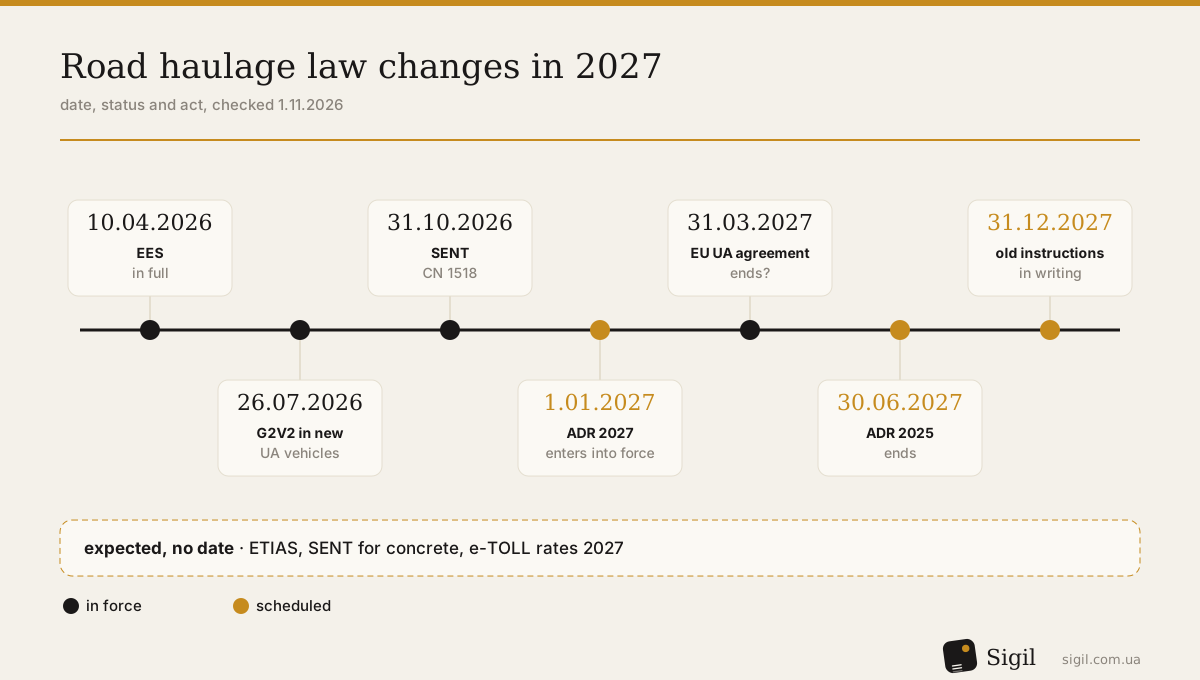
Which changes take effect in 2027
Each row below has an act and a date. "In force" means the rule already applies, "scheduled" means an adopted rule with a future date, and "expected" means there is no act or no date yet. The status was checked on 1 November 2026, and the rows on the EU Ukraine agreement, ETIAS, e-TOLL, exit booking and SENT for concrete on 14 November 2026. The page is updated every quarter.
| Date | What changes | Status | Act |
|---|---|---|---|
| from 12.10.2025, in full from 10.04.2026 | EES, biometric registration of non-EU drivers at the border | in force | Commission Decision (EU) 2025/1544, Regulation (EU) 2025/1534 |
| from 1.07.2026 | tachograph and Regulation 561/2006 rules for vehicles above 2.5 t of EU firms in international transport | in force | Regulation (EC) 561/2006, art. 2(1)(aa) |
| from 26.07.2026 | G2V2 smart tachograph in vehicles first registered in Ukraine after 30.06.2026, in carriage under the EU agreement | in force | Ukrainian Order No 340 as amended by Order No 1727, chapter VI point 1 |
| from 21.09.2026 | Polish e-TOLL: a combination pays when the tractor itself is above 3.5 t, fine 1,500 zł | in force | Act, Dz.U. 2026 poz. 982 |
| from 28.10.2026 | SENT: metal scrap under 19 waste codes taken out of SENT | in force | Regulation, Dz.U. 2026 poz. 1325 |
| from 31.10.2026 | SENT: oils and fats CN 1518 above 500 kg or 500 l | in force | Regulation, Dz.U. 2026 poz. 589 |
| by 30.11.2026 | Commission assessment on extending the EU Ukraine agreement | Joint Committee decision expected | Decision No 3/2025, recital 7 and appendix; Council Decision (EU) 2025/1997 |
| December 2026 | e-TOLL rates for 2027 | expected | notice of the Minister of Infrastructure |
| 1.01.2027 | ADR 2027 amendments | scheduled, confirmed by the UN | ADR, art. 14(3); C.N.395.2026 |
| 1.01.2027 | KSeF mandatory also for sales up to 10,000 zł a month, fines begin; a firm with no seat and no fixed establishment in Poland is excluded | scheduled | VAT Act, art. 106ga(2), art. 106ni, art. 145m |
| 1.03.2027 | mandatory paid booking for goods vehicles leaving Poland across the EU external border, 20 zł | expected | draft act UD339, Articles 15a to 15g of the Customs Law |
| 16.03.2027 | e-TOLL on about 880 km more roads for vehicles above 3.5 t | expected | draft Council of Ministers regulation RD341 |
| 25.03.2027 | EU states lose the option to toll only vehicles of 12 t or more | scheduled | Directive 1999/62/EC, art. 7(13) |
| 27 to 29.03.2027 | Easter in Poland, ban on trucks above 12 t | in force | Regulation, Dz.U. 2023 poz. 2423, § 2 |
| 31.03.2027 | end of the EU Ukraine agreement unless the Joint Committee extends it | in force until that date | Decision No 3/2025, art. 1(1) and (2) |
| until 30.06.2027 | transition period, carriage under ADR 2025 | scheduled | ADR 1.6.1.1 as amended by WP.15/274 |
| 25.06 to 29.08.2027 | Polish summer truck ban | in force | Regulation, Dz.U. 2023 poz. 2423, § 2 pkt 3 |
| 1.07.2027 | ADR: tyre pressure monitoring in new EX/II, EX/III, FL and AT vehicles | scheduled | ADR 9.2.9 as amended by WP.15/274 |
| 31.12.2027 | ADR: deadline for old instructions in writing | scheduled | ADR 1.6.1.58 |
| no date | ETIAS | expected | Regulation (EU) 2018/1240 |
| no date | SENT for concrete and the SENT fines reform, draft UD437 | expected | government draft, not an act |
| no date | e-TOLL with a CO2 emission charge, draft UC74 | expected | government draft, not an act |
What ADR 2027 changes and how long the transition lasts
The amendments to Annexes A and B of ADR enter into force on 1 January 2027 for all contracting parties, Poland and Ukraine among them. The UN depositary confirmed this in notification C.N.395.2026 of 9 October 2026: no state had objected by 1 October.
The transition period gives six months. After the amendment, paragraph 1.6.1.1 allows dangerous goods to be carried under the rules applicable until 31 December 2026 up to 30 June 2027. We derived that date from the amendment text, which replaces 2025 with 2027 and 2024 with 2026 in that paragraph.
Three changes are already visible for a carrier:
- instructions in writing in a new format, while the old ones may be used until 31 December 2027 (1.6.1.58);
- a tyre pressure monitoring system in EX/II, EX/III, FL and AT vehicles first registered after 1 July 2027 (9.2.9);
- new rear protection rules for tank vehicles (9.7.6), while vehicles registered before 1 January 2029 may run without conversion (1.6.5.29).
The amendments do not invalidate drivers' ADR certificates. How ADR works on the Polish leg and what an inspector checks is covered in the article on ADR dangerous goods in Poland.
Will the EU Ukraine agreement be extended after 31 March 2027
The EU Ukraine road transport agreement runs until 31 March 2027 under art. 1(1) of Joint Committee Decision No 3/2025. The decision makes any further extension depend on Ukraine's progress in aligning its law (art. 1(2)), and the Commission presents its next assessment of that progress by 30 November 2026.
As of 14 November 2026 no decision on an extension beyond 31 March 2027 has been taken, and no new Joint Committee decision has appeared in the Official Journal of the EU. The previous extension took two steps on 25 September 2025: the Council set the Union position in Decision (EU) 2025/1997, and the Joint Committee adopted Decision No 3/2025. The committee decides by consensus, and it must meet at least three months before the deadline.
What the agreement requires today, what changes without an extension, and why the RMPD notification stays either way is covered in the article on the EU Ukraine road transport agreement. Here we give only the date and the status, without repeating it.
What EES and ETIAS change for a driver from Ukraine
EES, the Entry/Exit System, started on 12 October 2025 (Commission Decision (EU) 2025/1544, art. 1). Regulation (EU) 2025/1534 gave it 180 days of progressive start, so the system has run in full since 10 April 2026. We derived that date from art. 2(1) and art. 13(2) of the regulation.
For a driver this means three things:
- at the first crossing of the EU external border a facial image and fingerprints are taken;
- every entry and exit is recorded, and the system itself counts 90 days in any 180-day period;
- truck drivers are not exempt, but holders of a residence permit or a long-stay D visa, such as a Polish one, fall outside EES (art. 2(3) of Regulation (EU) 2017/2226).
ETIAS, the travel authorisation for visa-exempt nationals, is not operating as of 14 November 2026. The official EU site says the specific start date will be announced several months before launch, and no such date has been announced. Once launched, ETIAS will apply to a driver travelling without a visa or residence permit, and the documents needed in the cab today are listed in the article on driver documents for international haulage.
Which smart tachograph deadlines apply in 2027
Regulation (EU) 165/2014 sets no new tachograph deadlines for 2027. The replacement deadlines for EU-registered vehicles operating outside their member state of registration have passed: old tachographs by 31 December 2024 and first-version smart tachographs to G2V2 by 19 August 2025 (art. 3(4) and (4a)). The article itself gives no dates; we computed them from the entry into force of Implementing Regulation (EU) 2021/1228 on 19 August 2021.
A Ukrainian vehicle is covered by a Ukrainian rule. A G2V2 smart tachograph is required in a vehicle first registered in Ukraine after 30 June 2026 if it performs international carriage under the agreement with the EU. Ukrainian law has no duty to retrofit the older fleet, and the conditions and exceptions are covered in the article on the G2V2 smart tachograph.
Driving and rest time on the whole journey from Ukraine is governed by AETR, not by Regulation 561/2006 (art. 2(3)(a) of that regulation). In the UN depositary records the last AETR amendment entered into force on 23 April 2022, and none is scheduled for 2027.
What changes in Poland in 2027
Nothing changes for the RMPD notification in 2027: the duty, the form and the 12,000 zł fine for a missing notification (annex 3 item 3.2a of the Road Transport Act) stay the same. The rules around it change, and three of them already apply since autumn 2026.
The first is e-TOLL. Since 21 September 2026 the act states expressly that a combination pays when the tractor itself has a permissible mass above 3.5 tonnes, and the fine for non-payment is 1,500 zł. How to register a vehicle and what to do about OBU is covered in the article on e-TOLL for trucks from Ukraine. The 2027 rates are announced separately by the minister and were not yet published on 14 November 2026.
The tolled network will grow too. Draft Council of Ministers regulation RD341 adds about 880 km of motorways, expressways and national roads to e-TOLL for vehicles above 3.5 tonnes, taking the tolled network from about 5,870 to 6,750 km. The government plans to adopt it in the fourth quarter of 2026, with entry into force set for 16 March 2027. The list of sections had not been published as of 14 November 2026.
Separately, the government is preparing draft UC74, which transposes Directive 2022/362. Under it the e-TOLL charge would have three parts: the infrastructure charge by EURO class, a new external cost charge by the vehicle's CO2 emission class and a new air pollution charge. As of 14 November 2026 this is a draft, not law. The Council of Ministers' legislative work list gives the third quarter of 2026 as the planned date for government adoption, but there is no adoption, no entry into force date and no rates.
The second is the SENT goods list. Since 28 October 2026 metal scrap under nineteen waste codes has been outside SENT, and since 31 October oils and fats under CN 1518 above 500 kg or 500 litres have been in it. The SENT goods check shows whether a given load is covered.
The third does not apply yet. Draft UD437, which adds concrete to SENT and softens some SENT fines, had not left the government stage as of 14 November 2026. Interministerial agreement ended on 5 October and public consultation and opinions on 16 September 2026, but the draft has not yet passed the Council of Ministers committees or the government itself. It has no entry into force date. What it contains and why older articles about "SENT for concrete from 2026" are wrong is covered in the article on SENT for concrete.
The fourth concerns leaving Poland. Draft act UD339 makes a goods vehicle leaving Poland across the EU external border, the Ukrainian border included, book its place and time at the road crossing in advance (Article 15a(1) of the Customs Law as drafted). The booking costs 20 zł, about 228 UAH at the NBU rate of 11.3916 UAH/zł on 16.11.2026, and according to the explanatory memorandum can only be paid electronically. The fee is refunded only in defined cases, such as the system being unavailable or a closed crossing (Articles 15e and 15f). The driver books in their own name, or a company registered on PUESC books through its representative (Article 15c). Under the draft the act enters into force on 1 February 2027, voluntary booking is possible from that day, and the obligation applies from 1 March 2027 (Articles 4 and 5). The text sets no weight threshold and no separate fine for leaving without a booking, and a regulation will name the crossings covered. As of 14 November 2026 the draft is at the stage of interministerial agreement and consultation that began on 10 September, and the government has not adopted it.
Polish truck bans in 2027 follow the same regulation: Easter on 28 March, Pentecost on 16 May, Corpus Christi on 27 May and the summer from 25 June to 29 August. The full calendar is in the article on the Poland truck driving ban, and the bans of the countries on the route over the holidays in the article on EU truck driving bans.
Does KSeF apply to a Ukrainian carrier from 2027
KSeF does not apply to a Ukrainian carrier that has neither its seat nor a fixed establishment in Poland. The Polish VAT Act expressly excludes such a taxpayer from the duty to issue invoices in KSeF (art. 106ga(2)(1)). The exclusion also holds when a fixed establishment in Poland exists but takes no part in the service invoiced (point 2). Such a firm may still use the system voluntarily.
KSeF, the Krajowy System e-Faktur, is the Polish state system for structured electronic invoices. The duty came in stages: from 1 February 2026 for firms with sales above 200 million zł including VAT in 2024, and from 1 April 2026 for everyone else. Until 31 December 2026 invoices may still be issued outside KSeF if their monthly total including VAT does not exceed 10,000 zł (art. 145m). That exception ends on 1 January 2027.
Fines start on the same day. An invoice that had to be issued in KSeF but was issued outside it can cost up to 100% of the VAT shown on it. For an invoice without tax the fine is up to 18.7% of the total amount, and the head of the tax office imposes it by decision (art. 106ni(1)). That provision enters into force on 1 January 2027.
Whether a firm has a fixed establishment in Poland is assessed case by case, on the facts. The Ministry of Finance says so in its KSeF questions and answers and promises separate guidance. A Polish counterparty working in KSeF passes an invoice to a foreign recipient in an agreed way, for example as a PDF with a QR code.
What comes later in the EU
The road charging directive lets EU states toll only vehicles of 12 tonnes or more until 25 March 2027 (art. 7(13) of Directive 1999/62/EC). After that date a state that tolls trucks must extend it to goods vehicles above 3.5 tonnes, unless the directive gives it another exception. This changes nothing in Poland, where e-TOLL already charges vehicles above 3.5 tonnes.
The revision of the weights and dimensions directive 96/53/EC remains a proposal without an adopted act as of 1 November 2026, so it is not in the table.
What to do
- Check by 30 June 2027 that the instructions in writing and the equipment for ADR loads meet ADR 2027.
- Follow the Joint Committee decision on the agreement, and sign no contracts beyond 31 March 2027 without a permits clause.
- Warn drivers that their biometrics will be taken at the first EU border crossing.
- Order a new vehicle with G2V2 if it will be registered in Ukraine and run under the EU agreement.
- Check the load against the new SENT goods list before carrying oils, fats or scrap.
- Put the 2027 Polish truck ban dates into the trip plan.
- Check with your accountant before 1 January 2027 whether the firm has a fixed establishment in Poland, because the KSeF duty depends on it.
What not to do
- Registering for ETIAS on third-party websites. The system is not running yet, and the EU will announce the start date in advance.
- Waiting for an automatic extension of the agreement. Decision No 3/2025 makes it depend on an assessment, and without a new decision permits return on 1 April 2027.
- Carrying under ADR 2025 after 30 June 2027. The transition will be over, and a check will apply the new edition.
- Believing articles about "SENT for concrete from 2026". The act was vetoed, and the new draft is not adopted.
- Waiting for new RMPD rules. The notification and the 12,000 zł fine are the same in 2027, so an error in the data costs just as much.
- Treating drafts UD437 and UC74 as law in force. Neither has been adopted by the government, and neither has an entry into force date.
Sigil files RMPD notifications and does not handle SENT or KSeF. This page describes changes in the law, not features of the service, and is updated every quarter.
A demo or training for your team
30 minutes online. We show how Sigil™ files an RMPD from a CMR and answer questions about your runs.
Frequently asked questions
- When does ADR 2027 enter into force?
- On 1 January 2027. The UN depositary confirmed this on 9 October 2026, as no state had objected. The transition period runs until 30 June 2027, and until then goods may be carried under the 2025 rules.
- Does a driver from Ukraine need ETIAS in 2027?
- Not yet. As of 14 November 2026 ETIAS is not operating and has no start date. The EU promises to announce the date several months in advance, and once it runs, a driver without a visa or residence permit will need the authorisation.
- Will the EU Ukraine road agreement be extended after 31 March 2027?
- There is no decision yet. None had been taken as of 14 November 2026. Decision No 3/2025 makes an extension depend on a Commission assessment due by 30 November 2026. There is no automatic extension, and without a new decision permits come back.
- Does the RMPD notification change in 2027?
- No. The duty to file RMPD, the form and the 12,000 zł fine for a missing notification are the same in 2027. The rules around it change: SENT, e-TOLL and the truck ban calendar.
- Must an older Ukrainian truck be retrofitted with a smart tachograph?
- No, under Ukrainian law. The G2V2 duty covers vehicles first registered in Ukraine after 30 June 2026 that run under the EU agreement. Retrofitting the older fleet appears only in the appendix to Decision No 3/2025, as a task for the state.
Sources
International acts:
- Notification C.N.395.2026.TREATIES-XI.B.14, UN Secretary-General as ADR depositary, 9.10.2026: entry into force of the amendments on 1.01.2027; C.N.252.2026.TREATIES-XI.B.14, 1.07.2026: proposal of amendments, document ECE/TRANS/WP.15/274: paragraphs 1.6.1.1, 1.6.1.58, 1.6.5.29, 9.2.9, 9.7.6.
- Joint Committee Decision No 3/2025, OJ L 2025/2352 of 21.11.2025: art. 1(1) and (2), recital 7, appendix.
- Council Decision (EU) 2025/1997 of 25.09.2025, OJ L of 1.10.2025: the Union position on continuing the agreement until 31.03.2027, recitals 5 and 9. No new Joint Committee decision as of 8.11.2026.
- Commission Implementing Decision (EU) 2025/1544: art. 1 (EES start on 12.10.2025); Regulation (EU) 2025/1534: art. 2(1), art. 4, art. 13(2); Regulation (EU) 2017/2226: art. 2(3).
- Regulation (EU) 2018/1240 on ETIAS; official ETIAS page, read 1.11.2026; no announcement of a start date found as of 8.11.2026.
- Regulation (EU) 165/2014, consolidated text of 31.12.2024: art. 3(4) and (4a), art. 8(1); Implementing Regulation (EU) 2021/1228.
- Regulation (EC) 561/2006, consolidated text of 22.05.2024: art. 2(1)(aa) and (3)(a).
- Directive 1999/62/EC as amended by Directive (EU) 2022/362: art. 7(13).
- AETR European Agreement, UN depositary record.
Polish acts (ISAP):
- Act of 29 May 2026 amending the Public Roads Act, Dz.U. 2026 poz. 982: art. 1 pkt 1 and 2.
- Regulation of 12 October 2026, Dz.U. 2026 poz. 1325, and Regulation of 22 April 2026, Dz.U. 2026 poz. 589, on SENT goods.
- Regulation on periodic traffic restrictions and bans, consolidated text Dz.U. 2023 poz. 2423: § 2.
- Road Transport Act, consolidated text Dz.U. 2025 poz. 1490: annex 3 item 3.2a.
- Act of 11 March 2004 on value added tax, consolidated text Dz.U. 2026 poz. 1263: art. 106ga(1) and (2)(1) and (2), art. 106ni(1), art. 145l, art. 145m; Act of 5 August 2025, Dz.U. 2025 poz. 1203: art. 2 point 5 (art. 106ni fines from 1.01.2027).
Government drafts, not law in force:
- Draft act amending the act on monitoring the road and rail carriage of goods (UD437), Government Legislative Process, status on 8.11.2026: interministerial agreement until 5.10.2026, consultation and opinions until 16.09.2026, Council of Ministers committees and the Council of Ministers still ahead.
- Draft act amending the public roads act and the toll motorways act (UC74), Council of Ministers legislative work list, gov.pl, read 8.11.2026: three charge components, planned government adoption in the third quarter of 2026.
- Draft act amending the Customs Law and the National Revenue Administration Act (UD339), Government Legislative Process, status on 14.11.2026: Articles 15a to 15g, Articles 4 and 5 of the draft.
- Draft Council of Ministers regulation amending the regulation on tolled national roads and e-TOLL rates (RD341), Council of Ministers legislative work list, status on 14.11.2026.
Authorities:
- KSeF 2.0 questions and answers, Ministry of Finance, ksef.podatki.gov.pl, read 8.11.2026: stages of 1.02.2026 and 1.04.2026, the 10,000 zł limit until 31.12.2026, fines from 1.01.2027, the exclusion of foreign taxpayers, delivery of an invoice to a foreign recipient.
Ukrainian acts:
- Regulation on drivers' working and rest time, Order No 340 as amended by Order No 1727 of 12.12.2025, in force since 26.07.2026: chapter VI point 1.
Rate: National Bank of Ukraine, 11.3916 ₴/zł on 16.11.2026.
Read next
- EU Ukraine road transport agreement until 31.03.2027The EU Ukraine road transport agreement runs to 31 March 2027 under Decision No 3/2025. What an extension needs, what it requires now, what happens to RMPD.
- ADR dangerous goods in Poland for carriersADR dangerous goods in Poland. Whether a Ukrainian driver certificate counts, what must be in the cab, what ITD checks and what each breach costs.
- The G2V2 smart tachograph and who needs itThe G2V2 smart tachograph binds only vehicles first registered in Ukraine after 30 June 2026. Why the older fleet needs no retrofit and when that will change.
Sigil™ turns a CMR into an RMPD declaration and files it with PUESC, with every field checked against the original.
More about RMPD