SENT
ADR dangerous goods in Poland for carriers
ADR dangerous goods in Poland. Whether a Ukrainian driver certificate counts, what must be in the cab, what ITD checks and what each breach costs.
Published · Author: Makaiev Kostiantyn Oleksandrovych, founder of Sigil RMPD
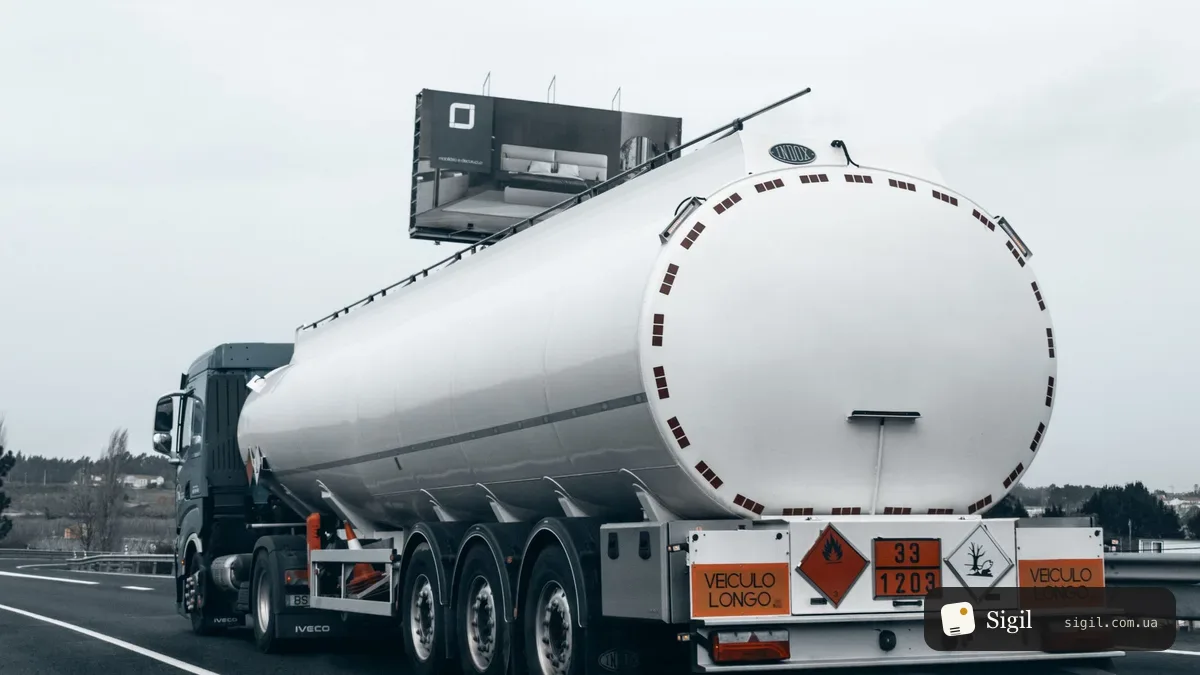
ADR dangerous goods rules in Poland come from the same agreement that applies in Ukraine, so a Ukrainian carrier needs no Polish course and no Polish driver certificate (ADR 8.2.1.6). Inspectors check documents, plates, equipment and the driver and vehicle certificates. ADR fines reach 10,000 zł per participant per check, while SENT and RMPD are separate duties.
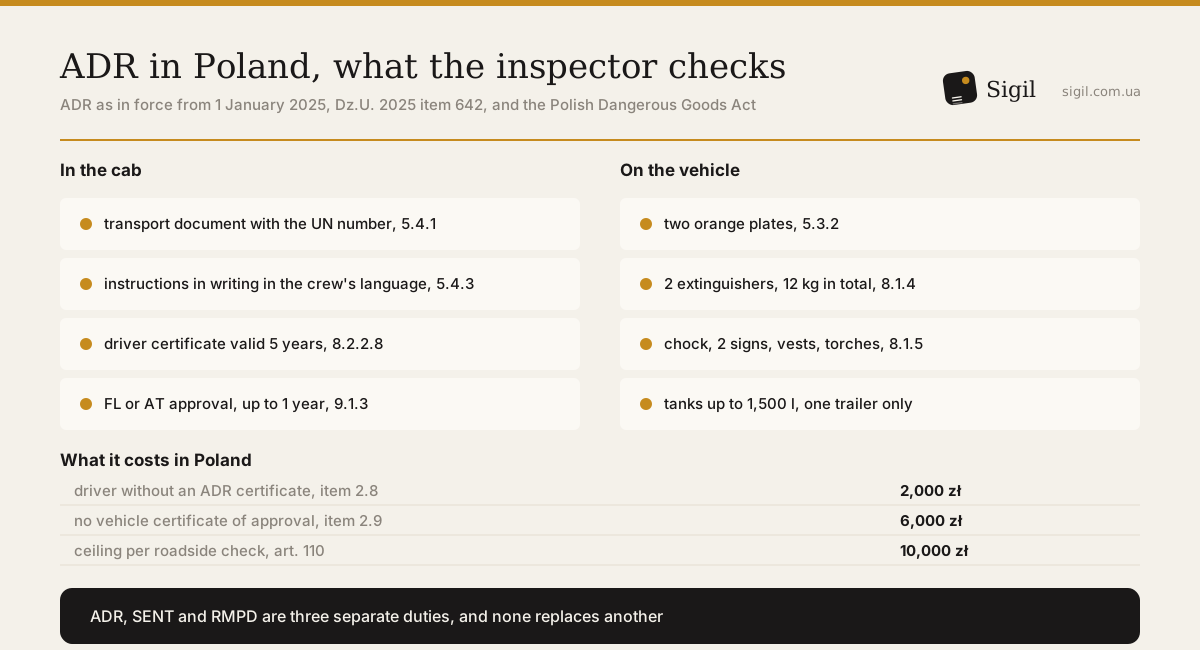
In brief: ADR applies in Poland and in Ukraine alike: Poland has been a party since 6 June 1975, and Ukraine acceded by Law No. 1511-III of 2 March 2000 · in Ukraine the driver certificate is issued by the Ministry of Internal Affairs, it is valid for 5 years, and Poland recognises it without any Polish course (ADR 8.2.1.6) · the cab must hold the transport document (5.4.1), instructions in writing in the crew's language (5.4.3), the driver certificate and, for an FL or AT tanker, a certificate of approval valid for at most a year (9.1.3) · the vehicle needs two orange plates (5.3.2) and, above 7.5 tonnes, two extinguishers totalling 12 kg (8.1.4.1) plus the kit in 8.1.5 · Polish fines run from 200 to 10,000 zł per breach, capped at 10,000 zł per participant per roadside check; a driver without a certificate costs the carrier 2,000 zł · fuels and alcohol are often under ADR and SENT at once, and these are two separate duties; a carrier from outside the EU files RMPD on every Polish run regardless of ADR, and its 12,000 zł penalty comes from a different act · ADR 2027 enters into force on 1 January 2027, goods may travel under ADR 2025 until 30 June 2027, and the old instructions in writing may stay in the cab until 31 December 2027.
On 22 March 2022, on national road 8 at Budzisko in north-eastern Poland, inspectors of the Polish Road Transport Inspection (ITD) stopped a truck and trailer running from Spain to Russia. The driver said he was carrying household chemicals. The IBCs held a corrosive toxic liquid, UN 2922, and the vehicle had no orange plates. The driver had no ADR certificate and no instructions in writing, and the fuel tanks held 1,715 litres instead of the permitted 1,500. The vehicle went to a guarded car park until every requirement was met and a deposit was paid.
What is ADR and does it bind both Ukraine and Poland
ADR is the Agreement concerning the International Carriage of Dangerous Goods by Road, signed in Geneva on 30 September 1957. Ukrainian legislation calls it ДОПНВ, while Ukrainian drivers and dispatchers mostly search for it as ДОПОГ, the Russian acronym. Polish law calls it Umowa ADR. All three names mean the same agreement and the same certificate.
The agreement entered into force on 29 January 1968. Poland deposited its instrument of accession on 6 May 1975 and has been bound since 6 June 1975 (government statement, Dz.U. 1975 No. 35 item 190). Ukraine acceded by Law No. 1511-III of 2 March 2000 and deposited its instrument of accession with the UN on 1 May 2000. Under Article 7 the agreement binds a new party one month after the instrument is deposited.
The technical rules sit in Annexes A and B. Poland published the text in force from 1 January 2025 in Dz.U. 2025 item 642. The Polish Act on the Carriage of Dangerous Goods permits carriage only on ADR terms (art. 5 ust. 1) and refers to ADR for everything it does not regulate itself (art. 4). For a Ukrainian carrier this means the rules are identical on both sides of the border.
Who issues the ADR driver certificate in Ukraine
In Ukraine a regional service centre of the Main Service Centre of the Ministry of Internal Affairs (ГСЦ МВС) holds the examination and issues the certificate. ДОПНВ is the official Ukrainian name of the ADR agreement, so the ДОПНВ driver training certificate is the same ADR certificate the driver shows in Poland. The ministry's competence comes from Article 16 of the Ukrainian Law on the Carriage of Dangerous Goods and section II of the Rules approved by Ministry Order No. 656 of 4 August 2018.
The procedure is set by the Procedure approved by Ministry of Internal Affairs Order No. 449 of 21 July 2022. Staff of the regional service centres hold the examinations (section I point 2), and the card follows the ADR model in 8.2.2.8.5 (section VI point 1). Candidates sit the examination after special training at a centre designated by the Main Service Centre. The back of the card lists the classes or UN numbers the driver may carry.
There are several courses. The basic course is required of every driver carrying dangerous goods (8.2.1.2). A tank specialisation is required for fixed or demountable tanks above 1 m³ and for tank containers above 3 m³ (8.2.1.3). Separate courses cover class 1, explosives, and class 7, radioactive material (8.2.1.4). The certificate is a plastic card in ID-1 format, the size of a bank card, with its title repeated in English, French or German (8.2.2.8.3 and 8.2.2.8.4).
How to renew a Ukrainian ADR driver certificate and what it costs
A Ukrainian ADR driver certificate is renewed with a refresher course and an examination at a regional service centre of the Ministry of Internal Affairs, and the best time is the 12 months before it expires. The new certificate then runs for 5 years from the old expiry date, so no day is lost (section VI point 4 of Procedure No. 449). An examination passed earlier gives 5 years from the examination date, and part of the old period is lost (point 5). The old card goes back to the service centre.
The validity itself is 5 years from the examination after the basic or a specialisation course (ADR 8.2.2.8.2, section VI point 2 of the Procedure). A driver who adds a specialisation during that period, a tank course for example, receives a new card with the same expiry date rather than a fresh 5 years (point 3).
| Item | Amount or timing | Source |
|---|---|---|
| fee for the examination and the certificate | 78 hryvnias, the same for a resit | Main Service Centre service page |
| blank card | paid separately | Main Service Centre service page |
| processing time | up to 5 working days | Main Service Centre service page |
| resit after a failed examination | no earlier than 5 days later | Main Service Centre service page |
| validity of the certificate | 5 years | ADR 8.2.2.8.2, section VI point 2 |
The 78 hryvnias is only the state fee. The course at a special training centre is paid for separately, and the service page gives no price for it. The application comes with a passport or residence permit, a national driving licence, the taxpayer number document if the ministry register lacks it, and a payment receipt that can be checked on check.gov.ua. An exchange also needs the current ДОПНВ certificate.
Anyone can check online on the Main Service Centre's website whether a certificate is valid, using its series and number. A consignor who wants to verify a driver before loading can do the same. ADR 2027 allows a partly remote refresher, as the section below explains.
Does Poland recognise a Ukrainian ADR certificate
Yes, with nothing to file. ADR 8.2.1.6 says that certificates issued by the competent authority of one Contracting Party are recognised by the others for as long as they are valid. The Polish act requires the driver to hold a valid ADR certificate (art. 20 ust. 1), and a valid Ukrainian certificate meets that requirement.
A Polish certificate is issued by the voivodeship marshal, the regional authority, to a person aged at least 21 after a course and examination (art. 20 ust. 2). The ADR schools that fill the Polish search results train for that document. A Ukrainian carrier's driver with a valid Ukrainian certificate does not need it.
Does a Ukrainian driver have to swap an ADR certificate for a Polish one to drive through Poland? No. The Ukrainian certificate is recognised until it expires. A Polish one goes to whoever takes the course and examination in Poland.
One concession stays at home. In Ukraine a driver who left the certificate behind, while the ministry's register shows it valid, commits the lightest category of breach (section III point 15 of the Rules). Polish law has no such exception. Letting a driver without a certificate carry dangerous goods costs the carrier 2,000 zł (item 2.8 of Annex 1), and each required document missing from the vehicle costs 500 zł (item 2.10).
What must be in the cab and on the vehicle
The required set depends on whether the load travels under full ADR or under the 1.1.3.6 exemption described in the next section. Before departure the carrier must make sure the documents are on board, the plates are fitted and the equipment is complete (ADR 1.4.2.2.1). Under full ADR:
| What | ADR provision | When |
|---|---|---|
| Transport document: UN number, proper shipping name, label numbers, packing group, quantity, consignor, consignee, tunnel code | 5.4.1.1.1 | always, also under 1.1.3.6 |
| Instructions in writing, four pages to the model, in a language every crew member can read | 5.4.3 | full ADR |
| Driver training certificate | 8.2.1, 8.1.2.2 | full ADR |
| Vehicle certificate of approval, at most a year from the inspection | 9.1.3 | EX/II, EX/III, FL, AT, MEMU |
| Photo identity document for each crew member | 1.10.1.4, 8.1.2.1 | full ADR |
| Two orange plates, front and rear | 5.3.2.1.1 | full ADR |
| Plates with the hazard identification number and UN number on the tank sides | 5.3.2.1.2 | tankers |
| Two extinguishers totalling 12 kg, one of at least 2 kg and one of at least 6 kg, for units above 7.5 t | 8.1.4.1 | full ADR |
| A wheel chock per vehicle, two self-standing warning signs, eye rinsing liquid | 8.1.5.2 | full ADR |
| For each crew member a warning vest, portable lighting, gloves and eye protection | 8.1.5.2 | full ADR |
Language matters at the border. The transport document is written in an official language of the country of dispatch and, if that is not English, French or German, also in one of those three (5.4.1.4.1). For a load from Ukraine that means Ukrainian plus, for example, English. The carrier hands the crew the instructions in writing before departure, in a language each crew member can read and understand (5.4.3.2).
The certificate of approval depends on the vehicle type. A tanker carrying petrol, UN 1203, is an FL vehicle, while a tanker carrying diesel to EN 590, UN 1202, is an AT vehicle, because the FL definition expressly excludes that diesel (9.1.1.2). The orange plate on a diesel tanker carries 30 over 1202, on a petrol tanker 33 over 1203 (Table A, column 20). The certificate expires no later than a year after the inspection (9.1.3.4), and Poland recognises a Ukrainian one for that whole period (9.1.3.2).
Four more rules catch carriers most often. A transport unit with dangerous goods may have no more than one trailer or semi-trailer (8.1.1). Fixed fuel tanks may hold 1,500 litres per transport unit and 500 litres on a trailer, with at most 60 litres in portable cans (1.1.3.3). Passengers are not allowed (8.3.1), and smoking during handling is prohibited, electronic cigarettes included (8.3.5).
When full ADR is not needed
Small quantities in packages may travel without orange plates, instructions in writing or a driver certificate. This is the ADR 1.1.3.6 exemption. Every substance has a transport category from 0 to 4 (column 15 of Table A), and each category has a limit per transport unit, in kilograms for solids and litres for liquids. The article on dangerous goods classes and UN numbers shows how to find the UN number, class and category of a load and how to read the digits on a plate.
| Category | Which goods | Limit per transport unit |
|---|---|---|
| 0 | the most dangerous entries listed in table 1.1.3.6.3 | 0, no exemption |
| 1 | packing group I and selected entries | 20 |
| 2 | packing group II, for example petrol UN 1203 | 333 |
| 3 | packing group III, for example diesel UN 1202 | 1,000 |
| 4 | selected entries, for example charcoal UN 1361 packing group III | unlimited |
With mixed categories you add them up: category 1 times 50, category 2 times 3, category 3 as it stands, and the total must not exceed 1,000 (1.1.3.6.4). The exemption does not lift everything. The transport document stays, showing the total quantity and the calculated value (5.4.1.1.1, Note 1). So do one 2 kg extinguisher (8.1.4.2), crew training (8.2.3) and the smoking ban (8.3.5).
Does 400 litres of diesel in 20 jerrycans need orange plates? No. It is category 3, with a limit of 1,000. Petrol is different: 400 litres of category 2 exceeds 333, so full ADR applies, with plates, instructions in writing and a certified driver.
Limited quantities (LQ) follow a separate rule. A transport unit with a maximum mass above 12 tonnes carrying more than 8 tonnes gross of limited quantity packages must show the LQ mark front and rear (3.4.13 and 3.4.14).
What ADR 2027 changes for a carrier
ADR 2027 enters into force on 1 January 2027 in every state party to the agreement, Ukraine and Poland included. The UN depositary confirmed the date in notification C.N.395.2026 of 9 October 2026, as no state had objected by 1 October. Goods may still travel under the ADR 2025 rules until 30 June 2027, because the amendment replaces the years in 1.6.1.1 with 2027 and 2026.
| Change | What it means for a carrier | ADR provision |
|---|---|---|
| new model of instructions in writing | the old instructions may stay in the cab until 31.12.2027 | 5.4.3, 1.6.1.58 |
| remote driver training | the initial course in person or live online, the refresher also by e-learning | 8.2.2.4.3, 8.2.2.5.4 |
| certificate of approval for a trailer | may be kept outside the cab, in a weatherproof place on the trailer | 8.1.2.2 |
| tyre pressure monitoring system | for EX/II, EX/III, FL and AT vehicles and trailers above 3.5 t first registered after 1.07.2027 | 9.2.9 |
| batteries installed in a cargo transport unit | new entries UN 3563 (lithium metal) and UN 3564 (sodium ion) | Table A |
| rear protection of tank vehicles | vehicles registered before 1.01.2029 may keep running unmodified | 9.7.6, 1.6.5.29 |
Remote training covers theory only. Individual practical exercises stay in person, and the theoretical part of a refresher may not be delivered entirely as e-learning (8.2.2.5.4). How a given training centre runs such a course is for that centre and the competent authority to settle.
Does a driver need a new ADR certificate because of ADR 2027? No. The amendments change neither the validity of the certificate nor its recognition between states. A card issued in 2025 or 2026 stays valid until the date printed in field 8.
Who checks ADR in Poland and what happens on the spot
Four services carry out checks. The Road Transport Inspection works on roads, in car parks and at the premises of anyone involved in the carriage. The police and the Border Guard check on roads and in car parks, and the National Revenue Administration's customs service checks documents only, anywhere in Poland (art. 99 ust. 1 and art. 100 ust. 3 of the Act).
The inspector completes a checklist and a report, and the carrier receives one copy (art. 101). At a border clearance check the report is drawn up only if breaches are found (art. 101 ust. 4). The report shows which service carried out the check, and that decides who issues the fine decision (art. 107 ust. 4).
Where a breach affects safety, the consequence is harder than a fine. At a crossing the vehicle is refused entry to Poland, and inside the country it is removed with its load to a car park at the owner's or holder's expense (art. 102 ust. 1). It is released once the breach is remedied and the removal, parking and safety costs are paid (art. 102 ust. 2). That is how the Budzisko check ended.
What an ADR breach costs in Poland
The Act sets 200 to 10,000 zł per breach (art. 107 ust. 1), with the exact amounts in Annex 1. Fines are imposed by the regional road transport inspector, the police, the Border Guard or the customs authorities (art. 107 ust. 4). The total for one participant in one roadside check cannot exceed 10,000 zł (art. 110 ust. 1). The driver personally can be fined up to 1,000 zł (art. 111).
The annex names the breach, not the person. The fine falls on the participant whose duty was breached (art. 107 ust. 1), and ADR chapter 1.4 divides the duties: the consignor classifies and supplies the document, the carrier checks the vehicle, plates, equipment and driver. The items that come up most often:
| Item | Breach | Amount | Whose duty under ADR |
|---|---|---|---|
| 2.1 | No transport document drawn up | 1,000 zł (≈ 11,500 ₴) | consignor (1.4.2.1.1) |
| 2.4 | Carriage without a transport document | 800 zł (≈ 9,200 ₴) | carrier (1.4.2.2.1) |
| 2.5 | UN number, packing group or name missing from the document | 500 zł (≈ 5,800 ₴) | carrier |
| 2.7 | Crew without instructions in writing | 300 zł (≈ 3,500 ₴) | carrier (5.4.3.2) |
| 2.8 | Driver without an ADR certificate allowed to carry | 2,000 zł (≈ 23,100 ₴) | carrier |
| 2.9 | No vehicle certificate of approval | 6,000 zł (≈ 69,200 ₴) | carrier |
| 2.10 | A required document missing from the transport unit | 500 zł (≈ 5,800 ₴) each | carrier |
| 4.1 | Vehicle without plates and marks | 2,000 zł (≈ 23,100 ₴) | carrier |
| 4.5 | Orange plates without justification | 500 zł (≈ 5,800 ₴) | carrier |
| 5.1 | Missing ADR equipment or instructions | 200 zł (≈ 2,300 ₴) per item | carrier |
| 5.2 | Required extinguishers missing | 500 zł (≈ 5,800 ₴) | carrier |
| 6.1 | Consigning incorrectly classified goods | 6,000 zł (≈ 69,200 ₴) | consignor |
| 6.7 | Fuel tanks above the ADR limit | 2,000 zł (≈ 23,100 ₴) | carrier |
| 6.8 | Combination with more than one trailer | 1,500 zł (≈ 17,300 ₴) | carrier |
National Bank of Ukraine rate 11.5401 ₴/zł on 25.10.2026, amounts rounded to the nearest hundred hryvnias. For scale: at Budzisko, an uncertified driver, no plates, oversized tanks and missing instructions come to 2,000, 2,000, 2,000 and 300 zł under the annex alone, 6,300 zł in total, about 72,700 ₴.
The Road Transport Act has its own entry as well: carrying dangerous goods without marking the vehicle costs the carrier 2,000 zł (Annex 3 to the Road Transport Act, item 17). The same breach is not punished twice: if another authority has already fined it, no fine is imposed under the Dangerous Goods Act (art. 109 ust. 1 pkt 2).
Where ADR overlaps with SENT
ADR looks at the properties of the goods and the UN number, SENT at the CN code, the direction and the customs procedure. Many loads fall under both. Petrol and diesel have CN code 2710 and at the same time UN 1203 and UN 1202. Ethyl alcohol has code 2207 and UN 1170, methanol code 2905 and UN 1230. The SENT list also includes propane and butane gas and some solvents.
It works the other way round too. Hard coal 2701 is under SENT but, unground, falls outside ADR, while charcoal is outside SENT and under ADR as UN 1361, as set out in coal, SENT and ADR. A CN code can be checked in the SENT goods search.
Neither duty replaces the other. The SENT notification is filed by the consignor or consignee, and in transit through Poland without a customs procedure by the carrier. The carrier pays 20,000 zł, about 230,800 ₴, for failing to file where required (art. 22 ust. 1 of the SENT Act). Thresholds and exemptions for each entry are collected in SENT goods 2026.
Does an ADR load need an RMPD filing
Yes. A carrier from outside the EU files an RMPD notification for carriage in Poland, and the hazard class of the load makes no difference (art. 28b of the Road Transport Act). Who exactly must file and when is explained in who must file RMPD.
The penalty for a missing filing is 12,000 zł, about 138,500 ₴ (Road Transport Act, Annex 3, item 3.2a). It comes from a different act than the ADR fines and has its own ceiling of 12,000 zł per roadside check (art. 92a ust. 3 of the Road Transport Act). The 10,000 zł ceiling in the Dangerous Goods Act applies only to its own Annex 1. Your own figure can be worked out in the SENT and RMPD fines calculator.
How a roadside RMPD check runs and what the inspector asks the driver is covered in the RMPD roadside check.
What to do
- Ask the consignor before loading for the UN number, proper shipping name, class, packing group and quantity. Classification is the consignor's duty (ADR 1.4.2.1.1).
- Work out whether the load fits the 1.1.3.6 limits and decide between full ADR and the exemption.
- Check the driver certificate's expiry. If less than 12 months remain, book the refresher course now.
- For a tanker, check the certificate of approval: the FL or AT type matches the load, and less than a year has passed since the inspection.
- Put a transport document in Ukrainian and English in the cab, with instructions in writing in the driver's language.
- Before departure, check the plates, sealed and dated extinguishers, the 8.1.5 kit and total tank capacity.
- Check the CN code against SENT and file RMPD before the carriage in Poland starts.
- Replace the instructions in writing with the ADR 2027 model by 31 December 2027.
What not to do
- Do not let the driver leave the certificate at home. The register concession works only in Ukraine, and in Poland each missing document costs 500 zł.
- Do not fit orange plates just in case on an empty vehicle or on a load within 1.1.3.6. Unjustified plates cost 500 zł (item 4.5).
- Do not fit extra tanks beyond 1,500 litres per transport unit. That is item 6.7 and 2,000 zł, as at Budzisko.
- Do not hitch a second trailer to a combination carrying dangerous goods. That is item 6.8 and 1,500 zł.
- Do not trust the words household chemicals on an order. Classification is the consignor's job, but on the road the fine for plates and the driver certificate goes to the carrier.
- Do not confuse SENT with ADR. A SENT number does not replace the ADR transport document, and ADR plates do not replace a SENT notification.
Where technology fits in
Sigil does not classify dangerous goods, does not prepare ADR documents and does not file SENT. On this run it does one thing: a carrier from outside the EU files RMPD, and Sigil transfers the data from the CMR into the notification one to one. The dispatcher checks and confirms it, and PUESC returns the reference number. Time not spent retyping the CMR is time left to check plates, tanks and certificates.
Sigil handles RMPD notifications. ADR classification and the transport document are the consignor's, certificates come from the competent authority, and the SENT notification is filed by the consignor, consignee or carrier as the law provides.
A demo or training for your team
30 minutes online. We show how Sigil™ files an RMPD from a CMR and answer questions about your runs.
Frequently asked questions
- Does Poland recognise a Ukrainian ADR driver certificate?
- Yes. Under ADR 8.2.1.6, certificates issued by the competent authority of one Contracting Party are recognised by the others for as long as they are valid. The Polish act requires a valid ADR certificate (art. 20 ust. 1), and a valid Ukrainian one meets that requirement. No Polish course is needed.
- Who issues the ADR driver certificate in Ukraine?
- A regional service centre of the Ministry of Internal Affairs. It holds the examination and issues the ДОПНВ certificate on the ADR model in 8.2.2.8.5, under the Procedure approved by Ministry Order No. 449 of 21 July 2022. Article 16 of the Ukrainian Law on the Carriage of Dangerous Goods gives the ministry this competence. The fee is 78 hryvnias plus the blank card.
- How long is an ADR driver certificate valid?
- 5 years. The period runs from the examination after the initial course (ADR 8.2.2.8.2). A refresher with an examination in the 12 months before expiry adds 5 years from the old expiry date; an earlier refresher gives 5 years from the examination date.
- Do small quantities of dangerous goods need orange plates?
- Not if the load stays within the ADR 1.1.3.6 limits. The limit is 333 for category 2 and 1,000 for category 3, in kilograms or litres per transport unit. The transport document, a 2 kg extinguisher and crew training remain mandatory.
- Does an ADR load need an RMPD filing?
- Yes. A carrier from outside the EU files RMPD for carriage in Poland whatever the hazard class (art. 28b of the Road Transport Act). The 12,000 zł penalty for a missing filing comes from that act, separately from the ADR fines.
Sources
Legislation, as in force on the publication date:
- Agreement concerning the International Carriage of Dangerous Goods by Road (ADR), text from 1 January 2025, Dz.U. 2025 item 642: Article 7, 1.1.3.3, 1.1.3.6, 1.4.2.1.1, 1.4.2.2, 1.10.1.4, 3.4.13, 3.4.14, 5.3.2.1, 5.4.1.1.1, 5.4.1.4.1, 5.4.3, 8.1.1, 8.1.2, 8.1.4, 8.1.5, 8.2.1, 8.2.2.8, 8.2.3, 8.3.1, 8.3.5, 9.1.1.2, 9.1.3, Table A (UN 1202, UN 1203). Text-searchable version from the Ministry of Infrastructure: ADR volume I and ADR volume II, gov.pl.
- Government statement of 8 October 1975 on Poland's accession to ADR, Dz.U. 1975 No. 35 item 190: accession 6.05.1975, in force 6.06.1975.
- Act of 19 August 2011 on the carriage of dangerous goods, consolidated text Dz.U. 2024 item 643: art. 4, art. 5 ust. 1, art. 20, art. 99 ust. 1, art. 100 ust. 3, art. 101, art. 102, art. 107, art. 109 ust. 1, art. 110, art. 111, Annex 1 (items 2.1, 2.4, 2.5, 2.7, 2.8, 2.9, 2.10, 4.1, 4.5, 5.1, 5.2, 6.1, 6.7, 6.8).
- Act of 6 September 2001 on road transport, consolidated text Dz.U. 2025 item 1490: art. 28b, art. 92a ust. 3, Annex 3 (items 3.2a and 17).
- Act of 9 March 2017 on the system for monitoring the road and rail carriage of goods (SENT Act), consolidated text: art. 7, art. 22 ust. 1.
- Law of Ukraine No. 1511-III of 2 March 2000 on accession to ADR, zakon.rada.gov.ua.
- Law of Ukraine No. 1644-III of 6 April 2000 on the carriage of dangerous goods: Article 16.
- Order of the Ministry of Internal Affairs of Ukraine No. 656 of 4 August 2018, Rules for the Road Carriage of Dangerous Goods: section II point 1, section III point 15.
- Order of the Ministry of Internal Affairs of Ukraine No. 449 of 21 July 2022, Procedure for examinations and issue of ДОПНВ driver certificates, registered as No. 950/38286, version of 11.11.2025: section I point 2, section VI points 1, 2, 3, 4, 5.
- Issue of ДОПНВ driver training certificates, Main Service Centre of the Ministry of Internal Affairs, hsc.gov.ua, checked 08.11.2026: 78 hryvnias plus the blank card, up to 5 working days, a resit no earlier than 5 days later, the list of documents.
- ADR 2027, Draft amendments to annexes A and B of ADR, ECE/TRANS/WP.15/274, UNECE, 24.02.2026, and corrigendum ECE/TRANS/WP.15/274/Corr.1: 1.6.1.1, 1.6.1.58, 1.6.5.29, 8.1.2.2, 8.2.2.4.3, 8.2.2.5.4, 9.2.9, 9.7.6, Table A (UN 3563, UN 3564).
Depositary:
- ADR, status of the Agreement, United Nations Treaty Collection: Ukraine, accession 1.05.2000; Poland, accession 6.05.1975.
- Depositary notification C.N.395.2026.TREATIES-XI.B.14, 9.10.2026: the ADR 2027 amendments enter into force on 1.01.2027.
Enforcement authorities:
- Driver without a certificate, truck unfit for ADR carriage, Chief Road Transport Inspectorate (GITD), gov.pl, 28.03.2022: the Budzisko check of 22.03.2022.
Exchange rate: official hryvnia to zloty rate, National Bank of Ukraine, 11.5401 ₴/zł on 25.10.2026.
Read next
- Coal and charcoal from Poland under SENT, ADR, or neitherHard coal 2701 is under SENT, charcoal 4402 is not. Charcoal is UN 1361 class 4.2 under ADR until test N.4 excludes it. "SP 925" is maritime, void since 2026.
- The 2026 list of goods under SENT monitoringThe 2026 SENT goods list with thresholds and CN codes: fuels, oils, grain, honey, poultry, clothing and footwear in 2026. Why Ukrainian goods count.
- What an RMPD is and who must file itRMPD from scratch: what the filing is, who must file it since 1 November 2024, when it is not needed, how it differs from SENT, what happens at entry without it
- SENT and RMPD fines 2026, amounts, who pays, how to appealEvery SENT and RMPD fine in one table: amount in złoty and hryvnia, who pays, article number with a link. Appeal deadlines and the difference between two acts.
Sigil™ turns a CMR into an RMPD declaration and files it with PUESC, with every field checked against the original.
More about SENT