SENT
A collective SENT filing and when it is allowed
A collective SENT filing is for a consignor carrying the goods itself, in one vehicle, and only fuels. The conditions, the keys and the 10 percent margin.
Published · Author: Makaiev Kostiantyn Oleksandrovych, founder of Sigil RMPD
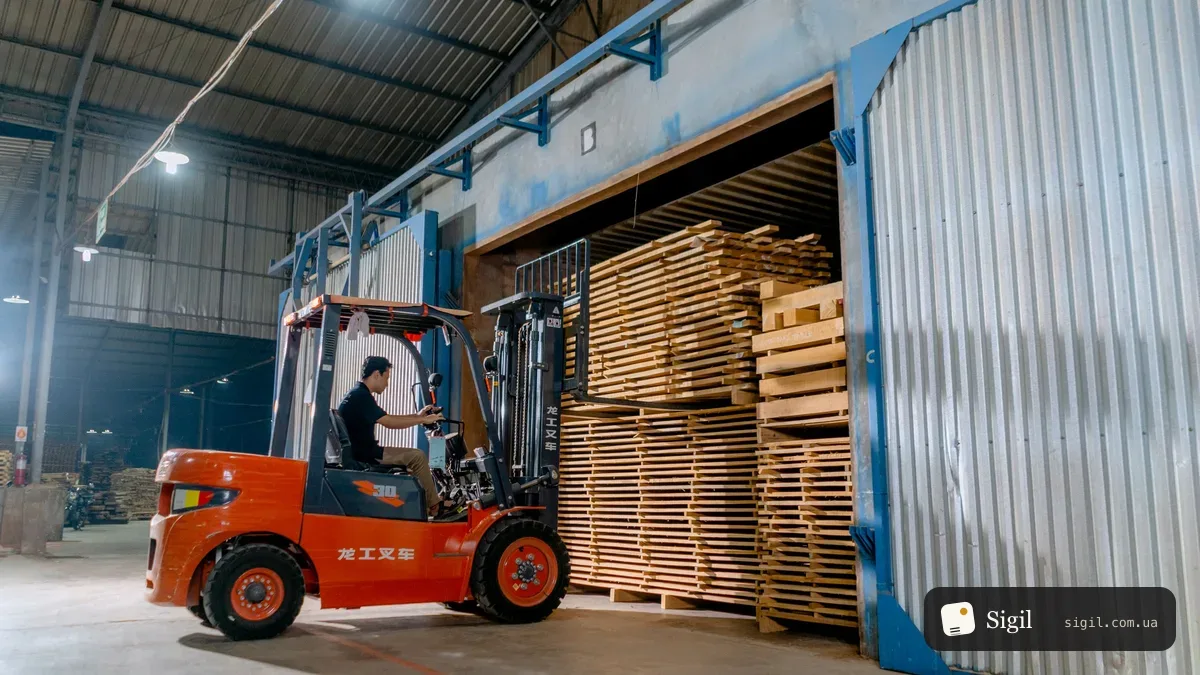
A collective SENT filing is one filing for several deliveries of fuel in one vehicle. Only a consignor that is also the carrier, or fills in the carrier's data, may submit it (§ 7 of the finance minister's regulation). Only fuels qualify, and a discrepancy of up to 10 percent still counts as correct data.
In short: a collective filing is an exception rather than a way to cut paperwork, and it lives in § 7 of the Minister of Finance regulation on carriage filings · only a consignor who is also the carrier, or who performs the carrier's supplementing step, may file one · the carriage runs on a single means of transport and covers at least two supplies, or one supply to at least two places of delivery · the goods come from three groups only, all of them fuels · a discrepancy in quantity, mass or volume of up to 10 percent still counts as correct data · instead of the usual three keys the consignor receives two for itself and one for each consignee · a collective filing lifts nothing from the carrier, and failing to supplement a filing costs 10 000 zł (art. 22 ust. 2 of the SENT Act).
A dispatcher received one reference number from a fuel consignor and a note saying the filing was collective, because the tanker was serving three filling stations. Looking for the place to enter the vehicle data, the dispatcher found nothing, because another company's filing is closed without an access key. Half the work here has already been done by someone else.
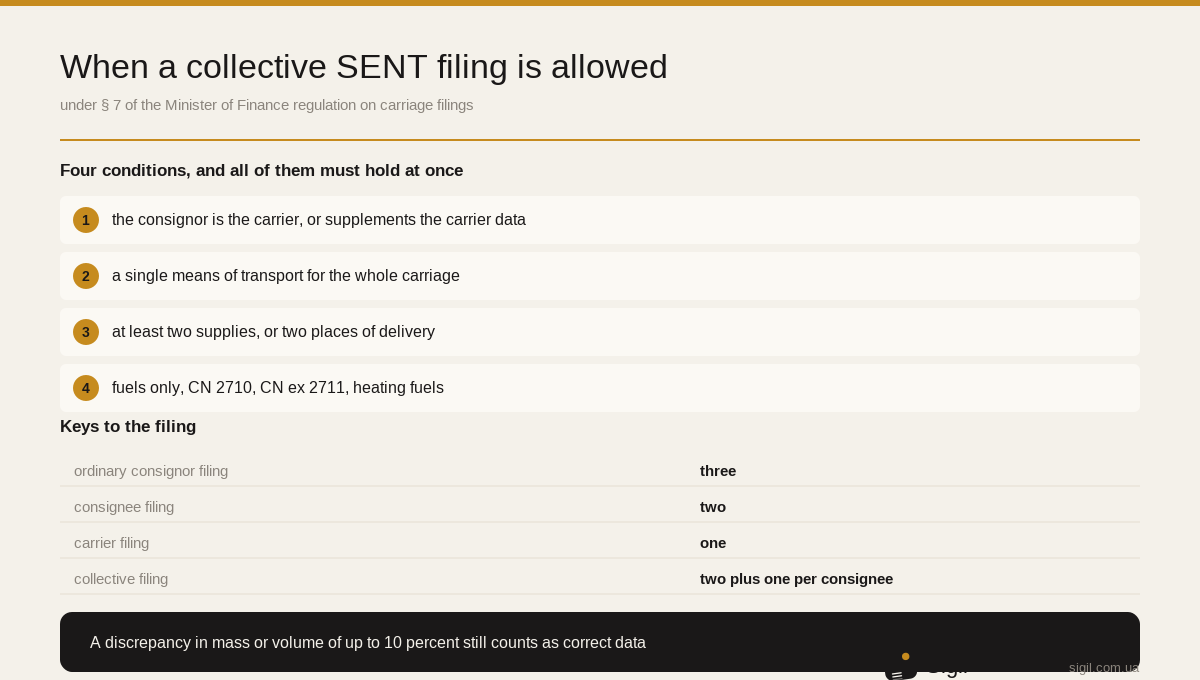
A collective filing is an exception inside the SENT system, and it rests on three conditions at once, namely who files, what vehicle carries the goods and what the goods are.
What a collective SENT filing is
A collective filing is a single filing in which the consignor describes several supplies at once, with the data of every consignee and every place of delivery, and states the total quantity, gross mass or volume of the goods. The portal form is called SENT120 Zbiorcze zgłoszenie przewozu drogowego.
The conditions do not sit in the statute itself but in the Minister of Finance regulation on carriage filings. That explains why they are hard to find: readers look in the Act, and the Act is silent. What the monitoring system is and who files what inside it is explained in the overview of the SENT system in Poland.
Who may file one
The filing is open to a consignor that is at the same time the carrier, or one that performs on the carrier's behalf the step of supplementing the filing with the carrier's data, the vehicle and the dates (§ 7 ust. 1 of the regulation, referring to art. 5 ust. 4 pkt 1 of the SENT Act). In other words, a collective filing assumes that one company holds both ends of the carriage.
From that follows a conclusion rarely stated plainly. If a hired haulier carries the goods and supplements the filing with its own data, there will be no collective filing; there will be separate filings for each supply. Who files what in the ordinary arrangement is set out in the article on who files a SENT.
Which goods a collective filing may carry
The list is closed and entirely made of fuels. Other goods, even when covered by SENT, cannot enter a collective filing.
| Goods | Condition |
|---|---|
| CN 2710 | loaded in a tax warehouse |
| CN ex 2711, propane, butane and their mixtures | loaded in a tax warehouse, or carried immediately after release for free circulation |
| heating fuels under art. 3 ust. 2 pkt 1a of the SENT Act | loaded in a tax warehouse |
Heating fuels stay under supervision whatever the quantity in the consignment, so the 500 kg and 500 litre thresholds that apply to other entries do not apply to them. Whether a given code falls under SENT can be checked in the SENT goods list.
What an access key is and how many of them exist
A key is an electronic code securing access to a filing, which lets its holder supplement or update that filing (§ 2 of the regulation). Without a key another company neither sees nor changes the filing, so it is the key rather than the reference number that decides who may do what.
| Who filed | How many keys and for whom |
|---|---|
| consignor, ordinary filing | three, for itself, for the carrier and for the consignee when the place of delivery is in Poland |
| consignee | two, for itself and for the carrier |
| carrier | one, for itself |
| consignor, collective filing | two for itself and one for each consignee |
The last row says the same thing from another side: a collective filing carries no separate key for the carrier, because the consignor is the carrier. If somebody sends a number, says the filing is collective and attaches no key, that is not forgetfulness.
Why a discrepancy of up to 10 percent is not an error
The 10 percent margin runs through SENT as a whole. The Act treats data on quantity, mass or volume as correct where the discrepancy against the filing stays within 10 percent (art. 23 of the SENT Act). With fuel this is not a relaxation of discipline but an acknowledgement of physics: a liquid changes volume with temperature, and it is never drained to the last litre.
In a collective filing the regulation computes that margin differently, and more generously. The ten percent is taken from the figure increased by the difference between the amount stated for each consignee and the amount that consignee actually took (§ 7 ust. 3). In other words, it accepts that three filling stations did not each receive exactly the litres written beside their names. What errors in SENT and RMPD cost is collected in the article on the penalty amounts.
How a filing is sent and how it is supplemented
There are four channels and all of them rank equally. A filing, a supplement or an update travels through the electronic form on PUESC, as an XML document e-mailed to puesc@mf.gov.pl, through the network services for non-visual communication, or through the portal's file import function (§ 3 ust. 1 of the regulation). A company running its own system never has to open the portal at all.
Heating fuels have one more route that almost nobody writes about. The consignee may supplement the filing with the receipt information using transaction codes generated through PUESC (§ 3 ust. 2). That simplifies exactly the case a collective filing was built for: one tanker and several points of receipt.
What a carrier risks in a fuel carriage
Penalties in fuel carriage are the heaviest in the whole system, and three of them fall on the carrier. Failing to supplement the filing with its own data costs 10 000 zł (art. 22 ust. 2). Failing to file where the carrier is the one who files, or carrying goods that do not match the filing in kind, quantity, mass or volume, costs 20 000 zł (art. 22 ust. 1).
Two penalties of 100 000 zł stand apart and concern fuel specifically. The first applies where declared heating fuel reached a different place of delivery and the party that acquired or holds it has not been established (art. 22 ust. 1a). The second applies where declared goods never reached the place of delivery or the place where carriage ends in Poland, and neither the acquirer nor that place has been established (art. 22a ust. 1). The authority may waive a penalty in the important interest of the carrier or in the public interest, but that is the exception rather than the rule.
What it means for a non-EU carrier
For a carrier a collective filing is almost always somebody else's. It shows up when a Polish fuel consignor carries the goods in its own vehicles, or when it fills in the carrier's data on the carrier's behalf. In the second case it is worth remembering that an act of a representative takes effect for the represented, so the carrier answers for the content of the filing, not the person who pressed the button.
Where the carrier's data is missing, it has to be supplemented before the carriage starts on a public road. That duty comes from art. 5 ust. 4 pkt 1 of the SENT Act, and failing it costs 10 000 zł. Which code stands for which message, SENT100, SENT120 or SENT300, is shown in the dictionary of message codes.
Whether collective filings exist outside road transport
Collective filings exist outside road transport too, in a different shape. The regulation allows a single filing where one kind of goods travels in one train from one sender to one recipient and to one place of delivery (§ 8). This is not the same as the road version: there, several consignees share one vehicle; here, many wagons share one train.
An exception within the exception: the rule does not cover medicinal products, foodstuffs for particular nutritional uses or medical devices. For those, one filing per train is not available.
What to do
- Ask the client who they are in the filing, the consignor alone or the consignor and the carrier at once.
- Check whether the company and vehicle data already stand in the filing before setting off.
- Supplement the filing with your own data before entering a public road if that data is missing.
- Ask the client for the key when the supplementing falls to you, because without a key there is no access.
- Keep the reference number with the driver, because that is what an inspection asks for.
What not to do
- Asking the consignor for "one collective filing" to avoid several. The § 7 conditions are narrow, and for ordinary goods a collective filing simply does not exist.
- Agree instead on who supplements each separate filing, and when.
- Assuming a collective filing lifts the carrier's duties. Supplementing the data is the carrier's duty, and the 10 000 zł penalty is the carrier's penalty.
- Measuring the 10 percent margin the collective way in an ordinary carriage. The general margin comes from art. 23, while the wider calculation in § 7 ust. 3 works only in a collective filing.
- Waiting for a carrier key in a collective filing. There is none, because the consignor is the carrier.
Sigil handles RMPD declarations. A SENT filing is made by the consignor or the consignee.
A demo or training for your team
30 minutes online. We show how Sigil™ files an RMPD from a CMR and answer questions about your runs.
Frequently asked questions
- May one collective filing cover several different goods?
- No. A collective filing covers only the three fuel groups listed in § 7 of the regulation, and only where everything travels on one means of transport. Other goods take separate filings.
- Does a collective filing lift the carrier's duties?
- No. Where the carrier's data is missing from the filing, it must be supplemented before the vehicle enters a public road (art. 5 ust. 4 pkt 1 of the SENT Act). Failing that duty costs 10 000 zł.
- Why is there no carrier key in a collective filing?
- Because the consignor is the carrier. The regulation grants two keys to the consignor and one per consignee (§ 7 ust. 4), so a separate carrier key does not exist there by definition.
- What does the 10 percent margin mean?
- That a small discrepancy is not an error. The general 10 percent margin comes from art. 23 of the SENT Act, and in a collective filing it is measured from the figure increased by the difference between the amount declared for each consignee and the amount taken (§ 7 ust. 3).
- Does a collective filing apply to transit through Poland?
- No. § 7 of the regulation speaks of carriage beginning in Poland with loading in a tax warehouse. Carriage that begins and ends outside Poland goes through a different filing.
Sources
Legal acts:
- Ustawa z dnia 9 marca 2017 r. o systemie monitorowania drogowego i kolejowego przewozu towarów oraz obrotu paliwami opałowymi, ISAP, consolidated text Dz.U. 2024 poz. 1218: art. 3 ust. 2 pkt 1a, art. 5 ust. 1, 2 and 4 pkt 1, art. 22 ust. 1, 1a and 2, art. 22a ust. 1, art. 23.
- Rozporządzenie Ministra Finansów w sprawie zgłoszeń przewozu towarów i zgłoszeń obrotu paliwami opałowymi, ISAP, consolidated text Dz.U. 2021 poz. 1345: § 2, § 3, § 4 ust. 1 to 5, § 7 ust. 1, 3 and 4, § 8.
PUESC service pages:
- Złóż, uzupełnij, zaktualizuj lub zamknij zgłoszenie przewozu rozpoczynającego się na terytorium RP, form SENT120 "Zbiorcze zgłoszenie przewozu drogowego".
Read next
- Who files SENT, the consignor, the consignee or the carrierThe role in SENT follows the route, not the contract. Who files on import, export and transit, what the carrier completes and who pays for another's mistake.
- The difference between SENT and RMPD nobody explainsSENT follows the goods, RMPD follows a non-EU carrier. Who files which, when both meet on one run, and what a missing one costs: 12,000 and 20,000 zł.
- SENT and RMPD fines 2026, amounts, who pays, how to appealEvery SENT and RMPD fine in one table: amount in złoty and hryvnia, who pays, article number with a link. Appeal deadlines and the difference between two acts.
- SENT and RMPD message codes and what each one meansSENT and RMPD message codes from the official PUESC specification: SENT100, SENT300, RMPD100, RMPD406 and the rest, who files each and what to do with it.
Sigil™ turns a CMR into an RMPD declaration and files it with PUESC, with every field checked against the original.
More about SENT