RMPD
RMPD for a van under 3.5 tonnes
RMPD under 3.5 tonnes is still required: the act stops only at 2.5 tonnes, and an exemption from permits is not one from filing. Three thresholds, one van.
Published · Author: Makaiev Kostiantyn Oleksandrovych, founder of Sigil RMPD
RMPD under 3.5 tonnes is still required, because the Road Transport Act does not apply only to vehicles of up to 2.5 tonnes maximum permissible mass (art. 3 ust. 1 pkt 2a). A three-tonne van in international carriage needs an RMPD filing, and a permit exemption does not remove it (art. 28b ust. 1). A missing filing costs 12,000 zł.
In brief: the Road Transport Act does not apply to carriage of goods by a vehicle whose maximum permissible mass is up to 2.5 tonnes (art. 3 ust. 1 pkt 2a) · the 3.5 tonne threshold covers only national carriage by a carrier doing nothing but national carriage, and non-commercial carriage (pkt 2 lit. a and b) · an exemption from permits is not an exemption from filing, because the duty covers the exemption case too (art. 28b ust. 1) · the SENT act knows no vehicle weight threshold at all, its thresholds attach to the goods · the e-TOLL toll begins above 3.5 tonnes, a third and separate threshold · in our data 91 filings from one firm used the ground meant for small vehicles.
A firm carries groupage in a three-tonne van and has heard for years that RMPD starts at 3.5 tonnes. The driver enters Poland with no filing, because "we are small". At the first check it turns out the 3.5 tonne threshold does not apply to international carriage of goods at all.
The mistake is not invented. The figure of 3.5 tonnes genuinely sits in the statute, only in another place and for another case.
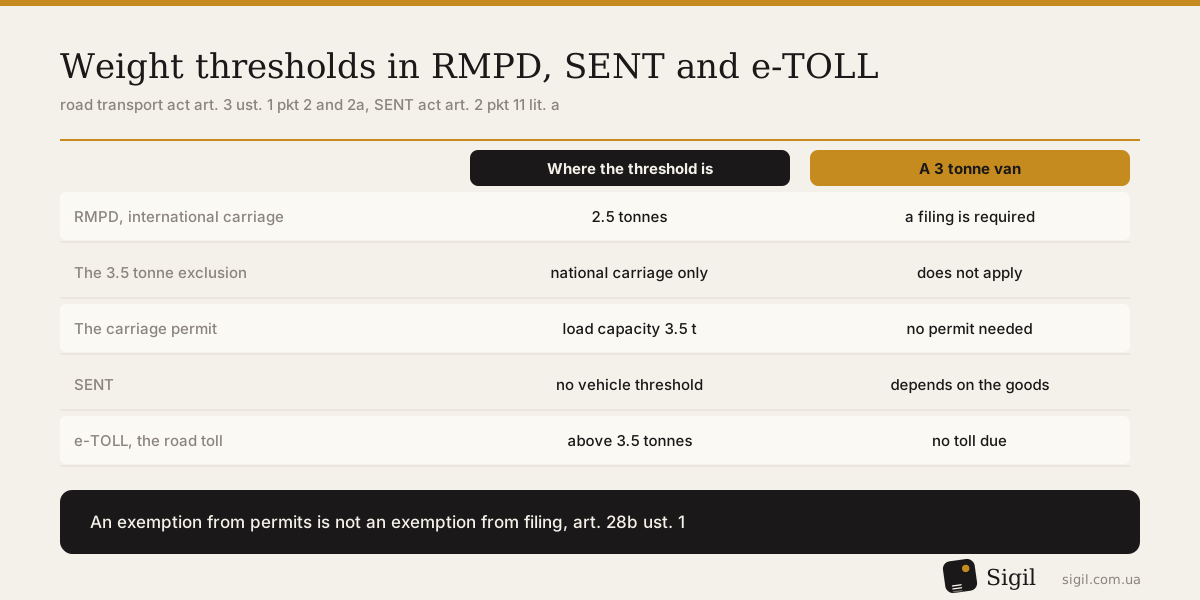
Three systems, three different thresholds, and none of them matches the others. That is why "we are under 3.5 tonnes, this does not concern us" can be true in one system and false in the other two at the same time.
Where 2.5 tonnes really sits in the statute
The Road Transport Act lists the cases in which its provisions do not apply. Among them stands carriage of goods by a motor vehicle or a combination whose maximum permissible mass does not exceed 2.5 tonnes in the road transport of goods (art. 3 ust. 1 pkt 2a).
That is the real boundary for an international carrier. Below it the statute is silent; above it the statute applies with everything that follows from it.
Why 3.5 tonnes misleads
The same provision has a point with 3.5 tonnes, and that is the one the market repeats. It is limited to two cases, though: national carriage of goods where the operator performs nothing but national carriage, and non-commercial carriage (art. 3 ust. 1 pkt 2 lit. a and b).
Does it cover a van from Ukraine driving into Poland? No. Such a run is neither national nor non-commercial, so the exclusion does not apply and the 2.5 tonne boundary governs.
An exemption from permits is not an exemption from filing
Here lies the second half of the mistake. The intergovernmental agreement of 18 May 1992 exempts from permits carriage performed by vehicles with a load capacity up to 3.5 tonnes or a maximum permissible mass up to 6 tonnes. A firm hears "no permit needed" and concludes that no filing is needed either.
The conclusion is wrong. The duty to file arises in three cases, and the third of them is precisely an exemption from permits under an international agreement (art. 28b ust. 1). Instead of a permit number the filing then carries the legal ground of that exemption, which the article on the ECMT book and the grounds for carriage sets out in detail.
Our data shows this is what carriers do. The ground meant for small vehicles stands behind 91 filings from one firm, beside the 6,758 made under the agreement between the European Union and Ukraine. These are filings in the production environment with a carriage start date from 31.10.2024 to 24.10.2026, one platform's data, not the market's.
What SENT says about it
The SENT act knows no vehicle weight threshold. A means of transport is defined simply as a motor vehicle or a combination with a trailer or semi-trailer (art. 2 pkt 11 lit. a), with no figure attached. The regulation on exclusions from filing does not mention vehicle mass either, since it works with CN positions.
From this follows the most surprising part. A three-tonne van carrying 600 kilograms of coal falls under SENT, because the threshold attaches to the goods rather than to the vehicle, and such thresholds fill the SENT list of goods.
The third threshold, the road toll
The electronic toll duty in e-TOLL covers vehicles and combinations above 3.5 tonnes and buses. It is the third threshold in this story and has nothing in common with the two before it, though it uses the same figure. How the app works and how it differs from SENT monitoring is shown in the article on e-TOLL and sending the position.
A table worth pinning up in the office
| System | Where the weight threshold sits | What it means for a 3 tonne van |
|---|---|---|
| RMPD, the Road Transport Act | 2.5 tonnes, art. 3 ust. 1 pkt 2a | a filing is required |
| the carriage permit | load capacity 3.5 t or mass 6 t | no permit, but a filing yes |
| SENT | no vehicle weight threshold | depends on the goods and the quantity |
| e-TOLL | above 3.5 tonnes | no toll due |
Which figure to read, the permissible mass or the load capacity
Two different quantities meet in this topic, and confusing them costs the most. The Road Transport Act counts the maximum permissible mass, that is the vehicle together with its load. The ground of exemption from permits speaks instead of a load capacity up to 3.5 tonnes or a maximum permissible mass up to 6 tonnes, and that is an alternative: meeting one of the two is enough.
Take both figures from the registration document rather than from memory. For a combination add the tractor and the trailer, because the provision speaks of a vehicle or a combination of vehicles.
One van, three different answers
A van with a maximum permissible mass of 3.2 tonnes and a load capacity of 1.4 tonnes carries 700 kilograms of honey from Lutsk to Lublin. What does it need?
An RMPD filing yes, because 3.2 tonnes is above the 2.5 tonne line where the statute begins to apply. A permit no, because the load capacity is below 3.5 tonnes, and that is exactly what goes into the filing as the ground of exemption. A SENT filing yes, because honey of CN position 0409 enters monitoring from 10 kilograms and the van carries seven hundred. An e-TOLL toll no, because 3.2 tonnes is less than 3.5. Who pays above that threshold and what a kilometre costs is worked out in the text on e-TOLL for trucks from Ukraine.
Four questions, four different answers, and none of them follows from the one before. A tachograph in such a van on a run from Ukraine is a fifth, separate question, covered in the article on when a van under 3.5 tonnes needs a tachograph.
Cabotage in a small vehicle
Cabotage has its own provision and its own filing (art. 28b ust. 2), and not a word there concerns the vehicle's mass. Every cabotage operation needs a separate filing, with no further conditions (ust. 9).
For a firm running vans that is the worst combination available. The vehicle is small, the carriage itself needs no permit, and the number of filings equals the number of operations in the run.
What the mistake costs
The penalty for a missing filing is the same whatever the size of the vehicle: 12,000 zł on the carrier (annex 3 item 3.2a). For a firm with two vans that is more than one of them earns in a month. Your own figure comes out of the SENT and RMPD penalty calculator.
The driver answers separately, 1,500 zł for failing to produce the number, and the size of the vehicle does not matter there either. What exactly happens during a check is covered in the article on an RMPD roadside check.
How much one check can cost
The penalties for breaches found during a single roadside check may not exceed 12,000 zł together (art. 92a ust. 3 of the Road Transport Act). A check at the undertaking itself has higher ceilings, from 15,000 zł where the average number of drivers is up to ten, to 30,000 zł above two hundred and fifty (ust. 5). A small van earns no discount here, because the ceilings depend on the number of drivers rather than on the mass of the vehicle.
What to do
- Take the maximum permissible mass from the registration document rather than the load capacity.
- File for every vehicle above 2.5 tonnes travelling in international carriage.
- Enter the ground of exemption from permits where the vehicle is small.
- Check the goods separately, because SENT does not see the vehicle's mass.
- Count the combination as a whole, since the threshold covers combinations too.
What not to do
- Treating 3.5 tonnes as the boundary of the international duty. That figure belongs to national carriage.
- Inferring from the absence of a permit that no filing is needed. The exemption is the third case of the duty.
- Looking at the goods separately from the vehicle, since SENT thresholds attach to goods.
- Counting only the tractor's mass when a combination travels.
Sigil handles RMPD filings whatever the size of the vehicle. A SENT filing is made by the consignor or the consignee.
A demo or training for your team
30 minutes online. We show how Sigil™ files an RMPD from a CMR and answer questions about your runs.
Frequently asked questions
- Is RMPD required for a van under 3.5 tonnes?
- Yes, where the maximum permissible mass exceeds 2.5 tonnes. The Road Transport Act does not apply to carriage of goods by a vehicle of up to 2.5 tonnes (art. 3 ust. 1 pkt 2a). The 3.5 tonne threshold belongs to national and non-commercial carriage, not to international carriage.
- If no permit is needed, is a filing needed?
- Yes. The duty to file also covers the case of an exemption from permits under an international agreement (art. 28b ust. 1). Instead of a permit number the filing then carries the legal ground of the exemption from the portal's dictionary.
- Does SENT apply to small vehicles?
- Yes, because SENT does not look at the vehicle's mass. A means of transport in the SENT act is simply a motor vehicle or a combination (art. 2 pkt 11 lit. a), with no threshold. The thresholds attach to the goods, for example 500 kilograms for coal.
- Does a three-tonne van pay the e-TOLL toll?
- No. The electronic toll duty covers vehicles and combinations above 3.5 tonnes and buses. It is a separate threshold, and it says nothing about RMPD or SENT.
- Is the penalty smaller for a small vehicle?
- No. The penalty for a missing filing is 12,000 zł on the carrier whatever the size of the vehicle (annex 3 item 3.2a), and the driver answers separately with 1,500 zł for failing to produce the number.
Sources
Legislation:
- Act of 6 September 2001 on road transport, ISAP, consolidated text Dz.U. 2025 poz. 1490: art. 3 ust. 1 pkt 2 lit. a and b and pkt 2a, art. 28 ust. 1, art. 28b ust. 1 and ust. 3 pkt 10 lit. b, annex 1 item 2a, annex 3 item 3.2a.
- Act of 9 March 2017 on the road and rail carriage monitoring system, ISAP, consolidated text Dz.U. 2024 poz. 1218: art. 2 pkt 11 lit. a.
- Regulation of the Minister of Finance on excluding certain duties regarding carriage filings, ISAP, consolidated text Dz.U. 2023 poz. 1276: § 2, a list of CN positions with no vehicle weight threshold at all.
The portal's dictionary:
- Dictionary pdr2147 of grounds for exemption from permits, the entry on carriage by vehicles with a load capacity up to 3.5 tonnes or a maximum permissible mass up to 6 tonnes, the intergovernmental agreement on international road carriage of 18 May 1992, form RMPD100 on puesc.gov.pl.
Platform data: 91 filings from one firm on the ground meant for small vehicles and 6,758 on the ground of the European Union and Ukraine agreement, out of 7,133 filings by 18 firms in the PUESC production environment with a register number, cancellations excluded, carriage start date from 31 October 2024 to 24 October 2026, as of 25 October 2026, the Rmpd table. One platform's data, not the market's.
Rate: National Bank of Ukraine, 11.5297 ₴/zł on 15 October 2026.
Read next
- What an RMPD is and who must file itRMPD from scratch: what the filing is, who must file it since 1 November 2024, when it is not needed, how it differs from SENT, what happens at entry without it
- The ECMT permit and what it means for an RMPD filingThe ECMT permit in an RMPD filing: when to name it and when an exemption, what goes into the permit field, and why one filing per run is often not enough.
- e-TOLL and RMPD, how a phone sends your positione-TOLL for RMPD and SENT: one app for the road toll and the position. Where the business number comes from, why the filing list is empty, where the feed breaks.
- The 2026 list of goods under SENT monitoringThe 2026 SENT goods list with thresholds and CN codes: fuels, oils, grain, honey, poultry, clothing and footwear in 2026. Why Ukrainian goods count.
- An RMPD roadside check and what the inspector doesAn RMPD roadside check: what the inspector looks at in the filing, why last trip's number does not help, when the truck is impounded and the driver's rights.
- e-TOLL Poland for trucks from Ukrainee-TOLL in Poland for trucks from Ukraine: who pays, how to register in IKK, phone, OBU or ZSL, prepaid or security, and 1,500 zł fines after 21.09.2026.
Sigil™ turns a CMR into an RMPD declaration and files it with PUESC, with every field checked against the original.
More about RMPD