RMPD
International road haulage licence in Ukraine
An international road haulage licence in Ukraine costs 3,328 UAH in 2026 and has no expiry. How it differs from a permit and where it matters on a Poland run.
Published · Author: Makaiev Kostiantyn Oleksandrovych, founder of Sigil RMPD
An international road haulage licence in Ukraine is a decision by Ukrtransbezpeka that a firm may carry goods across borders. It has no expiry date, and the fee in 2026 is 3,328 UAH. The licence gives no right to a specific run; permits, ECMT licences and international agreements do that. Without it the firm is outside the EU agreement.
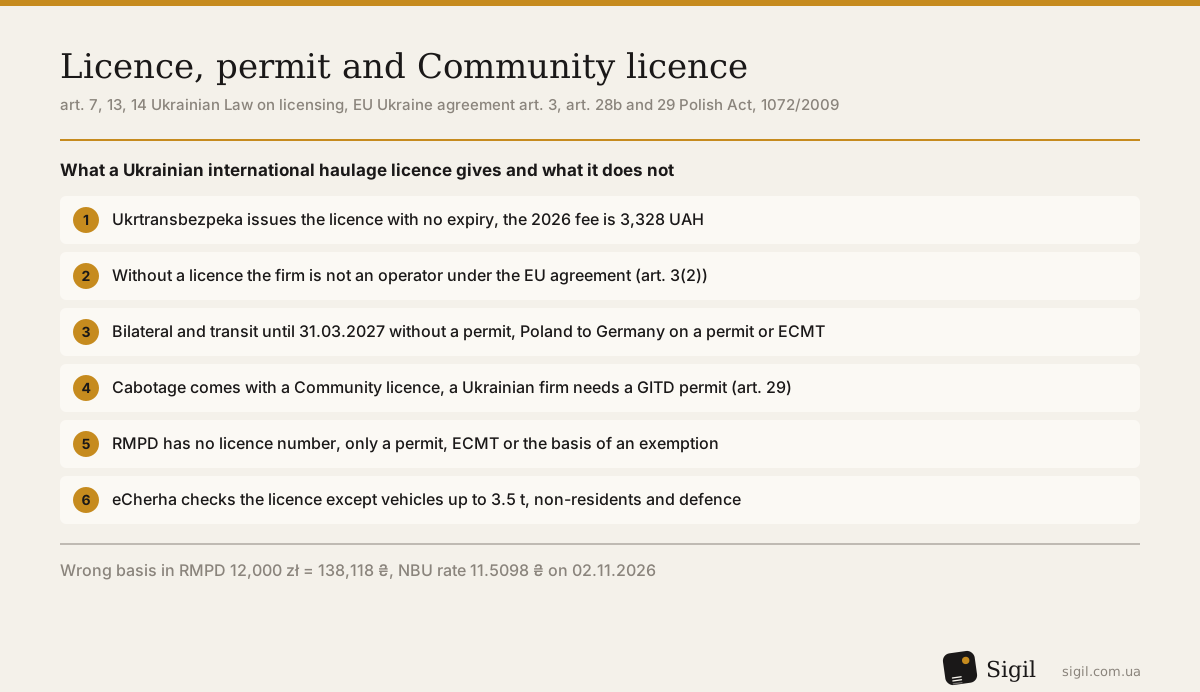
In brief: the licence for international carriage of goods is issued by Ukrtransbezpeka with no expiry date, and the fee equals one subsistence minimum for working-age persons, 3,328 UAH in 2026 · the EU Ukraine agreement exempts from the Polish permit only a carrier authorised by its own state for international carriage, so without the licence the agreement does not cover the firm · the licence is not a permit, and until 31 March 2027 bilateral runs and transit go without a permit form, while a run from Poland to Germany needs a permit or an ECMT licence · the licence is not a Community licence, and cabotage in Poland requires a separate GITD permit for a Ukrainian firm · the licence number does not go into the RMPD filing, the basis field takes a permit number, ECMT data or the legal basis of an exemption · eCherha, the Ukrainian electronic exit queue, checks the licence before a booking, except for vehicles up to 3.5 tonnes, foreign-registered trucks of non-residents and defence vehicles · a wrong basis in an RMPD filing costs the carrier 12,000 zł, which is 138,118 ₴ at the NBU rate of 2 November 2026.
A Polish freight forwarder receives a scan from a new Ukrainian carrier with a question: is this enough for the run? The scan is a decision of Ukrtransbezpeka, the Ukrainian State Service for Transport Safety, granting a licence. Someone in the office calls it "a licence for Poland". Someone else says a permit is still needed. Both are partly right, because three different documents are being mixed up.
Who issues the international haulage licence and for how long
The licence is issued by the State Service of Ukraine for Transport Safety, known as Ukrtransbezpeka. International carriage of passengers and goods by road is on the list of activities that require a licence (art. 7(1) item 24 of the Ukrainian Law on licensing of types of economic activity).
The Ukrainian Law on road transport splits this activity into types of work (art. 9). For goods there are two. International carriage of goods by trucks, other than dangerous goods and waste. And, separately, international carriage of dangerous goods and dangerous waste. A licence for ordinary goods does not cover an ADR load; that needs the second type of work.
The law sets the deadlines. The authority decides to grant or refuse within ten working days of receiving the application (art. 13(8)), and the licence is issued for an unlimited period (art. 13(12)). So "the licence for Poland expired" makes no sense. What expires is a permit or the term of the agreement, not the licence.
The conditions a licensee must meet and the list of documents for the application are in the Licensing Conditions approved by Cabinet of Ministers resolution No 1001 of 2 December 2015. Ukrtransbezpeka orders granting licences cite this resolution, order No 2056 of 20 October 2026 among them. Check the document list against the version in force on the day of filing, because a change to it is being prepared.
The authority's own data shows the scale. On 17 March 2026, 32,210 businesses held a licence for international carriage of goods other than dangerous goods.
How much does an international haulage licence cost in 2026
The fee for issuing a licence equals one subsistence minimum for working-age persons in force on the day of the decision (art. 14(1) of the Law on licensing). From 1 January 2026 that minimum is 3,328 UAH, so a licence issued in 2026 costs 3,328 UAH. The figure of 3,028 UAH still circulates online, but that was the 2025 minimum.
The law sets two payment rules. The authority may not demand the fee before it has decided to grant the licence (art. 14(4)). Payment is due within ten working days of the decision being entered in the licence register (art. 14(2)).
A Ukrtransbezpeka report confirms the figure. In the week it reported on 28 October 2026 it issued 98 new licences, and local budgets received 326,144 UAH, exactly 3,328 UAH per licence. Of those 98 licences, 54 were for international carriage of goods.
What changes for licence holders in 2026 and 2027
Law No 4337-IX of 27 March 2025 brought the carrier requirements of Regulation (EC) No 1071/2009 into Ukrainian law. It added three conditions for licensees to the Law on road transport: impeccable good repute (art. 9-1), adequate financial standing (art. 9-2) and professional competence through a transport manager (art. 9-3).
A transport manager receives a certificate for 10 years after a written examination. If the certificate lapses, the firm has 20 working days to engage another manager (art. 9-3). One manager may run no more than four carriers at a time, with a combined fleet of up to 50 vehicles (art. 34-1).
The law leaves the actual financial standing amounts to the Licensing Conditions. In March 2026 Ukrtransbezpeka wrote that resolution No 1001 in force contains no such provisions, and put a draft of a new resolution out for consultation. We found no adopted new version as of 30 October 2026, so no amounts are given here.
For the Polish route this is not an internal Ukrainian matter. The appendix to Joint Committee decision No 3/2025 lists what Ukraine is to transpose: an electronic register of road transport undertakings (art. 16 of Regulation 1071/2009), the establishment requirements (art. 5) and the good repute requirements (art. 6). Tachographs are on the list too, covered separately in the article on the G2V2 smart tachograph. Any extension of the agreement beyond 31 March 2027 depends on this progress (art. 1(2) of the decision), and the Commission delivers its next progress assessment by 30 November 2026.
How the licence differs from a permit and a Community licence
The licence, the permit and the Community licence answer three different questions, and none of the three documents replaces the other two.
| Document | Issued by | What it confirms | Where it is checked |
|---|---|---|---|
| international haulage licence | Ukrtransbezpeka | the firm may carry goods across borders | eCherha, condition of the EU agreement, checks in Ukraine |
| permit (zezwolenie, art. 28(1) of the Polish Road Transport Act) | the Polish minister, forms handed out by Ukrtransbezpeka offices | this vehicle may make this run | Polish roadside checks, permit field in RMPD |
| ECMT licence | International Transport Forum | the vehicle runs between system countries during its validity | checks in ECMT countries, permit field in RMPD |
| Community licence (licencja wspólnotowa) | the EU state where the firm is established | an EU firm has access to the EU market and to cabotage | checks in EU states |
An EU state issues a Community licence to a carrier established on its territory, for up to 10 years (art. 4(1) and (2) of Regulation 1072/2009). That licence is what gives the right to cabotage (art. 8(1)). A Ukrainian licence does not become a Community licence through the agreement or through decision No 3/2025.
Can a firm with a valid Ukrainian licence take a reload from Wrocław to Poznań? No. That is cabotage. A carrier established outside the EU may perform it in Poland only on a permit from the Chief Inspector of Road Transport (GITD). The application must carry at least two positive opinions from national carriers' organisations (art. 29(1) and (2) of the Polish Road Transport Act). Cabotage without a permit costs 12,000 zł (annex 3, item 3.5).
Why a licence matters when no permit is needed for Poland
The EU Ukraine agreement exempts from the permit not anyone, but a "road haulage operator". The agreement defines it as a person established in a Party and holding an authorisation from that Party to carry goods internationally for hire or reward (art. 3(2) of the agreement). In Ukraine that authorisation is the Ukrtransbezpeka licence. Without it the firm is not an operator within the meaning of the agreement, and the exemption it declares in a filing has nothing to stand on.
The agreement covers four kinds of journey (art. 4). A laden journey between Ukraine and the EU, with or without transit through a third country. A journey from Ukraine back to Ukraine in transit through the EU. A journey from Ukraine to or from a third country in transit through the EU. And unladen journeys linked to those three. Decision No 3/2025 extended the agreement to 31 March 2027 (art. 1(1)).
Everything that happens within the EU stays outside the agreement (art. 2(1)). A Ukrainian firm makes a run from Poland to Germany on a permit or an ECMT licence, and the national licence does not replace that document. A journey without the required permit costs 12,000 zł (annex 3, item 3.1). How to tell transit, carriage to a third country and cabotage apart is set out in the article on carriage to a third country.
Lutsk, 15 March 2027, a laden run to Lublin. Is a permit form needed? No. This is a bilateral journey under the agreement, which runs until 31 March 2027. The filing shows an exemption with its legal basis, not the licence number and not last year's permit number.
What goes into the RMPD filing instead of the licence
The licence number appears nowhere in an RMPD filing. The Polish Act lists the filing data in full, and there is no item for the firm's licence (art. 28b(3) of the Road Transport Act). There is a basis field, and it takes one of three things: a permit number, an ECMT licence number with its validity and the state of establishment, or the legal basis of an exemption (art. 28b(3) item 10).
The duty to file arises in all three cases, so an exemption from the permit is not an exemption from RMPD (art. 28b(1)). Who exactly files is covered in the article on who must file RMPD.
How to fill in the permit field when the run uses an ECMT licence is explained in the article on the ECMT permit and the filing. The remaining fields that come over from the CMR are shown in the CMR to RMPD field map.
A missing filing, or data that does not match the facts, a wrong basis included, costs the carrier 12,000 zł (annex 3, item 3.2a). At the NBU rate of 11.5098 ₴ per 1 zł on 2 November 2026 that is 138,118 ₴. The SENT and RMPD fines calculator works out the figure for a given case. Fines from one roadside check add up to no more than 12,000 zł (art. 92a(3)).
Where a permit was required and no filing was made, the journey counts as made without a permit (art. 28b(10)). That adds no money above 12,000 zł, but the vehicle is sent to a guarded car park at the carrier's expense, and the permit is withheld and cancelled (art. 89a1(1a) and (1b)). A run under the agreement can also end up in the car park, and it may continue once the filing is sent and a reference number obtained (art. 89a1(1a)).
How eCherha checks the licence before departure
Before a truck leaves Ukraine, the licence is checked not by a Polish inspector but by eCherha. The carrier is authorised through a check of the international haulage licence in Ukraine's integrated land transport safety information system (item 9 of the Rules approved by Ministry of Development order No 1028). Without a licence in the register, no truck slot can be booked.
The Rules name three exceptions where the licence is not checked. Vehicles with a maximum mass of up to 3.5 tonnes, foreign-registered trucks owned by non-residents, and vehicles of the security and defence forces. The exception applies only to the queue. It is not a permit for the run, does not lift Polish requirements and says nothing about cabotage.
A refused booking is not a refusal of entry to Poland. It means the system does not see the firm's licence, and a scan of a Polish permit form will not help. Check the firm's entry in the licence register on the Ukrtransbezpeka website, because the authority corrects register errors by separate orders. How the queue itself works is covered in the article on the eCherha truck queue.
When the licence stops being valid
The licence has no expiry date, but it is not eternal. The most common reason it ends is mundane: the firm closed down, and the Ukrainian state register shows an entry on its termination (art. 16(12) item 3 of the Law on licensing). Between 19 and 23 October 2026 Ukrtransbezpeka terminated the licences of 37 carriers on that ground.
A decision terminating a licence can be appealed to the Expert Appeals Council on licensing or to an administrative court within 30 calendar days of the licensee being notified. That is the deadline stated in Ukrtransbezpeka's termination orders. Decisions are published on the authority's website on the next working day, so it pays to watch the site yourself.
How to check a carrier's licence in the Ukrtransbezpeka register
A Ukrainian carrier's licence can be checked free of charge and without logging in, in the "Реєстр виданих та анульованих ліцензій" (register of issued and revoked licences) on the Ukrtransbezpeka website. Type the firm's ЄДРПОУ code or a sole trader's ІПН tax number into the "Пошук" (search) field, and the register shows all its licences with the type of activity, the number and date of the order and the status. On 8 November 2026 the register held 95,052 records.
Two columns matter. "Вид діяльності" (type of activity) must read "міжнародні перевезення вантажів вантажними автомобілями (крім перевезення небезпечних вантажів та небезпечних відходів)" for ordinary goods, and separately "міжнародні перевезення небезпечних вантажів та небезпечних відходів вантажними автомобілями" for ADR loads. "Статус" (status) must be "Чинна" (valid), and the status filter also knows "Анульована" (revoked), "Недійсна" (invalid) and "Поновлена" (reinstated). For a licence of unlimited duration the "Дата закінчення дії" (end date) column is empty, which is normal.
Is the status "Чинна" enough to hand the firm fuel or another ADR load? No. Its record must also list the activity for dangerous goods, because an ordinary licence does not cover ADR loads.
The register serves both sides of an order. A carrier sees what eCherha checks before a booking, and a forwarder can check a subcontractor before the run. If a record differs from the order the firm received, the Ukrtransbezpeka information line answers daily from 08:00 to 19:00 on +38 (044) 350-43-04.
What to do
- Check the firm's entry in the Ukrtransbezpeka licence register before the first eCherha booking.
- Match the type of work in the licence to the load: ADR needs its own type of work.
- Decide the basis for each run separately, agreement, permit or ECMT, and put exactly that basis into RMPD.
- Carry a permit or an ECMT licence in the cab on a run from Poland to Germany and enter the same number in the filing.
- Follow the new Ukrainian Licensing Conditions, because the transport manager and financial standing are already in the law.
- Check after 30 November 2026 whether the EU agreement is extended beyond 31 March 2027.
What not to do
- Do not show a Polish inspector the licence decision in place of a permit for a run to Germany. The licence is not a permit, and the journey will count as made without one, which is 12,000 zł.
- Do not enter the licence number in the RMPD permit field. A wrong basis is data that does not match the facts, and 12,000 zł.
- Do not take a reload within Poland because "the licence is international". Cabotage without a GITD permit costs 12,000 zł.
- Do not pay for a licence before the decision. The law forbids the authority to demand the fee in advance, so money paid before the decision is not the licence fee.
Where technology fits in
Sigil does not check the licence register, does not obtain licences and does not order permits. It carries the CMR data 1:1 into the RMPD100 filing, while a person chooses and confirms the basis of carriage, that is the agreement exemption, a permit or ECMT. The filing goes to PUESC under the carrier's own credentials.
The licence says the firm carries goods abroad. The permit says this run may be made. The Community licence says the firm is established in the EU. Sigil handles RMPD filings only; SENT is filed by the consignor or the consignee.
A demo or training for your team
30 minutes online. We show how Sigil™ files an RMPD from a CMR and answer questions about your runs.
Frequently asked questions
- Does an international haulage licence replace a permit for Poland?
- No. Until 31 March 2027 bilateral runs and transit go without a permit because of the EU agreement, not because of the licence. The licence only makes the firm an operator within the meaning of the agreement. A run from Poland to Germany needs a permit or an ECMT licence alongside the licence.
- How much does an international haulage licence cost in Ukraine in 2026?
- 3,328 UAH. The fee equals one subsistence minimum for working-age persons on the day of the decision (art. 14 of the Ukrainian Law on licensing). It is paid within ten working days of the decision entering the register, and the authority may not demand it in advance.
- Does the licence number go into an RMPD filing?
- No. The basis field takes a permit number, ECMT data or the legal basis of an exemption (art. 28b(3) item 10 of the Polish Road Transport Act). A licence number in the permit field is a wrong basis, for which the carrier pays 12,000 zł.
- Is a Ukrainian licence a Community licence?
- No. A Community licence is issued by an EU state to a firm established on its territory, and only that licence gives cabotage (Regulation 1072/2009, art. 4 and 8). A Ukrainian firm needs a GITD permit for cabotage in Poland (art. 29 of the Polish Act).
- Does eCherha check the licence for a vehicle up to 3.5 tonnes?
- No. The eCherha Rules do not require a licence check for vehicles up to 3.5 tonnes, foreign-registered trucks of non-residents and defence vehicles (item 9 of the Rules). The exception covers only the queue and does not lift Polish requirements for the run.
Sources
Legal acts as in force on the day of publication:
- Law of Ukraine on licensing of types of economic activity, No 222-VIII of 02.03.2015: art. 7(1) item 24 (international carriage of goods requires a licence), art. 13(8) and (12) (ten working days for a decision, unlimited validity), art. 14(1), (2) and (4) (fee, payment deadline, no fee demanded before the decision), art. 16(12) item 3 (termination after an entry in the state register).
- Law of Ukraine on road transport, No 2344-III: art. 9 (types of work), art. 9-1, 9-2, 9-3 and 34-1 as added by Law No 4337-IX of 27.03.2025 (good repute, financial standing, professional competence, transport manager).
- Licensing Conditions for road carriage of passengers, dangerous goods and dangerous waste and international carriage of passengers and goods, Cabinet of Ministers resolution No 1001 of 02.12.2015.
- Law of Ukraine on the State Budget for 2026, No 4695-IX of 03.12.2025: subsistence minimum for working-age persons from 01.01.2026, 3,328 UAH.
- Order No 1028 of the Ministry for Development of Communities and Territories of 20.06.2025, registered with the Ministry of Justice on 24.07.2025 under No 1116/44522: Rules, item 9 (licence check and three exceptions).
- Agreement between the European Union and Ukraine on the carriage of freight by road, EUR-Lex: art. 2(1), art. 3(2), art. 4.
- Joint Committee decision No 3/2025, OJ L 2025/2352: art. 1(1) and (2), appendix (art. 5, 6 and 16 of Regulation 1071/2009, tachographs), Commission assessment by 30.11.2026.
- Regulation (EC) No 1071/2009, EUR-Lex: art. 5, 6 and 16.
- Regulation (EC) No 1072/2009, EUR-Lex: art. 4(1) and (2), art. 8(1).
- Polish Road Transport Act of 6 September 2001, ISAP, consolidated text Dz.U. 2025 poz. 1490: art. 28(1), art. 28b(1), (3) item 10 and (10), art. 29(1) and (2), art. 89a1(1a) and (1b), art. 92a(3), annex 3, items 3.1, 3.2a and 3.5.
Authorities:
- Register of issued and cancelled licences, Ukrtransbezpeka, read 08.11.2026: search by ЄДРПОУ or ІПН, activity types, statuses, 95,052 records, information line.
- Ukrtransbezpeka order No 2056 of 20.10.2026 (licences granted, legal bases) and order No 2055 of 20.10.2026 (licences terminated, appeal within 30 calendar days).
- 98 new licensees, dsbt.gov.ua, 28.10.2026, and licences of 37 carriers terminated, 27.10.2026.
- Regulatory impact analysis of the draft resolution on carrier requirements, Ukrtransbezpeka, 18.03.2026 (32,210 licensees, current conditions without the provisions of Law No 4337-IX).
Exchange rate: NBU, 11.5098 ₴/zł on 02.11.2026.
Read next
- The ECMT permit and what it means for an RMPD filingThe ECMT permit in an RMPD filing: when to name it and when an exemption, what goes into the permit field, and why one filing per run is often not enough.
- eCherha truck queue and the RMPD filingThe eCherha truck queue books your exit from Ukraine, and without it you are not let onto the crossing. Waiting times westbound and when to file RMPD.
- Transit or third-country carriage, how to tellLoading in Poland and unloading in Germany is third-country carriage for a Ukrainian operator, and the EU Ukraine agreement does not cover it.
- The G2V2 smart tachograph and who needs itThe G2V2 smart tachograph binds only vehicles first registered in Ukraine after 30 June 2026. Why the older fleet needs no retrofit and when that will change.
Sigil™ turns a CMR into an RMPD declaration and files it with PUESC, with every field checked against the original.
More about RMPD