SENT
The T1 transit declaration and what it changes
A T1 transit declaration lifts SENT for most goods groups but never lifts RMPD. Who opens it, what the driver carries and what the queue makes of it.
Published · Author: Makaiev Kostiantyn Oleksandrovych, founder of Sigil RMPD
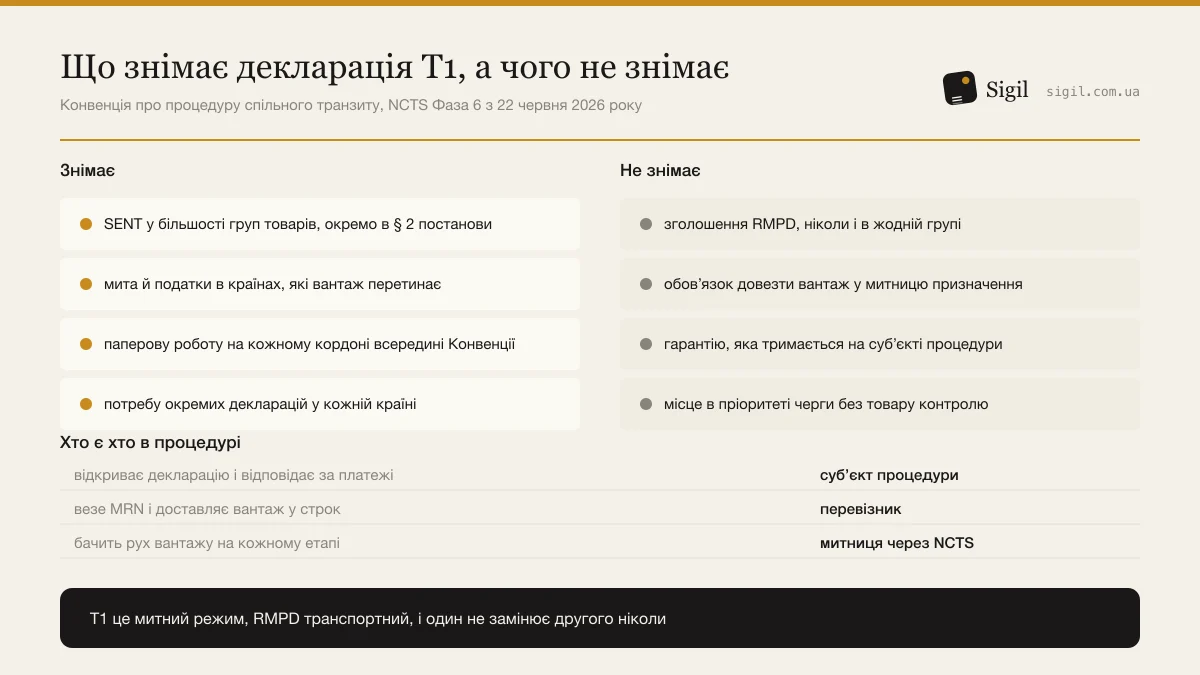
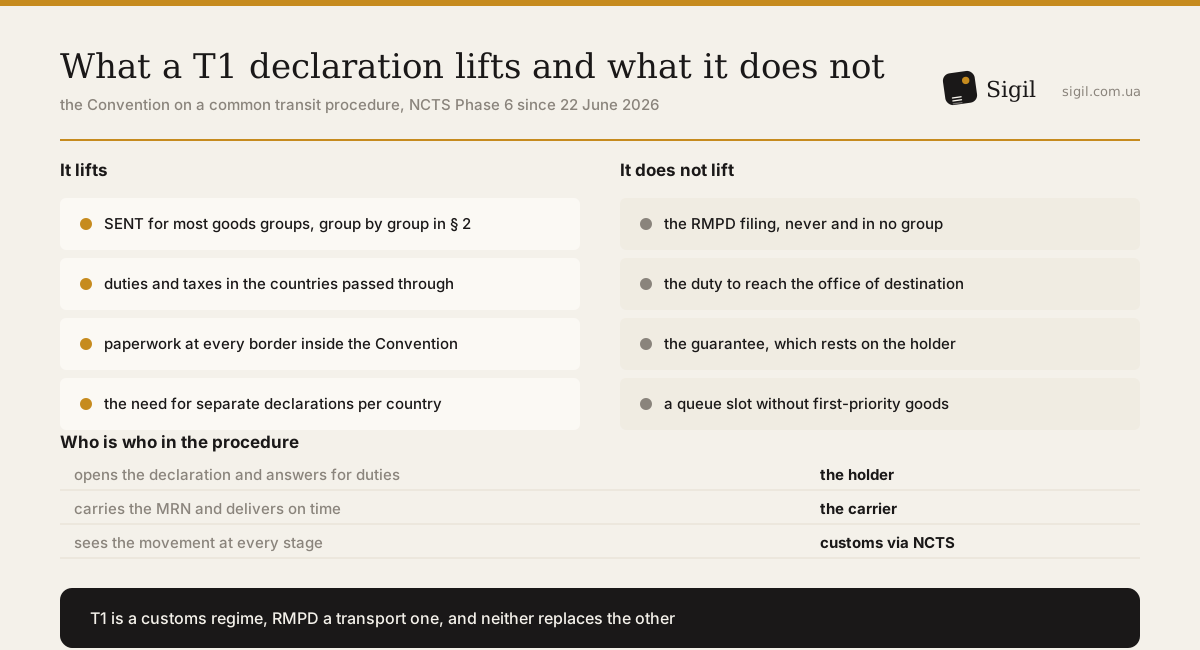
A T1 transit declaration places goods under common transit in NCTS and is opened by the declarant, not the driver. It lifts SENT for most goods groups (§ 2 of the goods regulation) but never lifts the RMPD filing, because customs and transport are separate regimes. The driver carries the MRN and delivers the goods to the office of destination.
In brief: T1 is a transit declaration under the common transit procedure, opened by the holder of the procedure, that is the declarant, not the driver · Ukraine has been in the Convention on a common transit procedure since 1 October 2022, and NCTS has run in Phase 6 since 22 June 2026 · the customs transit procedure lifts SENT for most goods groups, written separately for each group in § 2 of the goods regulation · T1 never lifts the RMPD filing, because these are two regimes, customs and transport · a T1 declaration on its own earns no priority slot in the eCherha queue; it counts only together with goods subject to first-priority control (p. 15 of the Rules) · if the procedure is not discharged, the holder and its guarantee answer for the duties, and the Convention itself decides the rules (art. 102-1 of the Ukrainian Customs Code) · the driver carries the MRN and must deliver the goods to the office of destination.
A truck carried maize from Ukraine to Germany through Poland under a T1 transit declaration. The dispatcher knew that SENT does not apply in transit and left it there. Near Lublin an inspector asked for the RMPD reference number, which nobody had filed, because "we are on a T1". A 12 000 zł deposit and a guarded car park followed.
What a T1 transit declaration is and who opens it
T1 is a transit declaration under which goods move across the territories of the Convention countries under customs supervision, without paying duties and taxes in the countries they pass. It is opened by the holder of the common transit procedure, the declarant. Usually that is a customs agency, a freight forwarder or the consignor itself, not the carrier and not the driver.
Ukraine acceded to the Convention on a common transit procedure in October 2022. In April 2024 it moved to NCTS Phase 5, and at 14:00 on 22 June 2026 to Phase 6, which supports safety and security data within the same procedure.
The declaration is ordered by whoever sells the goods or arranges the carriage: a carrier asks the client for the MRN rather than opening a T1 itself. For a carrier the consequence is plain. "We are running on a T1" means somebody else has taken on the procedure, the guarantee and the liability for duties. The carrier's part is to deliver the goods to the office of destination on time and with the seals intact.
What NCTS is
NCTS, the New Computerised Transit System, is the electronic system in which every T1 declaration lives. The European Commission describes it as a trans-European digital customs system for Union and common transit, launched in 2004 and mandatory since 2005. It is made up of national applications in EU countries and in the other Convention countries that exchange messages over a common network, and 41 countries are connected to it in Phase 6.
There is no paper declaration in this chain. The declarant lodges the T1 electronically, the office of departure registers it and issues the MRN, and the office of destination sends the control results back into the system. Only then does the office of departure close the movement and release the guarantee. A truck that never reaches the office of destination leaves an open movement in NCTS, and that is where the question of duties described below begins.
Phase 6 is aligned with the EU's ICS2 system, so in road transit the declaration can also carry safety and security data for entry into the EU. Poland's NCTS2 PLUS has worked this way since 3 August 2026, which is why the CMR number is now checked by two systems, as the text on a CMR with no number explains.
What the driver sees of a T1
The MRN and the accompanying document. The MRN is the declaration's registration number in the system, by which customs can see at every stage what is happening with the consignment.
In practice a driver needs three things: the MRN, the office of destination and the deadline for getting there. If something goes wrong, a breakdown or a change of route, that is a matter for the holder of the procedure rather than the driver, and it is handled through the system.
Ukrainian customs run a round-the-clock helpdesk for common transit: on working days from 08:00 to 20:00 through the support module, e-mail and phones, and outside those hours through a separate monitoring mailbox.
Does T1 lift the SENT filing
Mostly yes, and not in one sentence but separately for each group of goods. In § 2 of the regulation on goods covered by monitoring almost every paragraph opens the same way: the provision does not apply to goods placed under the customs procedure of transit, storage, temporary admission, processing, export or re-export.
So for fuels, tobacco raw material, denatured ethyl alcohol, liquefied gas and most other groups the transit procedure lifts the SENT duty. There is one group, though, where transit does not help at all. Clothing and footwear have been under SENT since 17 March 2026 (§ 1 pkt 10 of the regulation), and no customs procedure lifts the duty there. A truck carrying clothes on a T1 through Poland needs a SENT filing exactly as it would without one. The remaining groups and thresholds are taken apart in the list of goods covered by SENT.
Does T1 mean SENT is never needed? No. The exemption depends on the group of goods rather than on the bare fact of transit, and that is where the mistake usually happens.
What T1 never lifts
The RMPD filing. These are different systems and different regimes: T1 is customs, RMPD is transport. The duty to file comes from a Polish provision on international carriage and does not depend on the customs procedure the goods travel under.
So the reasoning "we are on a T1, therefore we file nothing" ends at the roadside with a 12 000 zł deposit, and who must file an RMPD knows no exception for transit.
Does T1 earn priority in the border queue
Only together with goods subject to first-priority control. The customs announcement of 16 July 2026 about testing priority in eCherha lists T1 and the TIR carnet next to AEO status, which reads as though the declaration alone were enough.
The text of the Rules is more precise. The first priority slot belongs to a vehicle carrying goods subject to first-priority control, moved by an AEO or travelling under a TIR carnet or the common transit procedure (p. 15 of the Rules). Without such goods neither T1 nor a TIR carnet earns a slot on its own, unlike AEO status, which occupies the third slot separately.
The simplifications that keep a truck away from the customs office
The simplifications in common transit come from the Convention itself rather than from the Ukrainian code. Its Appendix I names the comprehensive guarantee and the guarantee waiver, seals of a special type, the status of authorised consignor and the status of authorised consignee (art. 55 of Appendix I to the Convention on a common transit procedure).
The authorisation is issued by the customs authority of the country where the applicant keeps its main accounts, while an application for consignor status goes to the country where the transit operations will start. Hence a limit worth knowing: consignor status works for operations starting in the country that granted it, not everywhere.
The Ukrainian code adds one line that is rarely quoted. A simplification granted under the Convention may also be used by the company for internal transit (art. 91-1(2)).
For a carrier all of this comes down to one thing. If the consignor holds authorised consignor status, the procedure opens at its premises and the separate trip to the customs office disappears. The same applies at the consignee's end when the status is theirs.
Who pays if the procedure is not discharged
The holder of the procedure and its guarantee. The Ukrainian Customs Code says so directly: establishing the fact and the place where the obligation to pay arises for goods in transit under the Convention, identifying the persons liable, calculating the amount and supervising payment all follow the provisions of the Convention itself (art. 102-1(1)).
The guarantee is not a formality but a condition of the procedure. Companies holding AEO-C have, among their simplifications, a comprehensive guarantee and its reduction to 50 and to 30 percent, or a waiver (art. 13(1) of the Code). For a carrier that means the choice of a partner with such a simplification decides how much money the procedure ties up.
For the driver the practical conclusion is short. An unconfirmed arrival at the office of destination is not a paperwork detail but an open liability for the duties, and the first to feel it is whoever opened the procedure.
What to do
- Ask the client for the MRN and the office of destination before departure, not at the border.
- Check whether your goods fall under SENT at all, because the exemption depends on the group rather than on T1 as such.
- File the RMPD regardless of T1, in the ordinary way.
- Do not plan on queue priority from the declaration alone unless the goods are subject to first-priority control.
- Deliver to the office of destination on time and leave the seals alone, because the whole procedure rests on that.
- If the system is unavailable or the trip falls through, go to the holder of the procedure, who goes to the round-the-clock helpdesk.
What not to do
- Treating T1 as a universal exemption. It is a customs one and has nothing to do with the RMPD filing.
- Assuming transit lifts SENT for any goods. Clothing and footwear under § 1 pkt 10 are freed by no customs procedure at all.
- Promising a client queue priority for the T1 alone. Without first-priority goods the Rules grant no slot.
- Changing the route or the consignee on your own. The holder runs the procedure and changes go through the system, not through a roadside agreement.
- Leaving the MRN only in the dispatcher's phone. The driver needs it in the cab, because that is what gets asked for at the border.
Sigil handles RMPD filings. A T1 transit declaration is opened by the holder of the common transit procedure in NCTS, and Sigil takes no part in it.
A demo or training for your team
30 minutes online. We show how Sigil™ files an RMPD from a CMR and answer questions about your runs.
Frequently asked questions
- Who opens a T1 declaration, the carrier or the consignor?
- The holder of the procedure, that is the declarant. Usually a customs agency, a freight forwarder or the consignor. The carrier plays a different part: delivering the goods to the office of destination on time and with the seals intact.
- Is a SENT filing needed when the goods travel on a T1?
- It depends on the group of goods. In § 2 of the goods regulation almost every group carries an exception for goods placed under the customs transit procedure. Clothing and footwear under § 1 pkt 10, however, are freed by no procedure, so the commodity code has to be checked separately.
- Does T1 remove the RMPD filing?
- No, never. RMPD rests on a Polish provision about international carriage, not on a customs procedure. Transit under T1 is no exception, and at the roadside it costs a 12 000 zł deposit.
- Does T1 earn priority in the electronic queue?
- Only together with goods subject to first-priority control. Under p. 15 of the Rules the first slot belongs to a vehicle carrying such goods, moved by an AEO or under TIR or common transit. The declaration alone earns nothing.
Sources
Normative acts, in force on the day of publication:
- Rozporządzenie Ministra Finansów z dnia 25 kwietnia 2022 r. w sprawie towarów, których przewóz jest objęty systemem monitorowania, ISAP, consolidated text Dz.U. 2024 poz. 1157: § 1 and § 2, including the exception for goods under the customs transit procedure in each group and the separate construction of § 2 ust. 9 for agricultural produce.
- Ustawa z dnia 6 września 2001 r. o transporcie drogowym, ISAP, consolidated text: art. 28b ust. 1 (the RMPD duty, independent of the customs procedure), załącznik nr 3 lp. 3.2a (12 000 zł).
- The Customs Code of Ukraine, zakon.rada.gov.ua, in the redaction of 17.09.2026: art. 102-1 (application of the common transit procedure), art. 13(1) (the comprehensive guarantee and its reductions as simplifications), art. 91-1(2) (a Convention simplification used for internal transit).
- Convention on a common transit procedure, EUR-Lex, consolidated text: art. 55 of Appendix I, the catalogue of simplifications and where the application is filed.
- Order of the Ukrainian ministry of development of 20 June 2025 no. 1028, zakon.rada.gov.ua: p. 15 of the Rules, the priority algorithm and the place of T1 and the TIR carnet in it.
Authorities:
- Ukraine has moved to NCTS Phase 6, State Customs Service of Ukraine, 22 June 2026: the switch at 14:00, Phase 5 from April 2024, accession to the Convention in October 2022.
- Common transit (NCTS), State Customs Service of Ukraine: the helpdesk, its hours and channels.
- New Computerised Transit System (NCTS), European Commission: launch in 2004, mandatory since 2005, message exchange between customs offices, Phase 6 in 41 countries and its alignment with ICS2.
Exchange rate: National Bank of Ukraine, 11.5582 hryvnia to the zloty on 20 October 2026.
Read next
- The 2026 list of goods under SENT monitoringThe 2026 SENT goods list with thresholds and CN codes: fuels, oils, grain, honey, poultry, clothing and footwear in 2026. Why Ukrainian goods count.
- The authorised economic operator statusThe authorised economic operator status has given priority in the Ukrainian border queue since 17 July 2026. Two types, five criteria and the limits.
- What an RMPD is and who must file itRMPD from scratch: what the filing is, who must file it since 1 November 2024, when it is not needed, how it differs from SENT, what happens at entry without it
- eCherha truck queue and the RMPD filingThe eCherha truck queue books your exit from Ukraine, and without it you are not let onto the crossing. Waiting times westbound and when to file RMPD.
- A CMR with no number now stalls the transitSince 3 August 2026 the Polish NCTS passes safety data to ICS2, and a missing or repeated CMR number gets the declaration rejected. What to check at loading.
Sigil™ turns a CMR into an RMPD declaration and files it with PUESC, with every field checked against the original.
More about SENT