Tachograph
The digital tachograph and its generations
A digital tachograph comes in several generations, and an advert says nothing about them. What is compulsory for a Ukrainian vehicle and what only permitted.
Published · Author: Makaiev Kostiantyn Oleksandrovych, founder of Sigil RMPD
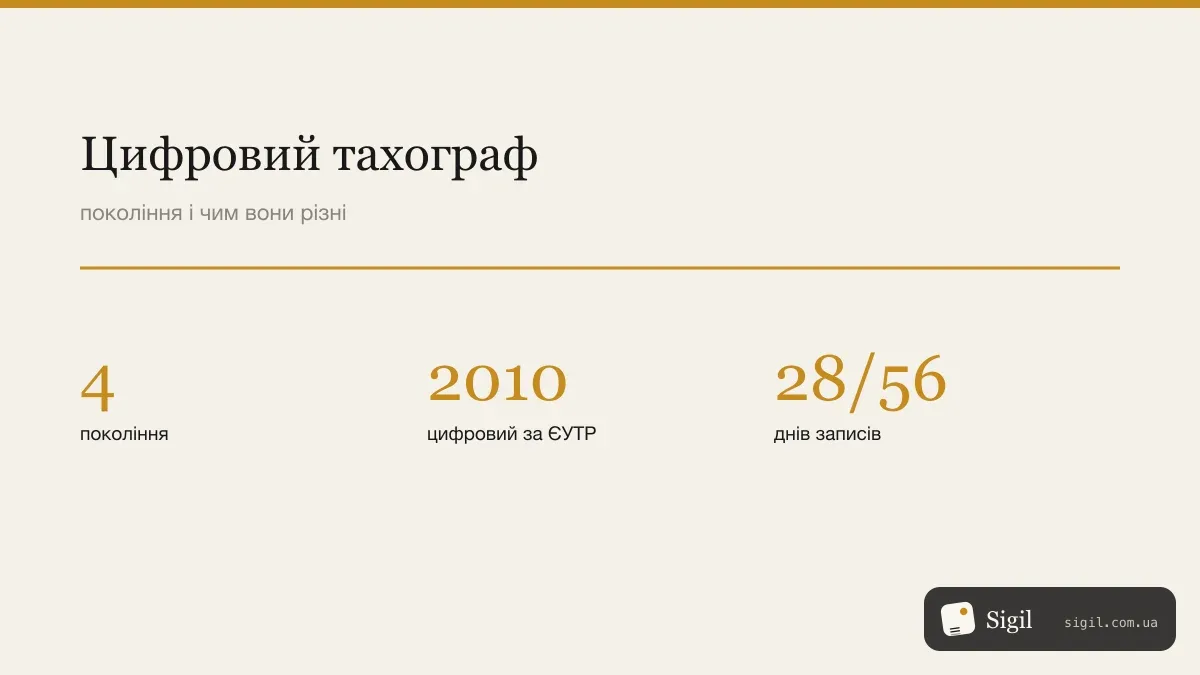
A digital tachograph is a device that writes data into memory and onto the driver card rather than onto a paper record sheet. Under the AETR it is compulsory in international carriage for vehicles first registered from 16 June 2010. There are several generations, and the newest, the G2V2 smart tachograph, adds position, remote detection of manipulation and an interface for transport systems.
In brief: an analogue tachograph writes onto a paper record sheet, a digital one into memory and onto the driver card, and a smart one adds position and remote checking · Regulation 165/2014 in art. 3(4) lists the older categories of device by the specifications applicable until 30.09.2011, from 1.10.2011 and from 1.10.2012 · a digital tachograph under the AETR is compulsory in international carriage for vehicles first registered from 16 June 2010 · the smart tachograph is permitted in the EU and in Ukraine to anyone who has one, under art. 2 of Decision No 2/2025, and compulsory only for new Ukrainian registrations · the generation shows in the type approval mark and the installation plaque, and these are exactly what periodic verification checks · an analogue device is not unlawful and remains lawful on international trips in a vehicle first registered before 16 June 2010, though not in a newer one · where a driver also used a vehicle with an analogue tachograph within 56 days, the record sheets for those days travel with the rest of the records.
The advert for a tractor unit from Lithuania said it briefly, namely "digital tachograph". The carrier called, asked about the year of the vehicle, booked the transfer, and only after registering it in Ukraine learned that devices going by the name "digital tachograph" come in several generations. The one in his truck had run legally around Europe for ten years. For a vehicle registered in Ukraine for the first time after 30 June 2026, however, it was no longer enough.
Which generations of device exist
In the rules they are scattered across two legal orders, the Ukrainian and the European, so it is easier to look at them together.
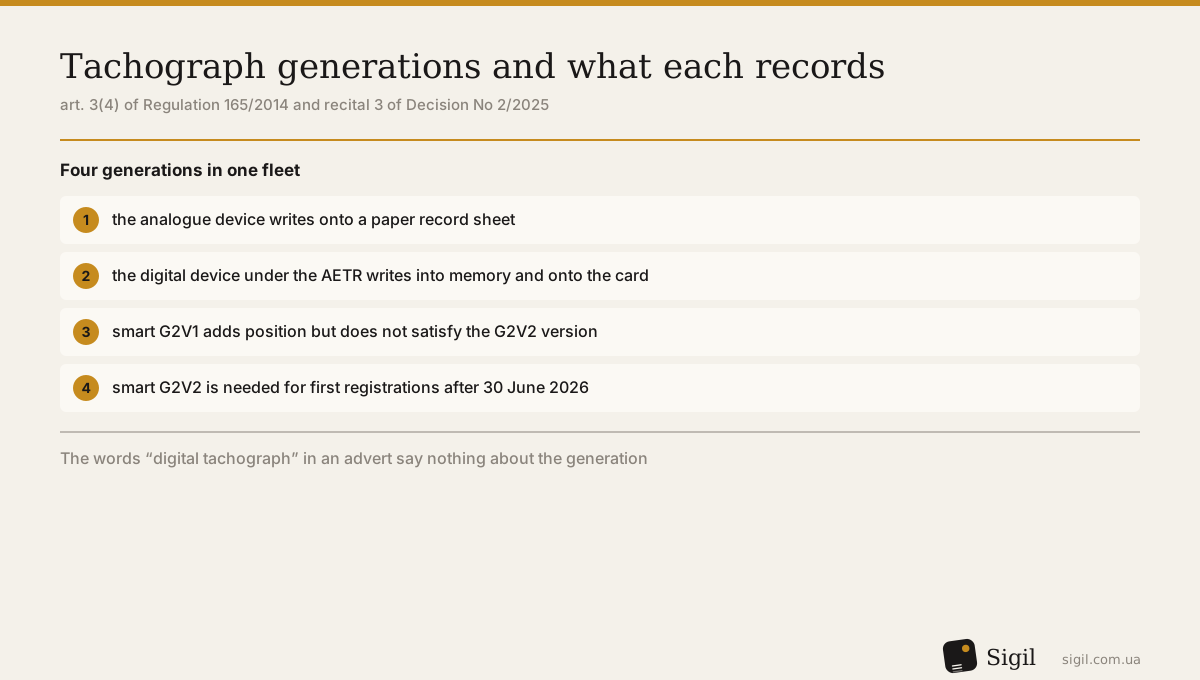
| Generation | Where it keeps data | Status for a Ukrainian carrier |
|---|---|---|
| analogue | paper record sheet | lawful, but not enough for international goods |
| digital under the AETR | device memory and the driver card | compulsory in international carriage for vehicles first registered from 16.06.2010 |
| smart G2V1 | the same plus position | permitted, but does not satisfy the G2V2 version requirement |
| smart G2V2 | the same, newest specification | compulsory for first registrations in Ukraine after 30.06.2026 |
Regulation 165/2014 in art. 3(4) distinguishes even the older digital devices from one another, namely those complying with the specifications applicable until 30 September 2011, from 1 October 2011 and from 1 October 2012. For a buyer of a used vehicle this means something simple. The words "digital tachograph" in an advert say nothing about the generation.
What is compulsory for a vehicle registered in Ukraine
The clock started long ago. Decision No 2/2025 of the Joint Committee recalls that vehicles engaged in international carriage and registered in Ukraine are to be equipped with digital tachographs complying with the AETR since 2010. That means vehicles first registered from 16 June 2010: the AETR did not require older ones to be retrofitted. In parallel, vehicles registered in the Union have carried smart tachographs under chapter II of Regulation 165/2014 since 2019.
Then come the differences that cause the confusion. For a Ukrainian carrier the smart tachograph is a permission rather than a duty: art. 2 of Decision No 2/2025 allows it to be used both in the Union and in Ukraine, and recital 7 adds expressly that digital devices under the AETR remain allowed.
The duty is created by Ukrainian law, and only for part of the fleet. The three conditions in the regulation, namely first registration in Ukraine after 30 June 2026, international carriage of goods and performance under the agreement with the EU, are covered in the text on the G2V2 smart tachograph.
How to tell which generation sits in a vehicle
During periodic verification the service point looks, among other things, at the type approval mark on the device and at the installation plaque. Those are the same two things that let you establish the generation yourself, without taking the dashboard apart.
A third source is the verification and adaptation protocol. It carries the device data and the number of the workshop card used to set it up, so the protocol from the last verification answers the question about the generation faster than the seller's advert does.
A fourth clue sits on the display. Signs for loading, unloading and the border crossing flag appear only on the second version of the smart tachograph, because only that version has these functions, and the full set is explained in the text on tachograph symbols.
The practical order when buying a used vehicle looks like this. First the date of first registration in Ukraine, because that decides whether G2V2 is needed at all. Then the plaque and the type approval mark. And only then the advert. What exactly the service point checks every two years is covered in the text on tachograph calibration.
Can an analogue tachograph still be used
The answer depends on when the vehicle was first registered. The AETR requires a digital tachograph in vehicles first registered from 16 June 2010 and does not require older ones to be retrofitted. So a vehicle registered earlier may run international trips with an analogue device, provided it works and has been checked, while a newer one may not.
Inside the country the picture differs. The Ukrainian regulation even allows work without a tachograph in a narrow case, namely internal regular carriage of passengers on routes no longer than 50 kilometres, provided a shift schedule or an individual control book of a self-employed driver is kept. Where the device in such a vehicle works and is verified, the records may be kept with it as well.
There is one more situation, and it concerns a mixed fleet. Where a driver has also driven a vehicle with an analogue tachograph within the last 56 days, they carry the record sheets for those days together with the rest of the records. An analogue device in one vehicle therefore creates extra paper for a driver who also drives digital ones.
What to write when the device does not print
A breakdown does not lift the record keeping; it moves it onto paper, and here the generation matters again. On an analogue device the driver writes on the record sheet, on a digital or smart one either through manual entry into the card, or on a printout, or in a temporary registration sheet.
The Ukrainian regulation lists what such a sheet has to hold. That is the carrier's name with its identification code and address, the driver's surname and name with the details of their card or driving licence, and the vehicle registration number. Next come the start and end of working time, driving, breaks, periods of availability and rest. Last come the nature and reasons for any departures from the norms, and the date, time and place of completion with the driver's signature.
Three rules around that sheet are easy to miss. One sheet covers no more than one 24 hour period. The blank forms are printed by the carrier itself and handed to the driver before departure, so there is nowhere to get them on the road. And the carrier keeps the completed originals at its own address for 24 months after the retention period in the vehicle ends.
Why the difference matters at the roadside
Records. For an analogue device these are paper record sheets; for a digital and a smart one, the driver card and printouts. The driver carries completed record sheets in the number the AETR requires, or the driver card or a printout, depending on the type of device. How long the card itself lasts and how long it takes to issue is covered in the text on the driver card.
Depth of the check. The AETR itself speaks of the day of the check and the previous 28 days. In the EU it has been 56 days since 31 December 2024 (art. 36 of Regulation 165/2014 as amended by Regulation 2020/1054), and the Ukrainian regulation has required the same 56 days and the day of the check since 26 July 2026. Firms prepared to the old 28 day measure come unstuck right here.
Liability. The device does not relieve the carrier of the duty to analyse the data and to react to breaches, and the carrier keeps each driver's data for 12 months from the last entry. What an inspector looks at on the road is covered in the text on RMPD roadside inspection, and the whole set of duties on one trip in the text on tachograph rules for a Ukrainian carrier.
What to do
- When buying a used vehicle, ask not about a "digital tachograph" but about the generation and the date of first registration in Ukraine.
- Look over the installation plaques and type approval marks on your vehicles and write the generation into each vehicle's file.
- Keep the last verification protocol in the vehicle, because it answers the question about the device faster than any conversation.
- If the fleet holds analogue devices, warn the drivers that the record sheets for those days travel with them for another 56 days.
- Plan a device replacement only where a rule requires it, that is by the date of first registration rather than for the sake of newness.
What not to do
- Do not trust the words "digital tachograph" in an advert. There are several generations and they differ in what they satisfy.
- Do not treat the smart tachograph as compulsory for everyone. In EU law it is a permission, while the Ukrainian duty hangs on the date of first registration.
- Do not put an analogue device in a vehicle first registered from 16 June 2010 that runs international trips. The AETR requires a digital one for it.
- Do not mix up the records of different devices. Record sheets from an analogue device and printouts from a digital one for the same period are both needed.
- Do not prepare records for 28 days if a Ukrainian inspector may check you. For them the period is 56 days and the day of the check, and in the EU that has been the standard since 31.12.2024.
A tachograph, an RMPD filing and SENT geolocation are three separate duties on one trip, and penalties are counted separately, as the SENT and RMPD penalty calculator shows.
What a non-EU carrier's duties consist of is gathered on the cluster pillar page.
A demo or training for your team
30 minutes online. We show how Sigil™ files an RMPD from a CMR and answer questions about your runs.
Frequently asked questions
- How does a digital tachograph differ from a smart one?
- By three abilities. A smart tachograph adds automatic recording of position, remote detection of manipulation and an ITS interface. That is how art. 1 of Decision No 2/2025 of the Joint Committee defines it.
- May an analogue tachograph be used on international runs?
- Yes, if the vehicle was first registered before 16 June 2010. Newer vehicles need a digital tachograph under the AETR for international carriage, and older ones need not be retrofitted.
- How can the generation be identified without taking the dashboard apart?
- By the type approval mark and the installation plaque. They are checked at periodic verification too, and the device data also appears in the protocol of the last verification.
- Does the EU require a smart tachograph from a Ukrainian carrier?
- No. Article 2 of Decision No 2/2025 permits the use of a smart tachograph, and recital 7 expressly leaves digital devices under the AETR allowed. The duty comes from Ukrainian law.
- What if a driver used both an analogue and a digital vehicle?
- Carry both the record sheets and the printouts. For the days on which the driver used a vehicle with an analogue tachograph, the record sheets belong to the set for 56 days and the day of the check.
Sources
Legal acts as in force on the day of publication:
- Decision No 2/2025 of the Joint Committee, OJ L 2025/409 of 25.02.2025: recital 3 (digital tachographs under the AETR in Ukrainian vehicles since 2010, smart tachographs in EU vehicles since 2019), recital 7, art. 1(2) and art. 2.
- Regulation (EU) 165/2014, EUR-Lex, version of 20.08.2020: art. 3(4) (categories of device by the specifications until 30.09.2011, from 1.10.2011 and from 1.10.2012), arts 8, 9 and 10, art. 36.
- Regulation (EU) 2020/1054, EUR-Lex: art. 2(12) and art. 3 (art. 36 of Regulation 165/2014, records for the day of the check and the previous 56 days from 31.12.2024).
- European Commission digital tachograph help desk, JRC: the digital tachograph covers only vehicles first registered after the set date, with no retrofitting of older ones.
- Regulation on drivers' working and rest time, nakaz No 340 in the redaction of nakaz No 1727 of 12.12.2025: p. 1 of chapter VI (a working device and G2V2), p. 2 of chapter VI (when a tachograph is not compulsory on routes up to 50 kilometres), p. 10 of chapter VI (the set of records for 56 days and the day of the check, including record sheets from an analogue device).
- Instruction on the use of recording equipment, nakaz No 385 in the redaction of nakaz No 532 of 21.03.2025: p. 6 of chapter II (the type approval mark, the installation plaque and the remaining verification items), chapter III p. 3 (what the driver carries) and p. 7 (12 months of retention).
Read next
- The G2V2 smart tachograph and who needs itThe G2V2 smart tachograph binds only vehicles first registered in Ukraine after 30 June 2026. Why the older fleet needs no retrofit and when that will change.
- The driver card for a tachograph and how to get itA tachograph driver card runs up to 5 years and is issued in 20 working days. What about the photograph, the TachoNET check and a card lost mid-trip.
- What SENT-GEO demands of the carrier and the locatorWhat Poland's SENT-GEO demands of carrier and driver: a locator on the whole Polish leg, three ways to transmit (e-TOLL PL, OBU, ZSL), on and off times, fines.
Sigil™ turns a CMR into an RMPD declaration and files it with PUESC, with every field checked against the original.
More about Tachograph