RMPD
Posting of drivers to Poland from a third country
Posting of drivers to Poland from a third country such as Ukraine. When transit is exempt, what goes to the PIP, what the driver carries and what a gap costs.
Published · Author: Makaiev Kostiantyn Oleksandrovych, founder of Sigil RMPD

Posting of drivers to Poland from a third country such as Ukraine covers every run that loads or unloads in Poland; only transit is exempt (art. 5(1), Act of 28 July 2023). The carrier notifies the PIP and puts a paper confirmation in the cab before the run. Without it the driver pays 500 zł, the carrier 6,000 zł.
In brief: posting of drivers in Poland is governed by the Act of 28 July 2023, consolidated text Dz.U. 2025 poz. 797 · for a carrier from Ukraine the only thing that is not posting is transit with no loading or unloading in Poland (art. 5(1)) · a run from Ukraine that unloads in Poland is posting, because the bilateral exemption in art. 4 is written for EU companies · the carrier files a posting declaration with the Polish State Labour Inspectorate through biznes.gov.pl no later than the start of the posting (art. 12(1)(1)) · before the carriage starts, the carrier issues a paper confirmation on the template from regulation Dz.U. 2023 poz. 1638, signed by carrier and driver (art. 12(1)(2)) · a driver without the confirmation pays 500 zł, and the carrier pays 6,000 zł for a missing declaration, an unissued confirmation or a confirmation that is not in the cab (annex to the Act, items 5, 7 and 9) · the IMI template and the Community licence are the route for EU companies (art. 9), and the EU and Ukraine agreement does not move a Ukrainian company onto it.
Before loading in Lutsk, a Polish freight forwarder sends the dispatcher an IMI posting declaration template and asks for the Community licence number. The dispatcher has neither the template nor the licence, because the company is Ukrainian. The forwarder insists that without the posting the truck will not enter Poland. Unloading is in Lublin, six hours from the border.
This article covers the posting of drivers to Poland from a third country: when a driver of a Ukrainian company counts as posted, what the carrier has to file and what the driver must carry in the cab. It does not cover daily allowances or the driver's taxes.
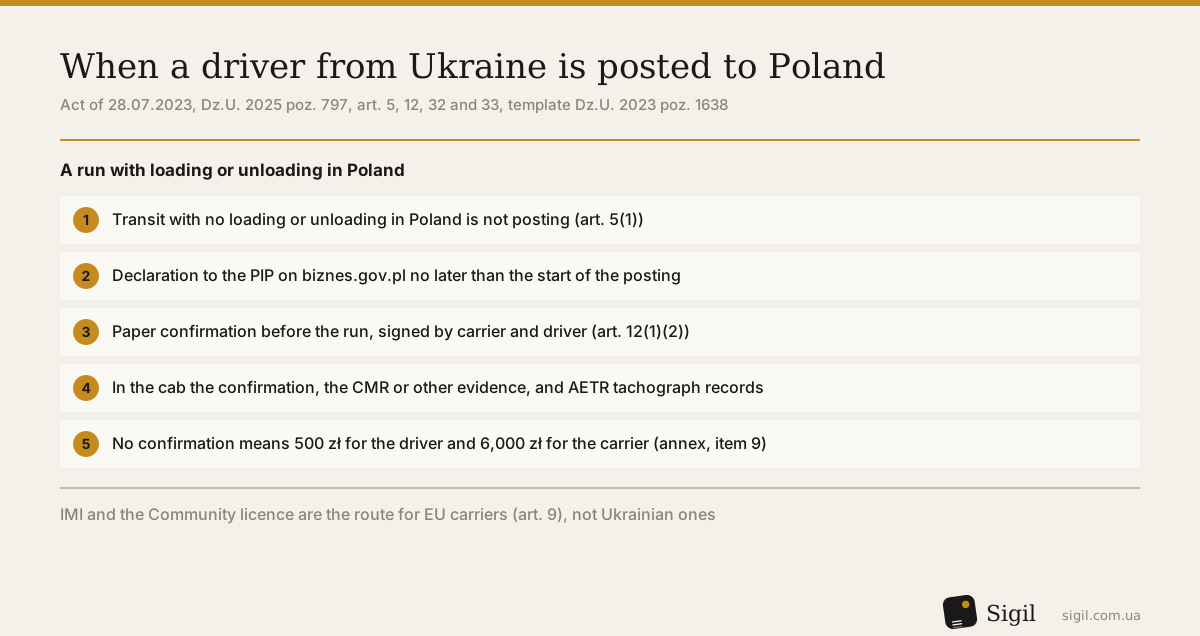
When a driver from Ukraine counts as posted to Poland
A driver of a Ukrainian company is posted to Poland every time there is loading or unloading in Poland. The Act calls such a company a road carrier from a third country that, in connection with a road transport service, temporarily sends a driver to Polish territory (art. 3(10) and (11)). A third country is any state outside the EU, the European Economic Area and Switzerland (art. 3(9)).
Such a company has one exemption. A driver from a third country is not posted when he performs a transit journey (art. 5(1)). The Act defines transit as carriage through the territory of a member state during which the driver neither loads nor unloads (art. 3(14)). How to tell transit apart from carriage to a third country for RMPD purposes is covered in a separate article.
Does an overnight stop near Warsaw turn a run from Germany to Ukraine into posting? No. Transit ends with a loading or unloading operation, not with a stop. A run with no loading or unloading in Poland needs neither a declaration nor a confirmation.
Is a run from Lutsk unloading in Lublin a posting? Yes. There is unloading in Poland, so the art. 5 exemption does not apply. The service page on biznes.gov.pl names three kinds of such carriage outright: bilateral, other international operations, meaning cross-trade, and cabotage.
The declaration is filed every time (art. 12(1)(1)). For the purpose of calculating posting periods, a posting ends when the driver leaves Poland while performing international carriage (art. 8(1)).
Why the bilateral exemption does not cover a Ukrainian company
The bilateral exemption in art. 4 applies only to the driver the Act calls posted to Polish territory. By definition, that is a driver employed in another member state and sent to Poland by a carrier established in such a state (art. 3(5) and (7)).
The Act treats as member states the EU countries, the EEA countries and any state that has undertaken, by agreement with the EU, to implement Directive 2020/1057 (art. 3(3)). Ukraine has made no such commitment. For a Ukrainian company art. 4 therefore does not apply, and a bilateral run that unloads in Poland remains a posting.
The logic comes from the directive itself. Directive 2020/1057 covers drivers of undertakings established in a member state (art. 1(2)). Undertakings from outside the EU must not be treated more favourably than EU ones, including when they operate under bilateral or multilateral agreements (art. 1(10)). That is why the Polish Act has a separate chapter 4 for third countries, with its own declaration and its own paper document.
How the carrier files the posting declaration with the PIP
The declaration goes to the State Labour Inspectorate (Państwowa Inspekcja Pracy, PIP) every time, no later than the start of the posting (art. 12(1)(1)). The form is electronic and sits on the website of the Business Information Point run by the PIP, which is biznes.gov.pl (art. 13(1) of the Act of 10 June 2016 on the posting of workers).
The service page «Zgłoś delegowanie kierowcy z państwa trzeciego na terytorium Polski» describes the practice. Since 30 April 2025 the declaration is completed in an online wizard after logging in to biznes.gov.pl, and the inspectorate does not accept PDF files or e-mails. It is signed with a profil zaufany (the Polish trusted profile) or a qualified electronic signature. Filing is free, and the PIP issues no acknowledgement of receipt.
When a representative files the declaration, a power of attorney is attached. The stamp duty (opłata skarbowa) on it is 17 zł, which is UAH 196 at the National Bank of Ukraine rate of UAH 11.5098 per 1 zł on 2 November 2026.
Art. 12(3) lists the content of the declaration:
- carrier name, address and registered office, business phone and e-mail, and the number of the permit or journey form under which the carriage is performed;
- a contact person for the authorities, authorised to represent the carrier on employment conditions;
- the driver's name, address and driving licence number;
- the expected start and end dates of the posting;
- the start date of the contract with the driver and the law governing it;
- the registration number of the motor vehicle;
- the type of carriage, meaning goods, passengers, international or cabotage.
Incomplete or untrue data cost the carrier 4,000 zł (annex, item 3). The PIP processes the declaration data without automation and deletes them after 24 months unless a case is pending (art. 12(5) and (6)).
What the paper posting confirmation is
The paper confirmation is a second document, separate from the declaration to the PIP, and the carrier issues it every time before the carriage begins (art. 12(1)(2)).
The template is set by the regulation of the Minister of Infrastructure of 7 August 2023, Dz.U. 2023 poz. 1638, in force since 19 August 2023. The form is bilingual, Polish and English, has 15 fields and is filled in on a computer or typewriter in Latin characters. The driver and the carrier sign it before departure.
The fields mirror the declaration: carrier, address, phone, e-mail, permit number, driver, his address and driving licence, contract date, vehicle number, type of carriage, place and date. Field 5, the permit or journey form number, is filled in only when a permit is required, according to the note on the template. Bilateral carriage and transit under the EU and Ukraine agreement need no permit until 31 March 2027 (Joint Committee Decision No 3/2025).
The confirmation has to be on paper (art. 12(2)(1)). An EU company may keep a copy of its declaration electronically (art. 9(3)), while the Act gives a Ukrainian company no such option. An altered or forged confirmation is prohibited (art. 16) and costs 7,000 zł, the highest penalty in the annex (item 6).
What the driver carries and what the ITD checks
A driver posted from a third country keeps three things in the vehicle and shows them on request during a roadside check (art. 12(2), art. 13):
- the paper posting confirmation;
- evidence of the carriage, in particular consignment notes, the relevant international permit or the journey form;
- the tachograph records required by the AETR Agreement.
The Act names consignment notes first among the evidence, and on a run from Ukraine that means the CMR consignment note.
A driver qualification card with code 95 is not among these documents. The driver qualification Directive does not cover a driver of a third-country company, and the article on code 95 for Ukrainian truck drivers explains what Ukrainian law requires instead.
Roadside checks of posting are carried out by inspectors of the Inspekcja Transportu Drogowego, the Polish road transport inspectorate (ITD), art. 23(3). They check whether the carrier gave the driver these documents and whether the driver has them (art. 23(1)). The declaration to the PIP and the driver's employment conditions are checked by the labour inspectorate in its own inspection (art. 24).
At the same stop the inspector may also check the RMPD filing, and how such a check runs is described separately.
What a missing confirmation or declaration costs
Posting penalties fall on the driver and the carrier, and sometimes on the customer who ordered the run. A driver who fails to show the paper confirmation at a check is fined 500 zł (grzywna), which is UAH 5,755, and the ticket is issued by an ITD inspector (art. 32(2) and (3)). The carrier faces an administrative penalty of 4,000 to 7,000 zł per infringement, with the exact amount set by the annex to the Act (art. 33(1) and (2)). The hryvnia amounts in this section and in the table use the National Bank of Ukraine rate of UAH 11.5098 per 1 zł on 2 November 2026.
| Infringement | Who pays | Amount | Basis |
|---|---|---|---|
| driver did not show the confirmation | driver | 500 zł (UAH 5,755) | art. 32(2) |
| incomplete or untrue data in the declaration to the PIP | carrier | 4,000 zł (UAH 46,039) | annex, item 3 |
| declaration to the PIP not filed in the required manner and time | carrier | 6,000 zł (UAH 69,059) | item 5 |
| confirmation not issued before the run, or issued incorrectly | carrier | 6,000 zł (UAH 69,059) | item 7 |
| driver does not have the paper confirmation | carrier | 6,000 zł (UAH 69,059) | item 9 |
| documents not sent to the PIP within 8 weeks | carrier | 6,000 zł (UAH 69,059) | item 11 |
| confirmation altered or forged | carrier | 7,000 zł (UAH 80,569) | item 6 |
| customer knew or should have known of the infringement | customer | 3,000 zł (UAH 34,529) | art. 35(1) |
The penalty on the carrier is imposed by an ITD decision (art. 33(3)). A final decision becomes enforceable 30 days after service, and a complaint to the administrative court suspends enforcement (art. 33(4)). Payment is due within 14 days from the day the decision became enforceable (art. 33(6)).
The driver's ticket and the ITD penalty do not close the matter. The PIP may run its own inspection and impose its own penalty (art. 33(5)).
Where Poland has no agreement on mutual recovery of penalties with the carrier's state, the ITD inspector takes a deposit (kaucja) equal to the expected penalty from the annex. Without a deposit the vehicle is sent to a guarded car park at the carrier's expense (art. 25(1) and (7)). A posting deposit is returned within 30 days of service of the decision cancelling the penalty (art. 25(5)(2)), and the deposit mechanics for RMPD are explained in the article on the RMPD and SENT deposit.
Does an RMPD filing replace the posting declaration
An RMPD filing does not replace the posting declaration, because these are two separate duties owed to two different authorities. The RMPD notification of the carriage goes to PUESC before entry, while the posting declaration goes to the PIP through biznes.gov.pl. Who files RMPD and for which runs is explained in who must file RMPD.
A missing RMPD filing or data that do not match the CMR cost the carrier 12,000 zł, which is UAH 138,118 at the same rate (annex 3 to the Road Transport Act, item 3.2a). The SENT and RMPD fines calculator works out the amount for RMPD and SENT, but it does not calculate posting penalties.
Can a Ukrainian company file the posting through IMI
A Ukrainian company files with the PIP, not in IMI, unless an international agreement says otherwise. The Act opens the public interface linked to the IMI system to carriers established in a member state (art. 9(1)). Their declaration contains the Community licence number where available (art. 9(2)(1)), which is why the Polish forwarder asks for it.
A third-country carrier switches to IMI only when an international agreement provides for it (art. 15(1)). The driver then carries a copy of the IMI declaration instead of the paper confirmation, and documents after the posting are also sent through IMI (art. 15(2) and (3)).
The agreement between the EU and Ukraine on the carriage of freight by road contains no such provision. It grants rights to bilateral runs, transit and runs to third countries through the other Party's territory (art. 4 of the agreement), and stays silent on posting, also after its 2024 amendment. Joint Committee Decision No 3/2025 extended the agreement until 31 March 2027. Its appendix, listing EU law that Ukraine must transpose, says outright next to driving time and working time that this does not include connection to the IMI social module.
The service page on biznes.gov.pl says a declaration to the PIP is not needed if one was filed in IMI. The Act ties that to an international agreement (art. 15(1)), so a company from Lutsk has a single route, the PIP and the paper confirmation.
What else the carrier owes the driver during the posting
A third-country carrier guarantees the posted driver the Polish employment conditions in art. 4 to 4b of the Act on the posting of workers (art. 7(2)). They cover, among other things, working time and rest, annual leave, pay, health and safety, and equal treatment (art. 4(2) of the Act of 10 June 2016). Calculating the pay is beyond the scope of this article. Driving time and rest on the run itself are counted separately under the AETR, as explained in the article on AETR driving time and rest.
The labour inspectorate checks this after the run. Within 8 weeks of receiving the inspectorate's request, the carrier sends copies of the cab documents and the driver's pay records for the posting period. It also sends the contract, working time records and proof of payment (art. 14). Documents not sent in time cost 6,000 zł (item 11).
What to do
- Check before every run whether there is loading or unloading in Poland. Leave pure transit without a declaration and without a confirmation.
- File the declaration with the PIP on biznes.gov.pl no later than the start of the posting, every time.
- Fill in the confirmation on the Dz.U. 2023 poz. 1638 template on a computer, in Latin characters, and sign it together with the driver before departure.
- Put the paper confirmation, the CMR and the tachograph records in the cab, and the permit as well if the run needs one.
- File the RMPD notification in PUESC separately, because the posting does not replace it.
- Keep the driver's contract, working time records and proof of payment ready to send to the PIP within 8 weeks of a request.
What not to do
- Do not send the forwarder an IMI template with an empty Community licence field. It is an EU company's declaration and does not discharge your duty to the PIP.
- Do not sign the confirmation after a check. The Act requires it before the carriage begins, and an unissued confirmation costs 6,000 zł.
- Do not keep the confirmation only on the driver's phone. For a third-country company the Act requires paper, and without it the driver pays 500 zł and the company 6,000 zł.
- Do not rework a signed form for another run. An altered confirmation is prohibited and costs 7,000 zł.
- Do not treat the RMPD filing as a posting declaration. PUESC and the PIP are two registers, and each carries its own penalty.
Where technology fits
Sigil carries the CMR data one to one into the RMPD100 filing, the dispatcher confirms them, and the system sends the filing to PUESC under the carrier's credentials. Sigil does not prepare the posting declaration to the PIP or the paper confirmation.
Sigil handles RMPD filings. The carrier files the driver posting with the PIP itself on biznes.gov.pl.
A demo or training for your team
30 minutes online. We show how Sigil™ files an RMPD from a CMR and answer questions about your runs.
Frequently asked questions
- Does transit through Poland require a posting declaration?
- No. A third-country driver who passes through Poland with no loading or unloading is not posted (art. 5(1) of the Act of 28 July 2023). Such a run needs neither a declaration to the PIP nor a paper confirmation.
- Does a run from Ukraine that unloads in Poland need a declaration to the PIP?
- Yes. Unloading in Poland makes the driver posted, because the bilateral exemption in art. 4 is written for EU companies. The declaration is filed on biznes.gov.pl no later than the start of the posting, and a paper confirmation signed by carrier and driver is issued before the run.
- Can a Ukrainian company file the posting through IMI?
- No, unless an international agreement provides for it. Art. 15(1) moves a third-country carrier onto IMI only on the basis of an agreement, and the EU and Ukraine agreement on the carriage of freight by road has no posting provision. The Ukrainian route is the PIP and the paper confirmation.
- What does a missing posting confirmation cost at a check?
- 500 zł for the driver and 6,000 zł for the carrier. The driver pays the fine under art. 32(2), the carrier the penalty under item 9 of the annex to the Act. Failing to issue the confirmation before the run is a separate infringement carrying the same 6,000 zł (item 7).
Sources
Legal acts as in force on the day of publication:
- Act of 28 July 2023 on the posting of drivers in road transport, ISAP, consolidated text Dz.U. 2025 poz. 797, amended by Dz.U. 2024 poz. 1544: art. 3 points 3, 5, 7, 9, 10, 11 and 14, art. 4, art. 5, art. 7(2), art. 8(1), art. 9, art. 12, art. 13, art. 14, art. 15, art. 16, art. 23, art. 24, art. 25, art. 32, art. 33, art. 35, annex (items 3, 5, 6, 7, 9 and 11).
- Regulation of the Minister of Infrastructure of 7 August 2023 on the posting confirmation form for a driver posted to Poland from a third country, Dz.U. 2023 poz. 1638: the 15-field template, note to field 5.
- Act of 10 June 2016 on the posting of workers in the framework of the provision of services, ISAP, consolidated text Dz.U. 2025 poz. 1682: art. 4(2), art. 13(1).
- Road Transport Act of 6 September 2001, ISAP, consolidated text Dz.U. 2025 poz. 1490: annex 3, item 3.2a.
- Directive (EU) 2020/1057, EUR-Lex: art. 1(2) and (10).
- Agreement between the European Union and Ukraine on the carriage of freight by road, OJ L 179, 6.7.2022: art. 2, 3 and 4; amended by OJ L 2024/1878.
- Decision No 3/2025 of the Joint Committee, OJ L 2025/2352, 21.11.2025: art. 1, appendix (note on the IMI social module).
Authorities:
- Zgłoś delegowanie kierowcy z państwa trzeciego na terytorium Polski, biznes.gov.pl, State Labour Inspectorate: online wizard since 30.04.2025, signature, free filing, 17 zł for a power of attorney, no acknowledgement of receipt.
Exchange rate: National Bank of Ukraine, UAH 11.5098 per zł on 02.11.2026.
Read next
- Transit or third-country carriage, how to tellLoading in Poland and unloading in Germany is third-country carriage for a Ukrainian operator, and the EU Ukraine agreement does not cover it.
- What an RMPD is and who must file itRMPD from scratch: what the filing is, who must file it since 1 November 2024, when it is not needed, how it differs from SENT, what happens at entry without it
- An RMPD roadside check and what the inspector doesAn RMPD roadside check: what the inspector looks at in the filing, why last trip's number does not help, when the truck is impounded and the driver's rights.
- CMR consignment note, a practical guideThe CMR consignment note under the Convention: three originals, boxes 1–24, reservations, the 8.33 SDR/kg limit, claim deadlines, e-CMR, insurance and RMPD.
- The driver card for a tachograph and how to get itA tachograph driver card runs up to 5 years and is issued in 20 working days. What about the photograph, the TachoNET check and a card lost mid-trip.
Sigil™ turns a CMR into an RMPD declaration and files it with PUESC, with every field checked against the original.
More about RMPD